Vasculites Associadas ao Anticorpo Citoplasmático Antineutrófilo (ANCA)
Vasculites Associadas ao Anticorpo Citoplasmático Antineutrófilo (ANCA)
A vasculite associada ao anticorpo citoplasmático antineutrófilo (ANCAANCAGroup of systemic vasculitis with a strong association with anca. The disorders are characterized by necrotizing inflammation of small and medium size vessels, with little or no immune-complex deposits in vessel walls.Rapidly Progressive Glomerulonephritis) (VAA, de vasculite associada a ANCAANCAGroup of systemic vasculitis with a strong association with anca. The disorders are characterized by necrotizing inflammation of small and medium size vessels, with little or no immune-complex deposits in vessel walls.Rapidly Progressive Glomerulonephritis) é uma subcategoria de vasculites, que incluem a granulomatose com poliangeíte (GPAGPAA multisystemic disease of a complex genetic background. It is characterized by inflammation of the blood vessels (vasculitis) leading to damage in any number of organs. The common features include granulomatous inflammation of the respiratory tract and kidneys. Most patients have measurable autoantibodies (antineutrophil cytoplasmic antibodies) against myeloblastin.Granulomatosis with Polyangiitis), a poliangeíte microscópica (PAM), a granulomatose eosinofílica com poliangeíte (GEPA), a glomerulonefrite crescêntica e necrotizante limitada ao rim, e a vasculite associada ao ANCAANCAGroup of systemic vasculitis with a strong association with anca. The disorders are characterized by necrotizing inflammation of small and medium size vessels, with little or no immune-complex deposits in vessel walls.Rapidly Progressive Glomerulonephritis induzida por fármacos. As 5 doenças podem cursar com uma vasculite de pequenos vasos ameaçadora à vida, cursando com uma ampla variedade de manifestações sistémicas, que podem envolver os pulmões, rins, pele, coração e outros tecidos. O diagnóstico é estabelecido através da apresentação clínica e um teste citoplasmático (c)- ou perinuclear (p)-ANCA positivo. A biópsia do tecido envolvido confirma o diagnóstico. Os glucocorticoides e a terapêutica imunossupressora são os principais pilares do tratamento.
As vasculites associadas ao anticorpo citoplasmático antineutrófilo (ANCAANCAGroup of systemic vasculitis with a strong association with anca. The disorders are characterized by necrotizing inflammation of small and medium size vessels, with little or no immune-complex deposits in vessel walls.Rapidly Progressive Glomerulonephritis) (VAA) correspondem a vasculites necrotizantes de pequenos vasos, com um teste de ANCAANCAGroup of systemic vasculitis with a strong association with anca. The disorders are characterized by necrotizing inflammation of small and medium size vessels, with little or no immune-complex deposits in vessel walls.Rapidly Progressive Glomerulonephritis positivo, sem deposição significativa de complexos imunes.
Contextualização
Anticorpos citoplasmáticos antineutrófilo (ANCAANCAGroup of systemic vasculitis with a strong association with anca. The disorders are characterized by necrotizing inflammation of small and medium size vessels, with little or no immune-complex deposits in vessel walls.Rapidly Progressive Glomerulonephritis) são:
Autoanticorpos dirigidos contra as proteínas contidas nos neutrófilos (e monócitos, em menor grau)
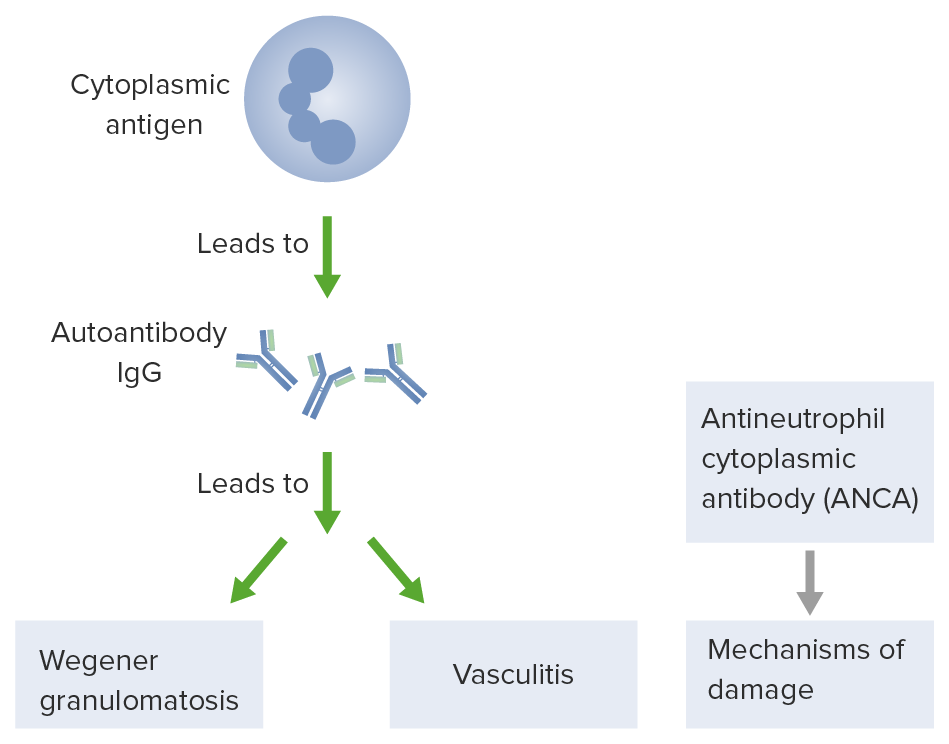
Específicos para alvos proteicos associados a grânulos citoplasmáticos de neutrófilos e, a sua ligação ao alvo, desencadeiam uma resposta inflamatória exagerada (ou seja, uma reação autoimune)
Existem 2 subtipos clinicamente significativos de ANCAANCAGroup of systemic vasculitis with a strong association with anca. The disorders are characterized by necrotizing inflammation of small and medium size vessels, with little or no immune-complex deposits in vessel walls.Rapidly Progressive Glomerulonephritis:
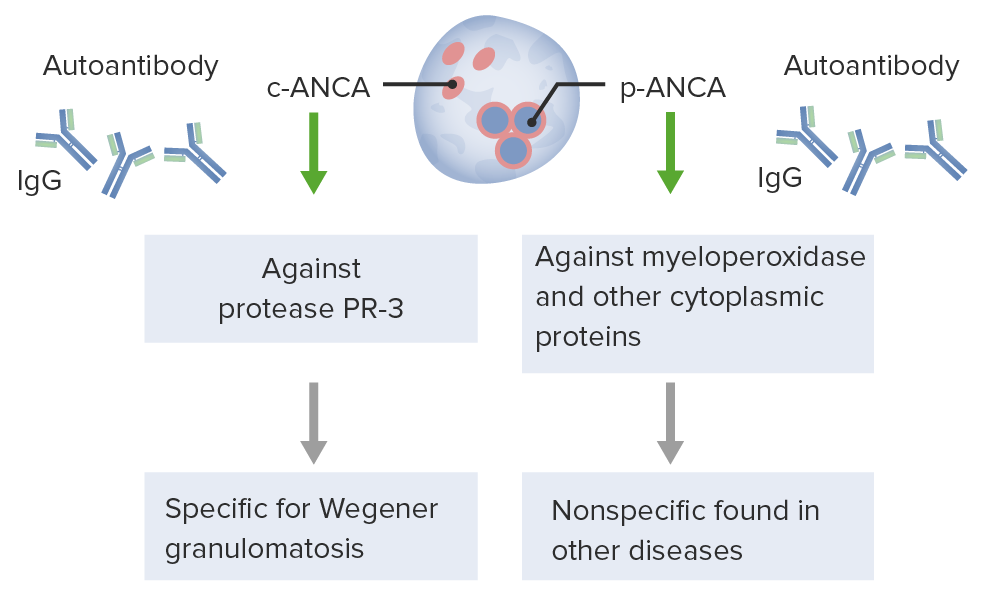
Ligam-se à MPOMPOAcute Myeloid Leukemia (existem autoanticorpos pANCA menos significativos clinicamente que visam a elastaseElastaseA protease of broad specificity, obtained from dried pancreas. Molecular weight is approximately 25, 000. The enzyme breaks down elastin, the specific protein of elastic fibers, and digests other proteins such as fibrin, hemoglobin, and albumin.Proteins and Peptides, catepsina G, lisozima e lactoferrina).
A MPOMPOAcute Myeloid Leukemia é uma proteína encontrada em grânulos neutrofílicos, que está envolvida na formação de espécies reativas de oxigénio com ação antimicrobiana.
O défice de MPOMPOAcute Myeloid Leukemia (secundário à destruição autoimune dos neutrófilos) resulta numa resposta inflamatória exagerada.
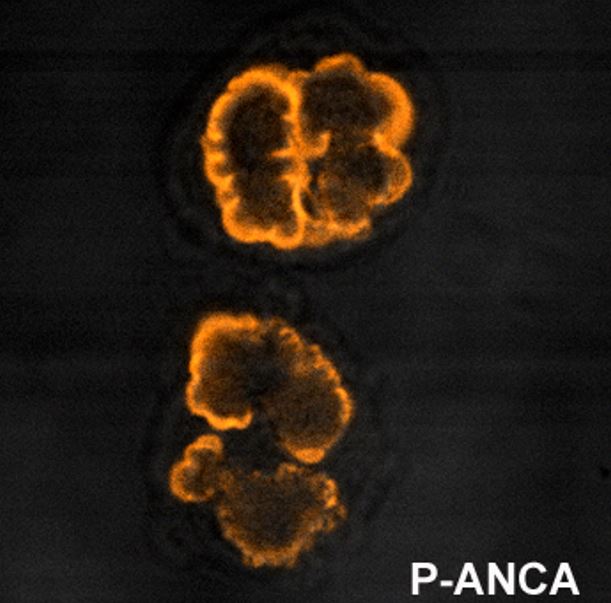
O “p” em pANCA significa perinuclear porque, na coloração, estes anticorpos mancham a área perinuclear do neutrófilo (onde a MPOMPOAcute Myeloid Leukemia e outras proteínas carregadas negativamente se encontram em altas concentrações).
Autoanticorpos antiproteinase 3 (PR3):
Também conhecidos como cANCA
Transportam uma carga líquida negativa
Ligam-se ao PR3
O PR3 é uma proteína encontrada em grânulos neutrofílicos azurofílicos, que está envolvida na proteólise de peptídeos antimicrobianos com ações antimicrobianas.
O défice de PR3 (secundário à destruição autoimune dos neutrófilos) resulta numa resposta inflamatória exagerada.
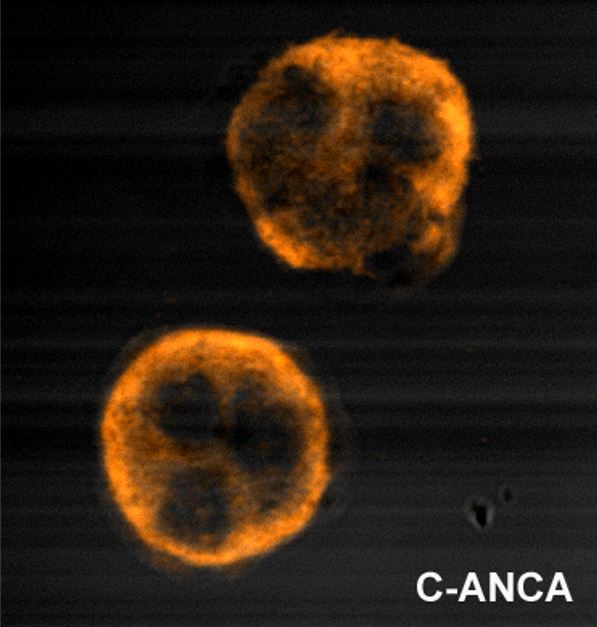
O “c” em cANCA significa citoplasma porque, na coloração, estes anticorpos coram a zona periférica citoplasmática do neutrófilo (onde o PR3, que tem uma carga positiva, se encontra em altas concentrações).
A presença de ANCAANCAGroup of systemic vasculitis with a strong association with anca. The disorders are characterized by necrotizing inflammation of small and medium size vessels, with little or no immune-complex deposits in vessel walls.Rapidly Progressive Glomerulonephritis (e.g., um teste ANCAANCAGroup of systemic vasculitis with a strong association with anca. The disorders are characterized by necrotizing inflammation of small and medium size vessels, with little or no immune-complex deposits in vessel walls.Rapidly Progressive Glomerulonephritis positivo):
Não:
Diagnostica uma entidade patológica
Se correlaciona com a gravidade dos sintomas
Se correlaciona com a atividade da doença
É simplesmente um marcador que ajuda a estabelecer padrões de doença
A positividade ANCAANCAGroup of systemic vasculitis with a strong association with anca. The disorders are characterized by necrotizing inflammation of small and medium size vessels, with little or no immune-complex deposits in vessel walls.Rapidly Progressive Glomerulonephritis está associada a processos patológicos autoimunes (as seguintes designações pANCA/cANCA são apenas um guia; existe uma variabilidade significativa):
Vasculites
Granulomatose com poliangite (cANCA)
Poliangite microscópica (pANCA)
Granulomatose eosinofílica com poliangeíte (pANCA)
Glomerulonefrite crescêntica e necrotizante pauci-imune primária (também conhecida por glomerulonefrite rapidamente progressiva (GNRP) ou vasculite apenas com atingimento renal) (pANCA)
Vasculite associada ao ANCAANCAGroup of systemic vasculitis with a strong association with anca. The disorders are characterized by necrotizing inflammation of small and medium size vessels, with little or no immune-complex deposits in vessel walls.Rapidly Progressive Glomerulonephritis induzida por fármacos (pANCA)
Doença do autoanticorpo anti-membrana basal glomerular (MBG) (pANCA)
Nefrite intersticial (pANCA)
Colite ulcerosa (pANCA)
Colangite esclerosante primária (pANCA)
Hepatite auto-imune (pANCA)
Artrite reumatoide (pANCA)
Fibrose quística (pANCA)
Classificação
As VAA incluem as 3 principais doenças que se seguem:
Granulomatose com poliangeíte (GPAGPAA multisystemic disease of a complex genetic background. It is characterized by inflammation of the blood vessels (vasculitis) leading to damage in any number of organs. The common features include granulomatous inflammation of the respiratory tract and kidneys. Most patients have measurable autoantibodies (antineutrophil cytoplasmic antibodies) against myeloblastin.Granulomatosis with Polyangiitis)
A maioria dos casos são cANCA+ (80%-90%).
Uma pequena percentagem é pANCA+ ou ANCA-.
Poliangeíte microscópica (MPAMPAA primary systemic vasculitis of small- and some medium-sized vessels. It is characterized by a tropism for kidneys and lungs, positive association with anti-neutrophil cytoplasmic antibodies (ANCA), and a paucity of immunoglobulin deposits in vessel walls.Vasculitides)
A maioria dos casos são pANCA+ (quase 90%).
Uma pequena percentagem é cANCA+ ou ANCA-.
Granulomatose eosinofílica com poliangeíte (EGPA) (também conhecida como síndrome de Churg-Strauss):
A maioria dos casos são ANCA- (50%-70%).
Uma minoria de casos é ANCAANCAGroup of systemic vasculitis with a strong association with anca. The disorders are characterized by necrotizing inflammation of small and medium size vessels, with little or no immune-complex deposits in vessel walls.Rapidly Progressive Glomerulonephritis+ (30%-50%).
A maioria dos casos de ANCAANCAGroup of systemic vasculitis with a strong association with anca. The disorders are characterized by necrotizing inflammation of small and medium size vessels, with little or no immune-complex deposits in vessel walls.Rapidly Progressive Glomerulonephritis+ são pANCA+ (75%-80%).
Uma pequena percentagem é cANCA+.
Some sources also include the following 2 diseases:
Vasculite limitada ao rim e glomerulonefrite crescêntica:
A maioria dos casos são pANCA+ (75%-80%).
Uma pequena percentagem é cANCA+ ou ANCA-.
Vasculite associada ao ANCAANCAGroup of systemic vasculitis with a strong association with anca. The disorders are characterized by necrotizing inflammation of small and medium size vessels, with little or no immune-complex deposits in vessel walls.Rapidly Progressive Glomerulonephritis induzida por fármacos:
A maioria dos casos são de pANCA+.
Uma pequena percentagem é cANCA+.
Tabela: Fármacos implicados na vasculite associada ao ANCAANCAGroup of systemic vasculitis with a strong association with anca. The disorders are characterized by necrotizing inflammation of small and medium size vessels, with little or no immune-complex deposits in vessel walls.Rapidly Progressive Glomerulonephritis
Agentes antitiroideus
Propiltiouracilo
Metamizol
Biológicos
EtanerceptEtanerceptA recombinant version of soluble human tnf receptor fused to an IgG Fc fragment that binds specifically to tumor necrosis factor and inhibits its binding with endogenous tnf receptors. It prevents the inflammatory effect of tnf and is used to treat rheumatoid arthritis; psoriatic arthritis and ankylosing spondylitis.Immunosuppressants
InfliximabInfliximabA chimeric monoclonal antibody to tnf-alpha that is used in the treatment of rheumatoid arthritis; ankylosing spondylitis; psoriatic arthritis and Crohn’s disease.Disease-Modifying Antirheumatic Drugs (DMARDs)
AdalimumabAdalimumabA humanized monoclonal antibody that binds specifically to tnf-alpha and blocks its interaction with endogenous tnf receptors to modulate inflammation. It is used in the treatment of rheumatoid arthritis; psoriatic arthritis; Crohn’s disease and ulcerative colitis.Disease-Modifying Antirheumatic Drugs (DMARDs)
Vasculite ANCAANCAGroup of systemic vasculitis with a strong association with anca. The disorders are characterized by necrotizing inflammation of small and medium size vessels, with little or no immune-complex deposits in vessel walls.Rapidly Progressive Glomerulonephritis induzida por fármacos:
Geralmente, é uma doença menos severa com melhor prognóstico
Fisiopatologia
Multifatorial
Factores contributivos:
Genética
Exposição ambiental
Infeções
Respostas inatas e adaptativas do sistema imunitário
Intensidade e duração do processo de doença subjacente
Os neutrófilos desempenham um papel central:
Os neutrófilos possuem autoantigénios ANCAANCAGroup of systemic vasculitis with a strong association with anca. The disorders are characterized by necrotizing inflammation of small and medium size vessels, with little or no immune-complex deposits in vessel walls.Rapidly Progressive Glomerulonephritis sequestrados em grânulos citoplasmáticos, dentro da célula (não podem ser acedidos por anticorpos séricos).
Evento inflamatório inicial (e.g., infeção, fármacos) → indução de uma pré-ativação neutrofílica por citocina/ complemento (fator de necrose tumoral ɑ (TNF-ɑ, pela sigla em inglês), IL-1β, C5a)
Pré-ativação neutrofílica → MPOMPOAcute Myeloid Leukemia e PR3 passam do citoplasma para a superfície celular → ligação a autoanticorpos ANCAANCAGroup of systemic vasculitis with a strong association with anca. The disorders are characterized by necrotizing inflammation of small and medium size vessels, with little or no immune-complex deposits in vessel walls.Rapidly Progressive Glomerulonephritis
Ligação de autoanticorpos ANCAANCAGroup of systemic vasculitis with a strong association with anca. The disorders are characterized by necrotizing inflammation of small and medium size vessels, with little or no immune-complex deposits in vessel walls.Rapidly Progressive Glomerulonephritis a MPOMPOAcute Myeloid Leukemia/PR3 → Ativação neutrofílica induzida por Fcɣ
Activação dos neutrófilos → activação da via de ativação do complemento → elaboração do C5a (atrai maisMAISAndrogen Insensitivity Syndrome neutrófilos e atua como um pré-ativador neutrofílico adicional)
Os neutrófilos ativados aderem às/penetram as paredes dos vasos → inflamação aguda/geração de espécies reativas de oxigénio → dano endotelial
Inflamação aguda → ativação da deposição de fibrina/colagénio (formação de armadilhas extracelulares neutrofílicas (NETs, pela sigla em inglês)) → inflamação crónica (apoptose, necrose, fibrose)
Anticorpo anti-citoplasma do neutrófilo – proteínase 3 (PR3) (ANCA) com padrão granular, citoplasmático (c-ANCA)
Patogénese do anticorpo anti-citoplasma de neutrófilos (ANCA) danificado
Imagem por Lecturio.
Formação de autoanticorpos anti-citoplasma de neutrófilos (ANCA)
Imagem por Lecturio.
Apresentação Clínica
As VAA apresenta-se com uma vasta gama de sinais e sintomas, dependendo do(s) sistema(s) de órgãos envolvido(s).
Sintomas constitucionais
Os sintomas constitucionais podem estar presentes semanas ou meses antes do desenvolvimento de características clínicas específicas:
Artralgias
Febres, suores noturnos
Fadiga, letargia
AnorexiaAnorexiaThe lack or loss of appetite accompanied by an aversion to food and the inability to eat. It is the defining characteristic of the disorder anorexia nervosa.Anorexia Nervosa
Perda ponderal
Envolvimento do trato respiratório superior
MaisMAISAndrogen Insensitivity Syndrome comum na GPAGPAA multisystemic disease of a complex genetic background. It is characterized by inflammation of the blood vessels (vasculitis) leading to damage in any number of organs. The common features include granulomatous inflammation of the respiratory tract and kidneys. Most patients have measurable autoantibodies (antineutrophil cytoplasmic antibodies) against myeloblastin.Granulomatosis with Polyangiitis (95%) do que na MPAMPAA primary systemic vasculitis of small- and some medium-sized vessels. It is characterized by a tropism for kidneys and lungs, positive association with anti-neutrophil cytoplasmic antibodies (ANCA), and a paucity of immunoglobulin deposits in vessel walls.Vasculitides (35%)
As manifestações clínicas incluem:
Sinusite
Otite média
Corrimento nasal purulento/sanguinolento
Úlceras da mucosa
Policondrite
Destruição do osso/cartilagem:
Perda de dentes
Deformidade nasal em sela
Perda auditiva de condução ou deformação do nariz em sela (típico na GPAGPAA multisystemic disease of a complex genetic background. It is characterized by inflammation of the blood vessels (vasculitis) leading to damage in any number of organs. The common features include granulomatous inflammation of the respiratory tract and kidneys. Most patients have measurable autoantibodies (antineutrophil cytoplasmic antibodies) against myeloblastin.Granulomatosis with Polyangiitis)
Vias aéreas:
Rouquidão
Estridor
Tosse
Dispneia
Roncos
Sibilos
Hemoptise
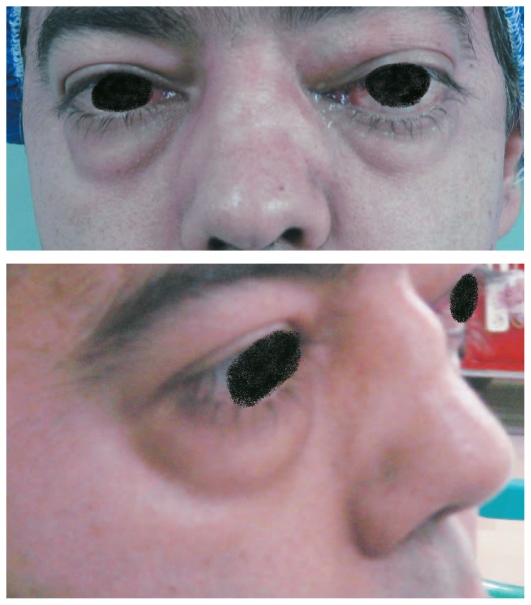
Exemplo de colapso da ponte nasal (deformação do nariz em sela) observada na granulomatose com poliangeíte (GPA): Também pode haver envolvimento ocular com proptose (protrusão do globo ocular), edema das pálpebras e movimentos oculares limitados. O envolvimento ocular surge habitualmente anos após o início da doença.
Imagem: “Anterior and lateral appearance of the patient” por Aletaha M, Tavakoli M, Kanavi MR, Hashemlou A, Roghaei S. License: CC BY 2.5
Envolvimento do trato respiratório inferior
Parênquima:
Crepitações
Hemorragia alveolar difusa
Sinais de consolidação e/ou derrame pleural, incluindo macicez à percussão
Antecedentes de asmaASMAAutoimmune Hepatitis favorece o diagnóstico de EGPA relativamente a GPAGPAA multisystemic disease of a complex genetic background. It is characterized by inflammation of the blood vessels (vasculitis) leading to damage in any number of organs. The common features include granulomatous inflammation of the respiratory tract and kidneys. Most patients have measurable autoantibodies (antineutrophil cytoplasmic antibodies) against myeloblastin.Granulomatosis with Polyangiitis/MPAMPAA primary systemic vasculitis of small- and some medium-sized vessels. It is characterized by a tropism for kidneys and lungs, positive association with anti-neutrophil cytoplasmic antibodies (ANCA), and a paucity of immunoglobulin deposits in vessel walls.Vasculitides.
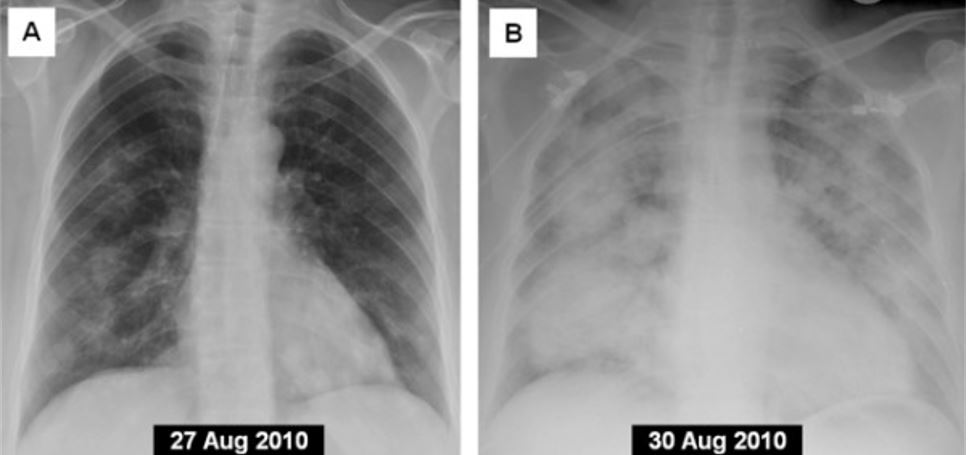
Progressão para hemorragia alveolar difusa num indivíduo com granulomatose com poliangeíte (GPA): A) radiografia do tórax frontal na admissão B) radiografia do tórax frontal no mesmo indivíduo após 4 dias
Imagem: “Posterior-anterior chest X-ray 4 days prior to admission” por Cardenas-Garcia J, Farmakiotis D, Baldovino BP, Kim P. License: CC BY 2.0
Envolvimento renal
A glomerulonefrite é observada em 20% dos indivíduos aquando do diagnóstico e 80% dos indivíduos após 2 anos.
As manifestações clínicas incluem:
Hematúria
Cilindros celulares
Hipertensão arterial
↑ Creatinina
Glomerulonefrite rapidamente progressiva (GNRP): ↓ abrupta da função renal ao longo dos dias e histologicamente com formação de crescentes glomerulares
Manifestações cutâneas
Afeta 50% dos indivíduos
MaisMAISAndrogen Insensitivity Syndrome frequentemente observadas na vasculite ANCAANCAGroup of systemic vasculitis with a strong association with anca. The disorders are characterized by necrotizing inflammation of small and medium size vessels, with little or no immune-complex deposits in vessel walls.Rapidly Progressive Glomerulonephritis associada a fármacos do que em outras formas de VAA
Inclui:
Púrpura
Úlceras
Urticária
Livedo reticularisLivedo reticularisA condition characterized by a reticular or fishnet pattern on the skin of lower extremities and other parts of the body. This red and blue pattern is due to deoxygenated blood in unstable dermal blood vessels. The condition is intensified by cold exposure and relieved by rewarming.Chronic Kidney Disease
Nódulos
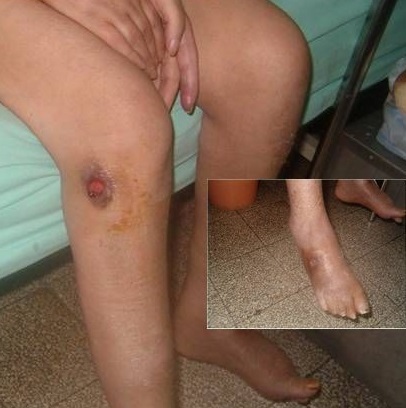
Múltiplas úlceras num indivíduo com poliangeíte microscópica (MPA)
Imagem: “Ulcérations cutanées aux membres inférieurs” por Khammassi N, Chakroun A. License: CC BY 2.0
Manifestações oftálmicas
Dor ocular
Visão desfocada/diplopiaDiplopiaA visual symptom in which a single object is perceived by the visual cortex as two objects rather than one. Disorders associated with this condition include refractive errors; strabismus; oculomotor nerve diseases; trochlear nerve diseases; abducens nerve diseases; and diseases of the brain stem and occipital lobe.Myasthenia Gravis
Conjuntivite
Episclerite/esclerite
Úlcera da córnea, uveíte, retinite
Neuropatia ótica
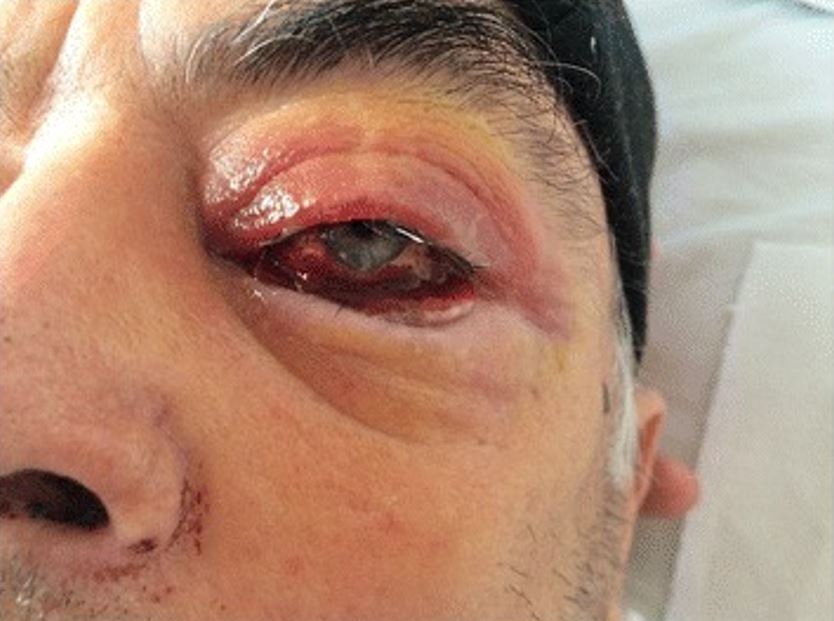
Edema das pálpebras, esclerites, quemose e hemorragia subconjuntival num indivíduo com granulomatose com poliangeíte (GPA)
Imagem: “The eye involvement of Wegener’s granulomatosis and signs of an acute epistaxis” por Bîrluţiu V, Rezi EC, Bîrluţiu RM, Zaharie IS. Licença: CC BY 4.0
↑ ASTASTEnzymes of the transferase class that catalyze the conversion of l-aspartate and 2-ketoglutarate to oxaloacetate and l-glutamate.Liver Function Tests/ALTALTAn enzyme that catalyzes the conversion of l-alanine and 2-oxoglutarate to pyruvate and l-glutamate.Liver Function Tests indica envolvimento hepático.
Possível distúrbio electrolítico por disfunção renal
Possível distúrbio ácido-base por disfunção renal
Análise urinária:
Proteinúria devido a dano glomerular
Hematúria devido a dano glomerular
Marcadores inflamatórios:
Elevação não específica na taxa de sedimentação de eritrócitos (VS) e proteína C-reactiva (PCRPCRPolymerase chain reaction (PCR) is a technique that amplifies DNA fragments exponentially for analysis. The process is highly specific, allowing for the targeting of specific genomic sequences, even with minuscule sample amounts. The PCR cycles multiple times through 3 phases: denaturation of the template DNA, annealing of a specific primer to the individual DNA strands, and synthesis/elongation of new DNA molecules.Polymerase Chain Reaction (PCR))
↑ IgEIgEAn immunoglobulin associated with mast cells. Overexpression has been associated with allergic hypersensitivity.Immunoglobulins: Types and Functions (na GEPA)
Hemograma e leucograma:
Leucocitose
Trombocitose
AnemiaAnemiaAnemia is a condition in which individuals have low Hb levels, which can arise from various causes. Anemia is accompanied by a reduced number of RBCs and may manifest with fatigue, shortness of breath, pallor, and weakness. Subtypes are classified by the size of RBCs, chronicity, and etiology. Anemia: Overview and Types normocítica normocrómica
Eosinofilia (na GEPA)
Imunofluorescência positiva e/ou ensaio de imunofluorescência enzimática (ELISAELISAAn immunoassay utilizing an antibody labeled with an enzyme marker such as horseradish peroxidase. While either the enzyme or the antibody is bound to an immunosorbent substrate, they both retain their biologic activity; the change in enzyme activity as a result of the enzyme-antibody-antigen reaction is proportional to the concentration of the antigen and can be measured spectrophotometrically or with the naked eye. Many variations of the method have been developed.St. Louis Encephalitis Virus) para ANCAANCAGroup of systemic vasculitis with a strong association with anca. The disorders are characterized by necrotizing inflammation of small and medium size vessels, with little or no immune-complex deposits in vessel walls.Rapidly Progressive Glomerulonephritis (soro):
Mononeuropatia (e.g. pé pendente) ou polineuropatia
Infiltrados pulmonares
Anomalias dos seios paranasias
Acumulação extravascular de eosinófilos na biópsia
Biópsia
A confirmação diagnóstica inclui uma biópsia dos orgãos afetados:
O diagnóstico pode ser confirmado com uma biópsia pulmonar, cutânea ou do nervo periférico (pode revelar granulomasGranulomasA relatively small nodular inflammatory lesion containing grouped mononuclear phagocytes, caused by infectious and noninfectious agents.Sarcoidosis).
Locais de biópsia e achados:
GPAGPAA multisystemic disease of a complex genetic background. It is characterized by inflammation of the blood vessels (vasculitis) leading to damage in any number of organs. The common features include granulomatous inflammation of the respiratory tract and kidneys. Most patients have measurable autoantibodies (antineutrophil cytoplasmic antibodies) against myeloblastin.Granulomatosis with Polyangiitis: A biópsia tecidual de um local da doença ativa revela glomerulonefrite segmentar, com pouca ou nenhuma imunoglobulina, ou depósitos complementares (paucimune); as biópsias renal e pulmonar são as maisMAISAndrogen Insensitivity Syndrome específicas.
MPAMPAA primary systemic vasculitis of small- and some medium-sized vessels. It is characterized by a tropism for kidneys and lungs, positive association with anti-neutrophil cytoplasmic antibodies (ANCA), and a paucity of immunoglobulin deposits in vessel walls.Vasculitides: Biópsia pulmonar e/ou renal (glomerulonefrite crescente) revela arterite necrosante (histologicamente idêntica à poliarterite nodosa).
GEPA: A biópsia pulmonar mostra eosinofilia e pequenos granulomasGranulomasA relatively small nodular inflammatory lesion containing grouped mononuclear phagocytes, caused by infectious and noninfectious agents.Sarcoidosis eosinofílicos necrosantes com vasculite necrosante, envolvendo pequenas artérias e vénulas
Doença de autoanticorpos anti-MBG: A biópsia renal mostra glomerulonefrite necrosante com pouca ou nenhuma deposição de complexos imunitários ou de complemento.
Vasculite associada ao ANCAANCAGroup of systemic vasculitis with a strong association with anca. The disorders are characterized by necrotizing inflammation of small and medium size vessels, with little or no immune-complex deposits in vessel walls.Rapidly Progressive Glomerulonephritis induzida por fármacos: Sem um achado patológico distintivo para a discriminação entre vasculite induzida por fármacos e outras vaculites
Tratamento
Todos os indivíduos com um diagnóstico confirmado de VAA requerem terapêutica imunossupressora. A terapêutica pode ser iniciada precocemente com base num diagnóstico presuntivo dos seguintes critérios:
Características clínicas sugestivas
Teste ANCAANCAGroup of systemic vasculitis with a strong association with anca. The disorders are characterized by necrotizing inflammation of small and medium size vessels, with little or no immune-complex deposits in vessel walls.Rapidly Progressive Glomerulonephritis +
Probabilidade ↓ de outras etiologias
Indução de remissão
MPAMPAA primary systemic vasculitis of small- and some medium-sized vessels. It is characterized by a tropism for kidneys and lungs, positive association with anti-neutrophil cytoplasmic antibodies (ANCA), and a paucity of immunoglobulin deposits in vessel walls.Vasculitides e GPAGPAA multisystemic disease of a complex genetic background. It is characterized by inflammation of the blood vessels (vasculitis) leading to damage in any number of organs. The common features include granulomatous inflammation of the respiratory tract and kidneys. Most patients have measurable autoantibodies (antineutrophil cytoplasmic antibodies) against myeloblastin.Granulomatosis with Polyangiitis:
Ciclofosfamida + glucocorticoides fazem parte do esquema standard para indução de remissão.
O RituximabRituximabA murine-derived monoclonal antibody and antineoplastic agent that binds specifically to the cd20 antigen and is used in the treatment of leukemia; lymphoma and rheumatoid arthritis.Immunosuppressants é uma alternativa menos tóxica à ciclofosfamida para indução de remissão na GPAGPAA multisystemic disease of a complex genetic background. It is characterized by inflammation of the blood vessels (vasculitis) leading to damage in any number of organs. The common features include granulomatous inflammation of the respiratory tract and kidneys. Most patients have measurable autoantibodies (antineutrophil cytoplasmic antibodies) against myeloblastin.Granulomatosis with Polyangiitis ou MPAMPAA primary systemic vasculitis of small- and some medium-sized vessels. It is characterized by a tropism for kidneys and lungs, positive association with anti-neutrophil cytoplasmic antibodies (ANCA), and a paucity of immunoglobulin deposits in vessel walls.Vasculitides e é o 1º tratamento aprovado pela FDA.
EGPA:
Os glucocorticoides por si só são adequados para o tratamento de EGPA.
Os fármacos citotóxicos (ciclofosfamida) são necessários em < 20% dos indivíduos.
A plasmaferese pode ser necessária com doença (por exemplo, GNRP ou hemorragia pulmonar).
Manutenção da remissão
Uma vez alcançada a remissão, os indivíduos alteram para agentes menos tóxicos:
Azatioprina
RituximabRituximabA murine-derived monoclonal antibody and antineoplastic agent that binds specifically to the cd20 antigen and is used in the treatment of leukemia; lymphoma and rheumatoid arthritis.Immunosuppressants
Micofenolato mofetil
Metotrexato
Medidas gerais
Profilaxia antibiótica durante a terapêutica imunossupressora
Trimetoprim-sulfametoxazol para prevenir pneumoniaPneumoniaPneumonia or pulmonary inflammation is an acute or chronic inflammation of lung tissue. Causes include infection with bacteria, viruses, or fungi. In more rare cases, pneumonia can also be caused through toxic triggers through inhalation of toxic substances, immunological processes, or in the course of radiotherapy.Pneumonia por Pneumocystis (PCPPCPPneumocystis jiroveci is a yeast-like fungus causing pneumocystis pneumonia (PCP) in immunocompromised patients. Pneumocystis pneumonia is spread through airborne transmission and classically affects patients with AIDS, functioning as an AIDS-defining illness. Patients may present with insidious onset of fever, chills, dry cough, chest pain, and shortness of breath.Pneumocystis jirovecii/Pneumocystis Pneumonia (PCP))
Tabela de Comparação
Tabela com características laboratoriais e clínicas sugestivas dos 3 principais tipos de VAA:
Tabela: Características laboratoriais e clínicas sugestivas dos 3 principais tipos de VAA
VAA
ANCAANCAGroup of systemic vasculitis with a strong association with anca. The disorders are characterized by necrotizing inflammation of small and medium size vessels, with little or no immune-complex deposits in vessel walls.Rapidly Progressive Glomerulonephritis
Granuloma na biópsia
Caso típico
GPAGPAA multisystemic disease of a complex genetic background. It is characterized by inflammation of the blood vessels (vasculitis) leading to damage in any number of organs. The common features include granulomatous inflammation of the respiratory tract and kidneys. Most patients have measurable autoantibodies (antineutrophil cytoplasmic antibodies) against myeloblastin.Granulomatosis with Polyangiitis
MPAMPAA primary systemic vasculitis of small- and some medium-sized vessels. It is characterized by a tropism for kidneys and lungs, positive association with anti-neutrophil cytoplasmic antibodies (ANCA), and a paucity of immunoglobulin deposits in vessel walls.Vasculitides
Semelhante à GPAGPAA multisystemic disease of a complex genetic background. It is characterized by inflammation of the blood vessels (vasculitis) leading to damage in any number of organs. The common features include granulomatous inflammation of the respiratory tract and kidneys. Most patients have measurable autoantibodies (antineutrophil cytoplasmic antibodies) against myeloblastin.Granulomatosis with Polyangiitis, mas sem doença nasal/sinusal grave (apenas em 30%)
GPA: granulomatose com poliangeíte MPA: poliangeíte microscópica EGPA: granulomatose eosinofílica com poliangeíte
Diagnósticos Diferenciais
Vasculite ANCAANCAGroup of systemic vasculitis with a strong association with anca. The disorders are characterized by necrotizing inflammation of small and medium size vessels, with little or no immune-complex deposits in vessel walls.Rapidly Progressive Glomerulonephritis induzida por fármacos: Vasculite com ANCAANCAGroup of systemic vasculitis with a strong association with anca. The disorders are characterized by necrotizing inflammation of small and medium size vessels, with little or no immune-complex deposits in vessel walls.Rapidly Progressive Glomerulonephritis positivo por exposição a fármacos (propiltiouracil, methimazol, carbimazol, hidralazina e minociclina), que se manifesta com sintomas constitucionais como artralgias, fadiga e erupção cutânea. No entanto, outras características clínicas (incluindo insuficiência renal rapidamente progressiva e hemorragia alveolar) também podem ocorrer.
Síndrome de Goodpasture: doença autoimune rara em que os anticorpos atingem a membrana basal dos pulmões e rins, levando a hemorragia pulmonar e insuficiência renal. A síndrome de Goodpasture resulta em lesões pulmonares e renais permanentes e muitas vezes em morte. O tratamento inclui fármacos de supressão do sistema imunitário (por exemplo, corticosteróides e ciclofosfamida) e plasmaferese.
Poliarterite nodosa: vasculite sistémica de pequenos e médios vasos. A poliarterite nodosa envolve a pele, nervos periféricos, músculos, articulações, trato gastrointestinal e rins. Indivíduos com sintomas inespecíficos, hipertensão, risco de enfarte do miocárdio e polineuropatia. A angiografia revela um aspeto de aneurismas alternados e estenose dos vasos. O tratamento engloba um esquema de imunossupressão.
Arterite de células gigantes: vasculite das artérias médias e grandes (particularmente as artérias carótidas e aortaAortaThe main trunk of the systemic arteries.Mediastinum and Great Vessels: Anatomy). Os indivíduos apresentam cefaleia de novo, endurecimento e dor ao toque da artéria temporal, claudicação mandibular e amaurose fugaz. Os exames laboratoriais mostram uma VS e PCRPCRPolymerase chain reaction (PCR) is a technique that amplifies DNA fragments exponentially for analysis. The process is highly specific, allowing for the targeting of specific genomic sequences, even with minuscule sample amounts. The PCR cycles multiple times through 3 phases: denaturation of the template DNA, annealing of a specific primer to the individual DNA strands, and synthesis/elongation of new DNA molecules.Polymerase Chain Reaction (PCR) elevadas. A biópsia revela infiltração mononuclear das paredes dos vasos e formação de células gigantes. O tratamento envolve a administração imediata de glicocorticóides.
Púrpura de Henoch-Schönlein: vasculite autoimune de pequenos vasos. Apresenta-se habitualmente com a tríade de dor abdominal, hematúria e erupção purpúrica. A fisiopatologia envolve a deposição de complexos imunes IgAIgARepresents 15-20% of the human serum immunoglobulins, mostly as the 4-chain polymer in humans or dimer in other mammals. Secretory iga is the main immunoglobulin in secretions.Immunoglobulins: Types and Functions em múltiplos vasos, desencadeada por um precipitante. Os sintomas dependem dos tecidos irrigados pelos vasos. O diagnóstico é clínico e o tratamento é sintomático.
Artrite reumatoide: poliartrite inflamatória que se apresenta com dores nas articulações simétricas. A dor é pior de manhã, mas melhora durante o dia. As articulações interfalângicas proximais e metacarpofalângicas estão incluídas, mas as articulações interfalângicas distais são poupadas. O tratamento inclui AINEs, metotrexato, sulfassalazina, hidroxicloroquina e inibidores de TNF-α.
Lúpus eritematoso sistémico: condição inflamatória crónica com envolvimento da pele, articulações, rins, células sanguíneas e SNC. É uma condição autoimune associada à formação de autoanticorpos como o ANA, anti-Smith, e ADN de dupla cadeia (dsDNA). As características incluem erupção malar, artralgias, febre, proteinúria, hipertensão, anemiaAnemiaAnemia is a condition in which individuals have low Hb levels, which can arise from various causes. Anemia is accompanied by a reduced number of RBCs and may manifest with fatigue, shortness of breath, pallor, and weakness. Subtypes are classified by the size of RBCs, chronicity, and etiology. Anemia: Overview and Types, linfopenia, convulsões e/ou psicose.
Aratani, Y. (2018). Myeloperoxidase: Its role for host defense, inflammation, and neutrophil function. Arch Biochem Biophys. 640:47-52. https://pubmed.ncbi.nlm.nih.gov/29336940/
A Lecturio Medical complementa o teu estudo através de métodos de ensino baseados em evidência, vídeos de palestras, perguntas e muito mais – tudo combinado num só lugar e fácil de usar.
User Reviews
Details
×
Obtenha Premium para testar os seus conhecimentos
Lecturio Premium dá-lhe acesso total a todos os conteúdos e características
Obtenha Premium para ver todos os vídeos
Verifique agora o seu e-mail para obter um teste gratuito.
Crie uma conta gratuita para testar os seus conhecimentos
Lecturio Premium dá-lhe acesso total a todos os conteúdos e características - incluindo o Qbank de Lecturio com perguntas actualizadas ao estilo do board-.