


Imunoglobulinas: Tipos e Funções

As imunoglobulinas ( Igs Igs Immunoglobulins (Igs), also known as antibodies, are glycoprotein molecules produced by plasma cells that act in immune responses by recognizing and binding particular antigens. The various ig classes are IgG (the most abundant), IgM, IgE, IgD, and IgA, which differ in their biologic features, structure, target specificity, and distribution. Immunoglobulins: Types and Functions), também conhecidas como anticorpos, são moléculas de glicoproteínas produzidas por células plasmáticas que atuam nas respostas imunes reconhecendo e ligando-se a antigénios específicos. Os anticorpos passam por processos que aperfeiçoam a afinidade do antigénio e fornecem uma defesa adequada através da troca de classe. As várias classes de Ig Ig X-linked Agammaglobulinemia são a IgG IgG The major immunoglobulin isotype class in normal human serum. There are several isotype subclasses of igg, for example, igg1, igg2a, and igg2b. Hypersensitivity Pneumonitis (a classe mais MAIS Androgen Insensitivity Syndrome abundante), IgM IgM A class of immunoglobulin bearing mu chains (immunoglobulin mu-chains). Igm can fix complement. The name comes from its high molecular weight and originally being called a macroglobulin. Immunoglobulins: Types and Functions, IgE IgE An immunoglobulin associated with mast cells. Overexpression has been associated with allergic hypersensitivity. Immunoglobulins: Types and Functions, IgD IgD An immunoglobulin which accounts for less than 1% of plasma immunoglobulin. It is found on the membrane of many circulating B lymphocytes. Immunoglobulins: Types and Functions e IgA IgA Represents 15-20% of the human serum immunoglobulins, mostly as the 4-chain polymer in humans or dimer in other mammals. Secretory iga is the main immunoglobulin in secretions. Immunoglobulins: Types and Functions, que diferem nas suas características biológicas, estrutura, especificidade do alvo e distribuição. As principais funções incluem opsonização, neutralização da infeciosidade dos agentes patogénicos, citotoxicidade e ativação do complemento. As classes específicas apresentam mecanismos defensivos únicos.

Last updated: Dec 15, 2025
Editorial responsibility: Stanley Oiseth, Lindsay Jones, Evelin Maza

Descrição Geral

Imunoglobulinas ( Igs Igs Immunoglobulins (Igs), also known as antibodies, are glycoprotein molecules produced by plasma cells that act in immune responses by recognizing and binding particular antigens. The various ig classes are IgG (the most abundant), IgM, IgE, IgD, and IgA, which differ in their biologic features, structure, target specificity, and distribution. Immunoglobulins: Types and Functions)

  • Moléculas de glicoproteínas produzidas por células plasmáticas que atuam nas respostas imunes através do reconhecimento e ligação de antigénios específicos
  • Componentes estruturais:
    • 2 cadeias pesadas (H) idênticas e 2 cadeias leves (L) idênticas (nomeadas de acordo com o seu peso molecular):
      • Cadeias leves: aproximadamente 25 kDa cada
      • Cadeias pesadas: aproximadamente 50 kDa cada
    • As ligações dissulfeto ligam as cadeias pesadas às cadeias leves (formando uma molécula em forma de Y).
    • Região da dobradiça (que confere flexibilidade)
    • Porções de hidratos de carbono (geralmente associadas à região constante)
  • As cadeias são codificadas por diferentes cromossomas:
    • Cadeias pesadas (μ, δ, γ, α ou ε): codificadas pelo cromossoma 14
    • Cadeias leves (κ ou λ):
      • κ cadeia leve: cromossoma 2
      • λ cadeia leve: cromossoma 22

Regiões e fragmentos de Ig Ig X-linked Agammaglobulinemia

  • Ambas as cadeias pesadas e leves nas Igs Igs Immunoglobulins (Igs), also known as antibodies, are glycoprotein molecules produced by plasma cells that act in immune responses by recognizing and binding particular antigens. The various ig classes are IgG (the most abundant), IgM, IgE, IgD, and IgA, which differ in their biologic features, structure, target specificity, and distribution. Immunoglobulins: Types and Functions têm regiões variáveis e constantes.
  • Regiões:
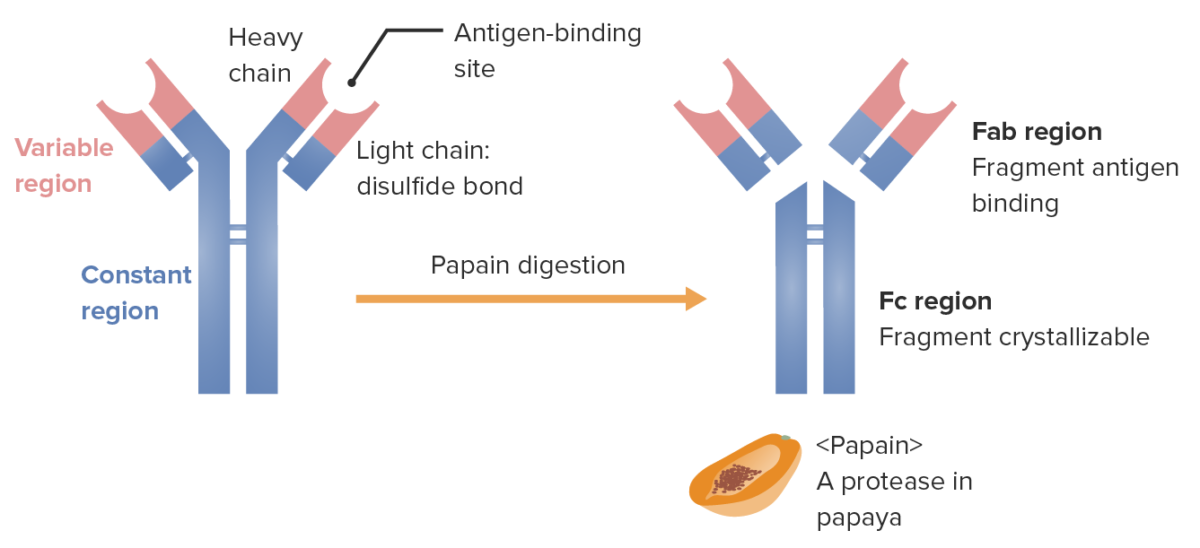
    • Região variável (ligação ao antigénio):
      • Corresponde à sequência de aminoácidos nas pontas do “Y”, que inclui extremidades de cadeias leves e pesadas
      • Possui uma região hipervariável ou região determinante de complementaridade (CDR, pela sigla em inglês) em cada terminal
      • A CDR fornece especificidade ao antigénio, pois é estruturalmente complementar ao determinante antigénico (epítopo).
    • Região constante (funções efetoras):
      • Constitui o polipéptido restante
      • Liga-se a recetores Fc Fc Crystallizable fragments composed of the carboxy-terminal halves of both immunoglobulin heavy chains linked to each other by disulfide bonds. Fc fragments contain the carboxy-terminal parts of the heavy chain constant regions that are responsible for the effector functions of an immunoglobulin (complement fixation, binding to the cell membrane via fc receptors, and placental transport). This fragment can be obtained by digestion of immunoglobulins with the proteolytic enzyme papain. Immunoglobulins: Types and Functions e complemento
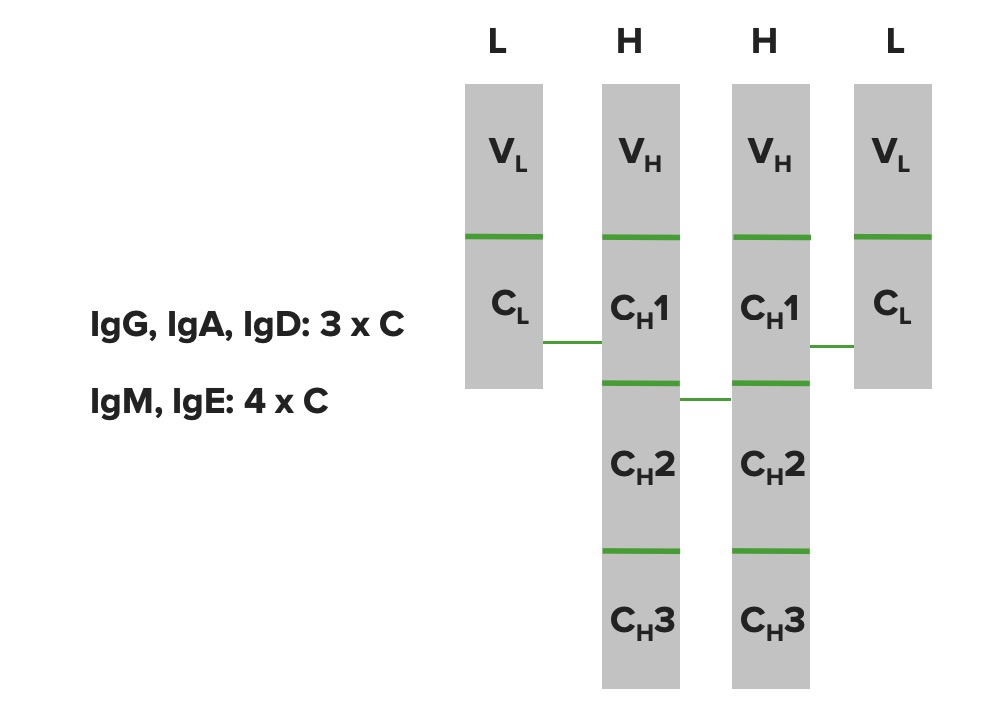
  • As regiões da cadeia pesada e da cadeia leve são dobradas em segmentos tridimensionais chamados domínios.
    • A cadeia leve tem 1 domínio variável e 1 domínio constante.
    • A cadeia pesada tem 1 domínio variável, mas possui diferentes números de domínios constantes:
      • IgG IgG The major immunoglobulin isotype class in normal human serum. There are several isotype subclasses of igg, for example, igg1, igg2a, and igg2b. Hypersensitivity Pneumonitis, IgA IgA Represents 15-20% of the human serum immunoglobulins, mostly as the 4-chain polymer in humans or dimer in other mammals. Secretory iga is the main immunoglobulin in secretions. Immunoglobulins: Types and Functions, IgD IgD An immunoglobulin which accounts for less than 1% of plasma immunoglobulin. It is found on the membrane of many circulating B lymphocytes. Immunoglobulins: Types and Functions: 3 domínios constantes
      • IgM IgM A class of immunoglobulin bearing mu chains (immunoglobulin mu-chains). Igm can fix complement. The name comes from its high molecular weight and originally being called a macroglobulin. Immunoglobulins: Types and Functions e IgE IgE An immunoglobulin associated with mast cells. Overexpression has been associated with allergic hypersensitivity. Immunoglobulins: Types and Functions: 4 domínios constantes
  • Fragmentos (determinados pelo local onde a enzima papaína divide a Ig Ig X-linked Agammaglobulinemia):
    • Fab Fab Univalent antigen-binding fragments composed of one entire immunoglobulin light chain and the amino terminal end of one of the immunoglobulin heavy chains from the hinge region, linked to each other by disulfide bonds. Fab contains the immunoglobulin variable regions, which are part of the antigen-binding site, and the first immunoglobulin constant regions. This fragment can be obtained by digestion of immunoglobulins with the proteolytic enzyme papain. Immunoglobulins: Types and Functions (fragmento de ligação ao antigénio):
      • Possui as regiões variáveis e partes da região constante das cadeias pesada e leve
      • Interage com o antigénio
    • Fc Fc Crystallizable fragments composed of the carboxy-terminal halves of both immunoglobulin heavy chains linked to each other by disulfide bonds. Fc fragments contain the carboxy-terminal parts of the heavy chain constant regions that are responsible for the effector functions of an immunoglobulin (complement fixation, binding to the cell membrane via fc receptors, and placental transport). This fragment can be obtained by digestion of immunoglobulins with the proteolytic enzyme papain. Immunoglobulins: Types and Functions (fragmento cristalizável):
      • Constitui a parte restante (cauda) do anticorpo (apenas cadeia pesada)
      • Região constante, frações de hidratos de carbono
      • Complemento de ligação
      • Confere o isotipo de Ig Ig X-linked Agammaglobulinemia (por exemplo, IgM IgM A class of immunoglobulin bearing mu chains (immunoglobulin mu-chains). Igm can fix complement. The name comes from its high molecular weight and originally being called a macroglobulin. Immunoglobulins: Types and Functions, IgA IgA Represents 15-20% of the human serum immunoglobulins, mostly as the 4-chain polymer in humans or dimer in other mammals. Secretory iga is the main immunoglobulin in secretions. Immunoglobulins: Types and Functions)
  • A composição da cadeia pesada (região constante e Fc Fc Crystallizable fragments composed of the carboxy-terminal halves of both immunoglobulin heavy chains linked to each other by disulfide bonds. Fc fragments contain the carboxy-terminal parts of the heavy chain constant regions that are responsible for the effector functions of an immunoglobulin (complement fixation, binding to the cell membrane via fc receptors, and placental transport). This fragment can be obtained by digestion of immunoglobulins with the proteolytic enzyme papain. Immunoglobulins: Types and Functions) determina a classe/isotipo de Ig Ig X-linked Agammaglobulinemia:
    • µ: IgM IgM A class of immunoglobulin bearing mu chains (immunoglobulin mu-chains). Igm can fix complement. The name comes from its high molecular weight and originally being called a macroglobulin. Immunoglobulins: Types and Functions
    • δ: IgD IgD An immunoglobulin which accounts for less than 1% of plasma immunoglobulin. It is found on the membrane of many circulating B lymphocytes. Immunoglobulins: Types and Functions
    • γ: IgG IgG The major immunoglobulin isotype class in normal human serum. There are several isotype subclasses of igg, for example, igg1, igg2a, and igg2b. Hypersensitivity Pneumonitis
    • α: IgA IgA Represents 15-20% of the human serum immunoglobulins, mostly as the 4-chain polymer in humans or dimer in other mammals. Secretory iga is the main immunoglobulin in secretions. Immunoglobulins: Types and Functions
    • ε: IgE IgE An immunoglobulin associated with mast cells. Overexpression has been associated with allergic hypersensitivity. Immunoglobulins: Types and Functions
Domínios de imunoglobulina

Domínios de imunoglobulinas:
As cadeias pesadas e cadeias leves são dobradas em estruturas chamadas domínios. A cadeia leve possui 1 domínio variável e 1 domínio constante. A cadeia pesada possui 1 domínio variável, mas dependendo da molécula de Ig pode possuir domínios constantes diferentes (IgG, IgA e IgD têm 3 domínios constantes, enquanto IgM e IgE têm 4 domínios constantes).
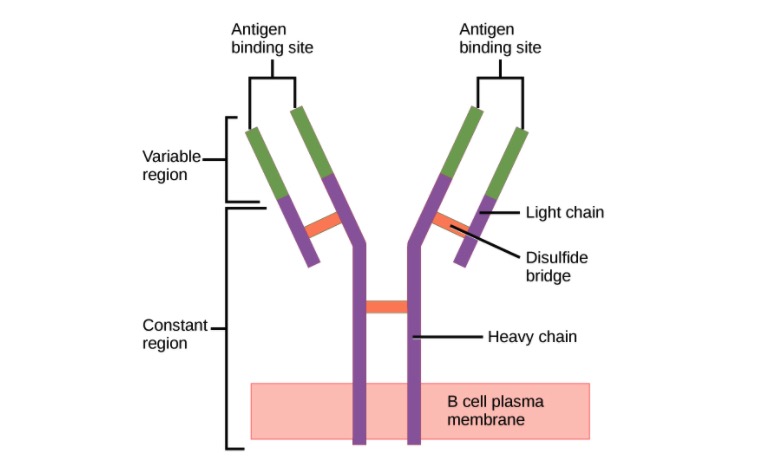
Imagem por Lecturio.

Genes de Imunoglobulinas

Segmentos de genes Genes A category of nucleic acid sequences that function as units of heredity and which code for the basic instructions for the development, reproduction, and maintenance of organisms. DNA Types and Structure de Ig Ig X-linked Agammaglobulinemia

  • Os genes Genes A category of nucleic acid sequences that function as units of heredity and which code for the basic instructions for the development, reproduction, and maintenance of organisms. DNA Types and Structure da cadeia pesada (situados num único locus Locus Specific regions that are mapped within a genome. Genetic loci are usually identified with a shorthand notation that indicates the chromosome number and the position of a specific band along the P or Q arm of the chromosome where they are found. For example the locus 6p21 is found within band 21 of the P-arm of chromosome 6. Many well known genetic loci are also known by common names that are associated with a genetic function or hereditary disease. Basic Terms of Genetics génico, IgH), são constituídos a partir de 4 segmentos de genes Genes A category of nucleic acid sequences that function as units of heredity and which code for the basic instructions for the development, reproduction, and maintenance of organisms. DNA Types and Structure:
    • Região variável (V)
    • Região de diversidade (D)
    • Região de junção (J)
    • Região constante (C)
  • Os genes Genes A category of nucleic acid sequences that function as units of heredity and which code for the basic instructions for the development, reproduction, and maintenance of organisms. DNA Types and Structure da cadeia leve (encontrados como 2 loci génicos separados – o locus Locus Specific regions that are mapped within a genome. Genetic loci are usually identified with a shorthand notation that indicates the chromosome number and the position of a specific band along the P or Q arm of the chromosome where they are found. For example the locus 6p21 is found within band 21 of the P-arm of chromosome 6. Many well known genetic loci are also known by common names that are associated with a genetic function or hereditary disease. Basic Terms of Genetics κ (IgK) e o locus Locus Specific regions that are mapped within a genome. Genetic loci are usually identified with a shorthand notation that indicates the chromosome number and the position of a specific band along the P or Q arm of the chromosome where they are found. For example the locus 6p21 is found within band 21 of the P-arm of chromosome 6. Many well known genetic loci are also known by common names that are associated with a genetic function or hereditary disease. Basic Terms of Genetics λ (IgL)) vêm de 3 segmentos de genes Genes A category of nucleic acid sequences that function as units of heredity and which code for the basic instructions for the development, reproduction, and maintenance of organisms. DNA Types and Structure:
    • Região variável (V)
    • Região de junção (J)
    • Região constante (C)

Rearranjos genéticos

  • Nos estadios de desenvolvimento das células B, ocorrem rearranjos de genes Genes A category of nucleic acid sequences that function as units of heredity and which code for the basic instructions for the development, reproduction, and maintenance of organisms. DNA Types and Structure para formar a molécula de Ig Ig X-linked Agammaglobulinemia.
    • Nas cadeias de IgH, o rearranjo começa com os segmentos D e J.
    • A recombinação do gene Gene A category of nucleic acid sequences that function as units of heredity and which code for the basic instructions for the development, reproduction, and maintenance of organisms. Basic Terms of Genetics IgH VDJ (variable-diversity-joining, pela sigla em inglês) ocorre então, formando uma célula pré-B.
    • Seguem-se os rearranjos VJ da cadeia leve.
  • A partir deste processo é expressa uma molécula de anticorpo IgM IgM A class of immunoglobulin bearing mu chains (immunoglobulin mu-chains). Igm can fix complement. The name comes from its high molecular weight and originally being called a macroglobulin. Immunoglobulins: Types and Functions completa e forma-se uma célula B madura.
  • Os rearranjos de genes Genes A category of nucleic acid sequences that function as units of heredity and which code for the basic instructions for the development, reproduction, and maintenance of organisms. DNA Types and Structure contribuem para a diversidade de anticorpos.

Recombinação de troca de classe (CSR, pela sigla em inglês)

  • Também denominada troca de classe
  • Mecanismo biológico pelo qual a produção de Igs Igs Immunoglobulins (Igs), also known as antibodies, are glycoprotein molecules produced by plasma cells that act in immune responses by recognizing and binding particular antigens. The various ig classes are IgG (the most abundant), IgM, IgE, IgD, and IgA, which differ in their biologic features, structure, target specificity, and distribution. Immunoglobulins: Types and Functions pelas células B muda de uma classe para outra.
    • IgM IgM A class of immunoglobulin bearing mu chains (immunoglobulin mu-chains). Igm can fix complement. The name comes from its high molecular weight and originally being called a macroglobulin. Immunoglobulins: Types and Functions para outras Igs Igs Immunoglobulins (Igs), also known as antibodies, are glycoprotein molecules produced by plasma cells that act in immune responses by recognizing and binding particular antigens. The various ig classes are IgG (the most abundant), IgM, IgE, IgD, and IgA, which differ in their biologic features, structure, target specificity, and distribution. Immunoglobulins: Types and Functions → a região constante da cadeia pesada (C) altera o segmento μ ( IgM IgM A class of immunoglobulin bearing mu chains (immunoglobulin mu-chains). Igm can fix complement. The name comes from its high molecular weight and originally being called a macroglobulin. Immunoglobulins: Types and Functions) para γ ( IgG IgG The major immunoglobulin isotype class in normal human serum. There are several isotype subclasses of igg, for example, igg1, igg2a, and igg2b. Hypersensitivity Pneumonitis), ε ( IgE IgE An immunoglobulin associated with mast cells. Overexpression has been associated with allergic hypersensitivity. Immunoglobulins: Types and Functions) ou α ( IgA IgA Represents 15-20% of the human serum immunoglobulins, mostly as the 4-chain polymer in humans or dimer in other mammals. Secretory iga is the main immunoglobulin in secretions. Immunoglobulins: Types and Functions).
    • A comutação é influenciada por citocinas.
      • Fator de transformação do crescimento β (TGF-β): muda preferencialmente para IgA IgA Represents 15-20% of the human serum immunoglobulins, mostly as the 4-chain polymer in humans or dimer in other mammals. Secretory iga is the main immunoglobulin in secretions. Immunoglobulins: Types and Functions
      • IL-4: IgE IgE An immunoglobulin associated with mast cells. Overexpression has been associated with allergic hypersensitivity. Immunoglobulins: Types and Functions
      • Interferão IFN-γ, IL-4: IgG IgG The major immunoglobulin isotype class in normal human serum. There are several isotype subclasses of igg, for example, igg1, igg2a, and igg2b. Hypersensitivity Pneumonitis
  • A região constante da cadeia pesada de Ig Ig X-linked Agammaglobulinemia é alterada, mas a região variável permanece inalterada.
  • Como a região variável está intacta, a especificidade do anticorpo não muda.

Processos de recombinação de troca de classe

  • Excisão de exões:
    • Quando os antigénios são encontrados, as células B maduras IgM-positivas sofrem CSR.
    • Os exões que codificam o segmento de gene Gene A category of nucleic acid sequences that function as units of heredity and which code for the basic instructions for the development, reproduction, and maintenance of organisms. Basic Terms of Genetics de codificação constante (Cμ) da IgH são excisados.
    • Estes exões são substituídos por um novo segmento de gene Gene A category of nucleic acid sequences that function as units of heredity and which code for the basic instructions for the development, reproduction, and maintenance of organisms. Basic Terms of Genetics constante (por exemplo, Cγ, Cε ou Cα).
    • Resulta numa célula B (que expressa originalmente IgM IgM A class of immunoglobulin bearing mu chains (immunoglobulin mu-chains). Igm can fix complement. The name comes from its high molecular weight and originally being called a macroglobulin. Immunoglobulins: Types and Functions) que produz IgG IgG The major immunoglobulin isotype class in normal human serum. There are several isotype subclasses of igg, for example, igg1, igg2a, and igg2b. Hypersensitivity Pneumonitis, IgE IgE An immunoglobulin associated with mast cells. Overexpression has been associated with allergic hypersensitivity. Immunoglobulins: Types and Functions ou IgA IgA Represents 15-20% of the human serum immunoglobulins, mostly as the 4-chain polymer in humans or dimer in other mammals. Secretory iga is the main immunoglobulin in secretions. Immunoglobulins: Types and Functions
  • Reação de recombinação-deleção de DNA DNA A deoxyribonucleotide polymer that is the primary genetic material of all cells. Eukaryotic and prokaryotic organisms normally contain DNA in a double-stranded state, yet several important biological processes transiently involve single-stranded regions. DNA, which consists of a polysugar-phosphate backbone possessing projections of purines (adenine and guanine) and pyrimidines (thymine and cytosine), forms a double helix that is held together by hydrogen bonds between these purines and pyrimidines (adenine to thymine and guanine to cytosine). DNA Types and Structure:
    • As áreas repetitivas de DNA DNA A deoxyribonucleotide polymer that is the primary genetic material of all cells. Eukaryotic and prokaryotic organisms normally contain DNA in a double-stranded state, yet several important biological processes transiently involve single-stranded regions. DNA, which consists of a polysugar-phosphate backbone possessing projections of purines (adenine and guanine) and pyrimidines (thymine and cytosine), forms a double helix that is held together by hydrogen bonds between these purines and pyrimidines (adenine to thymine and guanine to cytosine). DNA Types and Structure, também conhecidas como regiões de comutação:
      • As enzimas modificadoras de DNA DNA A deoxyribonucleotide polymer that is the primary genetic material of all cells. Eukaryotic and prokaryotic organisms normally contain DNA in a double-stranded state, yet several important biological processes transiently involve single-stranded regions. DNA, which consists of a polysugar-phosphate backbone possessing projections of purines (adenine and guanine) and pyrimidines (thymine and cytosine), forms a double helix that is held together by hydrogen bonds between these purines and pyrimidines (adenine to thymine and guanine to cytosine). DNA Types and Structure (citidina desaminase induzida por ativação (AICDA) e uracilo nucleosídeo glicosilase ( UNG UNG B cells: Types and Functions, pela sigla em inglês)) criam quebras da cadeia dupla de DNA DNA A deoxyribonucleotide polymer that is the primary genetic material of all cells. Eukaryotic and prokaryotic organisms normally contain DNA in a double-stranded state, yet several important biological processes transiently involve single-stranded regions. DNA, which consists of a polysugar-phosphate backbone possessing projections of purines (adenine and guanine) and pyrimidines (thymine and cytosine), forms a double helix that is held together by hydrogen bonds between these purines and pyrimidines (adenine to thymine and guanine to cytosine). DNA Types and Structure (DSBs, pela sigla em inglês)
      • Determinam onde o segmento VDJ e a nova região constante são unidos por uma enzima de reparação
    • As novas moléculas de Ig Ig X-linked Agammaglobulinemia são geradas com uma região constante diferente (mas com a mesma afinidade/especificidade para o antigénio, uma vez que a região variável está intacta).
Class-switch recombination (CSR)

Recombinação de troca de classe (CSR):
A cadeia pesada possui diferentes segmentos de genes: região variável (V), região de diversidade (D), região de junção (J) e região constante (C).
A região C da cadeia pesada determina a classe/isótipo de Ig. Quando os antigénios são encontrados, as células B maduras IgM-positivas sofrem CSR. Os exões que codificam o segmento de gene de codificação constante (Cμ) da IgH são excisados. As áreas repetitivas de DNA, também conhecidas como regiões de troca (losangos negros) estão presentes.
As regiões de comutação guiam as enzimas, como a citidina desaminase induzida por ativação (AICDA), relativamente aos locais de rutura da cadeia dupla de DNA (DSBs) e onde o segmento VDJ e a nova região constante são unidos por uma enzima de reparação. O Cμ é substituído por um segmento novo de gene constante (por exemplo, Cγ, Cε ou Cα). Na imagem, Cγ1 é anexado ao segmento VDJ, formando IgG1.

Imagem por Lecturio.

Diversidade e Especificidade de Anticorpos

Os anticorpos criados possuem propriedades importantes (diversidade e especificidade) e essenciais na resposta imune.

Diversidade de anticorpos

Existem mecanismos específicos, que originam a grande diversidade de anticorpos existentes, tais como:
  • Vários segmentos V, D e J:
    • Como previamente mencionado, no início do desenvolvimento das células B, as cadeias pesadas e leves têm vários segmentos:
      • V, D, J e C para a cadeia pesada
      • V, J e C para a cadeia leve
  • Rearranjos dos segmentos V, D e J:
    • Sequências de DNA DNA A deoxyribonucleotide polymer that is the primary genetic material of all cells. Eukaryotic and prokaryotic organisms normally contain DNA in a double-stranded state, yet several important biological processes transiently involve single-stranded regions. DNA, which consists of a polysugar-phosphate backbone possessing projections of purines (adenine and guanine) and pyrimidines (thymine and cytosine), forms a double helix that is held together by hydrogen bonds between these purines and pyrimidines (adenine to thymine and guanine to cytosine). DNA Types and Structure (chamadas sequência de sinal de recombinação ( RSS RSS Immunoglobulins: Types and Functions, pela sigla em inglês)) que envolvem cada segmento de gene Gene A category of nucleic acid sequences that function as units of heredity and which code for the basic instructions for the development, reproduction, and maintenance of organisms. Basic Terms of Genetics.
    • Estas sequências são locais de reconhecimento para o processo de junção.
    • Os complexos enzimáticos de recombinase RAG1 RAG1 Immunoglobulins: Types and Functions e RAG2 RAG2 Immunoglobulins: Types and Functions ( genes Genes A category of nucleic acid sequences that function as units of heredity and which code for the basic instructions for the development, reproduction, and maintenance of organisms. DNA Types and Structure ativadores de recombinação 1 e 2) reconhecem o RSS RSS Immunoglobulins: Types and Functions e catalisam o processo de união.
    • O défice de RAG1 RAG1 Immunoglobulins: Types and Functions ou RAG2 RAG2 Immunoglobulins: Types and Functions pode levar à produção de células B não funcionais.
    • Os segmentos de cadeia leve são recombinados após os segmentos de cadeia pesada.
  • Diversidade juncional:
    • A união de segmentos de genes Genes A category of nucleic acid sequences that function as units of heredity and which code for the basic instructions for the development, reproduction, and maintenance of organisms. DNA Types and Structure de anticorpos é imprecisa.
    • Podem ser removidos e/ou inserido vários nucleótidos, a partir das extremidades dos segmentos de genes Genes A category of nucleic acid sequences that function as units of heredity and which code for the basic instructions for the development, reproduction, and maintenance of organisms. DNA Types and Structure recombinados.
  • Diversidade combinatória:
    • A diversidade é criada pelo emparelhamento aleatório das cadeias pesada e leve.
  • Hipermutação somática:
    • As mutações pontuais ocorrem com a estimulação repetida do antigénio (das respostas primárias às secundárias).
    • Aumenta a afinidade ao antigénio
    • Contribui para a diversidade do anticorpo

Especificidade

  • A hipermutação somática leva à maturação da afinidade (na região variável), reforçando a capacidade de reconhecer e ligar o antigénio.
  • A mudança de classe (que afeta a região constante) também contribui para a especificidade do anticorpo.
Processos de ativação e maturação de células B no centro germinativo

Processos de ativação e maturação de células B que ocorrem no centro germinativo:
Na fase de ativação, a célula B desloca-se da zona do manto e entra no centro germinativo. Ocorre a proliferação de células B (expansão clonal) e a afinidade do anticorpo para o antigénio é aperfeiçoada através do processo de hipermutação somática. Os ciclos repetidos de proliferação e hipermutação ajustam o recetor de células B. No entanto, nem todas as células B se diferenciam, sobretudo se a afinidade for fraca. Se a ligação antigénio-anticorpo não for otimizada ocorre apoptose celular. As células B com forte afinidade sobrevivem (seleção), com a ajuda de sinais de sobrevivência de células dendríticas foliculares e células T. As células B selecionadas avançam para a mudança de classe e diferenciação em células plasmáticas ou células de memória.
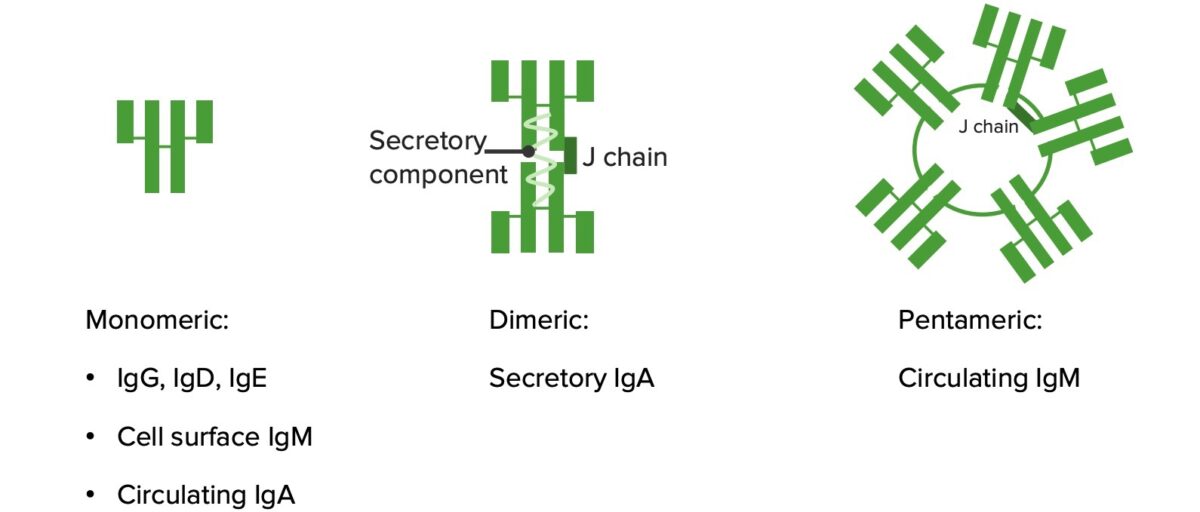
Imagem por Lecturio. Licença: CC BY-NC-SA 4.0

Classes e Características

Classes

  • IgG IgG The major immunoglobulin isotype class in normal human serum. There are several isotype subclasses of igg, for example, igg1, igg2a, and igg2b. Hypersensitivity Pneumonitis:
  • IgM IgM A class of immunoglobulin bearing mu chains (immunoglobulin mu-chains). Igm can fix complement. The name comes from its high molecular weight and originally being called a macroglobulin. Immunoglobulins: Types and Functions:
    • 1º anticorpo produzido em resposta a um antigénio
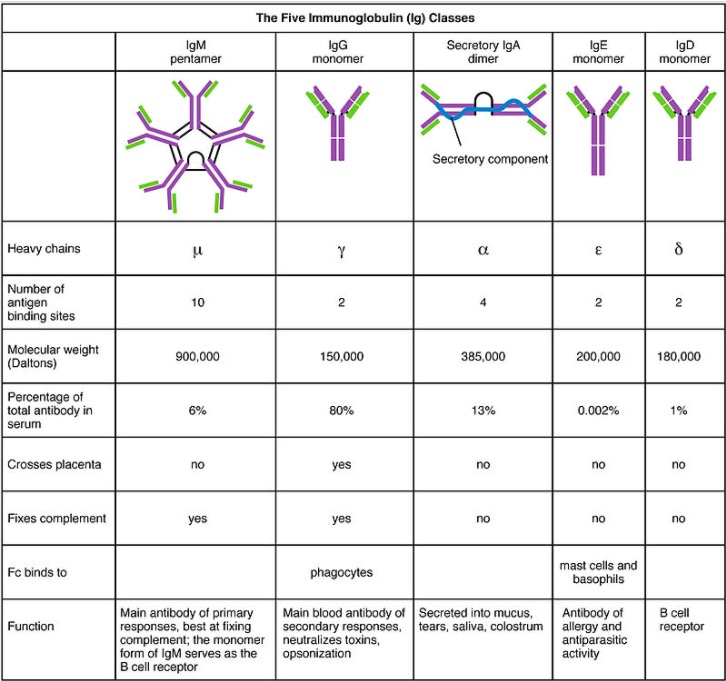
    • A estrutura pentamérica da IgM IgM A class of immunoglobulin bearing mu chains (immunoglobulin mu-chains). Igm can fix complement. The name comes from its high molecular weight and originally being called a macroglobulin. Immunoglobulins: Types and Functions possui 10 locais de ligação, tornando-a a Ig Ig X-linked Agammaglobulinemia com maior capacidade de ligação.
    • Não atravessa a placenta Placenta A highly vascularized mammalian fetal-maternal organ and major site of transport of oxygen, nutrients, and fetal waste products. It includes a fetal portion (chorionic villi) derived from trophoblasts and a maternal portion (decidua) derived from the uterine endometrium. The placenta produces an array of steroid, protein and peptide hormones (placental hormones). Placenta, Umbilical Cord, and Amniotic Cavity
  • IgA IgA Represents 15-20% of the human serum immunoglobulins, mostly as the 4-chain polymer in humans or dimer in other mammals. Secretory iga is the main immunoglobulin in secretions. Immunoglobulins: Types and Functions:
    • Principal Ig Ig X-linked Agammaglobulinemia da imunidade da mucosa (encontrada nas secreções dos tratos respiratório, GI e genitourinário)
    • Cerca de 10%–15% do total de Igs Igs Immunoglobulins (Igs), also known as antibodies, are glycoprotein molecules produced by plasma cells that act in immune responses by recognizing and binding particular antigens. The various ig classes are IgG (the most abundant), IgM, IgE, IgD, and IgA, which differ in their biologic features, structure, target specificity, and distribution. Immunoglobulins: Types and Functions no sangue
    • Subclasses: IgA1, IgA2
  • IgE IgE An immunoglobulin associated with mast cells. Overexpression has been associated with allergic hypersensitivity. Immunoglobulins: Types and Functions:
    • Ig Ig X-linked Agammaglobulinemia em menor quantidade no sangue
    • A região Fc Fc Crystallizable fragments composed of the carboxy-terminal halves of both immunoglobulin heavy chains linked to each other by disulfide bonds. Fc fragments contain the carboxy-terminal parts of the heavy chain constant regions that are responsible for the effector functions of an immunoglobulin (complement fixation, binding to the cell membrane via fc receptors, and placental transport). This fragment can be obtained by digestion of immunoglobulins with the proteolytic enzyme papain. Immunoglobulins: Types and Functions liga-se aos seus recetores em basófilos, eosinófilos e mastócitos.
  • IgD IgD An immunoglobulin which accounts for less than 1% of plasma immunoglobulin. It is found on the membrane of many circulating B lymphocytes. Immunoglobulins: Types and Functions:
    • Baixas quantidades no sangue
    • Principal Ig de superfície em células B “naive” maduras

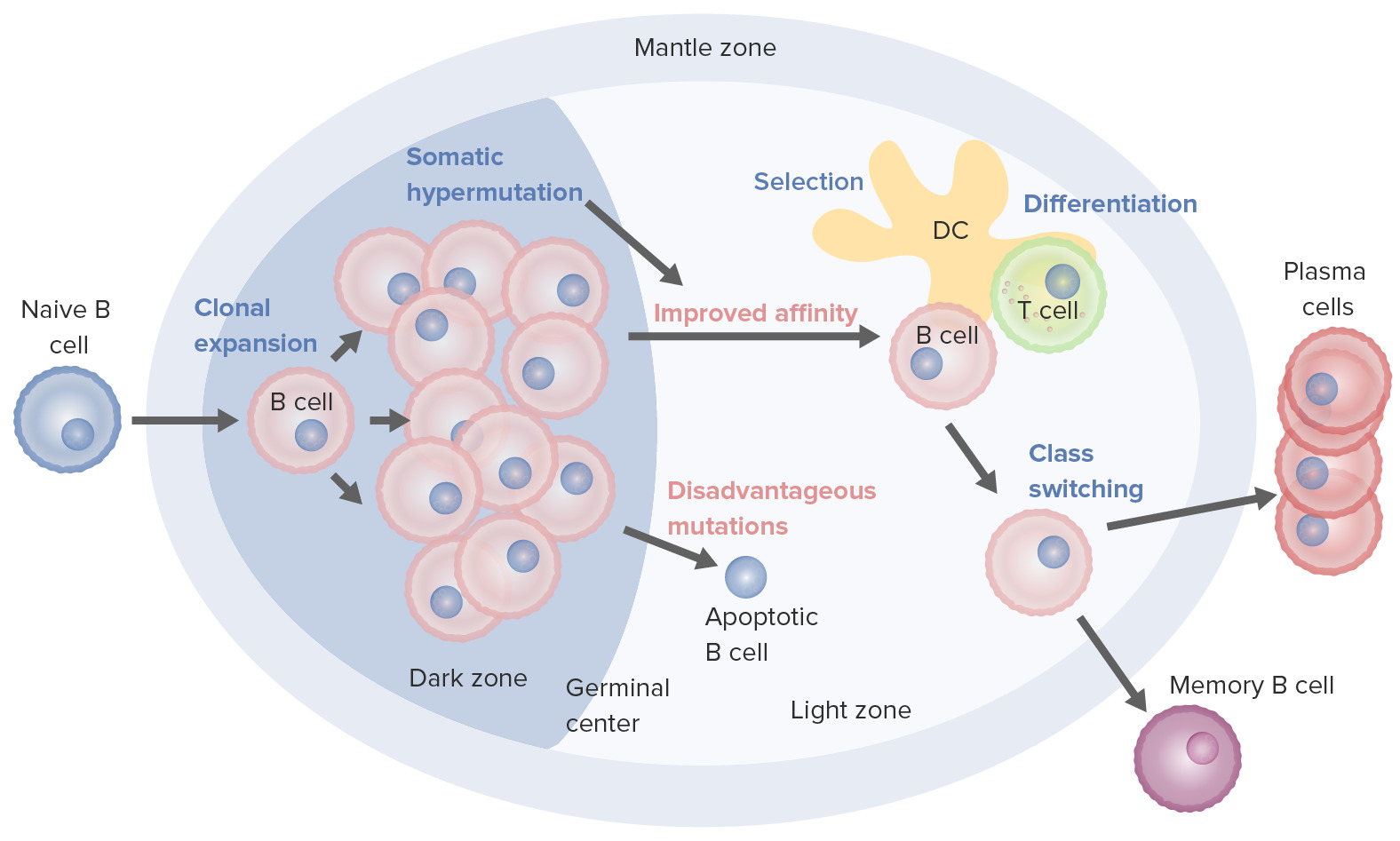
Monómeros e Polímeros

  • A unidade do anticorpo é uma pequena molécula (um monómero).
  • As imunoglobulinas IgA IgA Represents 15-20% of the human serum immunoglobulins, mostly as the 4-chain polymer in humans or dimer in other mammals. Secretory iga is the main immunoglobulin in secretions. Immunoglobulins: Types and Functions e IgM IgM A class of immunoglobulin bearing mu chains (immunoglobulin mu-chains). Igm can fix complement. The name comes from its high molecular weight and originally being called a macroglobulin. Immunoglobulins: Types and Functions formam polímeros de anticorpos (formados a partir de monómeros quimicamente ligados).
    • IgA IgA Represents 15-20% of the human serum immunoglobulins, mostly as the 4-chain polymer in humans or dimer in other mammals. Secretory iga is the main immunoglobulin in secretions. Immunoglobulins: Types and Functions:
      • Monómero semelhante à IgG IgG The major immunoglobulin isotype class in normal human serum. There are several isotype subclasses of igg, for example, igg1, igg2a, and igg2b. Hypersensitivity Pneumonitis
      • Nas secreções mucosas, a IgA IgA Represents 15-20% of the human serum immunoglobulins, mostly as the 4-chain polymer in humans or dimer in other mammals. Secretory iga is the main immunoglobulin in secretions. Immunoglobulins: Types and Functions secretada forma dímeros, 2 monómeros com a cadeia J (molécula estabilizadora) e um componente secretor.
    • IgM IgM A class of immunoglobulin bearing mu chains (immunoglobulin mu-chains). Igm can fix complement. The name comes from its high molecular weight and originally being called a macroglobulin. Immunoglobulins: Types and Functions:
      • Polímeros secretados de 5 anticorpos (pentâmero), unidos pela cadeia J
      • Possui 10 locais de ligação idênticos ao antigénio
      • A estrutura contribui para a eficiência do anticorpo, fixação do complemento e outras interações anticorpo-antigénio

Interação antigénio-anticorpo

  • A área do antigénio reconhecida pelo anticorpo corresponde ao epítopo.
    • Um antigénio pode ter vários epítopos.
    • Cada epítopo pode ser ligado por um anticorpo diferente.
  • O anticorpo liga-se ao antigénio de forma não covalente (reversível):
    • Ligações de hidrogénio
    • Interações eletrostáticas
    • Interações de Van der Waals
    • Interações hidrofóbicas
  • A afinidade é a força da ligação formada entre o local de ligação ao antigénio do anticorpo e o epítopo do antigénio (entre 2 moléculas).
  • A avidez é a força geral ou combinada das interações anticorpo-antigénio (já que o antigénio pode ter vários epítopos) e depende de:
    • Número de locais de ligação ao antigénio do anticorpo (valência do anticorpo)
    • Afinidade do antigénio aos locais de ligação
    • Arranjo estrutural de partes interativas do anticorpo-antigénio

Funções

Funções gerais

  • Neutralização de toxinas e infeciosidade de agentes patogénicos:
    • As toxinas bacterianas são neutralizadas e os seus efeitos são inativados.
    • Os anticorpos neutralizantes usam a porção Fab Fab Univalent antigen-binding fragments composed of one entire immunoglobulin light chain and the amino terminal end of one of the immunoglobulin heavy chains from the hinge region, linked to each other by disulfide bonds. Fab contains the immunoglobulin variable regions, which are part of the antigen-binding site, and the first immunoglobulin constant regions. This fragment can be obtained by digestion of immunoglobulins with the proteolytic enzyme papain. Immunoglobulins: Types and Functions (que forma uma ligação altamente específica nos locais ou recetores de fixação alvo) → impede a adesão do agente patogénico
    • Algumas Igs Igs Immunoglobulins (Igs), also known as antibodies, are glycoprotein molecules produced by plasma cells that act in immune responses by recognizing and binding particular antigens. The various ig classes are IgG (the most abundant), IgM, IgE, IgD, and IgA, which differ in their biologic features, structure, target specificity, and distribution. Immunoglobulins: Types and Functions fazem com que os microorganismos se agreguem ( IgA IgA Represents 15-20% of the human serum immunoglobulins, mostly as the 4-chain polymer in humans or dimer in other mammals. Secretory iga is the main immunoglobulin in secretions. Immunoglobulins: Types and Functions → aglutinação → aprisionamento no muco)
    • Após a fixação, pode ocorrer inibição da fusão com as membranas do hospedeiro.
  • Ativação do complemento e produção do complexo de ataque à membrana (MAC, pela sigla em inglês) levando à lise celular e inflamação
    • Os anticorpos (sobretudo IgM IgM A class of immunoglobulin bearing mu chains (immunoglobulin mu-chains). Igm can fix complement. The name comes from its high molecular weight and originally being called a macroglobulin. Immunoglobulins: Types and Functions e IgG IgG The major immunoglobulin isotype class in normal human serum. There are several isotype subclasses of igg, for example, igg1, igg2a, and igg2b. Hypersensitivity Pneumonitis) ativam o sistema complemento.
    • MAC:
      • Os componentes ativados do complemento são C5b, C6, C7, C8 e C9.
      • Introduz grandes poros na superfície do agente patogénico, provocando a sua morte
  • Opsonização (com ou sem complemento) para fagocitose
    • Envolve o revestimento de agentes patogénicos por moléculas que aumentam a fagocitose
    • Alguns anticorpos, sobretudo IgG IgG The major immunoglobulin isotype class in normal human serum. There are several isotype subclasses of igg, for example, igg1, igg2a, and igg2b. Hypersensitivity Pneumonitis, podem atuar como opsoninas (como C3b).
  • Citotoxicidade celular dependente de anticorpos ( ADCC ADCC The phenomenon of antibody-mediated target cell destruction by non-sensitized effector cells. The identity of the target cell varies, but it must possess surface immunoglobulin G whose Fc portion is intact. The effector cell is a ‘killer’ cell possessing Fc receptors. It may be a lymphocyte lacking conventional B- or T-cell markers, or a monocyte, macrophage, or polynuclear leukocyte, depending on the identity of the target cell. The reaction is complement-independent. Humoral Adaptive Immunity, pela sigla em inglês):
    • Envolve células imunes portadoras de Fc Fc Crystallizable fragments composed of the carboxy-terminal halves of both immunoglobulin heavy chains linked to each other by disulfide bonds. Fc fragments contain the carboxy-terminal parts of the heavy chain constant regions that are responsible for the effector functions of an immunoglobulin (complement fixation, binding to the cell membrane via fc receptors, and placental transport). This fragment can be obtained by digestion of immunoglobulins with the proteolytic enzyme papain. Immunoglobulins: Types and Functions (por exemplo, células natural killer) capazes de produzir moléculas tóxicas
    • Estas células são estimuladas através de recetores Fc Fc Crystallizable fragments composed of the carboxy-terminal halves of both immunoglobulin heavy chains linked to each other by disulfide bonds. Fc fragments contain the carboxy-terminal parts of the heavy chain constant regions that are responsible for the effector functions of an immunoglobulin (complement fixation, binding to the cell membrane via fc receptors, and placental transport). This fragment can be obtained by digestion of immunoglobulins with the proteolytic enzyme papain. Immunoglobulins: Types and Functions por Igs Igs Immunoglobulins (Igs), also known as antibodies, are glycoprotein molecules produced by plasma cells that act in immune responses by recognizing and binding particular antigens. The various ig classes are IgG (the most abundant), IgM, IgE, IgD, and IgA, which differ in their biologic features, structure, target specificity, and distribution. Immunoglobulins: Types and Functions (particularmente IgG IgG The major immunoglobulin isotype class in normal human serum. There are several isotype subclasses of igg, for example, igg1, igg2a, and igg2b. Hypersensitivity Pneumonitis).
    • A ativação da célula imune liberta moléculas tóxicas, causando a lise da célula alvo.
    • A IgE IgE An immunoglobulin associated with mast cells. Overexpression has been associated with allergic hypersensitivity. Immunoglobulins: Types and Functions também desencadeia ADCC ADCC The phenomenon of antibody-mediated target cell destruction by non-sensitized effector cells. The identity of the target cell varies, but it must possess surface immunoglobulin G whose Fc portion is intact. The effector cell is a ‘killer’ cell possessing Fc receptors. It may be a lymphocyte lacking conventional B- or T-cell markers, or a monocyte, macrophage, or polynuclear leukocyte, depending on the identity of the target cell. The reaction is complement-independent. Humoral Adaptive Immunity:
      • O eosinófilo (com o recetor Fc Fc Crystallizable fragments composed of the carboxy-terminal halves of both immunoglobulin heavy chains linked to each other by disulfide bonds. Fc fragments contain the carboxy-terminal parts of the heavy chain constant regions that are responsible for the effector functions of an immunoglobulin (complement fixation, binding to the cell membrane via fc receptors, and placental transport). This fragment can be obtained by digestion of immunoglobulins with the proteolytic enzyme papain. Immunoglobulins: Types and Functions) reconhece a IgE IgE An immunoglobulin associated with mast cells. Overexpression has been associated with allergic hypersensitivity. Immunoglobulins: Types and Functions.
      • A IgE IgE An immunoglobulin associated with mast cells. Overexpression has been associated with allergic hypersensitivity. Immunoglobulins: Types and Functions ligada a helmintas estimula a desgranulação de eosinófilos e os grânulos citotóxicos matam os parasitas que são grandes demais para serem fagocitados.
  • Depuração de complexos imunes:
    • Os complexos antigénio-anticorpo ativam o sistema complemento:
      • As regiões Fc Fc Crystallizable fragments composed of the carboxy-terminal halves of both immunoglobulin heavy chains linked to each other by disulfide bonds. Fc fragments contain the carboxy-terminal parts of the heavy chain constant regions that are responsible for the effector functions of an immunoglobulin (complement fixation, binding to the cell membrane via fc receptors, and placental transport). This fragment can be obtained by digestion of immunoglobulins with the proteolytic enzyme papain. Immunoglobulins: Types and Functions do anticorpo em IgM IgM A class of immunoglobulin bearing mu chains (immunoglobulin mu-chains). Igm can fix complement. The name comes from its high molecular weight and originally being called a macroglobulin. Immunoglobulins: Types and Functions e IgG IgG The major immunoglobulin isotype class in normal human serum. There are several isotype subclasses of igg, for example, igg1, igg2a, and igg2b. Hypersensitivity Pneumonitis ligam-se a C1q.
      • Os complexos imunes são opsonizados com fragmentos C3b.
    • Os complexos imunes, que contêm fragmentos C3b, ligam-se ao recetor 1 do complemento (CR1) nos eritrócitos.
    • Os eritrócitos levam os complexos imunes para o fígado e baço, onde são fagocitado pelos macrófagos.

Funções das diferentes classes de Ig Ig X-linked Agammaglobulinemia

  • IgG IgG The major immunoglobulin isotype class in normal human serum. There are several isotype subclasses of igg, for example, igg1, igg2a, and igg2b. Hypersensitivity Pneumonitis:
    • Anticorpo principal na resposta imune secundária
    • As suas funções dependem da subclasse, mas, no geral:
      • Fixa o complemento
      • Participa no ADCC ADCC The phenomenon of antibody-mediated target cell destruction by non-sensitized effector cells. The identity of the target cell varies, but it must possess surface immunoglobulin G whose Fc portion is intact. The effector cell is a ‘killer’ cell possessing Fc receptors. It may be a lymphocyte lacking conventional B- or T-cell markers, or a monocyte, macrophage, or polynuclear leukocyte, depending on the identity of the target cell. The reaction is complement-independent. Humoral Adaptive Immunity (ligação de recetores Fc Fc Crystallizable fragments composed of the carboxy-terminal halves of both immunoglobulin heavy chains linked to each other by disulfide bonds. Fc fragments contain the carboxy-terminal parts of the heavy chain constant regions that are responsible for the effector functions of an immunoglobulin (complement fixation, binding to the cell membrane via fc receptors, and placental transport). This fragment can be obtained by digestion of immunoglobulins with the proteolytic enzyme papain. Immunoglobulins: Types and Functions)
      • Aumenta a fagocitose (opsonina)
    • Capacidade de atravessar a placenta Placenta A highly vascularized mammalian fetal-maternal organ and major site of transport of oxygen, nutrients, and fetal waste products. It includes a fetal portion (chorionic villi) derived from trophoblasts and a maternal portion (decidua) derived from the uterine endometrium. The placenta produces an array of steroid, protein and peptide hormones (placental hormones). Placenta, Umbilical Cord, and Amniotic Cavity, mediado por recetores nas células placentárias para IgG IgG The major immunoglobulin isotype class in normal human serum. There are several isotype subclasses of igg, for example, igg1, igg2a, and igg2b. Hypersensitivity Pneumonitis Fc Fc Crystallizable fragments composed of the carboxy-terminal halves of both immunoglobulin heavy chains linked to each other by disulfide bonds. Fc fragments contain the carboxy-terminal parts of the heavy chain constant regions that are responsible for the effector functions of an immunoglobulin (complement fixation, binding to the cell membrane via fc receptors, and placental transport). This fragment can be obtained by digestion of immunoglobulins with the proteolytic enzyme papain. Immunoglobulins: Types and Functions.
      • Os anticorpos IgG IgG The major immunoglobulin isotype class in normal human serum. There are several isotype subclasses of igg, for example, igg1, igg2a, and igg2b. Hypersensitivity Pneumonitis produzidos na mãe contra agentes patogénicos passam para o feto.
      • Os níveis de IgG IgG The major immunoglobulin isotype class in normal human serum. There are several isotype subclasses of igg, for example, igg1, igg2a, and igg2b. Hypersensitivity Pneumonitis materna nos recém-nascidos diminuem 6-12 meses após o nascimento.
  • IgM IgM A class of immunoglobulin bearing mu chains (immunoglobulin mu-chains). Igm can fix complement. The name comes from its high molecular weight and originally being called a macroglobulin. Immunoglobulins: Types and Functions
    • A forma de monómero atua como um recetor de células B (BCR) em células B “naive”.
    • Facilita a ativação das células B, ligando-se às células T auxiliares
    • Produzida na resposta imune primária
    • Fixa o complemento, levando à lise dos microorganismos
    • Aglutinina: pode aglutinar agentes patogénicos, facilitando assim a sua eliminação
  • IgA IgA Represents 15-20% of the human serum immunoglobulins, mostly as the 4-chain polymer in humans or dimer in other mammals. Secretory iga is the main immunoglobulin in secretions. Immunoglobulins: Types and Functions:
    • A IgA IgA Represents 15-20% of the human serum immunoglobulins, mostly as the 4-chain polymer in humans or dimer in other mammals. Secretory iga is the main immunoglobulin in secretions. Immunoglobulins: Types and Functions apresenta uma componente secretora, que permite o seu transporte através de membranas mucosas.
    • A forma secretora (dímero) previne a colonização bacteriana das superfícies mucosas.
    • Principal Ig Ig X-linked Agammaglobulinemia nas secreções: lágrimas, saliva Saliva The clear, viscous fluid secreted by the salivary glands and mucous glands of the mouth. It contains mucins, water, organic salts, and ptyalin. Salivary Glands: Anatomy, colostro/leite materno e muco
  • IgE IgE An immunoglobulin associated with mast cells. Overexpression has been associated with allergic hypersensitivity. Immunoglobulins: Types and Functions:
    • A ligação do alergénio à IgE IgE An immunoglobulin associated with mast cells. Overexpression has been associated with allergic hypersensitivity. Immunoglobulins: Types and Functions desencadeia a libertação de mediadores inflamatórios dos mastócitos e basófilos (resposta alérgica)
    • Importante na eliminação de parasitas (os eosinófilos ligam-se aos helmintas revestidos de IgE IgE An immunoglobulin associated with mast cells. Overexpression has been associated with allergic hypersensitivity. Immunoglobulins: Types and Functions, levando à morte do parasita)
  • IgD IgD An immunoglobulin which accounts for less than 1% of plasma immunoglobulin. It is found on the membrane of many circulating B lymphocytes. Immunoglobulins: Types and Functions:
    • Juntamente com IgM, constitui o BCR das células B “naive”

Relevância Clínica

  • Agamaglobulinemia ligada ao X: resulta de mutações no gene Gene A category of nucleic acid sequences that function as units of heredity and which code for the basic instructions for the development, reproduction, and maintenance of organisms. Basic Terms of Genetics do cromossoma X que codifica a tirosina quinase de Bruton (BTK, pela sigla em inglês), essencial para o desenvolvimento e maturação das células B. A doença é caracterizada pela ausência de células B e consequentes infeções recorrentes, sobretudo por bactérias e vírus encapsulados, envolvendo os pulmões, seios da face e pele, e também SNC. O tratamento envolve a administração de imunoglobulina.
  • Imunodeficiência comum variável (ICV): caracterizada por células B fenotipicamente normais que não conseguem produzir anticorpos. A imunodeficiência comum variável pode estar associada a vários defeitos moleculares que afetam a produção de anticorpos. A doença manifesta-se em adultos com infeções sinopulmonares recorrentes. O tratamento envolve terapêutica de reposição de imunoglobulinas.
  • Síndrome de hiper-IgM: grupo heterogéneo de patologias de herança genética ligada ao X ou autossómica recessiva. As formas ligadas ao X são caracterizadas por células T auxiliares defeituosas que não podem ativar as células B para efetuar a recombinação de troca de classe. Como resultado, as células B produzem apenas IgM IgM A class of immunoglobulin bearing mu chains (immunoglobulin mu-chains). Igm can fix complement. The name comes from its high molecular weight and originally being called a macroglobulin. Immunoglobulins: Types and Functions. Os pacientes apresentam neutropenia Neutropenia Neutrophils are an important component of the immune system and play a significant role in the eradication of infections. Low numbers of circulating neutrophils, referred to as neutropenia, predispose the body to recurrent infections or sepsis, though patients can also be asymptomatic. Neutropenia e infeções sinopulmonares recorrentes desde a infância e estão mais MAIS Androgen Insensitivity Syndrome suscetíveis a pneumonia Pneumonia Pneumonia or pulmonary inflammation is an acute or chronic inflammation of lung tissue. Causes include infection with bacteria, viruses, or fungi. In more rare cases, pneumonia can also be caused through toxic triggers through inhalation of toxic substances, immunological processes, or in the course of radiotherapy. Pneumonia por Pneumocystis jiroveci Pneumocystis jiroveci Pneumocystis jiroveci is a yeast-like fungus causing pneumocystis pneumonia (PCP) in immunocompromised patients. Pneumocystis pneumonia is spread through airborne transmission and classically affects patients with AIDS, functioning as an AIDS-defining illness. Patients may present with insidious onset of fever, chills, dry cough, chest pain, and shortness of breath. Pneumocystis jirovecii/Pneumocystis Pneumonia (PCP) e infeções por Cryptosporidium Cryptosporidium A genus of coccidian parasites of the family cryptosporidiidae, found in the intestinal epithelium of many vertebrates including humans. Hyper-IgM Syndrome. As formas autossómicas recessivas são caracterizadas por níveis de IgM IgM A class of immunoglobulin bearing mu chains (immunoglobulin mu-chains). Igm can fix complement. The name comes from its high molecular weight and originally being called a macroglobulin. Immunoglobulins: Types and Functions muito mais MAIS Androgen Insensitivity Syndrome elevados, estando os indivíduos mais MAIS Androgen Insensitivity Syndrome predispostos ao desenvolvimento de linfomas de células B e a autoimunidade. A síndrome de hiper-IgM pode ainda estar associada à síndrome da rubéola congénita e a fármacos como a fenitoína. O tratamento inclui terapêutica de reposição de imunoglobulina e antibioterapia profilática.
  • Défice de IgA IgA Represents 15-20% of the human serum immunoglobulins, mostly as the 4-chain polymer in humans or dimer in other mammals. Secretory iga is the main immunoglobulin in secretions. Immunoglobulins: Types and Functions: caracterizada por baixos níveis de IgA IgA Represents 15-20% of the human serum immunoglobulins, mostly as the 4-chain polymer in humans or dimer in other mammals. Secretory iga is the main immunoglobulin in secretions. Immunoglobulins: Types and Functions com níveis normais de IgG IgG The major immunoglobulin isotype class in normal human serum. There are several isotype subclasses of igg, for example, igg1, igg2a, and igg2b. Hypersensitivity Pneumonitis e IgM IgM A class of immunoglobulin bearing mu chains (immunoglobulin mu-chains). Igm can fix complement. The name comes from its high molecular weight and originally being called a macroglobulin. Immunoglobulins: Types and Functions. O défice de IgA IgA Represents 15-20% of the human serum immunoglobulins, mostly as the 4-chain polymer in humans or dimer in other mammals. Secretory iga is the main immunoglobulin in secretions. Immunoglobulins: Types and Functions é a imunodeficiência primária mais MAIS Androgen Insensitivity Syndrome comum. A maioria dos indivíduos é assintomática; contudo, existe risco de infeções recorrentes, assim como predisposição para doenças autoimunes. Os indivíduos podem estar mais MAIS Androgen Insensitivity Syndrome propensos a reações transfusionais anafiláticas devido à presença de IgA IgA Represents 15-20% of the human serum immunoglobulins, mostly as the 4-chain polymer in humans or dimer in other mammals. Secretory iga is the main immunoglobulin in secretions. Immunoglobulins: Types and Functions nos produtos sanguíneos. Alguns destes casos podem evoluir para ICV. O tratamento envolve antibioterapia profilática e evicção de produtos sanguíneos que contenham IgA IgA Represents 15-20% of the human serum immunoglobulins, mostly as the 4-chain polymer in humans or dimer in other mammals. Secretory iga is the main immunoglobulin in secretions. Immunoglobulins: Types and Functions.

Referências

  1. Forthal, D.N. (2014). Functions of antibodies. Microbiology Spectrum 2(4):1–17. https://www.ncbi.nlm.nih.gov/pmc/articles/PMC4159104
  2. Patel, P., Jamal, Z., & Ramphul, K. (2023). Immunoglobulin. In StatPearls. StatPearls Publishing. Retrieved on October 28, 2025, from https://www.ncbi.nlm.nih.gov/books/NBK513460/
  3. Matthews, A.J., Zheng, S., DiMenna, L.J., Chaudhuri, J. (2014). Regulation of immunoglobulin class-switch recombination: choreography of noncoding transcription, targeted DNA deamination, and long-range DNA repair. Advances in Immunology 122:1–57. https://doi.org/10.1016/B978-0-12-800267-4.00001-8
  4. Riedel, S., Hobden, J.A., Miller, S., Morse, S.A., Mietzner, T.A., Detrick, B., Mitchell, T.G., Sakanari, J.A., Hotez, P., Mejia, R. (Eds.). (2019). Immunology. Chapter 8 of Jawetz, Melnick, & Adelberg’s Medical Microbiology, 28th ed. McGraw-Hill. https://accessmedicine.mhmedical.com/content.aspx?bookid=2629&sectionid=217769996
  5. Schroeder, H.W., Jr., Cavacini, L. (2010). Structure and function of immunoglobulins. Journal of Allergy and Clinical Immunology 125(2 Suppl 2):S41–S52. https://doi.org/10.1016/j.jaci.2009.09.046

Crie sua conta gratuita ou faça login para continuar lendo!

Cadastre-se agora e tenha acesso grátis ao Lecturio, com páginas de conceitos, vídeos de medicina e questões para sua educação médica.

Aprende mais com a Lecturio:

Multiple devices displaying human anatomy and health education content.

Complementa o teu estudo da faculdade com o companheiro de estudo tudo-em-um da Lecturio, através de métodos de ensino baseados em evidência.

Estuda onde quiseres

Two iPhones display medical education apps, one showing anatomy, the other Bookmatcher.

A Lecturio Medical complementa o teu estudo através de métodos de ensino baseados em evidência, vídeos de palestras, perguntas e muito mais – tudo combinado num só lugar e fácil de usar.

User Reviews

Have a holly, jolly study session 🎁 Save 50% on all plans now >>

Que tengas una sesión de estudio alegre y navideña 🎁 Ahorra 50% en todos los planes >>

Details