
Domina Conceptos Médicos

Estudia para la escuela de medicina y tus examenes con Lecturio.

Síndrome Antifosfolípido

El síndrome antifosfolípido (SAF) es un trastorno autoinmune adquirido caracterizado por la presencia persistente de anticuerpos antifosfolípidos, que crean un estado de hipercoagulabilidad. Estos anticuerpos se descubren con mayor frecuencia durante el estudio de un evento trombótico o en EN Erythema nodosum is an immune-mediated panniculitis (inflammation of the subcutaneous fat) caused by a type IV (delayed-type) hypersensitivity reaction. It commonly manifests in young women as tender, erythematous nodules on the shins. Erythema Nodosum pérdida recurrente gestacional, que son las dos manifestaciones clínicas más comunes del SAF. Los LOS Neisseria pacientes con SAF corren el riesgo de sufrir trombosis arterial y venosa, y luego de un evento trombótico, los LOS Neisseria pacientes son tratados con terapia anticoagulante a largo plazo.

Last updated: Dec 15, 2025

Editorial responsibility: Stanley Oiseth, Lindsay Jones, Evelin Maza

Descripción General

Definición

El síndrome antifosfolípido (SAF) es un fenómeno autoinmune que se presenta con eventos trombóticos y/o resultados adversos en EN Erythema nodosum is an immune-mediated panniculitis (inflammation of the subcutaneous fat) caused by a type IV (delayed-type) hypersensitivity reaction. It commonly manifests in young women as tender, erythematous nodules on the shins. Erythema Nodosum el embarazo relacionados con la presencia de anticuerpos antifosfolípidos ( aPL APL An acute myeloid leukemia in which abnormal promyelocytes predominate. It is frequently associated with disseminated intravascular coagulation. Acute Myeloid Leukemia, por sus siglas en EN Erythema nodosum is an immune-mediated panniculitis (inflammation of the subcutaneous fat) caused by a type IV (delayed-type) hypersensitivity reaction. It commonly manifests in young women as tender, erythematous nodules on the shins. Erythema Nodosum inglés) persistentes, que producen un estado hipercoagulable.

  • aPL APL An acute myeloid leukemia in which abnormal promyelocytes predominate. It is frequently associated with disseminated intravascular coagulation. Acute Myeloid Leukemia: autoanticuerpos dirigidos contra proteínas de unión a fosfolípidos
  • SAF primario: SAF que se produce debido a aPLs APLS Antiphospholipid syndrome (APLS) is an acquired autoimmune disorder characterized by the persistent presence of antiphospholipid antibodies, which create a hypercoagulable state. These antibodies are most commonly discovered during a workup for a thrombotic event or recurrent pregnancy loss, which are the 2 most common clinical manifestations. Antiphospholipid Syndrome aislados
  • SAF secundario: SAF que se produce en EN Erythema nodosum is an immune-mediated panniculitis (inflammation of the subcutaneous fat) caused by a type IV (delayed-type) hypersensitivity reaction. It commonly manifests in young women as tender, erythematous nodules on the shins. Erythema Nodosum el marco de una enfermedad autoinmune sistémica subyacente

Epidemiología

En EN Erythema nodosum is an immune-mediated panniculitis (inflammation of the subcutaneous fat) caused by a type IV (delayed-type) hypersensitivity reaction. It commonly manifests in young women as tender, erythematous nodules on the shins. Erythema Nodosum Estados Unidos:

  • Incidencia: aproximadamente 5 casos por cada 100 000 personas al AL Amyloidosis año
  • Prevalencia: aproximadamente 50 casos por cada 100 000 personas
  • Edad típica afectada: adultos jóvenes y de mediana edad
  • Sesgo de género: mujeres > hombres
  • Asociado a los LOS Neisseria aPL APL An acute myeloid leukemia in which abnormal promyelocytes predominate. It is frequently associated with disseminated intravascular coagulation. Acute Myeloid Leukemia:
    • 6%–9% de las pérdidas de embarazos (50 000 anuales)
    • 14% de los LOS Neisseria accidentes cerebrovasculares (110 000 anuales)
    • 11% de los LOS Neisseria infartos de miocardio (100 000 anuales)
    • 10% de las trombosis venosas profundas (30 000 anuales)

Clasificación

Los LOS Neisseria pacientes con SAF se clasifican en EN Erythema nodosum is an immune-mediated panniculitis (inflammation of the subcutaneous fat) caused by a type IV (delayed-type) hypersensitivity reaction. It commonly manifests in young women as tender, erythematous nodules on the shins. Erythema Nodosum función de sus manifestaciones clínicas.

Tabla: Clasificación del SAF
Clasificación Los LOS Neisseria pacientes presentan:
SAF trombótico Trombosis arterial o venosa
SAF obstétrico Complicaciones obstétricas:
  • Pérdida recurrente de embarazos
  • Parto prematuro asociado a insuficiencia placentaria
SAF catastrófico Eventos tromboembólicos que ponen en EN Erythema nodosum is an immune-mediated panniculitis (inflammation of the subcutaneous fat) caused by a type IV (delayed-type) hypersensitivity reaction. It commonly manifests in young women as tender, erythematous nodules on the shins. Erythema Nodosum peligro la vida y que provocan múltiples daños en EN Erythema nodosum is an immune-mediated panniculitis (inflammation of the subcutaneous fat) caused by a type IV (delayed-type) hypersensitivity reaction. It commonly manifests in young women as tender, erythematous nodules on the shins. Erythema Nodosum los LOS Neisseria órganos diana (por lo general, enfermedad microvascular de aparición aguda)

Etiología y Fisiopatología

El estado protrombótico del SAF está relacionado con la presencia de aPL APL An acute myeloid leukemia in which abnormal promyelocytes predominate. It is frequently associated with disseminated intravascular coagulation. Acute Myeloid Leukemia.

Etiología

  • Primaria (50%):
    • Predisposición genética a desarrollar anticuerpos
    • Debido a mutaciones en EN Erythema nodosum is an immune-mediated panniculitis (inflammation of the subcutaneous fat) caused by a type IV (delayed-type) hypersensitivity reaction. It commonly manifests in young women as tender, erythematous nodules on the shins. Erythema Nodosum HLA-DR7, DR4, DQw7, y/o C4
  • Secundaria (50%):
    • Lupus eritematoso sistémico (LES) (el más común, 35%)
    • Artritis reumatoide ( AR AR Aortic regurgitation (AR) is a cardiac condition characterized by the backflow of blood from the aorta to the left ventricle during diastole. Aortic regurgitation is associated with an abnormal aortic valve and/or aortic root stemming from multiple causes, commonly rheumatic heart disease as well as congenital and degenerative valvular disorders. Aortic Regurgitation)
    • Síndrome de Sjögren ( SS SS Scleroderma (systemic sclerosis) is an autoimmune condition characterized by diffuse collagen deposition and fibrosis. The clinical presentation varies from limited skin involvement to diffuse involvement of internal organs. Scleroderma)
    • Púrpura trombocitopénica inmune (PTI)
    • VIH
    • Virus Virus Viruses are infectious, obligate intracellular parasites composed of a nucleic acid core surrounded by a protein capsid. Viruses can be either naked (non-enveloped) or enveloped. The classification of viruses is complex and based on many factors, including type and structure of the nucleoid and capsid, the presence of an envelope, the replication cycle, and the host range. Virology de la hepatitis C Hepatitis C Hepatitis C is an infection of the liver caused by the hepatitis C virus (HCV). The infection can be transmitted through infectious blood or body fluids and may be transmitted during childbirth or through IV drug use or sexual intercourse. Hepatitis C virus can cause both acute and chronic hepatitis, ranging from a mild to a serious, lifelong illness including liver cirrhosis and hepatocellular carcinoma (HCC). Hepatitis C Virus (VHC)

Fisiopatología

  • Anticuerpos contra las proteínas de unión a fosfolípidos:
    • Anticardiolipina
    • Anti-β2-glicoproteína I
    • Anticoagulante lúpico
  • Los LOS Neisseria anticuerpos dan lugar a:
    • Activación de células inflamatorias, células endoteliales y plaquetas, favoreciendo la trombosis
    • Inactivación de los LOS Neisseria factores anticoagulantes (proteínas C y S), favoreciendo la trombosis
    • Aumento de la actividad del complemento hacia los LOS Neisseria trofoblastos, lo que provoca la pérdida recurrente de embarazos
  • Los LOS Neisseria aPL APL An acute myeloid leukemia in which abnormal promyelocytes predominate. It is frequently associated with disseminated intravascular coagulation. Acute Myeloid Leukemia transitorios son comunes, especialmente después de una enfermedad aguda.
    • El diagnóstico del SAF requiere la persistencia de los LOS Neisseria anticuerpos.

Presentación Clínica

El síndrome antifosfolípido tiende a presentarse en EN Erythema nodosum is an immune-mediated panniculitis (inflammation of the subcutaneous fat) caused by a type IV (delayed-type) hypersensitivity reaction. It commonly manifests in young women as tender, erythematous nodules on the shins. Erythema Nodosum mujeres jóvenes o de mediana edad con eventos tromboembólicos y/o complicaciones del embarazo. Pueden estar presentes otras afecciones autoinmunes.

Presentaciones tromboembólicas

  • Trombosis venosa profunda (TVP):
    • TVP de las extremidades inferiores (TVP más común):
      • Inflamación y/o dolor Dolor Inflammation unilateral en EN Erythema nodosum is an immune-mediated panniculitis (inflammation of the subcutaneous fat) caused by a type IV (delayed-type) hypersensitivity reaction. It commonly manifests in young women as tender, erythematous nodules on the shins. Erythema Nodosum la extremidad
      • Dolor Dolor Inflammation con la dorsiflexión del pie
    • TVP de las extremidades superiores
    • Embolismo pulmonar ( EP EP Ectopic pregnancy refers to the implantation of a fertilized egg (embryo) outside the uterine cavity. The main cause is disruption of the normal anatomy of the fallopian tube. Ectopic Pregnancy):
      • Disnea
      • Dificultad respiratoria aguda
      • Hipertensión pulmonar
    • Trombosis del seno cerebral
    • Trombosis hepática y de la vena porta
    • Trombosis de la vena renal
    • Trombosis de la vena suprarrenal
  • Trombosis venosa superficial
  • Trombosis arterial:
    • Accidente cerebrovascular (trombosis arterial más común) y accidentes isquémicos transitorios ( TIA TIA Transient ischemic attack (TIA) is a temporary episode of neurologic dysfunction caused by ischemia without infarction that resolves completely when blood supply is restored. Transient ischemic attack is a neurologic emergency that warrants urgent medical attention. Transient Ischemic Attack (TIA), por sus siglas en EN Erythema nodosum is an immune-mediated panniculitis (inflammation of the subcutaneous fat) caused by a type IV (delayed-type) hypersensitivity reaction. It commonly manifests in young women as tender, erythematous nodules on the shins. Erythema Nodosum inglés):
      • Hallazgos neurológicos focales
      • Déficits cognitivos
    • Infarto de miocardio (IM):
    • Trombosis de la retina Retina The ten-layered nervous tissue membrane of the eye. It is continuous with the optic nerve and receives images of external objects and transmits visual impulses to the brain. Its outer surface is in contact with the choroid and the inner surface with the vitreous body. The outermost layer is pigmented, whereas the inner nine layers are transparent. Eye: Anatomy
    • Nefropatía por vaso-oclusión en EN Erythema nodosum is an immune-mediated panniculitis (inflammation of the subcutaneous fat) caused by a type IV (delayed-type) hypersensitivity reaction. It commonly manifests in young women as tender, erythematous nodules on the shins. Erythema Nodosum los LOS Neisseria pequeños vasos renales:
  • Eventos tromboembólicos recurrentes

Presentaciones obstétricas

  • Abortos recurrentes
  • Parto prematuro de un lactante anatómicamente normal < 34 semanas de gestación debido a:
    • Preeclampsia Preeclampsia A complication of pregnancy, characterized by a complex of symptoms including maternal hypertension and proteinuria with or without pathological edema. Symptoms may range between mild and severe. Pre-eclampsia usually occurs after the 20th week of gestation, but may develop before this time in the presence of trophoblastic disease. Hypertensive Pregnancy Disorders severa o eclampsia Eclampsia Onset of hyperreflexia; seizures; or coma in a previously diagnosed pre-eclamptic patient (pre-eclampsia). Hypertensive Pregnancy Disorders
    • Características consistentes con insuficiencia placentaria:
      • Oligohidramnios (poco líquido amniótico)
      • Bajo peso al AL Amyloidosis nacer
      • Pruebas de vigilancia fetal no alentadoras o anormales (e.g., pruebas sin estrés, perfil biofísico, estudios doppler Doppler Ultrasonography applying the doppler effect, with frequency-shifted ultrasound reflections produced by moving targets (usually red blood cells) in the bloodstream along the ultrasound axis in direct proportion to the velocity of movement of the targets, to determine both direction and velocity of blood flow. Ultrasound (Sonography))

Otros hallazgos:

Algunos hallazgos adicionales pueden incluir:
  • Hallazgos hematológicos:
    • Trombocitopenia
    • Anemia Anemia Anemia is a condition in which individuals have low Hb levels, which can arise from various causes. Anemia is accompanied by a reduced number of RBCs and may manifest with fatigue, shortness of breath, pallor, and weakness. Subtypes are classified by the size of RBCs, chronicity, and etiology. Anemia: Overview and Types hemolítica autoinmune (AHAI)
    • Anemia Anemia Anemia is a condition in which individuals have low Hb levels, which can arise from various causes. Anemia is accompanied by a reduced number of RBCs and may manifest with fatigue, shortness of breath, pallor, and weakness. Subtypes are classified by the size of RBCs, chronicity, and etiology. Anemia: Overview and Types microangiopática trombótica
  • Hallazgos cardíacos: si están presentes, casi siempre involucran a las válvulas
    • Soplos en EN Erythema nodosum is an immune-mediated panniculitis (inflammation of the subcutaneous fat) caused by a type IV (delayed-type) hypersensitivity reaction. It commonly manifests in young women as tender, erythematous nodules on the shins. Erythema Nodosum el examen:
      • La mayoría de las veces afecta a las válvulas mitral y aórtica
      • Puede provocar regurgitación y, con menor frecuencia, estenosis
    • Engrosamiento de las valvas de la válvula
    • Nódulos/vegetaciones no bacterianas ( endocarditis Endocarditis Endocarditis is an inflammatory disease involving the inner lining (endometrium) of the heart, most commonly affecting the cardiac valves. Both infectious and noninfectious etiologies lead to vegetations on the valve leaflets. Patients may present with nonspecific symptoms such as fever and fatigue. Endocarditis de Libman-Sacks)
  • Hallazgos dermatológicos:
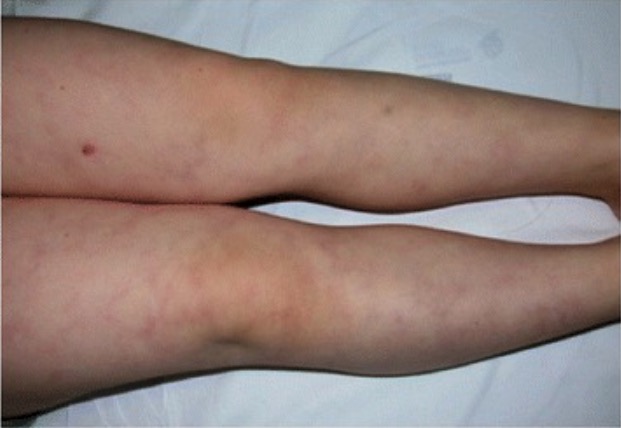
    • Livedo reticularis Livedo reticularis A condition characterized by a reticular or fishnet pattern on the skin of lower extremities and other parts of the body. This red and blue pattern is due to deoxygenated blood in unstable dermal blood vessels. The condition is intensified by cold exposure and relieved by rewarming. Chronic Kidney Disease: un patrón reticular de color rojo-azulado que se produce debido a un compromiso del flujo sanguíneo en EN Erythema nodosum is an immune-mediated panniculitis (inflammation of the subcutaneous fat) caused by a type IV (delayed-type) hypersensitivity reaction. It commonly manifests in young women as tender, erythematous nodules on the shins. Erythema Nodosum los LOS Neisseria vasos de tamaño medio
    • Ulceración y/o gangrena de los LOS Neisseria dedos
    • Hemorragias en EN Erythema nodosum is an immune-mediated panniculitis (inflammation of the subcutaneous fat) caused by a type IV (delayed-type) hypersensitivity reaction. It commonly manifests in young women as tender, erythematous nodules on the shins. Erythema Nodosum astilla
  • Hallazgos reumatológicos: consistentes con un trastorno reumatológico asociado
    • Erupciones
    • Artralgias
    • Fatiga
Livedo reticularis

Livedo reticularis

Imagen: “Livedo reticularis in a patient with DADA2” por Roberta Caorsi et al. Licencia: CC BY 4.0

Diagnóstico

Criterios diagnósticos

Para cumplir con los LOS Neisseria criterios de diagnóstico del SAF, un paciente debe cumplir tanto los LOS Neisseria criterios clínicos como los LOS Neisseria de laboratorio.

Tabla: Criterios de diagnóstico del SAF
Criterios Eventos que cumplen los LOS Neisseria criterios
Criterios clínicos Necesita tener antecedente de al AL Amyloidosis menos uno de los LOS Neisseria siguientes:
  • Trombosis vascular:
    • ≥ 1 trombosis venosa profunda, arterial o de pequeños vasos en EN Erythema nodosum is an immune-mediated panniculitis (inflammation of the subcutaneous fat) caused by a type IV (delayed-type) hypersensitivity reaction. It commonly manifests in young women as tender, erythematous nodules on the shins. Erythema Nodosum cualquier órgano o tejido
    • La trombosis venosa superficial no cumple este criterio.
  • Morbilidad en EN Erythema nodosum is an immune-mediated panniculitis (inflammation of the subcutaneous fat) caused by a type IV (delayed-type) hypersensitivity reaction. It commonly manifests in young women as tender, erythematous nodules on the shins. Erythema Nodosum el embarazo:
    • ≥ 3 pérdidas de embarazo consecutivas y espontáneas a < 10 semanas de edad gestacional (SEG)
    • ≥ 1 pérdida de embarazo de un feto morfológicamente normal ≥ 10 SEG
    • ≥ 1 parto prematuro a < 34 SEG debido a preeclampsia Preeclampsia A complication of pregnancy, characterized by a complex of symptoms including maternal hypertension and proteinuria with or without pathological edema. Symptoms may range between mild and severe. Pre-eclampsia usually occurs after the 20th week of gestation, but may develop before this time in the presence of trophoblastic disease. Hypertensive Pregnancy Disorders/ eclampsia Eclampsia Onset of hyperreflexia; seizures; or coma in a previously diagnosed pre-eclamptic patient (pre-eclampsia). Hypertensive Pregnancy Disorders grave, o insuficiencia placentaria.
Criterios de laboratorio Necesita al AL Amyloidosis menos un hallazgo positivo de anticuerpos, en EN Erythema nodosum is an immune-mediated panniculitis (inflammation of the subcutaneous fat) caused by a type IV (delayed-type) hypersensitivity reaction. It commonly manifests in young women as tender, erythematous nodules on the shins. Erythema Nodosum al AL Amyloidosis menos 2 ocasiones distintas, con al AL Amyloidosis menos 12 semanas de diferencia:
  • Anticoagulante lúpico (positivo = presente)
  • Anticuerpos anticardiolipina (positivos = títulos ↑ de inmunoglobulina G ( IgG IgG The major immunoglobulin isotype class in normal human serum. There are several isotype subclasses of igg, for example, igg1, igg2a, and igg2b. Hypersensitivity Pneumonitis) y/o inmunoglobulina M ( IgM IgM A class of immunoglobulin bearing mu chains (immunoglobulin mu-chains). Igm can fix complement. The name comes from its high molecular weight and originally being called a macroglobulin. Immunoglobulins: Types and Functions))
  • Anticuerpos contra la β2-glicoproteína-I (positivo = títulos ↑ IgG IgG The major immunoglobulin isotype class in normal human serum. There are several isotype subclasses of igg, for example, igg1, igg2a, and igg2b. Hypersensitivity Pneumonitis y/o IgM IgM A class of immunoglobulin bearing mu chains (immunoglobulin mu-chains). Igm can fix complement. The name comes from its high molecular weight and originally being called a macroglobulin. Immunoglobulins: Types and Functions)

Evaluación en EN Erythema nodosum is an immune-mediated panniculitis (inflammation of the subcutaneous fat) caused by a type IV (delayed-type) hypersensitivity reaction. It commonly manifests in young women as tender, erythematous nodules on the shins. Erythema Nodosum el laboratorio

  • Serologías y niveles de títulos para aPL APL An acute myeloid leukemia in which abnormal promyelocytes predominate. It is frequently associated with disseminated intravascular coagulation. Acute Myeloid Leukemia:
    • Anticuerpos anticardiolipina:
      • Nota: Los LOS Neisseria anticuerpos anticardiolipina pueden dar lugar a un falso positivo en EN Erythema nodosum is an immune-mediated panniculitis (inflammation of the subcutaneous fat) caused by a type IV (delayed-type) hypersensitivity reaction. It commonly manifests in young women as tender, erythematous nodules on the shins. Erythema Nodosum la prueba de sífilis porque reaccionan con el reactivo de cardiolipina en EN Erythema nodosum is an immune-mediated panniculitis (inflammation of the subcutaneous fat) caused by a type IV (delayed-type) hypersensitivity reaction. It commonly manifests in young women as tender, erythematous nodules on the shins. Erythema Nodosum la prueba de reagina plasmática rápida.
    • Anticuerpos anti-β2-glicoproteína I
    • Anticoagulante lúpico:
      • Nota: A pesar de llamarse “anticoagulante”, este factor es en EN Erythema nodosum is an immune-mediated panniculitis (inflammation of the subcutaneous fat) caused by a type IV (delayed-type) hypersensitivity reaction. It commonly manifests in young women as tender, erythematous nodules on the shins. Erythema Nodosum realidad protrombótico.
      • Su nombre proviene del hecho de que funciona como anticoagulante en EN Erythema nodosum is an immune-mediated panniculitis (inflammation of the subcutaneous fat) caused by a type IV (delayed-type) hypersensitivity reaction. It commonly manifests in young women as tender, erythematous nodules on the shins. Erythema Nodosum algunas pruebas de laboratorio.
  • Los LOS Neisseria estudios de hemograma y coagulación pueden mostrar:
    • Anemia Anemia Anemia is a condition in which individuals have low Hb levels, which can arise from various causes. Anemia is accompanied by a reduced number of RBCs and may manifest with fatigue, shortness of breath, pallor, and weakness. Subtypes are classified by the size of RBCs, chronicity, and etiology. Anemia: Overview and Types (hemolítica, microangiopática)
    • Trombocitopenia (las plaquetas se consumen en EN Erythema nodosum is an immune-mediated panniculitis (inflammation of the subcutaneous fat) caused by a type IV (delayed-type) hypersensitivity reaction. It commonly manifests in young women as tender, erythematous nodules on the shins. Erythema Nodosum los LOS Neisseria estados procoagulantes)
    • Tiempo parcial de tromboplastina activada (aPTT, por sus siglas en EN Erythema nodosum is an immune-mediated panniculitis (inflammation of the subcutaneous fat) caused by a type IV (delayed-type) hypersensitivity reaction. It commonly manifests in young women as tender, erythematous nodules on the shins. Erythema Nodosum inglés) prolongado (debido al AL Amyloidosis anticoagulante lúpico)
  • Estudios del complemento: pueden mostrar los LOS Neisseria niveles del complemento (e.g., C3 o C4), pueden observarse tanto en EN Erythema nodosum is an immune-mediated panniculitis (inflammation of the subcutaneous fat) caused by a type IV (delayed-type) hypersensitivity reaction. It commonly manifests in young women as tender, erythematous nodules on the shins. Erythema Nodosum el SAF primario como en EN Erythema nodosum is an immune-mediated panniculitis (inflammation of the subcutaneous fat) caused by a type IV (delayed-type) hypersensitivity reaction. It commonly manifests in young women as tender, erythematous nodules on the shins. Erythema Nodosum el secundario

Otras evaluaciones

Otras pruebas pueden estar clínicamente indicadas en EN Erythema nodosum is an immune-mediated panniculitis (inflammation of the subcutaneous fat) caused by a type IV (delayed-type) hypersensitivity reaction. It commonly manifests in young women as tender, erythematous nodules on the shins. Erythema Nodosum función de la presentación. Por ejemplo:

  • Imagenología:
    • Estudios doppler Doppler Ultrasonography applying the doppler effect, with frequency-shifted ultrasound reflections produced by moving targets (usually red blood cells) in the bloodstream along the ultrasound axis in direct proportion to the velocity of movement of the targets, to determine both direction and velocity of blood flow. Ultrasound (Sonography) en EN Erythema nodosum is an immune-mediated panniculitis (inflammation of the subcutaneous fat) caused by a type IV (delayed-type) hypersensitivity reaction. It commonly manifests in young women as tender, erythematous nodules on the shins. Erythema Nodosum sospecha de TVP
    • Tomografía computarizada (TC) en EN Erythema nodosum is an immune-mediated panniculitis (inflammation of the subcutaneous fat) caused by a type IV (delayed-type) hypersensitivity reaction. It commonly manifests in young women as tender, erythematous nodules on the shins. Erythema Nodosum sospecha de accidente cerebrovascular
  • Electrocardiograma ( ECG ECG An electrocardiogram (ECG) is a graphic representation of the electrical activity of the heart plotted against time. Adhesive electrodes are affixed to the skin surface allowing measurement of cardiac impulses from many angles. The ECG provides 3-dimensional information about the conduction system of the heart, the myocardium, and other cardiac structures. Electrocardiogram (ECG)) en EN Erythema nodosum is an immune-mediated panniculitis (inflammation of the subcutaneous fat) caused by a type IV (delayed-type) hypersensitivity reaction. It commonly manifests in young women as tender, erythematous nodules on the shins. Erythema Nodosum sospecha de IM
  • Estudio de trombofilia (e.g., si el único síntoma que se presenta es una TVP no provocada)
  • Estudio reumatológico (e.g., si el paciente tiene hallazgos consistentes con LES)

Tratamiento

Tratamiento de la trombosis aguda en EN Erythema nodosum is an immune-mediated panniculitis (inflammation of the subcutaneous fat) caused by a type IV (delayed-type) hypersensitivity reaction. It commonly manifests in young women as tender, erythematous nodules on the shins. Erythema Nodosum el SAF

El pilar de la terapia para el SAF, tanto primario como secundario (i.e., asociado al AL Amyloidosis LES), es la anticoagulación.

  • SAF trombótico y obstétrico:
    • Iniciar la anticoagulación con heparina superpuesta a la warfarina (nota: la warfarina está contraindicada en EN Erythema nodosum is an immune-mediated panniculitis (inflammation of the subcutaneous fat) caused by a type IV (delayed-type) hypersensitivity reaction. It commonly manifests in young women as tender, erythematous nodules on the shins. Erythema Nodosum el embarazo)
    • Las heparinas de bajo peso molecular (HBPM) suelen ser el medicamento de elección.
    • Las heparinas se continúan hasta que el índice internacional normalizado (INR, por sus siglas en EN Erythema nodosum is an immune-mediated panniculitis (inflammation of the subcutaneous fat) caused by a type IV (delayed-type) hypersensitivity reaction. It commonly manifests in young women as tender, erythematous nodules on the shins. Erythema Nodosum inglés) esté en EN Erythema nodosum is an immune-mediated panniculitis (inflammation of the subcutaneous fat) caused by a type IV (delayed-type) hypersensitivity reaction. It commonly manifests in young women as tender, erythematous nodules on the shins. Erythema Nodosum el rango terapéutico durante 2 días consecutivos.
    • Las heparinas pueden entonces suspenderse, mientras que la warfarina se mantiene indefinidamente para la profilaxis continua.
    • Los LOS Neisseria anticoagulantes orales directos (p. ej., rivaroxabán, apixabán) generalmente no se recomiendan porque los LOS Neisseria ensayos clínicos muestran una mayor recurrencia en EN Erythema nodosum is an immune-mediated panniculitis (inflammation of the subcutaneous fat) caused by a type IV (delayed-type) hypersensitivity reaction. It commonly manifests in young women as tender, erythematous nodules on the shins. Erythema Nodosum comparación con la warfarina.
  • SAF catastrófico:
    • Anticoagulación
    • Glucocorticoides intravenosos
    • Plasmaféresis
    • Inmunoglobulinas intravenosas (IGIV)
  • Trombosis arterial (e.g., IM, accidente cerebrovascular): se trata igual que los LOS Neisseria pacientes sin SAF

Prevención de la trombosis

  • Cesación de tabaquismo
  • Evitar los LOS Neisseria anticonceptivos que contienen estrógenos
  • Tratamiento de la hiperlipidemia/hipertensión
  • Para pacientes que nunca han tenido un evento trombótico (i.e., prevención primaria):
    • Considerar dosis bajas de aspirina (la evidencia es limitada; considerar todo el cuadro clínico).
    • Optimizar los LOS Neisseria factores de riesgo modificables.
  • Para pacientes con antecedentes de trombosis:
    • En EN Erythema nodosum is an immune-mediated panniculitis (inflammation of the subcutaneous fat) caused by a type IV (delayed-type) hypersensitivity reaction. It commonly manifests in young women as tender, erythematous nodules on the shins. Erythema Nodosum las pacientes que no esperan un embarazo: tratamiento con warfarina
    • En EN Erythema nodosum is an immune-mediated panniculitis (inflammation of the subcutaneous fat) caused by a type IV (delayed-type) hypersensitivity reaction. It commonly manifests in young women as tender, erythematous nodules on the shins. Erythema Nodosum las pacientes que esperan un embarazo: HBPM y aspirina (la warfarina es teratogénica)
  • En EN Erythema nodosum is an immune-mediated panniculitis (inflammation of the subcutaneous fat) caused by a type IV (delayed-type) hypersensitivity reaction. It commonly manifests in young women as tender, erythematous nodules on the shins. Erythema Nodosum el caso de los LOS Neisseria pacientes con aPL APL An acute myeloid leukemia in which abnormal promyelocytes predominate. It is frequently associated with disseminated intravascular coagulation. Acute Myeloid Leukemia, pero que no cumplen los LOS Neisseria criterios de diagnóstico del SAF, no se recomienda la medicación antitrombótica.

Otros puntos de tratamiento

  • Agentes inmunomoduladores:
    • Pueden considerarse en EN Erythema nodosum is an immune-mediated panniculitis (inflammation of the subcutaneous fat) caused by a type IV (delayed-type) hypersensitivity reaction. It commonly manifests in young women as tender, erythematous nodules on the shins. Erythema Nodosum algunos pacientes con:
      • Trombosis recurrente a pesar de anticoagulación adecuada
      • Manifestaciones hematológicas (e.g., trombocitopenia o microangiopatías trombóticas)
    • Evidencia limitada para guiar el uso, aunque teóricamente útil porque el SAF es una enfermedad autoinmune
    • Agentes a considerar: hidroxicloroquina, rituximab Rituximab A murine-derived monoclonal antibody and antineoplastic agent that binds specifically to the cd20 antigen and is used in the treatment of leukemia; lymphoma and rheumatoid arthritis. Immunosuppressants
  • Trombocitopenia:
    • Muchos pacientes con SAF tienen una trombocitopenia leve.
    • La causa de la trombocitopenia debe seguir siendo investigada.
    • La anticoagulación debe continuar mientras el recuento de plaquetas sea > 50 000/µl.
  • ECG ECG An electrocardiogram (ECG) is a graphic representation of the electrical activity of the heart plotted against time. Adhesive electrodes are affixed to the skin surface allowing measurement of cardiac impulses from many angles. The ECG provides 3-dimensional information about the conduction system of the heart, the myocardium, and other cardiac structures. Electrocardiogram (ECG) de tamizaje:
    • A pesar del mayor riesgo de valvulopatías cardíacas, generalmente no se recomiendan los LOS Neisseria ECG ECG An electrocardiogram (ECG) is a graphic representation of the electrical activity of the heart plotted against time. Adhesive electrodes are affixed to the skin surface allowing measurement of cardiac impulses from many angles. The ECG provides 3-dimensional information about the conduction system of the heart, the myocardium, and other cardiac structures. Electrocardiogram (ECG) de rutina.
    • Se deben realizar ECG ECG An electrocardiogram (ECG) is a graphic representation of the electrical activity of the heart plotted against time. Adhesive electrodes are affixed to the skin surface allowing measurement of cardiac impulses from many angles. The ECG provides 3-dimensional information about the conduction system of the heart, the myocardium, and other cardiac structures. Electrocardiogram (ECG) por nuevos soplos o síntomas.

Relevancia Clínica

Diagnóstico diferencial de la trombosis recurrente

Estados hipercoagulables: los LOS Neisseria estados hipercoagulables o trombofilias se definen por un mayor riesgo de formación de coágulos o trombosis. La causa puede ser hereditaria o adquirida; ambas conducen a la producción de coágulos que pueden provocar la oclusión de los LOS Neisseria vasos de los LOS Neisseria órganos principales, lo cual puede ser mortal. El factor V Leiden Factor V Leiden Hypercoagulable States es la causa hereditaria más común. El tratamiento suele incluir el uso de anticoagulantes.

Tabla: Causas de un estado hipercoagulable
Tipo Enfermedad Descripción
Primaria o hereditaria Factor V Leiden Factor V Leiden Hypercoagulable States
  • Autosómica dominante con penetrancia incompleta
  • Trombofilia hereditaria más común en EN Erythema nodosum is an immune-mediated panniculitis (inflammation of the subcutaneous fat) caused by a type IV (delayed-type) hypersensitivity reaction. It commonly manifests in young women as tender, erythematous nodules on the shins. Erythema Nodosum los LOS Neisseria caucásicos
  • Causada por una mutación puntual que sustituye la guanina por la adenina
  • Resulta en EN Erythema nodosum is an immune-mediated panniculitis (inflammation of the subcutaneous fat) caused by a type IV (delayed-type) hypersensitivity reaction. It commonly manifests in young women as tender, erythematous nodules on the shins. Erythema Nodosum la resistencia a la degradación del factor V Factor V Heat- and storage-labile plasma glycoprotein which accelerates the conversion of prothrombin to thrombin in blood coagulation. Factor V accomplishes this by forming a complex with factor Xa, phospholipid, and calcium (prothrombinase complex). Hemostasis por la proteína C
Mutaciones de la protrombina 20210A o del factor II
  • Autosómico dominante
  • Segunda trombofilia hereditaria más frecuente
  • Una mutación puntual conduce a una función de protrombina ↑.
Deficiencia de antitrombina
  • Autosómica dominante (o puede ser adquirida)
  • La antitrombina inhibe normalmente la trombina y el factor Xa.
  • La deficiencia de antitrombina conduce a:
    • ↑ Trombina y factor Xa
    • Resistencia a la HBPM
Deficiencia de proteína C o S
  • Las proteínas C y S son anticoagulantes dependientes de la vitamina K.
  • Las deficiencias dan lugar a una hiperactividad de los LOS Neisseria factores V y VIII.
Secundaria o adquirida Estasis venosa
  • Inmovilidad (con vendaje de yeso, pacientes con accidente cerebrovascular, después de una operación de rodilla, vuelos largos)
  • Venas varicosas (várices)
  • Hiperviscosidad (e.g., policitemia vera)
Lesión endotelial
  • Malignidad
  • Vasculitis Vasculitis Inflammation of any one of the blood vessels, including the arteries; veins; and rest of the vasculature system in the body. Systemic Lupus Erythematosus
  • Instrumentación
Hipercoagulabilidad adquirida
  • Píldoras anticonceptivas orales
  • Síndrome antifosfolípido
  • Síndrome nefrótico
  • Hemoglobinuria Hemoglobinuria The presence of free hemoglobin in the urine, indicating hemolysis of erythrocytes within the vascular system. After saturating the hemoglobin-binding proteins (haptoglobins), free hemoglobin begins to appear in the urine. Transfusion Reactions paroxística nocturna
  • Enfermedad inflamatoria intestinal

Presentaciones comunes de la trombosis recurrente

  • Trombosis venosa profunda (TVP): trombosis de los LOS Neisseria sistemas venosos profundos que se encuentran en EN Erythema nodosum is an immune-mediated panniculitis (inflammation of the subcutaneous fat) caused by a type IV (delayed-type) hypersensitivity reaction. It commonly manifests in young women as tender, erythematous nodules on the shins. Erythema Nodosum la extremidad inferior. Esta afección es una manifestación clínica de los LOS Neisseria estados hipercoagulables y requiere tratamiento agudo para prevenir el desarrollo de embolias pulmonares. El diagnóstico suele realizarse mediante ultrasonido doppler Doppler Ultrasonography applying the doppler effect, with frequency-shifted ultrasound reflections produced by moving targets (usually red blood cells) in the bloodstream along the ultrasound axis in direct proportion to the velocity of movement of the targets, to determine both direction and velocity of blood flow. Ultrasound (Sonography). La enfermedad se trata con anticoagulantes.
  • Embolismo pulmonar ( EP EP Ectopic pregnancy refers to the implantation of a fertilized egg (embryo) outside the uterine cavity. The main cause is disruption of the normal anatomy of the fallopian tube. Ectopic Pregnancy): emergencia médica en EN Erythema nodosum is an immune-mediated panniculitis (inflammation of the subcutaneous fat) caused by a type IV (delayed-type) hypersensitivity reaction. It commonly manifests in young women as tender, erythematous nodules on the shins. Erythema Nodosum la que un émbolo obstruye el tronco/arteria pulmonar, lo que provoca una dificultad respiratoria aguda y un deterioro de la ventilación/perfusión. Alrededor del 30% de estos pacientes tienen una TVP concurrente. El diagnóstico puede realizarse mediante una angiografía pulmonar por TC ( CTPA CTPA Pulmonary Function Tests, por sus siglas en EN Erythema nodosum is an immune-mediated panniculitis (inflammation of the subcutaneous fat) caused by a type IV (delayed-type) hypersensitivity reaction. It commonly manifests in young women as tender, erythematous nodules on the shins. Erythema Nodosum inglés) y/o ventilación/perfusión (V/Q). Los LOS Neisseria pacientes son tratados con anticoagulantes.

Referencias

  1. Medicines and Healthcare products Regulatory Agency. (2019). Direct-acting oral anticoagulants (DOACs): increased risk of recurrent thrombotic events in patients with antiphospholipid syndrome. GOV.UK. Retrieved May 20, 2025, from https://www.gov.uk/drug-safety-update/direct-acting-oral-anticoagulants-doacs-increased-risk-of-recurrent-thrombotic-events-in-patients-with-antiphospholipid-syndrome
  2. Urkan, D, Ortel, T. (2025). Clinical manifestations of antiphospholipid syndrome. Retrieved May 20, 2025, from https://www.uptodate.com/contents/clinical-manifestations-of-antiphospholipid-syndrome
  3. Erkan, D., & Ortel, T. L. (2024). Antiphospholipid syndrome: Diagnosis. In D. S. Pisetsky (Ed.), UpToDate. Wolters Kluwer. Retrieved May 20, 2025, from https://www.uptodate.com/contents/antiphospholipid-syndrome-diagnosis
  4. Erkan, D., & Ortel, T. L. (2024). Antiphospholipid syndrome: Management. In D. S. Pisetsky (Ed.), UpToDate. Wolters Kluwer. Retrieved May 20, 2025, from https://www.uptodate.com/contents/antiphospholipid-syndrome-management
  5. Bustamante, J. (2024). Antiphospholipid syndrome. In Singhal, M. (Ed.) StatPearls. Retrieved May 20, 2025, from https://www.statpearls.com/articlelibrary/viewarticle/17705/
  6. Movva, S. (2023). Antiphospholipid syndrome. In Diamond, H. (Ed.) Medscape. Retrieved May 20, 2025, from https://emedicine.medscape.com/article/333221-overview

¡Crea tu cuenta gratis o inicia una sesión para seguir leyendo!

Regístrate ahora y obtén acceso gratuito a Lecturio con páginas de concepto, videos médicos y cuestionarios para tu educación médica.

User Reviews

Que tengas una sesión de estudio alegre y navideña 🎁 Ahorra 50% en todos los planes >>

Details