
Domina Conceptos Médicos

Estudia para la escuela de medicina y tus examenes con Lecturio.

Rinovirus

Rinovirus es un virus Virus Viruses are infectious, obligate intracellular parasites composed of a nucleic acid core surrounded by a protein capsid. Viruses can be either naked (non-enveloped) or enveloped. The classification of viruses is complex and based on many factors, including type and structure of the nucleoid and capsid, the presence of an envelope, the replication cycle, and the host range. Virology de ácido ribonucleico (ARN) de sentido positivo, lábil en EN Erythema nodosum is an immune-mediated panniculitis (inflammation of the subcutaneous fat) caused by a type IV (delayed-type) hypersensitivity reaction. It commonly manifests in young women as tender, erythematous nodules on the shins. Erythema Nodosum medio ácido, de la familia Picornavirus. El virus Virus Viruses are infectious, obligate intracellular parasites composed of a nucleic acid core surrounded by a protein capsid. Viruses can be either naked (non-enveloped) or enveloped. The classification of viruses is complex and based on many factors, including type and structure of the nucleoid and capsid, the presence of an envelope, the replication cycle, and the host range. Virology, que causa el resfriado común, se adquiere con mayor frecuencia a través de las vías respiratorias mediante la inhalación de aerosoles, que contienen rinovirus, y fómites. Debido a que el ácido gástrico inactiva el rinovirus, el virus Virus Viruses are infectious, obligate intracellular parasites composed of a nucleic acid core surrounded by a protein capsid. Viruses can be either naked (non-enveloped) or enveloped. The classification of viruses is complex and based on many factors, including type and structure of the nucleoid and capsid, the presence of an envelope, the replication cycle, and the host range. Virology solo puede afectar la mucosa nasal y la conjuntiva, causando edema Edema Edema is a condition in which excess serous fluid accumulates in the body cavity or interstitial space of connective tissues. Edema is a symptom observed in several medical conditions. It can be categorized into 2 types, namely, peripheral (in the extremities) and internal (in an organ or body cavity). Edema de los LOS Neisseria tejidos subepiteliales y provocando el resfriado común 1–3 días después de la transmisión. El diagnóstico es clínico y la enfermedad suele ser leve y autolimitada. El tratamiento es de soporte y puede incluir una mayor ingesta de líquidos, antiinflamatorios no esteroideos (AINE) y descongestionantes nasales.

Last updated: Dec 15, 2025
Editorial responsibility: Stanley Oiseth, Lindsay Jones, Evelin Maza

Clasificación

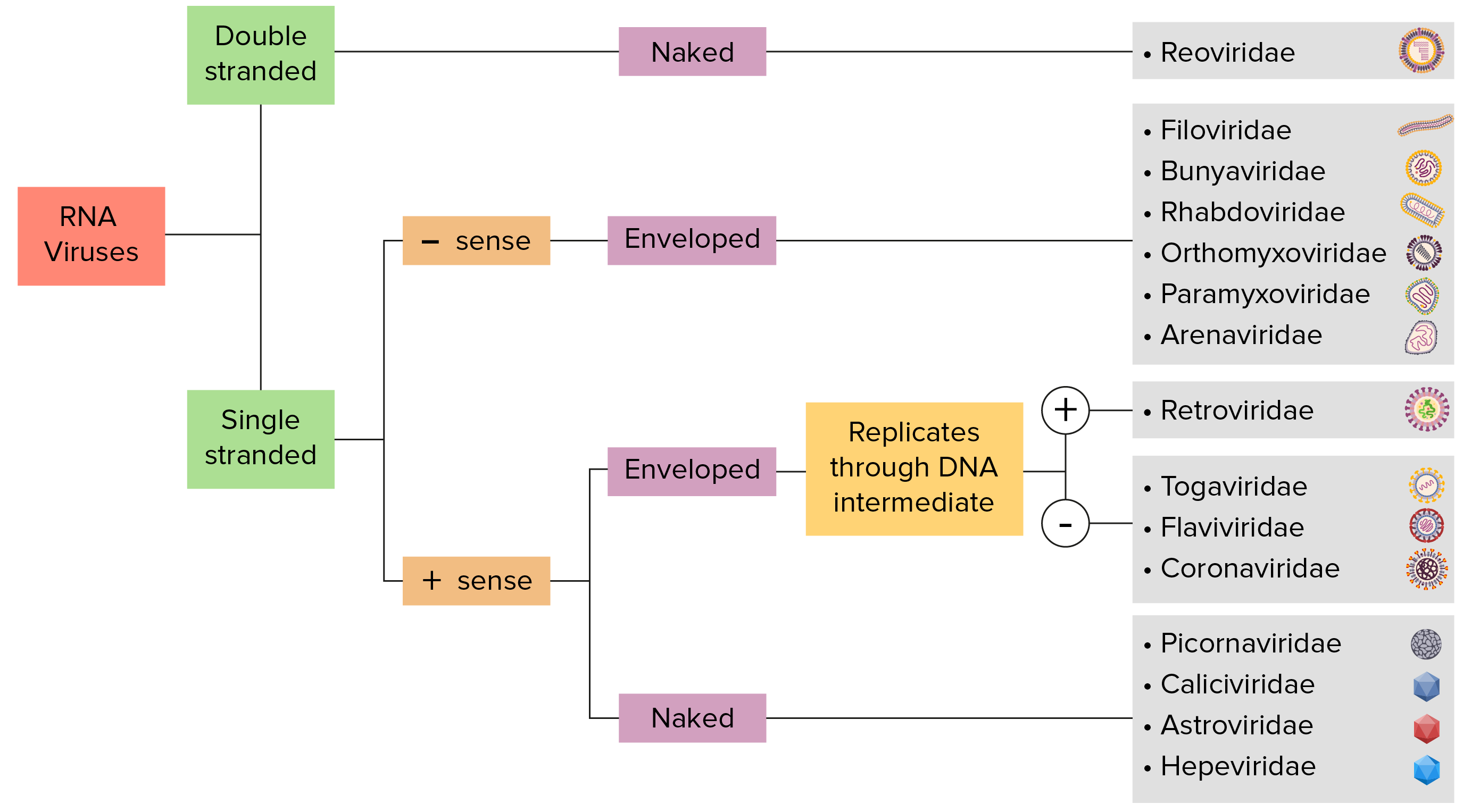
Diagrama de flujo de la clasificación de los virus de ARN

Identificación de los virus ARN:
Los virus pueden clasificarse de muchas maneras. La mayoría de los virus tienen un genoma formado por ácido desoxirribonucleico (ADN) o ARN. Los virus del genoma de ARN se pueden caracterizar además por un ARN de cadena simple o doble. Los virus “envueltos” están cubiertos por una fina capa de membrana celular (normalmente tomada de la célula huésped). Si la envoltura está ausente, los virus se denominan “desnudos”. Los virus con genomas monocatenarios son virus de “sentido positivo” si el genoma se emplea directamente como ARN mensajero (ARNm), que se traduce en proteínas. Los virus monocatenarios de “sentido negativo” emplean ARN polimerasa dependiente de ARN, una enzima viral, para transcribir el genoma en ARNm.
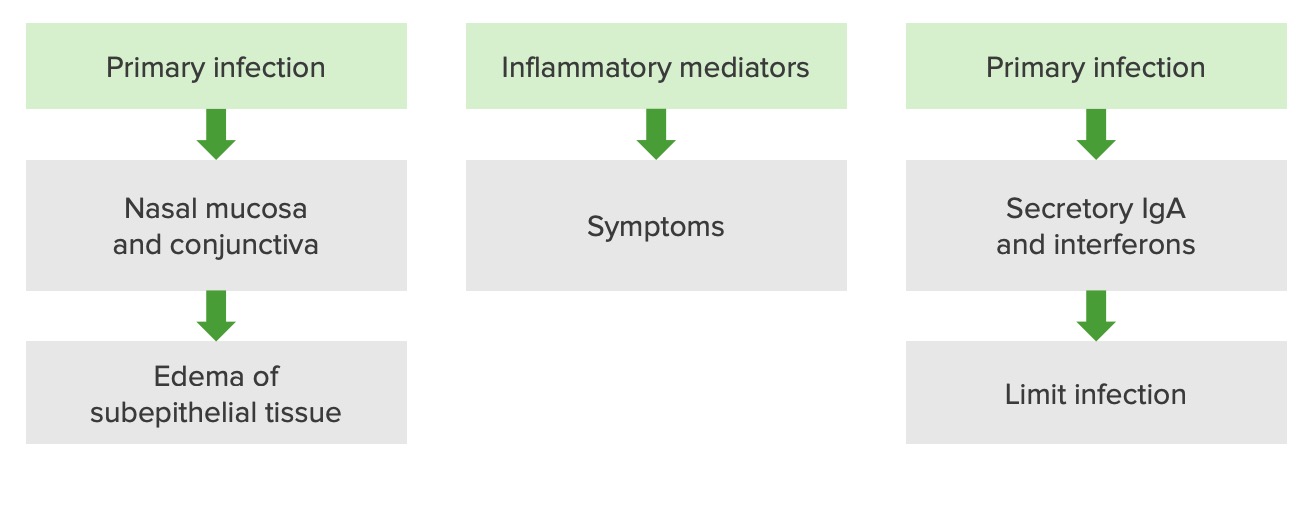
Imagen por Lecturio. Licencia: CC BY-NC-SA 4.0

Características Generales

Estructura

  • Familia Picornavirus
  • Virus Virus Viruses are infectious, obligate intracellular parasites composed of a nucleic acid core surrounded by a protein capsid. Viruses can be either naked (non-enveloped) or enveloped. The classification of viruses is complex and based on many factors, including type and structure of the nucleoid and capsid, the presence of an envelope, the replication cycle, and the host range. Virology de ARN
  • ARN monocatenario de sentido positivo
  • Desnudo

Características básicas

  • Muy pequeño: 30 nm
  • Ácido lábil → inactivado por ácido gástrico
  • Temperatura de proliferación: 33–35°C (se encuentra en EN Erythema nodosum is an immune-mediated panniculitis (inflammation of the subcutaneous fat) caused by a type IV (delayed-type) hypersensitivity reaction. It commonly manifests in young women as tender, erythematous nodules on the shins. Erythema Nodosum la nariz)
  • > 100 serotipos pueden causar infecciones de las vías respiratorias superiores (resfriado común).
  • Capaz de sobrevivir en EN Erythema nodosum is an immune-mediated panniculitis (inflammation of the subcutaneous fat) caused by a type IV (delayed-type) hypersensitivity reaction. It commonly manifests in young women as tender, erythematous nodules on the shins. Erythema Nodosum las manos durante horas

Enfermedades asociadas

  • Infecciones del tracto respiratorio superior
  • Bronquiolitis
  • Rinitis
  • Otitis media
  • Sinusitis Sinusitis Sinusitis refers to inflammation of the mucosal lining of the paranasal sinuses. The condition usually occurs concurrently with inflammation of the nasal mucosa (rhinitis), a condition known as rhinosinusitis. Acute sinusitis is due to an upper respiratory infection caused by a viral, bacterial, or fungal agent. Sinusitis
  • Bronquitis crónica

Patogénesis

Epidemiología

  • Más común otoño → primavera
  • La incidencia es más alta en EN Erythema nodosum is an immune-mediated panniculitis (inflammation of the subcutaneous fat) caused by a type IV (delayed-type) hypersensitivity reaction. It commonly manifests in young women as tender, erythematous nodules on the shins. Erythema Nodosum niños de preescolar y primaria (promedio de 3–8 resfriados por año).
  • Los LOS Neisseria adultos suelen tener de 2–4 resfriados al AL Amyloidosis año.

Transmisión

  • Los LOS Neisseria humanos son el único reservorio.
  • Partículas de aerosol
  • Contacto directo
  • Fómites (pueden retener el virus Virus Viruses are infectious, obligate intracellular parasites composed of a nucleic acid core surrounded by a protein capsid. Viruses can be either naked (non-enveloped) or enveloped. The classification of viruses is complex and based on many factors, including type and structure of the nucleoid and capsid, the presence of an envelope, the replication cycle, and the host range. Virology de las gotas respiratorias)
  • El rinovirus puede sobrevivir fuera de un huésped humano hasta por 3 horas.

Factores de riesgo

  • Asma ASMA Autoimmune Hepatitis
  • Fibrosis Fibrosis Any pathological condition where fibrous connective tissue invades any organ, usually as a consequence of inflammation or other injury. Bronchiolitis Obliterans quística
  • Bronquitis crónica
  • Enfermedad pulmonar obstructiva crónica (EPOC)
  • Lactantes y ancianos
  • Individuos inmunocomprometidos

Fisiopatología

  • Período de incubación: 1–3 días
  • Inoculación de la mucosa nasal → se adhiere al AL Amyloidosis epitelio respiratorio y se propaga localmente → provoca una respuesta inmunitaria innata que conduce a la inflamación y remodelación de las vías respiratorias
  • Pocas células son realmente infectadas por rinovirus (solo una pequeña porción del epitelio está involucrada).
Fisiopatología de una infección por rinovirus

Fisiopatología de una infección por rinovirus

Imagen por Lecturio. Licencia: CC BY-NC-SA 4.0

Prevención

  • Lavado de manos con agua y jabón.
  • Desinfectar manos y superficies.
  • Evitar el contacto de la cara con las manos.
  • Uso de mascarilla (e.g., quirúrgica, KN95, FFP2).

Presentación Clínica

  • Período de incubación: 12–72 horas
  • Duración: 7–10 días
  • Infecciones causadas:
    • Resfriado común (más a menudo)
    • Infección en EN Erythema nodosum is an immune-mediated panniculitis (inflammation of the subcutaneous fat) caused by a type IV (delayed-type) hypersensitivity reaction. It commonly manifests in young women as tender, erythematous nodules on the shins. Erythema Nodosum el oído
    • Infección sinusal
    • Neumonía y bronquiolitis (raro)
  • Síntomas:
    • Malestar
    • Dolor Dolor Inflammation de garganta
    • Secreción nasal
    • Congestión nasal
    • Estornudos
    • Cefalea
    • Presión facial y de oído
    • Disfonía

Diagnóstico

  • El diagnóstico se establece mediante los LOS Neisseria antecedentes clínicos y el examen.
  • Hallazgos del examen:
    • Nariz roja
    • Rinorrea
    • Las membranas mucosas nasales aparecen brillantes y vidriosas sin eritema o edema Edema Edema is a condition in which excess serous fluid accumulates in the body cavity or interstitial space of connective tissues. Edema is a symptom observed in several medical conditions. It can be categorized into 2 types, namely, peripheral (in the extremities) and internal (in an organ or body cavity). Edema evidente.
    • La faringe típicamente parece normal.
  • Opciones de pruebas para obtener un diagnóstico específico:
    • Pruebas directas de antígeno:
      • Síndrome respiratorio agudo severo causado por coronavirus Coronavirus Coronaviruses are a group of related viruses that contain positive-sense, single-stranded RNA. Coronavirus derives its name from “κορώνη korṓnē” in Greek, which translates as “crown,” after the small club-shaped proteins visible as a ring around the viral envelope in electron micrographs. Coronavirus 2 (SARS-CoV-2, por sus siglas en EN Erythema nodosum is an immune-mediated panniculitis (inflammation of the subcutaneous fat) caused by a type IV (delayed-type) hypersensitivity reaction. It commonly manifests in young women as tender, erythematous nodules on the shins. Erythema Nodosum inglés)
      • Influenza Influenza Influenza viruses are members of the Orthomyxoviridae family and the causative organisms of influenza, a highly contagious febrile respiratory disease. There are 3 primary influenza viruses (A, B, and C) and various subtypes, which are classified based on their virulent surface antigens, hemagglutinin (HA) and neuraminidase (NA). Influenza typically presents with a fever, myalgia, headache, and symptoms of an upper respiratory infection. Influenza Viruses/Influenza
      • Virus Virus Viruses are infectious, obligate intracellular parasites composed of a nucleic acid core surrounded by a protein capsid. Viruses can be either naked (non-enveloped) or enveloped. The classification of viruses is complex and based on many factors, including type and structure of the nucleoid and capsid, the presence of an envelope, the replication cycle, and the host range. Virology sincitial respiratorio ( RSV RSV Respiratory syncytial virus (RSV) is an enveloped, single-stranded, linear, negative-sense RNA virus of the family Paramyxoviridae and the genus Orthopneumovirus. Two subtypes (A and B) are present in outbreaks, but type A causes more severe disease. Respiratory syncytial virus causes infections of the lungs and respiratory tract. Respiratory Syncytial Virus, por sus siglas en EN Erythema nodosum is an immune-mediated panniculitis (inflammation of the subcutaneous fat) caused by a type IV (delayed-type) hypersensitivity reaction. It commonly manifests in young women as tender, erythematous nodules on the shins. Erythema Nodosum inglés)
      • Prueba de antígeno directo para parainfluenza y adenovirus Adenovirus Adenovirus (member of the family Adenoviridae) is a nonenveloped, double-stranded DNA virus. Adenovirus is transmitted in a variety of ways, and it can have various presentations based on the site of entry. Presentation can include febrile pharyngitis, conjunctivitis, acute respiratory disease, atypical pneumonia, and gastroenteritis. Adenovirus
    • Ensayos de reacción en EN Erythema nodosum is an immune-mediated panniculitis (inflammation of the subcutaneous fat) caused by a type IV (delayed-type) hypersensitivity reaction. It commonly manifests in young women as tender, erythematous nodules on the shins. Erythema Nodosum cadena de polimerasa ( PCR PCR Polymerase chain reaction (PCR) is a technique that amplifies DNA fragments exponentially for analysis. The process is highly specific, allowing for the targeting of specific genomic sequences, even with minuscule sample amounts. The PCR cycles multiple times through 3 phases: denaturation of the template DNA, annealing of a specific primer to the individual DNA strands, and synthesis/elongation of new DNA molecules. Polymerase Chain Reaction (PCR), por sus siglas en EN Erythema nodosum is an immune-mediated panniculitis (inflammation of the subcutaneous fat) caused by a type IV (delayed-type) hypersensitivity reaction. It commonly manifests in young women as tender, erythematous nodules on the shins. Erythema Nodosum inglés): SARS-CoV-2

Tratamiento y Complicaciones

Tratamiento

  • Autolimitado
  • Terapia de soporte:
    • Descanso
    • Hidratación
    • AINE
    • Descongestionantes nasales
    • Antihistamínicos

Complicaciones

  • Otitis media
  • Sinusitis Sinusitis Sinusitis refers to inflammation of the mucosal lining of the paranasal sinuses. The condition usually occurs concurrently with inflammation of the nasal mucosa (rhinitis), a condition known as rhinosinusitis. Acute sinusitis is due to an upper respiratory infection caused by a viral, bacterial, or fungal agent. Sinusitis
  • Exacerbación de enfermedad reactiva de las vías respiratorias
  • Infecciones del tracto respiratorio inferior

Comparación de Especies

Tabla: Presentación clínica de infecciones por virus Virus Viruses are infectious, obligate intracellular parasites composed of a nucleic acid core surrounded by a protein capsid. Viruses can be either naked (non-enveloped) or enveloped. The classification of viruses is complex and based on many factors, including type and structure of the nucleoid and capsid, the presence of an envelope, the replication cycle, and the host range. Virology respiratorios comunes
Síntoma Coronavirus Coronavirus Coronaviruses are a group of related viruses that contain positive-sense, single-stranded RNA. Coronavirus derives its name from “κορώνη korṓnē” in Greek, which translates as “crown,” after the small club-shaped proteins visible as a ring around the viral envelope in electron micrographs. Coronavirus ( COVID-19 COVID-19 Coronavirus disease 2019 (COVID-19) is an infectious disease caused by the severe acute respiratory syndrome coronavirus 2 (SARS-CoV-2) that mainly affects the respiratory system but can also cause damage to other body systems (cardiovascular, gastrointestinal, renal, and central nervous systems). ) Virus Virus Viruses are infectious, obligate intracellular parasites composed of a nucleic acid core surrounded by a protein capsid. Viruses can be either naked (non-enveloped) or enveloped. The classification of viruses is complex and based on many factors, including type and structure of the nucleoid and capsid, the presence of an envelope, the replication cycle, and the host range. Virology de la influenza Influenza Influenza viruses are members of the Orthomyxoviridae family and the causative organisms of influenza, a highly contagious febrile respiratory disease. There are 3 primary influenza viruses (A, B, and C) and various subtypes, which are classified based on their virulent surface antigens, hemagglutinin (HA) and neuraminidase (NA). Influenza typically presents with a fever, myalgia, headache, and symptoms of an upper respiratory infection. Influenza Viruses/Influenza (gripe) Rinovirus (resfriado común) Alergias estacionales
Fiebre A menudo A menudo Raro Raro
Fatiga A menudo A menudo Algunas veces A menudo
Tos TOS Thoracic outlet syndrome (TOS) is a broad term used for a spectrum of syndromes related to the general region of the thoracic outlet, which involves the compression or irritation of elements of the brachial plexus, subclavian artery, or subclavian vein. Thoracic Outlet Syndrome A menudo A menudo Algunas veces A menudo
Estornudos Raro No A menudo A menudo
Mialgias Algunas veces A menudo Algunas veces No
Rinorrea o congestión nasal Raro Algunas veces A menudo A menudo
Dolor Dolor Inflammation de garganta Algunas veces Algunas veces A menudo No
Diarrea Raro Algunas veces No No
Cefalea Algunas veces A menudo A menudo Algunas veces
Disnea A menudo Raro Raro Raro
Pérdida del gusto y el olfato A menudo Raro Algunas veces Raro

Diagnóstico Diferencial

  • Rinitis: inflamación de la mucosa nasal. La rinitis se puede clasificar como infecciosa, alérgica o no alérgica según la etiología. Los LOS Neisseria 3 tipos se presentan con congestión nasal, rinorrea y estornudos. El diagnóstico es principalmente clínico. El tratamiento incluye antihistamínicos, descongestionantes e inmunoterapia (“vacunas contra la alergia”).
  • Influenza Influenza Influenza viruses are members of the Orthomyxoviridae family and the causative organisms of influenza, a highly contagious febrile respiratory disease. There are 3 primary influenza viruses (A, B, and C) and various subtypes, which are classified based on their virulent surface antigens, hemagglutinin (HA) and neuraminidase (NA). Influenza typically presents with a fever, myalgia, headache, and symptoms of an upper respiratory infection. Influenza Viruses/Influenza: una enfermedad respiratoria altamente contagiosa que se presenta con fiebre, mialgia, cefalea y síntomas de una infección de las vías respiratorias superiores. Los LOS Neisseria síntomas de gastroenteritis Gastroenteritis Gastroenteritis is inflammation of the stomach and intestines, commonly caused by infections from bacteria, viruses, or parasites. Transmission may be foodborne, fecal-oral, or through animal contact. Common clinical features include abdominal pain, diarrhea, vomiting, fever, and dehydration. Gastroenteritis también pueden ocurrir y son más comunes en EN Erythema nodosum is an immune-mediated panniculitis (inflammation of the subcutaneous fat) caused by a type IV (delayed-type) hypersensitivity reaction. It commonly manifests in young women as tender, erythematous nodules on the shins. Erythema Nodosum niños. La gripe suele ser autolimitada, aunque la neumonía viral o bacteriana secundaria pueden complicar la enfermedad. El tratamiento suele ser de soporte, aunque pueden administrarse inhibidores de neuraminidasa en EN Erythema nodosum is an immune-mediated panniculitis (inflammation of the subcutaneous fat) caused by a type IV (delayed-type) hypersensitivity reaction. It commonly manifests in young women as tender, erythematous nodules on the shins. Erythema Nodosum las primeras etapas de la enfermedad.
  • Virus Virus Viruses are infectious, obligate intracellular parasites composed of a nucleic acid core surrounded by a protein capsid. Viruses can be either naked (non-enveloped) or enveloped. The classification of viruses is complex and based on many factors, including type and structure of the nucleoid and capsid, the presence of an envelope, the replication cycle, and the host range. Virology de la parainfluenza humana (HPIV, por sus siglas en EN Erythema nodosum is an immune-mediated panniculitis (inflammation of the subcutaneous fat) caused by a type IV (delayed-type) hypersensitivity reaction. It commonly manifests in young women as tender, erythematous nodules on the shins. Erythema Nodosum inglés): virus Virus Viruses are infectious, obligate intracellular parasites composed of a nucleic acid core surrounded by a protein capsid. Viruses can be either naked (non-enveloped) or enveloped. The classification of viruses is complex and based on many factors, including type and structure of the nucleoid and capsid, the presence of an envelope, the replication cycle, and the host range. Virology de ARN monocatenario de la familia Paramyxoviridae Paramyxoviridae A family of spherical viruses, of the order mononegavirales, somewhat larger than the orthomyxoviruses, and containing single-stranded RNA. Subfamilies include paramyxoviridae and pneumovirinae. Respiratory Syncytial Virus, que pueden causar enfermedades de las vías respiratorias superiores e inferiores, como crup (laringotraqueobronquitis), bronquiolitis y neumonía. El tratamiento es principalmente cuidados de soporte.
  • Adenovirus Adenovirus Adenovirus (member of the family Adenoviridae) is a nonenveloped, double-stranded DNA virus. Adenovirus is transmitted in a variety of ways, and it can have various presentations based on the site of entry. Presentation can include febrile pharyngitis, conjunctivitis, acute respiratory disease, atypical pneumonia, and gastroenteritis. Adenovirus: virus Virus Viruses are infectious, obligate intracellular parasites composed of a nucleic acid core surrounded by a protein capsid. Viruses can be either naked (non-enveloped) or enveloped. The classification of viruses is complex and based on many factors, including type and structure of the nucleoid and capsid, the presence of an envelope, the replication cycle, and the host range. Virology de ADN de doble cadena sin envoltura que suelen causar infecciones respiratorias leves (síntomas del resfriado común). Los LOS Neisseria adenovirus Adenovirus Adenovirus (member of the family Adenoviridae) is a nonenveloped, double-stranded DNA virus. Adenovirus is transmitted in a variety of ways, and it can have various presentations based on the site of entry. Presentation can include febrile pharyngitis, conjunctivitis, acute respiratory disease, atypical pneumonia, and gastroenteritis. Adenovirus también pueden causar conjuntivitis, neumonía atípica, gastroenteritis Gastroenteritis Gastroenteritis is inflammation of the stomach and intestines, commonly caused by infections from bacteria, viruses, or parasites. Transmission may be foodborne, fecal-oral, or through animal contact. Common clinical features include abdominal pain, diarrhea, vomiting, fever, and dehydration. Gastroenteritis o apendicitis. La transmisión es a través de aerosoles, fómites, contacto fecal-oral y contacto directo. El tratamiento es de soporte.
  • Neumonía: infección del tracto respiratorio inferior que provoca que los LOS Neisseria alvéolos se llenen de líquido o pus. Los LOS Neisseria síntomas incluyen tos TOS Thoracic outlet syndrome (TOS) is a broad term used for a spectrum of syndromes related to the general region of the thoracic outlet, which involves the compression or irritation of elements of the brachial plexus, subclavian artery, or subclavian vein. Thoracic Outlet Syndrome con flema, fiebre, escalofríos y dificultad para respirar. Para causas bacterianas, los LOS Neisseria antibióticos están indicados en EN Erythema nodosum is an immune-mediated panniculitis (inflammation of the subcutaneous fat) caused by a type IV (delayed-type) hypersensitivity reaction. It commonly manifests in young women as tender, erythematous nodules on the shins. Erythema Nodosum el tratamiento. Algunas formas de neumonía, como la neumonía neumocócica, se pueden prevenir con vacunas.

Referencias

  1. Pappas, D. (2025). Epidemiology, clinical manifestations, and pathogenesis of rhinovirus infections. UpToDate. Retrieved March 25, 2025, from https://www.uptodate.com/contents/epidemiology-clinical-manifestations-and-pathogenesis-of-rhinovirus-infections
  2. Buensalido, J. (2023). Rhinovirus (RV) Infection (Common Cold). Emedicine. Retrieved March 25, 2025, from https://emedicine.medscape.com/article/227820-overview
  3. Martin ET, Fairchok MP, Stednick ZJ, Kuypers J, Englund JA. Epidemiology of multiple respiratory viruses in childcare attendees. J Infect Dis. 2013 Mar. 207(6):982-9. 
  4. Makris, S, & Johnston, S. (2018). Recent advances in understanding rhinovirus immunity. F1000Research, 7, F1000 Faculty Rev-1537. https://doi.org/10.12688/f1000research.15337.1

¡Crea tu cuenta gratis o inicia una sesión para seguir leyendo!

Regístrate ahora y obtén acceso gratuito a Lecturio con páginas de concepto, videos médicos y cuestionarios para tu educación médica.

User Reviews

Que tengas una sesión de estudio alegre y navideña 🎁 Ahorra 50% en todos los planes >>

Details