Domina Conceptos Médicos

Estudia para la escuela de medicina y tus examenes con Lecturio.

Respuesta Inmune Adaptativa

Las respuestas inmunes contra patógenos se dividen en sistemas de respuesta inmune innata y adaptativa. La respuesta inmune adaptativa, también denominada sistema inmune adquirido, consta de 2 mecanismos principales: las respuestas inmunes humoral y celular. La inmunidad humoral está mediada por las células B (que producen anticuerpos), mientras que la inmunidad mediada por células involucra a las células T. Como 2da línea de defensa, el sistema inmune adaptativo es más lento y responde durante un período de tiempo más largo, pero el efecto generalmente conduce a una memoria inmunológica específica. Las 2 características importantes de la respuesta adaptativa son la especificidad (con reconocimiento de antígeno) y la memoria (respuesta inmune inducida por reinfección).

Last updated: Dec 15, 2025

Editorial responsibility: Stanley Oiseth, Lindsay Jones, Evelin Maza

Descripción General

Sistema inmune

El sistema inmune proporciona defensa (inmunidad) contra patógenos invasores que van desde virus Virus Viruses are infectious, obligate intracellular parasites composed of a nucleic acid core surrounded by a protein capsid. Viruses can be either naked (non-enveloped) or enveloped. The classification of viruses is complex and based on many factors, including type and structure of the nucleoid and capsid, the presence of an envelope, the replication cycle, and the host range. Virology hasta parásitos, y sus componentes están interconectados por la circulación sanguínea y linfática.

2 líneas de defensa (que se superponen):

  • Inmunidad innata (la cual no es específica)
  • Inmunidad adaptativa (adquirida) (basada en EN Erythema nodosum is an immune-mediated panniculitis (inflammation of the subcutaneous fat) caused by a type IV (delayed-type) hypersensitivity reaction. It commonly manifests in young women as tender, erythematous nodules on the shins. Erythema Nodosum el reconocimiento de antígenos específicos):
    • Inmunidad mediada por células: respuesta adaptativa en EN Erythema nodosum is an immune-mediated panniculitis (inflammation of the subcutaneous fat) caused by a type IV (delayed-type) hypersensitivity reaction. It commonly manifests in young women as tender, erythematous nodules on the shins. Erythema Nodosum células/tejidos que involucra a las células T
    • Inmunidad humoral: respuesta adaptativa en los fluidos (“humoral”) que involucra células B e inmunoglobulinas

Inmunidad innata vs adaptativa

Tabla: Inmunidad innata vs. adaptativa
Inmunidad innata Inmunidad adaptativa
Genética Línea germinal codificada Reordenamientos genéticos implicados en EN Erythema nodosum is an immune-mediated panniculitis (inflammation of the subcutaneous fat) caused by a type IV (delayed-type) hypersensitivity reaction. It commonly manifests in young women as tender, erythematous nodules on the shins. Erythema Nodosum el desarrollo de linfocitos
Respuesta inmune Inespecífica Altamente específica
Tiempo de respuesta Inmediato (minutos a horas) Se desarrolla durante un período de tiempo más prolongado
Respuesta de memoria Ninguna Con respuesta de memoria, que responde rápidamente al AL Amyloidosis reconocimiento del antígeno
Reconocimiento del patógeno Los LOS Neisseria receptores de reconocimiento de patrones, como los LOS Neisseria TLR, reconocen patrones moleculares asociados a patógenos
  • Células de memoria (células T y B)
  • Células B activadas
Componentes
  • Barreras anatómicas (e.g., piel)
  • Barreras químicas y biológicas (e.g., ácido gástrico, flora vaginal)
  • Células (e.g., granulocitos)
  • Proteínas secretadas:
    • Enzimas (e.g., lisozima)
    • Otros receptores de reconocimientos de patrones (e.g., péptidos antimicrobianos)
    • Citocinas*
    • Sistema de complemento*
  • Inmunidad mediada por células: células T
  • Inmunidad humoral: células B, inmunoglobulinas
*Estos mediadores también tienen funciones en la inmunidad adaptativa.

Componentes del Sistema Inmune Adaptativo

Inmunidad adaptativa

La respuesta inmune adaptativa se divide en EN Erythema nodosum is an immune-mediated panniculitis (inflammation of the subcutaneous fat) caused by a type IV (delayed-type) hypersensitivity reaction. It commonly manifests in young women as tender, erythematous nodules on the shins. Erythema Nodosum los LOS Neisseria sistemas inmunes mediados por respuesta humoral y celular.

  • Las células primarias del sistema inmunitario adaptativo son los LOS Neisseria linfocitos (células B y T).
    • Las células B juegan un papel importante en EN Erythema nodosum is an immune-mediated panniculitis (inflammation of the subcutaneous fat) caused by a type IV (delayed-type) hypersensitivity reaction. It commonly manifests in young women as tender, erythematous nodules on the shins. Erythema Nodosum la respuesta inmune humoral.
    • Las células T están involucradas principalmente en EN Erythema nodosum is an immune-mediated panniculitis (inflammation of the subcutaneous fat) caused by a type IV (delayed-type) hypersensitivity reaction. It commonly manifests in young women as tender, erythematous nodules on the shins. Erythema Nodosum la respuesta mediada por células.
    • Estas células pasan por diferentes etapas:
      • Las células inmaduras son células que aún no han encontrado su antígeno.
      • Las células efectoras han sido activadas por un antígeno compatible.
      • Las células de memoria son células que han sobrevivido a una infección previa.

Inmunidad mediada por células

  • Efectores primarios: células T
  • Otros componentes que también forman parte de la inmunidad mediada por células:
    • Células presentadoras de antígenos: como las células dendríticas (células presentadoras de antígenos más potentes), macrófagos, células B
    • Citocinas: proteínas solubles liberadas por diferentes células, que desempeñan funciones superpuestas tanto en EN Erythema nodosum is an immune-mediated panniculitis (inflammation of the subcutaneous fat) caused by a type IV (delayed-type) hypersensitivity reaction. It commonly manifests in young women as tender, erythematous nodules on the shins. Erythema Nodosum la inmunidad innata como en EN Erythema nodosum is an immune-mediated panniculitis (inflammation of the subcutaneous fat) caused by a type IV (delayed-type) hypersensitivity reaction. It commonly manifests in young women as tender, erythematous nodules on the shins. Erythema Nodosum la adaptativa
  • Descripción general:
    • Una célula presentadora de antígenos es una célula inmune que detecta e informa a la respuesta inmune adaptativa sobre una infección o invasión mediante la activación de las células T.
    • Las células T, a su vez, activan las células B, produciendo inmunoglobulinas.
  • La respuesta mediada por células ocurre en EN Erythema nodosum is an immune-mediated panniculitis (inflammation of the subcutaneous fat) caused by a type IV (delayed-type) hypersensitivity reaction. It commonly manifests in young women as tender, erythematous nodules on the shins. Erythema Nodosum las células/tejidos (infecciones intracelulares o células aberrantes como tumores).
Cell-mediated immunity

Inmunidad mediada por células:
La activación de los linfocitos T auxiliares da lugar a la liberación de citoquinas, activando así los linfocitos T citotóxicos y los fagocitos (como los macrófagos).
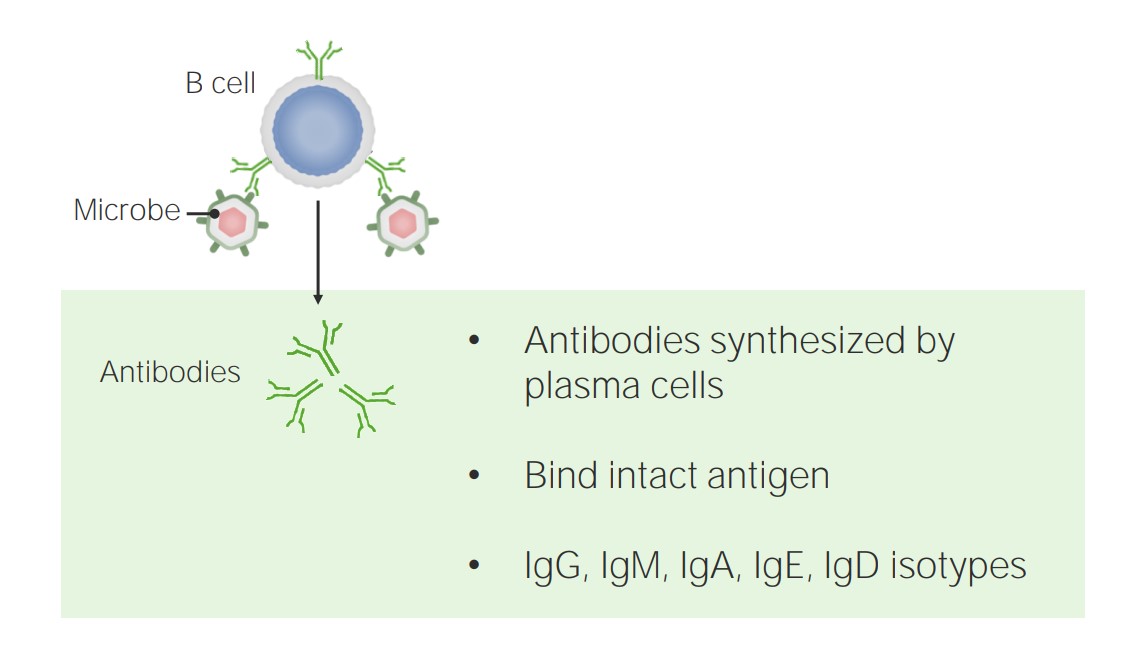
Imagen por Lecturio.

Inmunidad adaptativa humoral

  • Inmunidad mediada por anticuerpos
  • Compuesta por células B activadas y anticuerpos
    • Las células B encontradas por los LOS Neisseria antígenos responden mediante activación, proliferación y diferenciación, generando anticuerpos.
    • Las células B luego se diferencian en EN Erythema nodosum is an immune-mediated panniculitis (inflammation of the subcutaneous fat) caused by a type IV (delayed-type) hypersensitivity reaction. It commonly manifests in young women as tender, erythematous nodules on the shins. Erythema Nodosum células plasmáticas y células de memoria.
    • Las células de memoria conducen a una inmunidad duradera y permiten respuestas inmunológicas rápidas tras la exposición posterior al AL Amyloidosis antígeno.
  • La inmunidad humoral protege los fluidos extracelulares (“humorales”) de los LOS Neisseria vasos linfáticos (linfa), el intersticio y el sistema circulatorio ( plasma Plasma The residual portion of blood that is left after removal of blood cells by centrifugation without prior blood coagulation. Transfusion Products) de la contaminación microbiana.
Humoral immunity

La inmunidad humoral está mediada por las células B y los anticuerpos.

Imagen por Lecturio.
Activación de la Inmunidad Mediada por Células

Células T y presentación de antígenos

  • Las células T se derivan de progenitores linfoides comunes.
  • A diferencia de las células B, estas células de la médula ósea migran al AL Amyloidosis timo para completar el desarrollo de las células T.
  • Para que ocurra la proliferación y la activación, las células T maduras vírgenes (que tienen un grupo de moléculas de diferenciación (CD) 4 u 8 (CD4 o CD8)) tienen que interactuar con un antígeno extraño.
  • Así, estas células circulan en EN Erythema nodosum is an immune-mediated panniculitis (inflammation of the subcutaneous fat) caused by a type IV (delayed-type) hypersensitivity reaction. It commonly manifests in young women as tender, erythematous nodules on the shins. Erythema Nodosum la sangre y van a los LOS Neisseria tejidos linfoides secundarios.
  • Estos órganos linfoides secundarios (e.g., ganglios linfáticos) filtran el material antigénico, lo que permite que las células T maduras vírgenes:
    • Interactuar con antígenos para activarse
    • Interactuar con células presentadoras de antígenos como macrófagos o células dendríticas.
      • Las células presentadoras de antígenos fagocitan el patógeno y digieren el antígeno en EN Erythema nodosum is an immune-mediated panniculitis (inflammation of the subcutaneous fat) caused by a type IV (delayed-type) hypersensitivity reaction. It commonly manifests in young women as tender, erythematous nodules on the shins. Erythema Nodosum fragmentos.
      • A continuación, los LOS Neisseria fragmentos peptídicos se acoplan a moléculas del complejo mayor de histocompatibilidad de clase I o de clase II.
      • Una vez procesados, estos son transportados a la superficie celular para la presentación de antígenos.
    • Los LOS Neisseria antígenos presentados en EN Erythema nodosum is an immune-mediated panniculitis (inflammation of the subcutaneous fat) caused by a type IV (delayed-type) hypersensitivity reaction. It commonly manifests in young women as tender, erythematous nodules on the shins. Erythema Nodosum moléculas del complejo mayor de histocompatibilidad son reconocidos por las células T utilizando un receptor Receptor Receptors are proteins located either on the surface of or within a cell that can bind to signaling molecules known as ligands (e.g., hormones) and cause some type of response within the cell. Receptors de células T específico para el antígeno.
      • Las células T CD4 (células T colaboradoras) se unen solo a los LOS Neisseria complejos Antígeno-Complejo Mayor de Histocompatibilidad II.
      • Las células T CD8 (células T citotóxicas) se unen solo a los LOS Neisseria complejos Antígeno-Complejo Mayor de Histocompatibilidad I.
  • Continúa la activación de las células T (que requieren 2 señales para activarse), y las células T se convierten en EN Erythema nodosum is an immune-mediated panniculitis (inflammation of the subcutaneous fat) caused by a type IV (delayed-type) hypersensitivity reaction. It commonly manifests in young women as tender, erythematous nodules on the shins. Erythema Nodosum células T efectoras (que funcionan en EN Erythema nodosum is an immune-mediated panniculitis (inflammation of the subcutaneous fat) caused by a type IV (delayed-type) hypersensitivity reaction. It commonly manifests in young women as tender, erythematous nodules on the shins. Erythema Nodosum la inmunidad mediada por células).
Vías de presentación de antígenos Moléculas MHC clase I y II

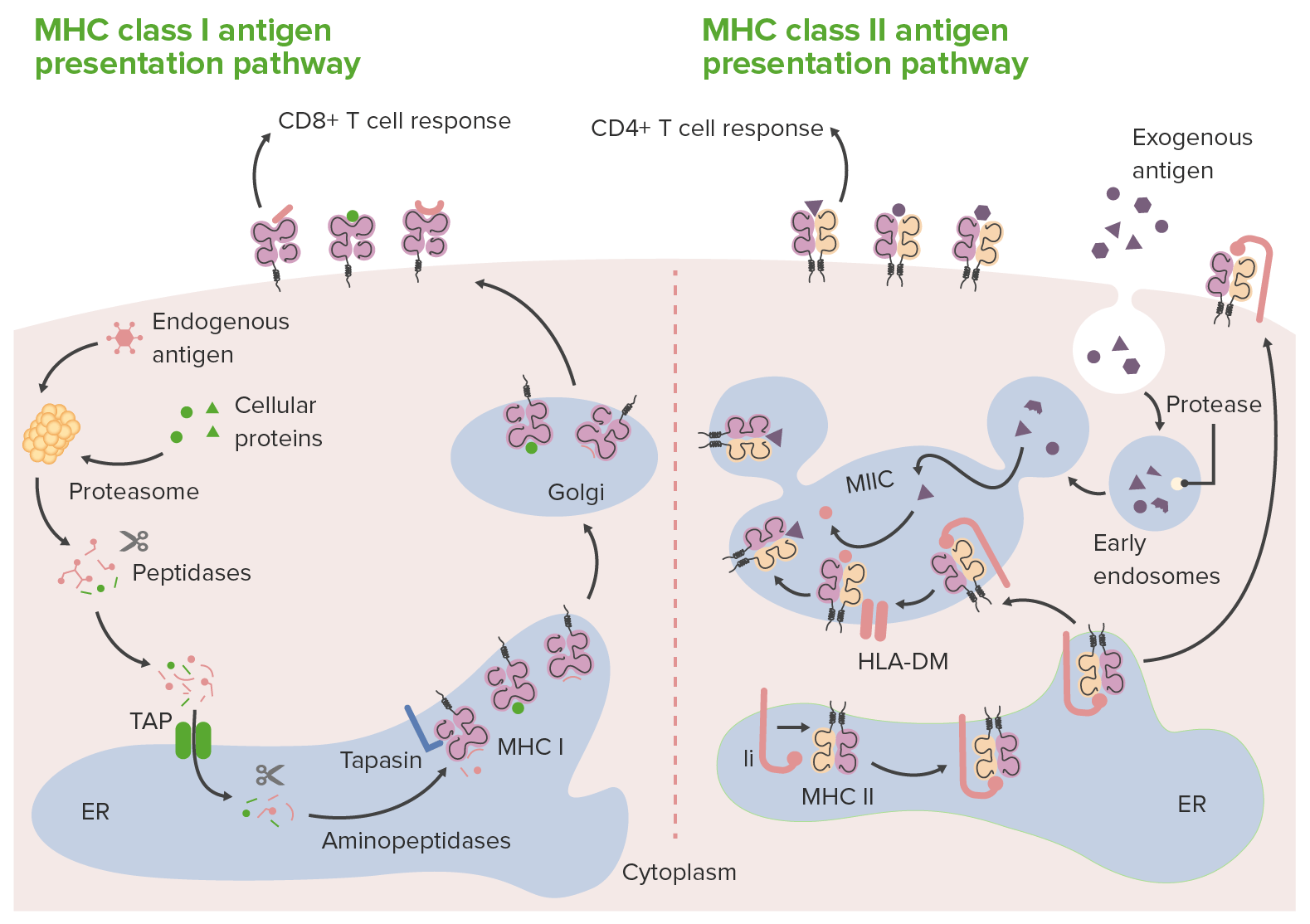
Vías de presentación de antígenos por moléculas del complejo mayor de histocompatibilidad (MHC, por sus siglas en inglés, de clase I y II:
En la presentación de antígenos de clase I (izquierda), los proteosomas degradan antígenos o proteínas endógenas (dentro de la célula) en péptidos. Los fragmentos de péptidos se transportan (a través del transportador asociado con el procesamiento de antígenos (TAP, por sus siglas en inglés)) al reticulo endoplasmico (ER, por sus siglas en inglés), donde las aminopeptidasas los recortan aún más y los acoplan en la molécula MHC de clase I. Los complejos Antígeno-MHC de clase I van al aparato de Golgi para la modificación postraduccional. Luego, los complejos se transportan a la superficie celular, donde se presentan a las células T CD8+. En la presentación de antígenos de clase II (derecha), las células presentadoras de antígenos captan los antígenos extracelulares/exógenos dentro de los fagosomas. Los fagosomas luego se fusionan con lisosomas llenos de enzimas proteolíticas. Esto da como resultado la descomposición de las proteínas fagocitadas en pequeños péptidos. Mientras tanto, en el ER se sintetizan nuevas moléculas MHC de clase II. Estas moléculas tienen la cadena invariable (estructura rosa en la imagen de la derecha, marcada como “Ii”), que se une a la hendidura de unión a antígeno. Con la hendidura ocluida (por la cadena invariable), los péptidos residentes en el ER no pueden unirse. La cadena invariable dirige el complejo MHC II al endosoma acidificado (donde están los péptidos del antígeno) a medida que sale del ER. Cuando los complejos MHC II se entregan al endosoma, la cadena invariable se libera, lo que permite el acople de péptidos del antígeno (acompañados por una proteína, HLA-DM) en las moléculas MHC de clase II. Una vez acoplados, los complejos péptido del antígeno-MHC de clase II formados se llevan a la superficie celular, listos para presentar el antígeno a las células T CD4+.
Ii: cadena invariable asociada a MHC de clase II
MIIC: compartimento MHC clase II
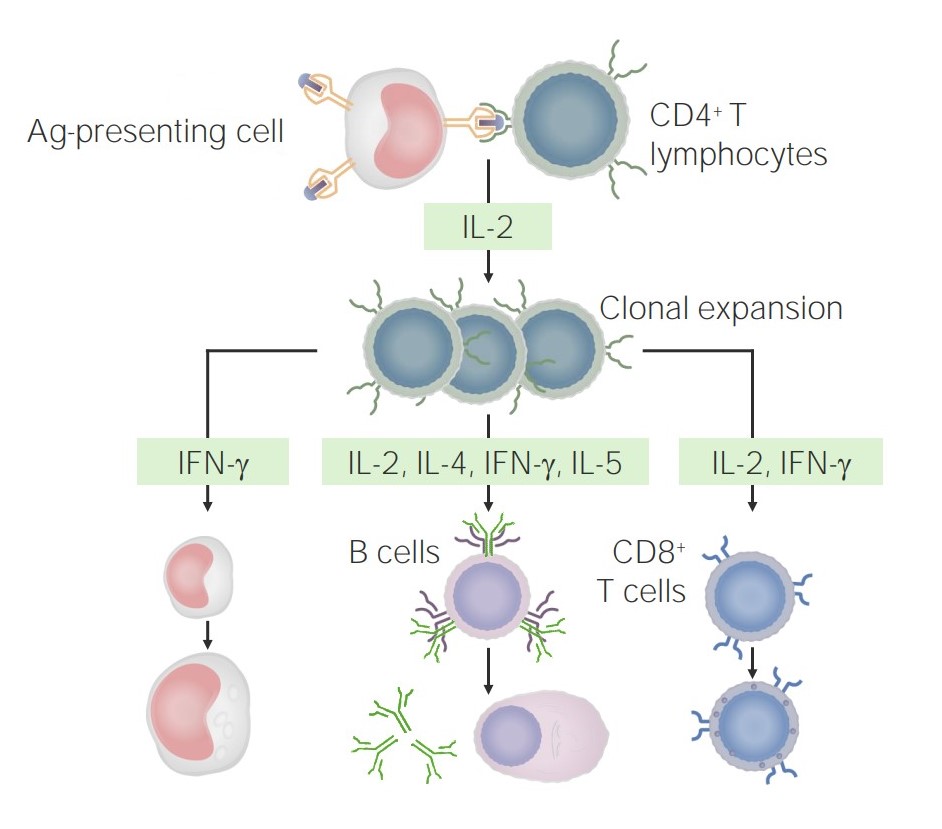
Imagen por Lecturio.

Células T activadas

  • Células T CD4+
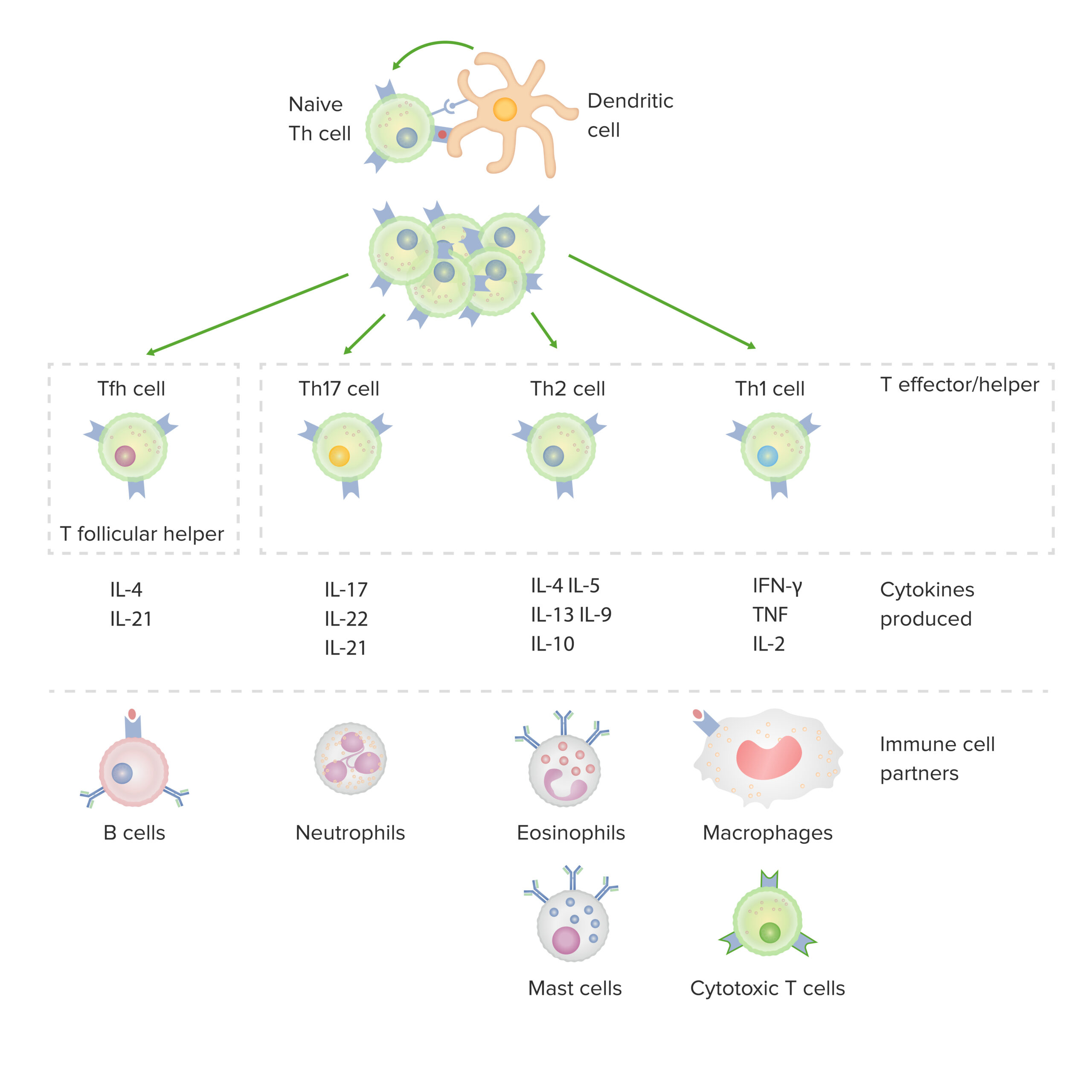
    • Con actividades efectoras: Th1 Th1 A subset of helper-inducer T-lymphocytes which synthesize and secrete interleukin-2; interferon-gamma; and interleukin-12. Due to their ability to kill antigen-presenting cells and their lymphokine-mediated effector activity, th1 cells are associated with vigorous delayed-type hypersensitivity reactions. T cells: Types and Functions, Th2 Th2 A subset of helper-inducer T-lymphocytes which synthesize and secrete the interleukins il-4; il-5; il-6; and il-10. These cytokines influence b-cell development and antibody production as well as augmenting humoral responses. T cells: Types and Functions, Th9, Th17 Th17 A subset of helper-effector T-lymphocytes which synthesize and secrete interleukins il-17; il-17f; and il-22. These cytokines are involved in host defenses and tissue inflammation in autoimmune diseases. T cells: Types and Functions, Th22, células T colaboradoras foliculares
    • Con actividades reguladoras: células T reguladoras
  • Citocinas, proteínas de señalización importantes para el desarrollo de las células inmunitarias, estimulan las células T y, al AL Amyloidosis mismo tiempo, son secretadas por las células T.
Stimulation and clonal expansion of CD4+ T cells

Tras interactuar con las células presentadoras de Ag, se produce la estimulación y expansión clonal de las células T CD4+:
Estas células liberan citoquinas que pueden tener diversos efectos, como la activación de macrófagos (izquierda), células B (centro) y células T CD8+.

Imagen por Lecturio.

Descripción de los LOS Neisseria subconjuntos de células T CD4+

Tabla: Descripción de los LOS Neisseria subconjuntos de células T CD4+
Células T CD4+ Estimulado por Citoquinas producidas Funciones Papel en EN Erythema nodosum is an immune-mediated panniculitis (inflammation of the subcutaneous fat) caused by a type IV (delayed-type) hypersensitivity reaction. It commonly manifests in young women as tender, erythematous nodules on the shins. Erythema Nodosum la enfermedad
Th1 Th1 A subset of helper-inducer T-lymphocytes which synthesize and secrete interleukin-2; interferon-gamma; and interleukin-12. Due to their ability to kill antigen-presenting cells and their lymphokine-mediated effector activity, th1 cells are associated with vigorous delayed-type hypersensitivity reactions. T cells: Types and Functions IL-12, IFN-γ IFN-γ, TNF TNF Tumor necrosis factor (TNF) is a major cytokine, released primarily by macrophages in response to stimuli. The presence of microbial products and dead cells and injury are among the stimulating factors. This protein belongs to the TNF superfamily, a group of ligands and receptors performing functions in inflammatory response, morphogenesis, and cell proliferation. Tumor Necrosis Factor (TNF), IL-2
  • Activar macrófagos
  • Activar Tcs TCS Treacher collins syndrome is a rare genetic condition with autosomal dominant inheritance. Treacher collins syndrome is also referred to as mandibulofacial dysostosis or franceschetti syndrome and is characterized by significant craniofacial deformities and conductive hearing loss. Treacher Collins Syndrome
  • Erradicar organismos intracelulares
  • Proinflamatorias
  • Autoinmunidad
Th2 Th2 A subset of helper-inducer T-lymphocytes which synthesize and secrete the interleukins il-4; il-5; il-6; and il-10. These cytokines influence b-cell development and antibody production as well as augmenting humoral responses. T cells: Types and Functions IL-2, IL-4 IL-4, IL-5, IL-6, IL-9, IL-10, IL-13
  • Activar eosinófilos, ↑ IgE IgE An immunoglobulin associated with mast cells. Overexpression has been associated with allergic hypersensitivity. Immunoglobulins: Types and Functions
  • Activar mastocitos
  • Infecciones parasitarias (e.g., helmintos)
  • Condiciones alérgicas
Th17 Th17 A subset of helper-effector T-lymphocytes which synthesize and secrete interleukins il-17; il-17f; and il-22. These cytokines are involved in host defenses and tissue inflammation in autoimmune diseases. T cells: Types and Functions IL-1, IL-6, IL-23, TGF-β IL-17, IL-21, IL-22 Promover la inflamación neutrofílica
Tfh IL-6 IL-4, IL-21 Facilitar la activación y maduración de las células B Producción de anticuerpos
Treg TGF-β, IL-2 TGF-β, IL-10, IL-35
  • Suprimir la respuesta inmune
  • Promover la autotolerancia
↓ Autoinmunidad, alergia, inflamación
Subsets of CD4-+ helper T cells

Subconjuntos de células T CD4+, incluidas las citocinas producidas y los socios celulares inmunitarios asociados
IFN: interferón
TNF: factor de necrosis tumoral
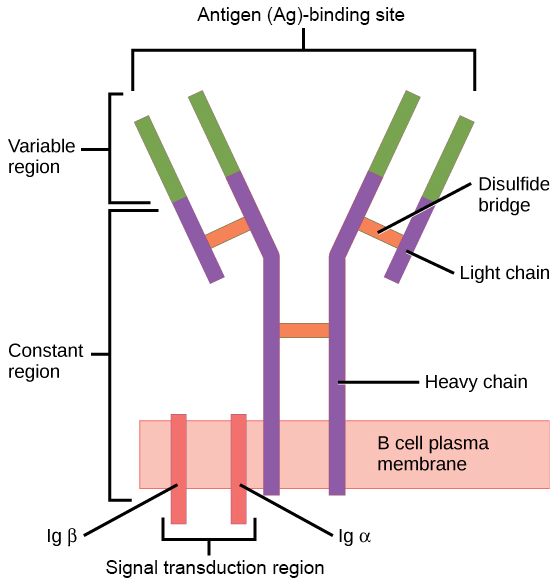
Imagen por Lecturio. Licencia: CC BY-NC-SA 4.0

Otros subconjuntos de células T CD4+

  • Th3
    • Importante en EN Erythema nodosum is an immune-mediated panniculitis (inflammation of the subcutaneous fat) caused by a type IV (delayed-type) hypersensitivity reaction. It commonly manifests in young women as tender, erythematous nodules on the shins. Erythema Nodosum la inducción de tolerancia mucosal
    • Promueven la formación y el mantenimiento de las células T reguladores inducidas
  • Th9 y Th22 se han descubierto recientemente.
    • Th9:
      • Estimuladas por IL-4, TGF-β
      • Importantes en EN Erythema nodosum is an immune-mediated panniculitis (inflammation of the subcutaneous fat) caused by a type IV (delayed-type) hypersensitivity reaction. It commonly manifests in young women as tender, erythematous nodules on the shins. Erythema Nodosum la inmunidad antitumoral, alergia y enfermedad autoinmune
    • Th22:
      • Produce IL-22 (como las células Th17 Th17 A subset of helper-effector T-lymphocytes which synthesize and secrete interleukins il-17; il-17f; and il-22. These cytokines are involved in host defenses and tissue inflammation in autoimmune diseases. T cells: Types and Functions)
      • La secreción de IL-22 con IL-17 produce efectos proinflamatorios (como en EN Erythema nodosum is an immune-mediated panniculitis (inflammation of the subcutaneous fat) caused by a type IV (delayed-type) hypersensitivity reaction. It commonly manifests in young women as tender, erythematous nodules on the shins. Erythema Nodosum la psoriasis Psoriasis Psoriasis is a common T-cell-mediated inflammatory skin condition. The etiology is unknown, but is thought to be due to genetic inheritance and environmental triggers. There are 4 major subtypes, with the most common form being chronic plaque psoriasis. Psoriasis).
      • Participa en EN Erythema nodosum is an immune-mediated panniculitis (inflammation of the subcutaneous fat) caused by a type IV (delayed-type) hypersensitivity reaction. It commonly manifests in young women as tender, erythematous nodules on the shins. Erythema Nodosum la inmunidad de las mucosas

Células T CD8+

  • Tcs TCS Treacher collins syndrome is a rare genetic condition with autosomal dominant inheritance. Treacher collins syndrome is also referred to as mandibulofacial dysostosis or franceschetti syndrome and is characterized by significant craniofacial deformities and conductive hearing loss. Treacher Collins Syndrome o células T citolíticas
  • Requieren la estimulación por citoquinas (IL-2) (de linfocitos Th1 Th1 A subset of helper-inducer T-lymphocytes which synthesize and secrete interleukin-2; interferon-gamma; and interleukin-12. Due to their ability to kill antigen-presenting cells and their lymphokine-mediated effector activity, th1 cells are associated with vigorous delayed-type hypersensitivity reactions. T cells: Types and Functions) para activarse, luego salen del órgano linfoide secundario, circulando en EN Erythema nodosum is an immune-mediated panniculitis (inflammation of the subcutaneous fat) caused by a type IV (delayed-type) hypersensitivity reaction. It commonly manifests in young women as tender, erythematous nodules on the shins. Erythema Nodosum busca de objetivos
  • Producen citoquinas IFNγ, TNF-α y TNF-β
  • Factor de transcripción: RUNX3
  • Sus funciones incluyen la eliminación de:
    • Patógenos
    • Células infectadas
    • Células tumorales
    • Aloinjertos

Activación de la Inmunidad Humoral

Células B

  • Las células B surgen del progenitor linfoide común.
  • En EN Erythema nodosum is an immune-mediated panniculitis (inflammation of the subcutaneous fat) caused by a type IV (delayed-type) hypersensitivity reaction. It commonly manifests in young women as tender, erythematous nodules on the shins. Erythema Nodosum etapas, las células B se desarrollan en EN Erythema nodosum is an immune-mediated panniculitis (inflammation of the subcutaneous fat) caused by a type IV (delayed-type) hypersensitivity reaction. It commonly manifests in young women as tender, erythematous nodules on the shins. Erythema Nodosum la médula ósea y se activan para realizar una respuesta inmune humoral.
  • Una célula B virgen madura con un receptor Receptor Receptors are proteins located either on the surface of or within a cell that can bind to signaling molecules known as ligands (e.g., hormones) and cause some type of response within the cell. Receptors de células B:
    • Sale de la médula ósea y migra a los LOS Neisseria órganos linfoides secundarios
    • Expresa IgM IgM A class of immunoglobulin bearing mu chains (immunoglobulin mu-chains). Igm can fix complement. The name comes from its high molecular weight and originally being called a macroglobulin. Immunoglobulins: Types and Functions e IgD IgD An immunoglobulin which accounts for less than 1% of plasma immunoglobulin. It is found on the membrane of many circulating B lymphocytes. Immunoglobulins: Types and Functions una vez dentro de los LOS Neisseria tejidos linfoides secundarios
receptor de células B

Receptor de células B:
Consiste en la molécula de inmunoglobulina y la molécula de señalización.
La inmunoglobulina unida a la membrana está anclada a la superficie celular. La Inmunoglobulina contiene 2 cadenas pesadas idénticas y 2 cadenas ligeras idénticas, unidas por un puente disulfuro.

Imagen: “Figure 42 02 06” por CNX OpenStax. Licencia: CC BY 4.0, editada por Lecturio.

Activación de células B

  • Se necesitan pasos ( en EN Erythema nodosum is an immune-mediated panniculitis (inflammation of the subcutaneous fat) caused by a type IV (delayed-type) hypersensitivity reaction. It commonly manifests in young women as tender, erythematous nodules on the shins. Erythema Nodosum detalle) para que la célula B funcione.
  • La activación puede ser:
    • Dependiente de células T
      • Las células B adhieren e internalizan antígenos extraños a través de sus receptores de células B (que funcionan como células presentadoras de antígenos) y luego presentan antígenos a través de moléculas del complejo mayor de histocompatibilidad II a las células T.
      • Las células B encuentran células Tfh CD4+ activadas (células T CD4 especializadas).
      • El complejo mayor de histocompatibilidad II-antígeno es reconocido por las células Tfh → las células B se activan → proliferación de células B
    • Independiente de células T
      • La activación no siempre necesita la ayuda de las células T.
      • Algunos antígenos, como los LOS Neisseria polisacáridos de una célula bacteriana (e.g., Streptococcus Streptococcus Streptococcus is one of the two medically important genera of gram-positive cocci, the other being Staphylococcus. Streptococci are identified as different species on blood agar on the basis of their hemolytic pattern and sensitivity to optochin and bacitracin. There are many pathogenic species of streptococci, including S. pyogenes, S. agalactiae, S. pneumoniae, and the viridans streptococci. Streptococcus pneumoniae y Haemophilus influenzae Haemophilus Influenzae A species of Haemophilus found on the mucous membranes of humans and a variety of animals. The species is further divided into biotypes I through viii. Haemophilus), pueden estimular directamente a las células B.
      • Respuestas de corta duración, principalmente con producción de IgM IgM A class of immunoglobulin bearing mu chains (immunoglobulin mu-chains). Igm can fix complement. The name comes from its high molecular weight and originally being called a macroglobulin. Immunoglobulins: Types and Functions (sin memoria)
  • Para producir una célula B diferenciada funcional después de la activación por un antígeno, los LOS Neisseria procesos que tienen lugar incluyen:
    • Proliferación
    • Maduración de la afinidad:
      • Ajuste de la afinidad del anticuerpo por el antígeno
      • Logrado por hipermutación somática (mutación programada que involucra genes Genes A category of nucleic acid sequences that function as units of heredity and which code for the basic instructions for the development, reproduction, and maintenance of organisms. DNA Types and Structure de cadena ligera y pesada de la inmunoglobulina)
      • Produce receptores de celulas B con capacidad mejorada para reconocer y unirse a un antígeno
    • Cambio de clase:
      • La cadena pesada determina la clase de la inmunoglobulina ( IgM IgM A class of immunoglobulin bearing mu chains (immunoglobulin mu-chains). Igm can fix complement. The name comes from its high molecular weight and originally being called a macroglobulin. Immunoglobulins: Types and Functions, IgG IgG The major immunoglobulin isotype class in normal human serum. There are several isotype subclasses of igg, for example, igg1, igg2a, and igg2b. Hypersensitivity Pneumonitis, IgE IgE An immunoglobulin associated with mast cells. Overexpression has been associated with allergic hypersensitivity. Immunoglobulins: Types and Functions, IgA IgA Represents 15-20% of the human serum immunoglobulins, mostly as the 4-chain polymer in humans or dimer in other mammals. Secretory iga is the main immunoglobulin in secretions. Immunoglobulins: Types and Functions, IgD IgD An immunoglobulin which accounts for less than 1% of plasma immunoglobulin. It is found on the membrane of many circulating B lymphocytes. Immunoglobulins: Types and Functions).
      • Influenciada por citoquinas
      • Se logra mediante el reordenamiento genético de los LOS Neisseria segmentos que codifican la región constante, mientras que la región variable Variable Variables represent information about something that can change. The design of the measurement scales, or of the methods for obtaining information, will determine the data gathered and the characteristics of that data. As a result, a variable can be qualitative or quantitative, and may be further classified into subgroups. Types of Variables no cambia
    • Diferenciación en EN Erythema nodosum is an immune-mediated panniculitis (inflammation of the subcutaneous fat) caused by a type IV (delayed-type) hypersensitivity reaction. It commonly manifests in young women as tender, erythematous nodules on the shins. Erythema Nodosum célula plasmática o célula de memoria.
B cell activation in the humoral immune response

Activación de las células B en la respuesta inmune humoral que produce los anticuerpos:
1) Una célula B se activa cuando encuentra su antígeno correspondiente.
2) El linfocito B engulle el antígeno y lo digiere.
3) A continuación, muestra fragmentos del antígeno unidos a su única molécula del complejo mayor de histocompatibilidad.
4) Esta combinación de antígeno y complejo mayor de histocompatibilidad atrae la ayuda de una célula T madura compatible.
5) Las citoquinas secretadas por la célula T ayudan a la célula B a multiplicarse y madurar en células plasmáticas productoras de anticuerpos.
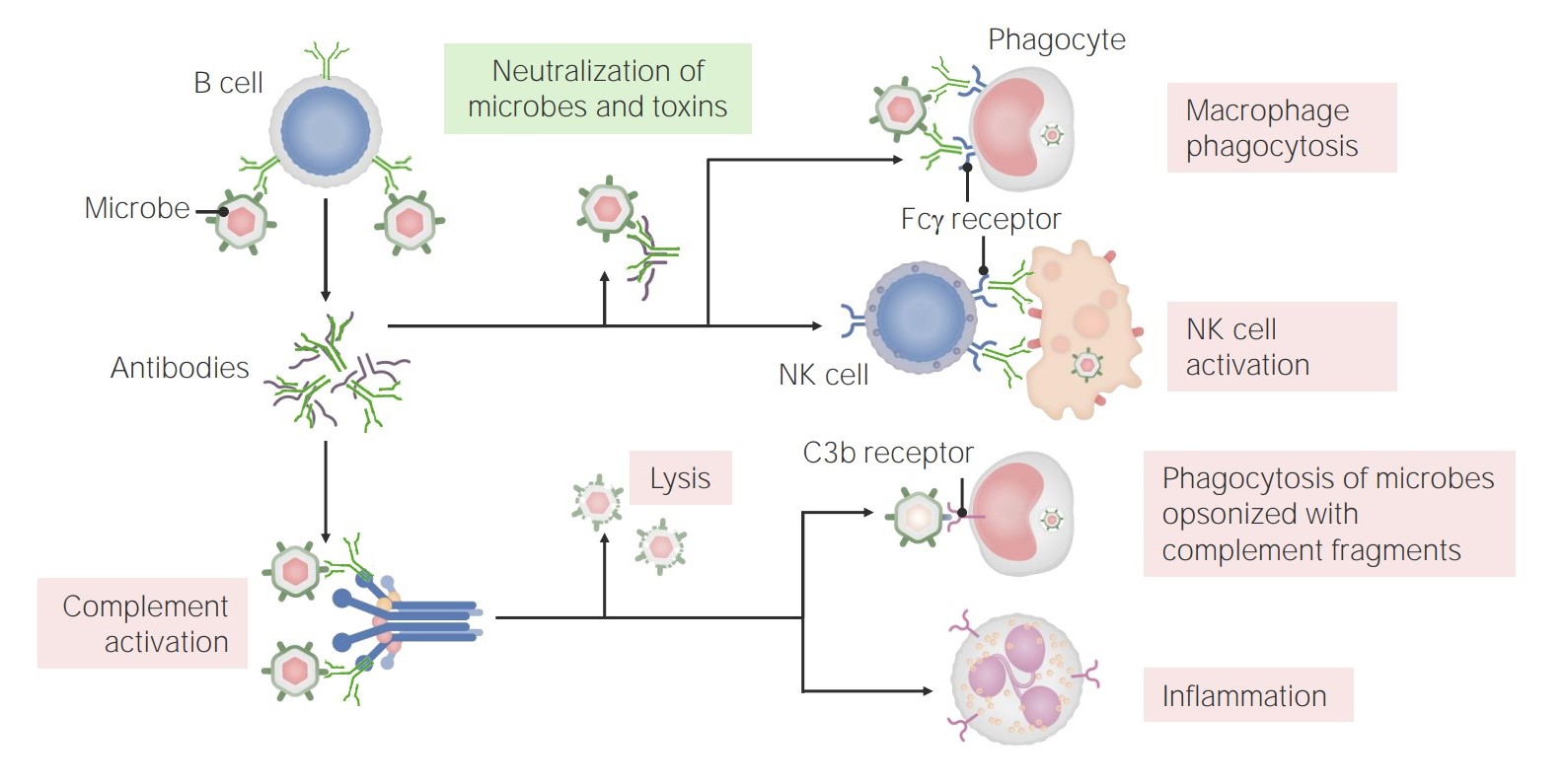
6) Liberados en la sangre, los anticuerpos se fijan al antígeno correspondiente. Los complejos antígeno-anticuerpo son eliminados por la cascada del complemento o por el hígado y el bazo.

Imagen por Lecturio.

Memoria Inmunológica

Una célula de memoria es un linfocito B o T específico para un antígeno que produce una fuerte respuesta inmune después de una nueva exposición al AL Amyloidosis mismo patógeno. Tanto las células B como las T de memoria expresan el marcador de superficie CD27.
Células B de memoria

  • Reaccionan a la estimulación antigénica ( en EN Erythema nodosum is an immune-mediated panniculitis (inflammation of the subcutaneous fat) caused by a type IV (delayed-type) hypersensitivity reaction. It commonly manifests in young women as tender, erythematous nodules on the shins. Erythema Nodosum respuesta a la reinfección)
  • Generan células plasmáticas que tengan anticuerpos de alta afinidad (particularmente IgG IgG The major immunoglobulin isotype class in normal human serum. There are several isotype subclasses of igg, for example, igg1, igg2a, and igg2b. Hypersensitivity Pneumonitis) en EN Erythema nodosum is an immune-mediated panniculitis (inflammation of the subcutaneous fat) caused by a type IV (delayed-type) hypersensitivity reaction. It commonly manifests in young women as tender, erythematous nodules on the shins. Erythema Nodosum respuestas inmunes secundarias

Células T de Memoria

  • Pueden ser CD4+ o CD8+
  • Estas células viven muchos años después de su diferenciación y maduración inicial, montando una respuesta inmune años después de la exposición inicial.
  • Después de la exposición inicial a antígenos, algunas células T se convierten en EN Erythema nodosum is an immune-mediated panniculitis (inflammation of the subcutaneous fat) caused by a type IV (delayed-type) hypersensitivity reaction. It commonly manifests in young women as tender, erythematous nodules on the shins. Erythema Nodosum células de memoria:
    • Estas células residen inicialmente dentro de los LOS Neisseria tejidos linfoides (células T de memoria central).
    • Luego, las células T de memoria se instalan en EN Erythema nodosum is an immune-mediated panniculitis (inflammation of the subcutaneous fat) caused by a type IV (delayed-type) hypersensitivity reaction. It commonly manifests in young women as tender, erythematous nodules on the shins. Erythema Nodosum los LOS Neisseria tejidos periféricos (células efectoras de memoria).
    • Después de la reinfección por el mismo antígeno, se convierten en EN Erythema nodosum is an immune-mediated panniculitis (inflammation of the subcutaneous fat) caused by a type IV (delayed-type) hypersensitivity reaction. It commonly manifests in young women as tender, erythematous nodules on the shins. Erythema Nodosum células T efectoras.
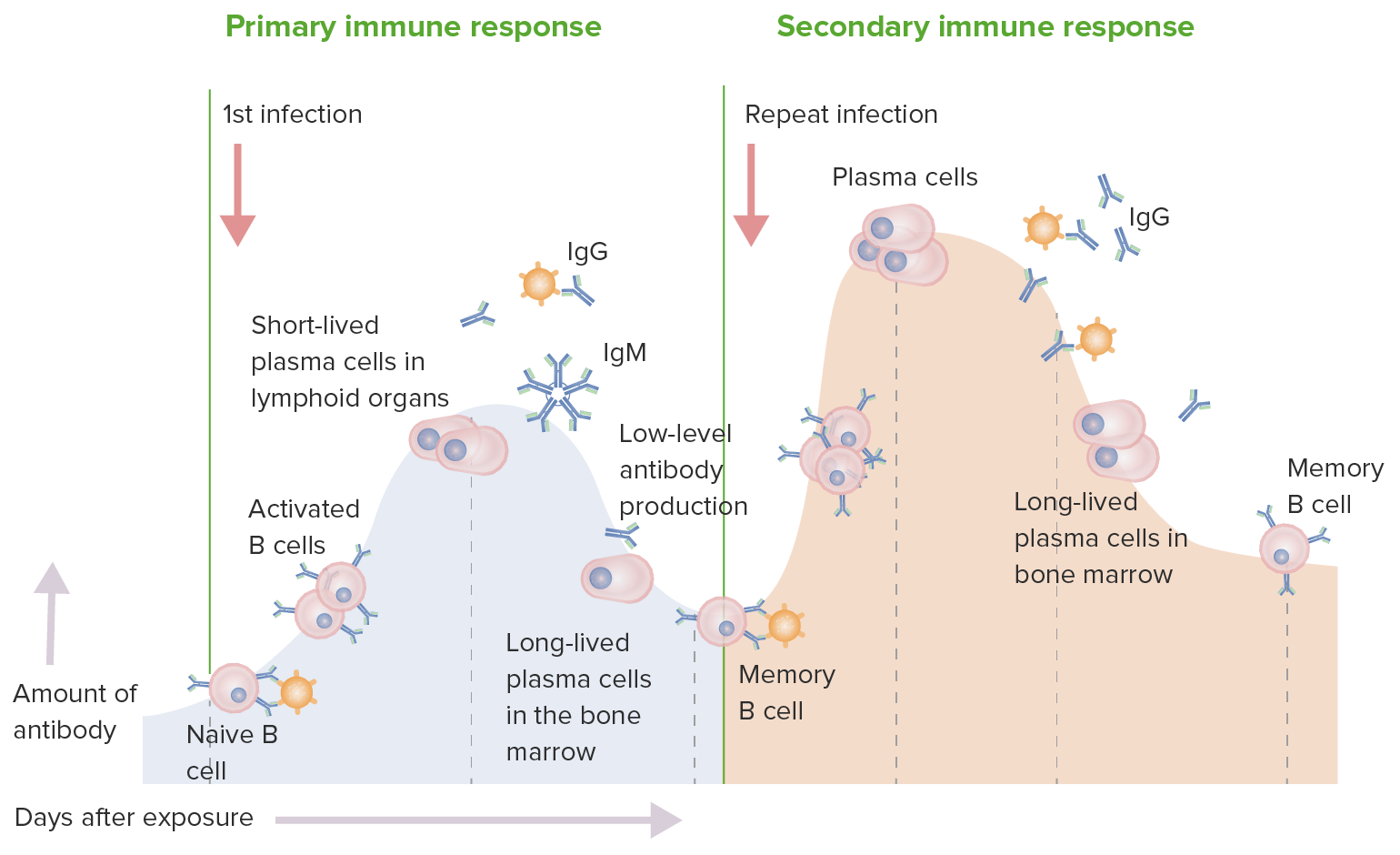
Diagrama de respuestas inmunitarias primarias y secundarias

Respuestas inmunes primarias y secundarias:
En una respuesta inmune primaria, las células B vírgenes son estimuladas por el antígeno. Se produce la activación de las células B y luego la diferenciación en células secretoras de anticuerpos. Los anticuerpos son específicos para el antígeno desencadenante. Luego, la producción de IgM es seguida por IgG. Si bien hay una respuesta inmune, la producción es de bajo nivel. En la respuesta inmune secundaria, el mismo antígeno estimula las células B de memoria, lo que conduce a la producción de mayores cantidades de anticuerpos específicos que se producen en la respuesta primaria. La producción y liberación de IgG también ocurre antes.

Imagen por Lecturio.

Relevancia Clínica

  • Agammaglobulinemia ligada al AL Amyloidosis cromosoma X: resulta de mutaciones en EN Erythema nodosum is an immune-mediated panniculitis (inflammation of the subcutaneous fat) caused by a type IV (delayed-type) hypersensitivity reaction. It commonly manifests in young women as tender, erythematous nodules on the shins. Erythema Nodosum el gen del cromosoma X que codifica para la tirosina quinasa de Bruton (BTK), que es esencial para el desarrollo y la maduración de las células B. La enfermedad se caracteriza por la ausencia de células B, lo que conduce a infecciones recurrentes, principalmente por bacterias encapsuladas y virus Virus Viruses are infectious, obligate intracellular parasites composed of a nucleic acid core surrounded by a protein capsid. Viruses can be either naked (non-enveloped) or enveloped. The classification of viruses is complex and based on many factors, including type and structure of the nucleoid and capsid, the presence of an envelope, the replication cycle, and the host range. Virology, que afectan los LOS Neisseria pulmones, los LOS Neisseria senos paranasales y la piel, así como el SNC. El tratamiento implica la administración de inmunoglobulinas.
  • Inmunodeficiencia variable Variable Variables represent information about something that can change. The design of the measurement scales, or of the methods for obtaining information, will determine the data gathered and the characteristics of that data. As a result, a variable can be qualitative or quantitative, and may be further classified into subgroups. Types of Variables común: también conocida como inmunodeficiencia humoral, la inmunodeficiencia variable Variable Variables represent information about something that can change. The design of the measurement scales, or of the methods for obtaining information, will determine the data gathered and the characteristics of that data. As a result, a variable can be qualitative or quantitative, and may be further classified into subgroups. Types of Variables común es un trastorno del sistema inmune caracterizado por niveles séricos reducidos de IgG IgG The major immunoglobulin isotype class in normal human serum. There are several isotype subclasses of igg, for example, igg1, igg2a, and igg2b. Hypersensitivity Pneumonitis, IgA IgA Represents 15-20% of the human serum immunoglobulins, mostly as the 4-chain polymer in humans or dimer in other mammals. Secretory iga is the main immunoglobulin in secretions. Immunoglobulins: Types and Functions e IgM IgM A class of immunoglobulin bearing mu chains (immunoglobulin mu-chains). Igm can fix complement. The name comes from its high molecular weight and originally being called a macroglobulin. Immunoglobulins: Types and Functions. Las causas subyacentes de la inmunodeficiencia variable Variable Variables represent information about something that can change. The design of the measurement scales, or of the methods for obtaining information, will determine the data gathered and the characteristics of that data. As a result, a variable can be qualitative or quantitative, and may be further classified into subgroups. Types of Variables común se desconocen en EN Erythema nodosum is an immune-mediated panniculitis (inflammation of the subcutaneous fat) caused by a type IV (delayed-type) hypersensitivity reaction. It commonly manifests in young women as tender, erythematous nodules on the shins. Erythema Nodosum gran medida. Los LOS Neisseria pacientes con inmunodeficiencia variable Variable Variables represent information about something that can change. The design of the measurement scales, or of the methods for obtaining information, will determine the data gathered and the characteristics of that data. As a result, a variable can be qualitative or quantitative, and may be further classified into subgroups. Types of Variables común son propensos a infecciones en EN Erythema nodosum is an immune-mediated panniculitis (inflammation of the subcutaneous fat) caused by a type IV (delayed-type) hypersensitivity reaction. It commonly manifests in young women as tender, erythematous nodules on the shins. Erythema Nodosum el tracto gastrointestinal y las vías respiratorias superiores e inferiores. La inmunodeficiencia variable Variable Variables represent information about something that can change. The design of the measurement scales, or of the methods for obtaining information, will determine the data gathered and the characteristics of that data. As a result, a variable can be qualitative or quantitative, and may be further classified into subgroups. Types of Variables común también se asocia con un mayor riesgo de desarrollar trastornos autoinmunes, enfermedades granulomatosas y malignidad. El tratamiento es la terapia de reemplazo de inmunoglobulinas.
  • Candidiasis Candidiasis Candida is a genus of dimorphic, opportunistic fungi. Candida albicans is part of the normal human flora and is the most common cause of candidiasis. The clinical presentation varies and can include localized mucocutaneous infections (e.g., oropharyngeal, esophageal, intertriginous, and vulvovaginal candidiasis) and invasive disease (e.g., candidemia, intraabdominal abscess, pericarditis, and meningitis). Candida/Candidiasis mucocutánea crónica: síndrome autoinmune con características que incluyen infecciones crónicas no invasivas por Candida Candida Candida is a genus of dimorphic, opportunistic fungi. Candida albicans is part of the normal human flora and is the most common cause of candidiasis. The clinical presentation varies and can include localized mucocutaneous infections (e.g., oropharyngeal, esophageal, intertriginous, and vulvovaginal candidiasis) and invasive disease (e.g., candidemia, intraabdominal abscess, pericarditis, and meningitis). Candida/Candidiasis de la piel, las uñas y las membranas mucosas. La enfermedad está asociada a manifestaciones autoinmunes (más comúnmente endocrinopatías). El hipoparatiroidismo es la anomalía endocrina más frecuente y se presenta en EN Erythema nodosum is an immune-mediated panniculitis (inflammation of the subcutaneous fat) caused by a type IV (delayed-type) hypersensitivity reaction. It commonly manifests in young women as tender, erythematous nodules on the shins. Erythema Nodosum el 30% de los LOS Neisseria pacientes. La insuficiencia suprarrenal ocurre en EN Erythema nodosum is an immune-mediated panniculitis (inflammation of the subcutaneous fat) caused by a type IV (delayed-type) hypersensitivity reaction. It commonly manifests in young women as tender, erythematous nodules on the shins. Erythema Nodosum > 60% de los LOS Neisseria casos a los LOS Neisseria 15 años. La candidiasis Candidiasis Candida is a genus of dimorphic, opportunistic fungi. Candida albicans is part of the normal human flora and is the most common cause of candidiasis. The clinical presentation varies and can include localized mucocutaneous infections (e.g., oropharyngeal, esophageal, intertriginous, and vulvovaginal candidiasis) and invasive disease (e.g., candidemia, intraabdominal abscess, pericarditis, and meningitis). Candida/Candidiasis mucocutánea crónica se debe a defectos genéticos en EN Erythema nodosum is an immune-mediated panniculitis (inflammation of the subcutaneous fat) caused by a type IV (delayed-type) hypersensitivity reaction. It commonly manifests in young women as tender, erythematous nodules on the shins. Erythema Nodosum el sistema inmunológico, incluidos los LOS Neisseria que afectan el regulador autoinmune, que es importante en EN Erythema nodosum is an immune-mediated panniculitis (inflammation of the subcutaneous fat) caused by a type IV (delayed-type) hypersensitivity reaction. It commonly manifests in young women as tender, erythematous nodules on the shins. Erythema Nodosum la selección negativa de las células T, y la vía de la interleucina 17, entre otros.
  • Desregulación inmune, poliendocrinopatía, enteropatía, síndrome ligado al AL Amyloidosis cromosoma X: una enfermedad causada por mutaciones en EN Erythema nodosum is an immune-mediated panniculitis (inflammation of the subcutaneous fat) caused by a type IV (delayed-type) hypersensitivity reaction. It commonly manifests in young women as tender, erythematous nodules on the shins. Erythema Nodosum el gen del factor de transcripción FOXP3. La característica definitoria es el deterioro de las células T reguladoras, que se manifiesta como una enfermedad autoinmune con inflamación alérgica. La enfermedad se presenta típicamente en EN Erythema nodosum is an immune-mediated panniculitis (inflammation of the subcutaneous fat) caused by a type IV (delayed-type) hypersensitivity reaction. It commonly manifests in young women as tender, erythematous nodules on the shins. Erythema Nodosum lactantes varones con una tríada de enteropatía, dermatitis Dermatitis Any inflammation of the skin. Atopic Dermatitis (Eczema) y endocrinopatía autoinmune (generalmente diabetes Diabetes Diabetes mellitus (DM) is a metabolic disease characterized by hyperglycemia and dysfunction of the regulation of glucose metabolism by insulin. Type 1 DM is diagnosed mostly in children and young adults as the result of autoimmune destruction of β cells in the pancreas and the resulting lack of insulin. Type 2 DM has a significant association with obesity and is characterized by insulin resistance. Diabetes Mellitus tipo 1 o tiroiditis). El diagnóstico se realiza mediante análisis mutacional del gen FOXP3. El trasplante de células hematopoyéticas es la única terapia curativa disponible.
  • Leucemia/linfoma de células T adultas: una neoplasia maligna rara, pero a menudo agresiva de células T maduras causada por una infección crónica de células T CD4+ con el virus linfotrópico T humano, tipo I. La presentación general es la afectación generalizada de los ganglios linfáticos, la sangre periférica y/o la piel. Los rasgos más característicos que se observan en la sangre periférica son las células en “hoja de trébol” o “flor” (células con núcleos hiperlobulados extraños). El diagnóstico se basa en EN Erythema nodosum is an immune-mediated panniculitis (inflammation of the subcutaneous fat) caused by a type IV (delayed-type) hypersensitivity reaction. It commonly manifests in young women as tender, erythematous nodules on the shins. Erythema Nodosum la presentación clínica, los LOS Neisseria cambios morfológicos e inmunofenotípicos de las células malignas y la confirmación de la infección por HTLV-I HTLV-I Acute Lymphoblastic Leukemia. El tratamiento incluye agentes antivirales, terapia con anticuerpos monoclonales, quimioterapia y trasplante alogénico de células madre.

Referencias

  1. Chaplin, DD. (2010). Overview of the immune response. Journal of Allergy and Clinical Immunology, 125(2), S3–S23. https://doi.org/10.1016/j.jaci.2009.12.980
  2. El-Sayed, Z. A., et al. (2019). X-linked agammaglobulinemia (XLA): Phenotype, diagnosis, and therapeutic challenges around the world. World Allergy Organization Journal, 12(3), 100018. https://doi.org/10.1016/j.waojou.2019.100018
  3. Grubbs, H., & Kahwaji, C. I. (2023). Physiology, active immunity. In StatPearls [Internet]. StatPearls Publishing. https://www.ncbi.nlm.nih.gov/books/NBK513280/

¡Crea tu cuenta gratis o inicia una sesión para seguir leyendo!

Regístrate ahora y obtén acceso gratuito a Lecturio con páginas de concepto, videos médicos y cuestionarios para tu educación médica.

User Reviews

Que tengas una sesión de estudio alegre y navideña 🎁 Ahorra 50% en todos los planes >>

Details