Domina Conceptos Médicos

Estudia para la escuela de medicina y tus examenes con Lecturio.

Piel: Estructura y Funciones

La piel, también conocida como sistema tegumentario, es el órgano más grande del cuerpo. La piel está compuesta principalmente por la epidermis Epidermis The external, nonvascular layer of the skin. It is made up, from within outward, of five layers of epithelium: (1) basal layer (stratum basale epidermidis); (2) spinous layer (stratum spinosum epidermidis); (3) granular layer (stratum granulosum epidermidis); (4) clear layer (stratum lucidum epidermidis); and (5) horny layer (stratum corneum epidermidis). Skin: Structure and Functions (capa externa) y la dermis Dermis A layer of vascularized connective tissue underneath the epidermis. The surface of the dermis contains innervated papillae. Embedded in or beneath the dermis are sweat glands; hair follicles; and sebaceous glands. Skin: Structure and Functions (capa profunda). La epidermis Epidermis The external, nonvascular layer of the skin. It is made up, from within outward, of five layers of epithelium: (1) basal layer (stratum basale epidermidis); (2) spinous layer (stratum spinosum epidermidis); (3) granular layer (stratum granulosum epidermidis); (4) clear layer (stratum lucidum epidermidis); and (5) horny layer (stratum corneum epidermidis). Skin: Structure and Functions se compone principalmente de queratinocitos que experimentan un rápido recambio, mientras que la dermis Dermis A layer of vascularized connective tissue underneath the epidermis. The surface of the dermis contains innervated papillae. Embedded in or beneath the dermis are sweat glands; hair follicles; and sebaceous glands. Skin: Structure and Functions contiene densas capas de tejido conectivo. La piel está compuesta por epitelio superficial, componentes exocrinos, tejido conectivo, músculos y nervios. La tarea principal de la piel es servir como barrera protectora entre el cuerpo interno y el ambiente externo; también protege al AL Amyloidosis cuerpo de la pérdida excesiva de líquidos.

Last updated: Dec 15, 2025

Editorial responsibility: Stanley Oiseth, Lindsay Jones, Evelin Maza

Estructura de la Piel

Células de la piel

  • Queratinocitos:
    • Principal tipo celular de la epidermis Epidermis The external, nonvascular layer of the skin. It is made up, from within outward, of five layers of epithelium: (1) basal layer (stratum basale epidermidis); (2) spinous layer (stratum spinosum epidermidis); (3) granular layer (stratum granulosum epidermidis); (4) clear layer (stratum lucidum epidermidis); and (5) horny layer (stratum corneum epidermidis). Skin: Structure and Functions
    • Sufren una mitosis Mitosis A type of cell nucleus division by means of which the two daughter nuclei normally receive identical complements of the number of chromosomes of the somatic cells of the species. Cell Cycle continua (estimulada por el factor de crecimiento epidérmico)
    • Producen queratina
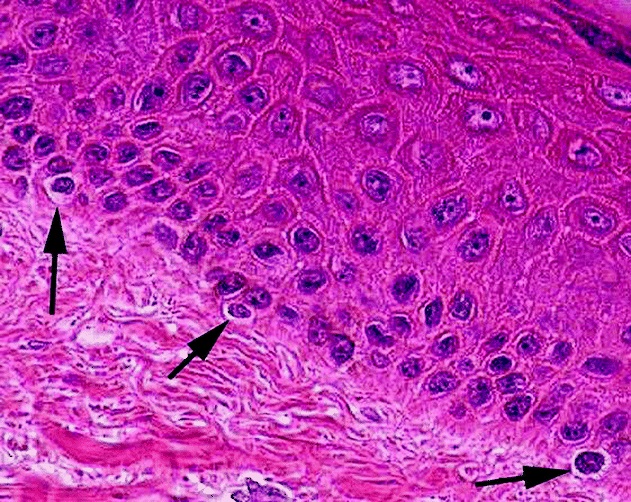
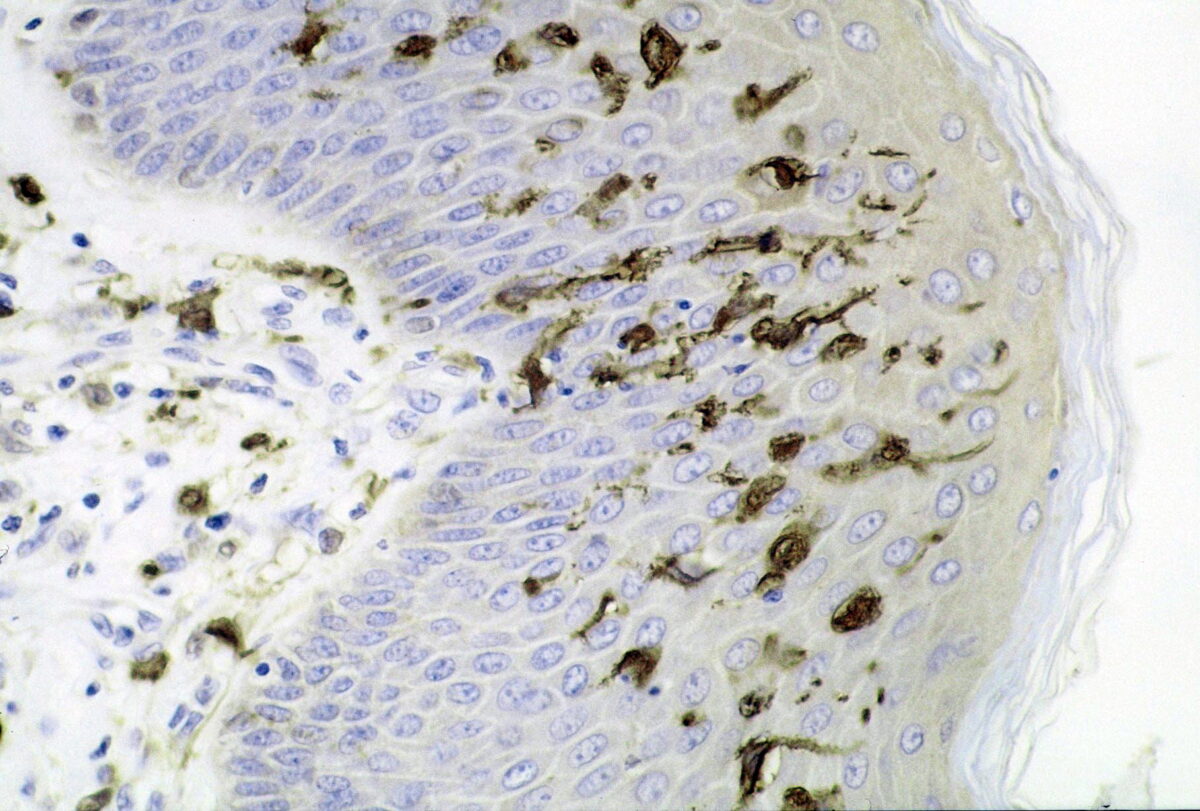
  • Melanocitos:
    • Células epiteliales en EN Erythema nodosum is an immune-mediated panniculitis (inflammation of the subcutaneous fat) caused by a type IV (delayed-type) hypersensitivity reaction. It commonly manifests in young women as tender, erythematous nodules on the shins. Erythema Nodosum forma de araña
    • Producen melanina (protección ultravioleta (UV))
    • Los LOS Neisseria gránulos de melanina se acumulan en EN Erythema nodosum is an immune-mediated panniculitis (inflammation of the subcutaneous fat) caused by a type IV (delayed-type) hypersensitivity reaction. It commonly manifests in young women as tender, erythematous nodules on the shins. Erythema Nodosum la superficie apical de los LOS Neisseria queratinocitos.
  • Células dendríticas (células de Langerhans):
    • Macrófagos residentes de la piel
    • Células presentadoras de antígenos
    • Activan el sistema inmunológico
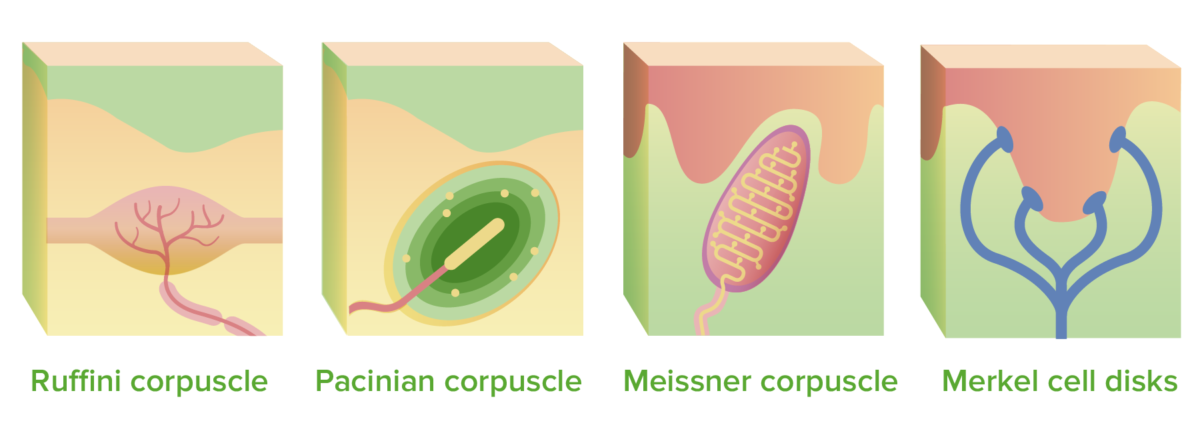
  • Mecanorreceptores:
    • Células de Merkel:
      • Receptores de tacto fino de adaptación lenta
      • Presentes en EN Erythema nodosum is an immune-mediated panniculitis (inflammation of the subcutaneous fat) caused by a type IV (delayed-type) hypersensitivity reaction. It commonly manifests in young women as tender, erythematous nodules on the shins. Erythema Nodosum la unión dermo–epidérmica
      • En EN Erythema nodosum is an immune-mediated panniculitis (inflammation of the subcutaneous fat) caused by a type IV (delayed-type) hypersensitivity reaction. It commonly manifests in young women as tender, erythematous nodules on the shins. Erythema Nodosum contacto con una terminación sensorial (Merkel o disco táctil)
    • Corpúsculos de Ruffini:
      • Receptores de estiramiento de adaptación lenta
      • Localizados en EN Erythema nodosum is an immune-mediated panniculitis (inflammation of the subcutaneous fat) caused by a type IV (delayed-type) hypersensitivity reaction. It commonly manifests in young women as tender, erythematous nodules on the shins. Erythema Nodosum la dermis Dermis A layer of vascularized connective tissue underneath the epidermis. The surface of the dermis contains innervated papillae. Embedded in or beneath the dermis are sweat glands; hair follicles; and sebaceous glands. Skin: Structure and Functions profunda
    • Corpúsculos de Meissner:
      • Receptores de tacto fino de adaptación rápida
      • Localizados en EN Erythema nodosum is an immune-mediated panniculitis (inflammation of the subcutaneous fat) caused by a type IV (delayed-type) hypersensitivity reaction. It commonly manifests in young women as tender, erythematous nodules on the shins. Erythema Nodosum la dermis Dermis A layer of vascularized connective tissue underneath the epidermis. The surface of the dermis contains innervated papillae. Embedded in or beneath the dermis are sweat glands; hair follicles; and sebaceous glands. Skin: Structure and Functions superficial
    • Corpúsculos de Pacini:
      • Detección profunda de presión y vibración
      • Localizados en EN Erythema nodosum is an immune-mediated panniculitis (inflammation of the subcutaneous fat) caused by a type IV (delayed-type) hypersensitivity reaction. It commonly manifests in young women as tender, erythematous nodules on the shins. Erythema Nodosum la dermis Dermis A layer of vascularized connective tissue underneath the epidermis. The surface of the dermis contains innervated papillae. Embedded in or beneath the dermis are sweat glands; hair follicles; and sebaceous glands. Skin: Structure and Functions profunda

Epidermis Epidermis The external, nonvascular layer of the skin. It is made up, from within outward, of five layers of epithelium: (1) basal layer (stratum basale epidermidis); (2) spinous layer (stratum spinosum epidermidis); (3) granular layer (stratum granulosum epidermidis); (4) clear layer (stratum lucidum epidermidis); and (5) horny layer (stratum corneum epidermidis). Skin: Structure and Functions

  • Derivada del ectodermo
  • Epitelio escamoso estratificado queratinizado
  • Tiene 4 o 5 capas principales:
    • Estrato basal (estrato germinativo):
      • Capa más profunda
      • Capa germinativa
      • Fila única de células epiteliales unidas a la dermis Dermis A layer of vascularized connective tissue underneath the epidermis. The surface of the dermis contains innervated papillae. Embedded in or beneath the dermis are sweat glands; hair follicles; and sebaceous glands. Skin: Structure and Functions por hemidesmosomas ( macula Macula An oval area in the retina, 3 to 5 mm in diameter, usually located temporal to the posterior pole of the eye and slightly below the level of the optic disk. It is characterized by the presence of a yellow pigment diffusely permeating the inner layers, contains the fovea centralis in its center, and provides the best phototropic visual acuity. It is devoid of retinal blood vessels, except in its periphery, and receives nourishment from the choriocapillaris of the choroid. Eye: Anatomy adherens Adherens Anchoring points where the cytoskeleton of neighboring cells are connected to each other. They are composed of specialized areas of the plasma membrane where bundles of the actin cytoskeleton attach to the membrane through the transmembrane linkers, cadherins, which in turn attach through their extracellular domains to cadherins in the neighboring cell membranes. In sheets of cells, they form into adhesion belts (zonula adherens) that go all the way around a cell. The Cell: Cell Junctions)
      • Se divide constantemente mientras se mueve hacia la superficie
      • Entre el 10%–15% de las células son melanocitos.
    • Estrato espinoso (capa espinosa):
      • Consta de varias capas (capa más gruesa de la epidermis Epidermis The external, nonvascular layer of the skin. It is made up, from within outward, of five layers of epithelium: (1) basal layer (stratum basale epidermidis); (2) spinous layer (stratum spinosum epidermidis); (3) granular layer (stratum granulosum epidermidis); (4) clear layer (stratum lucidum epidermidis); and (5) horny layer (stratum corneum epidermidis). Skin: Structure and Functions)
      • Sistema de filamentos similar a una red
      • Las células están unidas por desmosomas.
      • A medida que las células ascienden a través de la capa espinosa, acumulan gránulos de queratohialina.
      • Otros elementos presentes son las células dendríticas y los LOS Neisseria gránulos de melanina.
    • Estrato granuloso:
      • Capa delgada de 4–6 células
      • Localización de la queratinización
      • Las células se aplanan y los LOS Neisseria núcleos y organelos comienzan a desintegrarse.
      • Las células adquieren 2 tipos de gránulos, gránulos de queratohialina y gránulos lamelares (protegen de la pérdida de agua).
    • Estrato lúcido (capa clara):
      • Sólo se ve VE Ventilation: Mechanics of Breathing en EN Erythema nodosum is an immune-mediated panniculitis (inflammation of the subcutaneous fat) caused by a type IV (delayed-type) hypersensitivity reaction. It commonly manifests in young women as tender, erythematous nodules on the shins. Erythema Nodosum la piel gruesa
      • Banda delgada y translúcida
      • Formada por 2–3 capas de queratinocitos
    • Estrato córneo (capa córnea):
      • 20–30 capas de células anucleadas aplanadas
      • Más delgada en EN Erythema nodosum is an immune-mediated panniculitis (inflammation of the subcutaneous fat) caused by a type IV (delayed-type) hypersensitivity reaction. It commonly manifests in young women as tender, erythematous nodules on the shins. Erythema Nodosum el cristalino, más gruesa en EN Erythema nodosum is an immune-mediated panniculitis (inflammation of the subcutaneous fat) caused by a type IV (delayed-type) hypersensitivity reaction. It commonly manifests in young women as tender, erythematous nodules on the shins. Erythema Nodosum los LOS Neisseria callos
  • 4 tipos de células:
    • Queratinocitos:
      • Más profundos, producen queratina (proteína fibrosa resistente)
      • Pasan por todas las capas de la epidermis Epidermis The external, nonvascular layer of the skin. It is made up, from within outward, of five layers of epithelium: (1) basal layer (stratum basale epidermidis); (2) spinous layer (stratum spinosum epidermidis); (3) granular layer (stratum granulosum epidermidis); (4) clear layer (stratum lucidum epidermidis); and (5) horny layer (stratum corneum epidermidis). Skin: Structure and Functions en EN Erythema nodosum is an immune-mediated panniculitis (inflammation of the subcutaneous fat) caused by a type IV (delayed-type) hypersensitivity reaction. It commonly manifests in young women as tender, erythematous nodules on the shins. Erythema Nodosum 30 días
    • Melanocitos:
      • Producen melanina
      • Viven dentro del estrato basal
    • Células de Merkel:
      • Vinculadas con terminaciones nerviosas sensoriales
      • Único mecanorreceptor con conexión a la epidermis Epidermis The external, nonvascular layer of the skin. It is made up, from within outward, of five layers of epithelium: (1) basal layer (stratum basale epidermidis); (2) spinous layer (stratum spinosum epidermidis); (3) granular layer (stratum granulosum epidermidis); (4) clear layer (stratum lucidum epidermidis); and (5) horny layer (stratum corneum epidermidis). Skin: Structure and Functions
    • Células de Langerhans:
      • Células dendríticas similares a macrófagos
      • Activan el sistema inmunológico
Capas de la epidermis

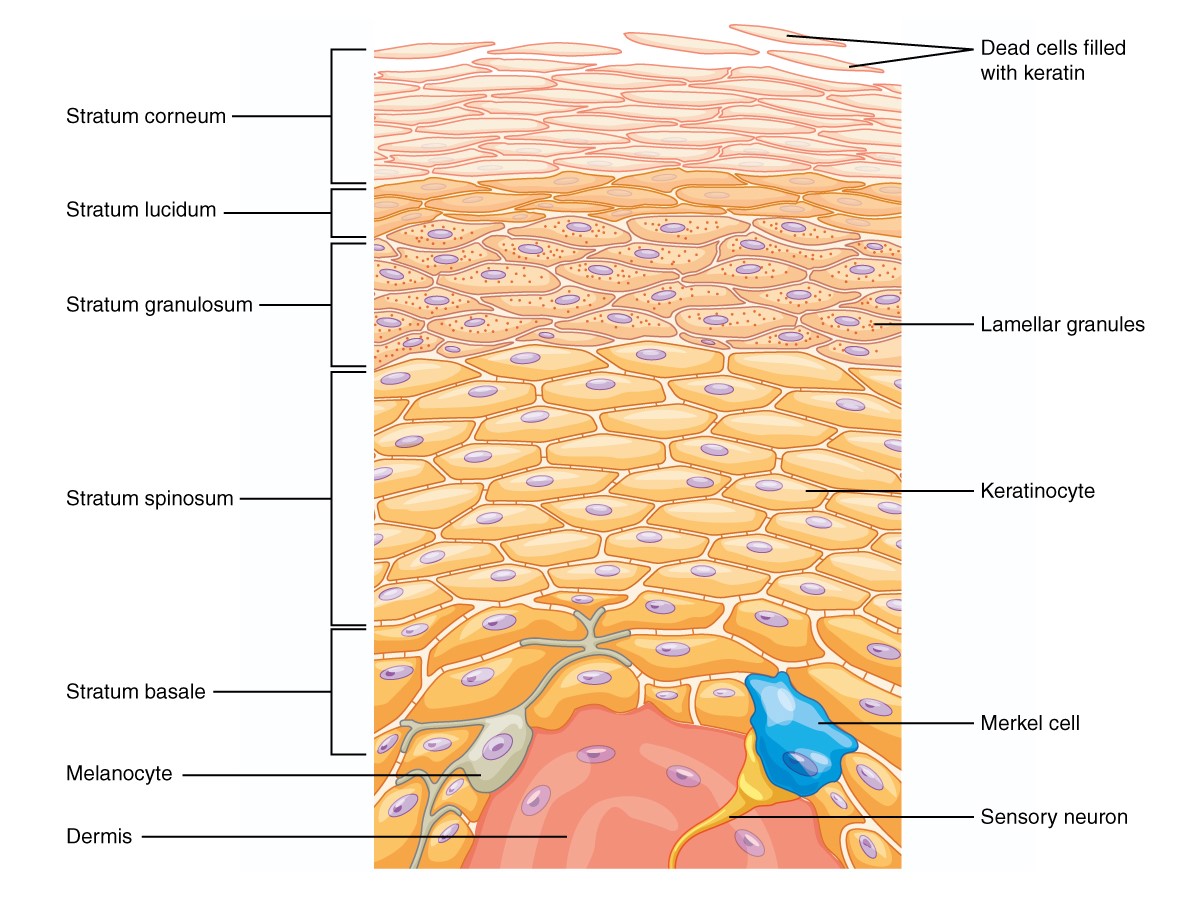
Hay 5 capas de la epidermis:
Partiendo de las células ubicadas en el estrato basal, se diferencian y proliferan hacia la superficie de la piel y se integran en las otras capas, siendo la última capa el estrato córneo, que está compuesto por células queratinizadas muertas.

Imagen: “The epidermis of thick skin has five layers: stratum basale, stratum spinosum, stratum granulosum, stratum lucidum, and stratum corneum.” por OpenStax College. Licencia: CC BY 4.0

Dermis Dermis A layer of vascularized connective tissue underneath the epidermis. The surface of the dermis contains innervated papillae. Embedded in or beneath the dermis are sweat glands; hair follicles; and sebaceous glands. Skin: Structure and Functions

  • Derivada del mesodermo
  • Componentes:
    • Tejido conectivo fuerte y flexible (principalmente colágeno)
    • Contiene fibroblastos, macrófagos, mastocitos ocasionales y leucocitos
    • Las fibras elásticas aportan flexibilidad a la dermis Dermis A layer of vascularized connective tissue underneath the epidermis. The surface of the dermis contains innervated papillae. Embedded in or beneath the dermis are sweat glands; hair follicles; and sebaceous glands. Skin: Structure and Functions
    • Las glándulas sebáceas mantienen la elasticidad y la fuerza.
  • Aporta nutrientes + humedad a la epidermis Epidermis The external, nonvascular layer of the skin. It is made up, from within outward, of five layers of epithelium: (1) basal layer (stratum basale epidermidis); (2) spinous layer (stratum spinosum epidermidis); (3) granular layer (stratum granulosum epidermidis); (4) clear layer (stratum lucidum epidermidis); and (5) horny layer (stratum corneum epidermidis). Skin: Structure and Functions
  • Contiene un abundante suministro de vasos sanguíneos, vasos linfáticos y terminaciones nerviosas
  • 2 capas:
    • Capa papilar:
      • Capa superficial fina
      • Compuesta por fibras de elastina y colágeno
      • Contiene fagocitos, fibroblastos y adipocitos
      • Las proyecciones de esta capa hacia la epidermis Epidermis The external, nonvascular layer of the skin. It is made up, from within outward, of five layers of epithelium: (1) basal layer (stratum basale epidermidis); (2) spinous layer (stratum spinosum epidermidis); (3) granular layer (stratum granulosum epidermidis); (4) clear layer (stratum lucidum epidermidis); and (5) horny layer (stratum corneum epidermidis). Skin: Structure and Functions se denominan papilas dérmicas.
      • Las papilas dérmicas forman crestas epidérmicas en EN Erythema nodosum is an immune-mediated panniculitis (inflammation of the subcutaneous fat) caused by a type IV (delayed-type) hypersensitivity reaction. It commonly manifests in young women as tender, erythematous nodules on the shins. Erythema Nodosum la superficie de la epidermis Epidermis The external, nonvascular layer of the skin. It is made up, from within outward, of five layers of epithelium: (1) basal layer (stratum basale epidermidis); (2) spinous layer (stratum spinosum epidermidis); (3) granular layer (stratum granulosum epidermidis); (4) clear layer (stratum lucidum epidermidis); and (5) horny layer (stratum corneum epidermidis). Skin: Structure and Functions (huellas dactilares).
      • Los LOS Neisseria bucles capilares y las terminaciones nerviosas (terminaciones nerviosas libres y corpúsculos de Meissner) se encuentran en EN Erythema nodosum is an immune-mediated panniculitis (inflammation of the subcutaneous fat) caused by a type IV (delayed-type) hypersensitivity reaction. It commonly manifests in young women as tender, erythematous nodules on the shins. Erythema Nodosum las papilas dérmicas.
    • Capa reticular:
      • Representa el 80% del grosor de la dermis Dermis A layer of vascularized connective tissue underneath the epidermis. The surface of the dermis contains innervated papillae. Embedded in or beneath the dermis are sweat glands; hair follicles; and sebaceous glands. Skin: Structure and Functions
      • Tejido conectivo fibroso denso irregular
      • Plexo cutáneo bien vascularizado
      • Da elasticidad a la piel y ayuda a endurecer la piel
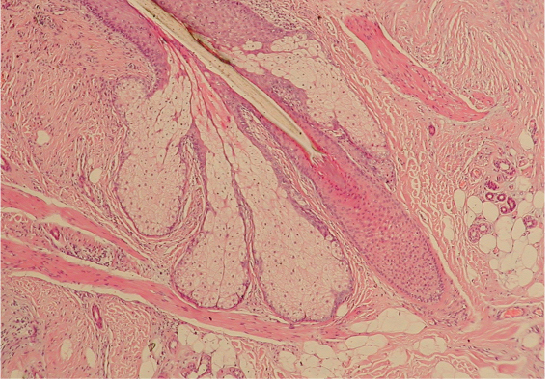
      • Contiene glándulas sudoríparas y folículos pilosos
Capas de la dermis

La dermis está formada por 2 capas:
La capa papilar está formada por fibras de colágeno y elastina y contiene fagocitos, fibroblastos y adipocitos. La capa reticular le da a la piel su elasticidad y ayuda a endurecer la piel. En esta capa se encuentran las glándulas sudoríparas y los folículos pilosos. Esta capa también está bien vascularizada.

Imagen: “This stained slide shows the two components of the dermis—the papillary layer and the reticular layer.” por OpenStax College. Licencia: CC BY 4.0

Función de la Piel

Cada capa de la piel tiene una función única.

Epidermis Epidermis The external, nonvascular layer of the skin. It is made up, from within outward, of five layers of epithelium: (1) basal layer (stratum basale epidermidis); (2) spinous layer (stratum spinosum epidermidis); (3) granular layer (stratum granulosum epidermidis); (4) clear layer (stratum lucidum epidermidis); and (5) horny layer (stratum corneum epidermidis). Skin: Structure and Functions y dermis Dermis A layer of vascularized connective tissue underneath the epidermis. The surface of the dermis contains innervated papillae. Embedded in or beneath the dermis are sweat glands; hair follicles; and sebaceous glands. Skin: Structure and Functions:

  • Protección mecánica
  • Protección contra patógenos externos
  • Mantenimiento de la pérdida de agua cutánea
  • Regulación de la temperatura:
    • ↑ Temperatura → Se dilatan los LOS Neisseria vasos sanguíneos de la capa papilar de la dermis Dermis A layer of vascularized connective tissue underneath the epidermis. The surface of the dermis contains innervated papillae. Embedded in or beneath the dermis are sweat glands; hair follicles; and sebaceous glands. Skin: Structure and Functions.
    • El cuerpo también se enfría liberando sudor.
  • Los LOS Neisseria melanocitos proporcionan protección contra la radiación UV.
  • Glándulas sebáceas:
    • Asociadas con folículos pilosos
    • Secretan sebo para hidratar la piel

Hipodermis:

  • Ubicada profundamente en EN Erythema nodosum is an immune-mediated panniculitis (inflammation of the subcutaneous fat) caused by a type IV (delayed-type) hypersensitivity reaction. It commonly manifests in young women as tender, erythematous nodules on the shins. Erythema Nodosum la dermis Dermis A layer of vascularized connective tissue underneath the epidermis. The surface of the dermis contains innervated papillae. Embedded in or beneath the dermis are sweat glands; hair follicles; and sebaceous glands. Skin: Structure and Functions
  • Contiene tejido adiposo, que sirve como reserva de energía

Anexos Cutáneos

Cabello

  • El crecimiento comienza en EN Erythema nodosum is an immune-mediated panniculitis (inflammation of the subcutaneous fat) caused by a type IV (delayed-type) hypersensitivity reaction. It commonly manifests in young women as tender, erythematous nodules on the shins. Erythema Nodosum la papila capilar de la dermis Dermis A layer of vascularized connective tissue underneath the epidermis. The surface of the dermis contains innervated papillae. Embedded in or beneath the dermis are sweat glands; hair follicles; and sebaceous glands. Skin: Structure and Functions.
  • Compuesto por células queratinizadas que emergen y migran hacia arriba dentro del folículo piloso.
  • Cada folículo piloso tiene una glándula sebácea asociada.
  • El músculo erector del pelo provoca la piloerección del tallo del cabello (piel de gallina).
  • Pelos terminales: pelo grueso en EN Erythema nodosum is an immune-mediated panniculitis (inflammation of the subcutaneous fat) caused by a type IV (delayed-type) hypersensitivity reaction. It commonly manifests in young women as tender, erythematous nodules on the shins. Erythema Nodosum cuero cabelludo, cejas, etc ETC The electron transport chain (ETC) sends electrons through a series of proteins, which generate an electrochemical proton gradient that produces energy in the form of adenosine triphosphate (ATP). Electron Transport Chain (ETC).
  • Vello: cabello muy fino que cubre a un recién nacido o las mejillas de un adulto
  • Pubertad:
    • Crecimiento de pelos terminales
    • Se acumula en EN Erythema nodosum is an immune-mediated panniculitis (inflammation of the subcutaneous fat) caused by a type IV (delayed-type) hypersensitivity reaction. It commonly manifests in young women as tender, erythematous nodules on the shins. Erythema Nodosum ciertas áreas (vello púbico/facial)
  • Piel lampiña o glabra: áreas de la piel no cubiertas por cabello (4%)
  • Ciclo de crecimiento:
    • Fase 1:
      • Fase de crecimiento/anágena
      • Dura 2–10 años
    • Fase 2:
      • Fase de transición/catágena
      • Dura 2 semanas
    • Fase 3:
      • Fase de reposo/telógena
      • Dura 3–8 meses

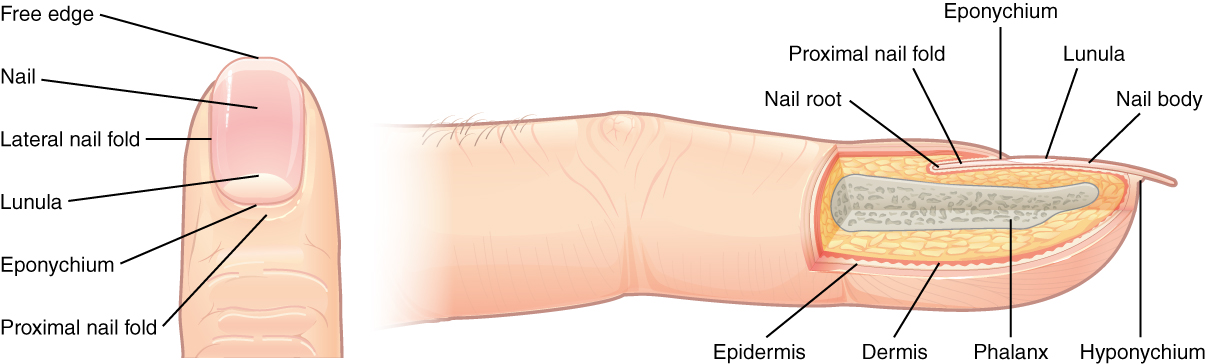
Uñas

  • Compuestas por densas células queratinizadas de la epidermis Epidermis The external, nonvascular layer of the skin. It is made up, from within outward, of five layers of epithelium: (1) basal layer (stratum basale epidermidis); (2) spinous layer (stratum spinosum epidermidis); (3) granular layer (stratum granulosum epidermidis); (4) clear layer (stratum lucidum epidermidis); and (5) horny layer (stratum corneum epidermidis). Skin: Structure and Functions
  • Protege las yemas de los LOS Neisseria dedos de las manos y los LOS Neisseria pies contra lesiones
  • Lúnula: área blanquecina en EN Erythema nodosum is an immune-mediated panniculitis (inflammation of the subcutaneous fat) caused by a type IV (delayed-type) hypersensitivity reaction. It commonly manifests in young women as tender, erythematous nodules on the shins. Erythema Nodosum forma de media luna en EN Erythema nodosum is an immune-mediated panniculitis (inflammation of the subcutaneous fat) caused by a type IV (delayed-type) hypersensitivity reaction. It commonly manifests in young women as tender, erythematous nodules on the shins. Erythema Nodosum el extremo proximal de la uña
  • Cutícula:
  • Raíz de las uñas:
    • Detrás de la cutícula
    • Forma células queratinizadas que empujan la uña hacia adelante
  • Estructura de la uña:
    • Placa de la uña: uña real, compuesta de queratina
    • Lecho ungueal:
      • Debajo de la placa de la uña
      • Continuo con estratos basales y espinoso
    • Matriz ungueal (raíz de la uña):
      • Extremo proximal de la uña, profundo a la piel
      • Responsable de la formación de nueva uña
    • Eponiquio: cutícula
    • Hiponiquio: extensión distal de la uña
Estructura de la uña

Estructura de la uña:
El extremo blanquecino en forma de media luna de la uña (hacia el cuerpo) se conoce como lúnula (“luna pequeña”). Entre la lúnula y la piel, hay una capa protectora, llamada cutícula, que evita que los patógenos entren debajo de la piel. Detrás de la cutícula (hacia el cuerpo), está la raíz de la uña, que forma células queratinizadas que empujan la uña hacia adelante.
Las uñas de las manos crecen más rápido que las de los pies. La tasa de crecimiento típica de una uña de las manos es de 1 mm por semana; una uña de los pies crece 0,5 mm por semana.

Imagen: “Nails” por OpenStax College. Licencia: CC BY 4.0

Related videos

Relevancia Clínica

  • Erisipela: infección cutánea superficial que afecta la dermis Dermis A layer of vascularized connective tissue underneath the epidermis. The surface of the dermis contains innervated papillae. Embedded in or beneath the dermis are sweat glands; hair follicles; and sebaceous glands. Skin: Structure and Functions, además de los LOS Neisseria linfáticos cutáneos superficiales. La afección es causada por bacterias, más comúnmente Streptococcus Streptococcus Streptococcus is one of the two medically important genera of gram-positive cocci, the other being Staphylococcus. Streptococci are identified as different species on blood agar on the basis of their hemolytic pattern and sensitivity to optochin and bacitracin. There are many pathogenic species of streptococci, including S. pyogenes, S. agalactiae, S. pneumoniae, and the viridans streptococci. Streptococcus pyogenes. La incidencia de la erisipela ha HA Hemolytic anemia (HA) is the term given to a large group of anemias that are caused by the premature destruction/hemolysis of circulating red blood cells (RBCs). Hemolysis can occur within (intravascular hemolysis) or outside the blood vessels (extravascular hemolysis). Hemolytic Anemia ido disminuyendo desde la introducción de los LOS Neisseria antibióticos. Los LOS Neisseria posibles factores de riesgo incluyen una higiene deficiente, un saneamiento deficiente y antecedentes de linfedema.
  • Molusco contagioso: infección viral de la piel que solo afecta al AL Amyloidosis ser humano. La infección es generalmente leve y no debe ser motivo de preocupación. El molusco contagioso causa múltiples pápulas del color de la piel en EN Erythema nodosum is an immune-mediated panniculitis (inflammation of the subcutaneous fat) caused by a type IV (delayed-type) hypersensitivity reaction. It commonly manifests in young women as tender, erythematous nodules on the shins. Erythema Nodosum forma de cúpula elevadas con umbilicación central. La afección es autolimitada y, por lo tanto, no requiere tratamiento. El virus Virus Viruses are infectious, obligate intracellular parasites composed of a nucleic acid core surrounded by a protein capsid. Viruses can be either naked (non-enveloped) or enveloped. The classification of viruses is complex and based on many factors, including type and structure of the nucleoid and capsid, the presence of an envelope, the replication cycle, and the host range. Virology pertenece a la familia Poxviridae Poxviridae A family of double-stranded DNA viruses infecting mammals (including humans), birds and insects. There are two subfamilies: chordopoxvirinae, poxviruses of vertebrates, and entomopoxvirinae, poxviruses of insects. Orthopoxvirus.
  • Carcinoma de células basales: la neoplasia maligna más común de la piel. El carcinoma de células basales es un cáncer de piel no melanoma Melanoma Melanoma is a malignant tumor arising from melanocytes, the melanin-producing cells of the epidermis. These tumors are most common in fair-skinned individuals with a history of excessive sun exposure and sunburns. Melanoma que se forma de novo a partir de células del estrato basal. El carcinoma de células basales afecta únicamente la piel con pelo y suele aparecer en EN Erythema nodosum is an immune-mediated panniculitis (inflammation of the subcutaneous fat) caused by a type IV (delayed-type) hypersensitivity reaction. It commonly manifests in young women as tender, erythematous nodules on the shins. Erythema Nodosum zonas expuestas a la radiación UV del sol. Las ubicaciones más comunes son la cara, cabeza y cuello.
  • Melanoma Melanoma Melanoma is a malignant tumor arising from melanocytes, the melanin-producing cells of the epidermis. These tumors are most common in fair-skinned individuals with a history of excessive sun exposure and sunburns. Melanoma: el melanoma Melanoma Melanoma is a malignant tumor arising from melanocytes, the melanin-producing cells of the epidermis. These tumors are most common in fair-skinned individuals with a history of excessive sun exposure and sunburns. Melanoma maligno implica la transformación maligna de los LOS Neisseria melanocitos. El melanoma Melanoma Melanoma is a malignant tumor arising from melanocytes, the melanin-producing cells of the epidermis. These tumors are most common in fair-skinned individuals with a history of excessive sun exposure and sunburns. Melanoma representa más del 90% de las muertes causadas por cáncer de piel. Exposición crónica a la luz UV, daño causado por la luz solar (incluidas las quemaduras solares, especialmente durante la infancia y la adolescencia), el tipo de piel clara y la aparición acumulada de nevos melanocíticos (> 100) o la presencia de nevos displásicos representan factores de riesgo importantes. El factor de riesgo más importante es la exposición a la luz solar, en EN Erythema nodosum is an immune-mediated panniculitis (inflammation of the subcutaneous fat) caused by a type IV (delayed-type) hypersensitivity reaction. It commonly manifests in young women as tender, erythematous nodules on the shins. Erythema Nodosum particular a la radiación UVB.
  • Carcinoma de células escamosas: cáncer de piel no melanocítico que surge de los LOS Neisseria queratinocitos epidérmicos suprabasales. El carcinoma de células escamosas es el 2do cáncer de piel no melanocítico más común, después del carcinoma de células basales. Este carcinoma se ve VE Ventilation: Mechanics of Breathing con mayor frecuencia en EN Erythema nodosum is an immune-mediated panniculitis (inflammation of the subcutaneous fat) caused by a type IV (delayed-type) hypersensitivity reaction. It commonly manifests in young women as tender, erythematous nodules on the shins. Erythema Nodosum las áreas expuestas al AL Amyloidosis sol en EN Erythema nodosum is an immune-mediated panniculitis (inflammation of the subcutaneous fat) caused by a type IV (delayed-type) hypersensitivity reaction. It commonly manifests in young women as tender, erythematous nodules on the shins. Erythema Nodosum las personas > 40 años de edad. Los LOS Neisseria hombres blancos tienen más probabilidades de verse afectados por este cáncer; sin embargo, el carcinoma de células escamosas es el cáncer de piel más común en EN Erythema nodosum is an immune-mediated panniculitis (inflammation of the subcutaneous fat) caused by a type IV (delayed-type) hypersensitivity reaction. It commonly manifests in young women as tender, erythematous nodules on the shins. Erythema Nodosum pacientes con tipos de piel más oscuros.

Referencias

  1. Kierszenbaum, A. L., Tres, L. L. (2019). Histology and Cell Biology: An Introduction to Pathology, 5th ed. Elsevier.
  2. Navarette-Dechent, C., et al. (2020). Human surface anatomy terminology for dermatology: a Delphi consensus from the International Skin Imaging Collaboration. Journal of the European Academy of Dermatology and Venereology 34:2659–2663. https://doi.org/10.1111/jdv.16855
  3. Yousef, H., Alhajj, M., Sharma, S. (2020). Anatomy, skin (integument), Epidermis. StatPearls. Retrived October 15, 2021, from https://europepmc.org/article/nbk/nbk470464

¡Crea tu cuenta gratis o inicia una sesión para seguir leyendo!

Regístrate ahora y obtén acceso gratuito a Lecturio con páginas de concepto, videos médicos y cuestionarios para tu educación médica.

User Reviews

Que tengas una sesión de estudio alegre y navideña 🎁 Ahorra 50% en todos los planes >>

Details