Domina Conceptos Médicos

Estudia para la escuela de medicina y tus examenes con Lecturio.

Penicilinas

Los LOS Neisseria antibióticos betalactámicos contienen un anillo betalactámico como parte de su estructura química. Los LOS Neisseria medicamentos de esta clase incluyen las penicilinas G y V, las penicilinas sensibles y resistentes a la penicilinasa, las cefalosporinas, los LOS Neisseria carbapenémicos y el aztreonam Aztreonam The carbapenems and aztreonam are both members of the bactericidal beta-lactam family of antibiotics (similar to penicillins). They work by preventing bacteria from producing their cell wall, ultimately leading to bacterial cell death. Carbapenems and Aztreonam. Los LOS Neisseria antibióticos betalactámicos bloquean la transpeptidasa bacteriana (proteína fijadora de penicilina) y, por lo tanto, inactivan el entrecruzamiento de peptidoglucano en EN Erythema nodosum is an immune-mediated panniculitis (inflammation of the subcutaneous fat) caused by a type IV (delayed-type) hypersensitivity reaction. It commonly manifests in young women as tender, erythematous nodules on the shins. Erythema Nodosum la pared celular. Todos los LOS Neisseria antibióticos betalactámicos son bactericidas. Los LOS Neisseria mecanismos comunes de resistencia incluyen la producción de betalactamasas o la mutación en EN Erythema nodosum is an immune-mediated panniculitis (inflammation of the subcutaneous fat) caused by a type IV (delayed-type) hypersensitivity reaction. It commonly manifests in young women as tender, erythematous nodules on the shins. Erythema Nodosum el gen de la proteína de unión a la penicilina. Los LOS Neisseria efectos secundarios comunes incluyen reacciones de hipersensibilidad, malestar gastrointestinal y anemia Anemia Anemia is a condition in which individuals have low Hb levels, which can arise from various causes. Anemia is accompanied by a reduced number of RBCs and may manifest with fatigue, shortness of breath, pallor, and weakness. Subtypes are classified by the size of RBCs, chronicity, and etiology. Anemia: Overview and Types hemolítica.

Last updated: Dec 15, 2025

Editorial responsibility: Stanley Oiseth, Lindsay Jones, Evelin Maza

Química

Las penicilinas son miembros de la familia de medicamentos betalactámicos y consisten en EN Erythema nodosum is an immune-mediated panniculitis (inflammation of the subcutaneous fat) caused by a type IV (delayed-type) hypersensitivity reaction. It commonly manifests in young women as tender, erythematous nodules on the shins. Erythema Nodosum:
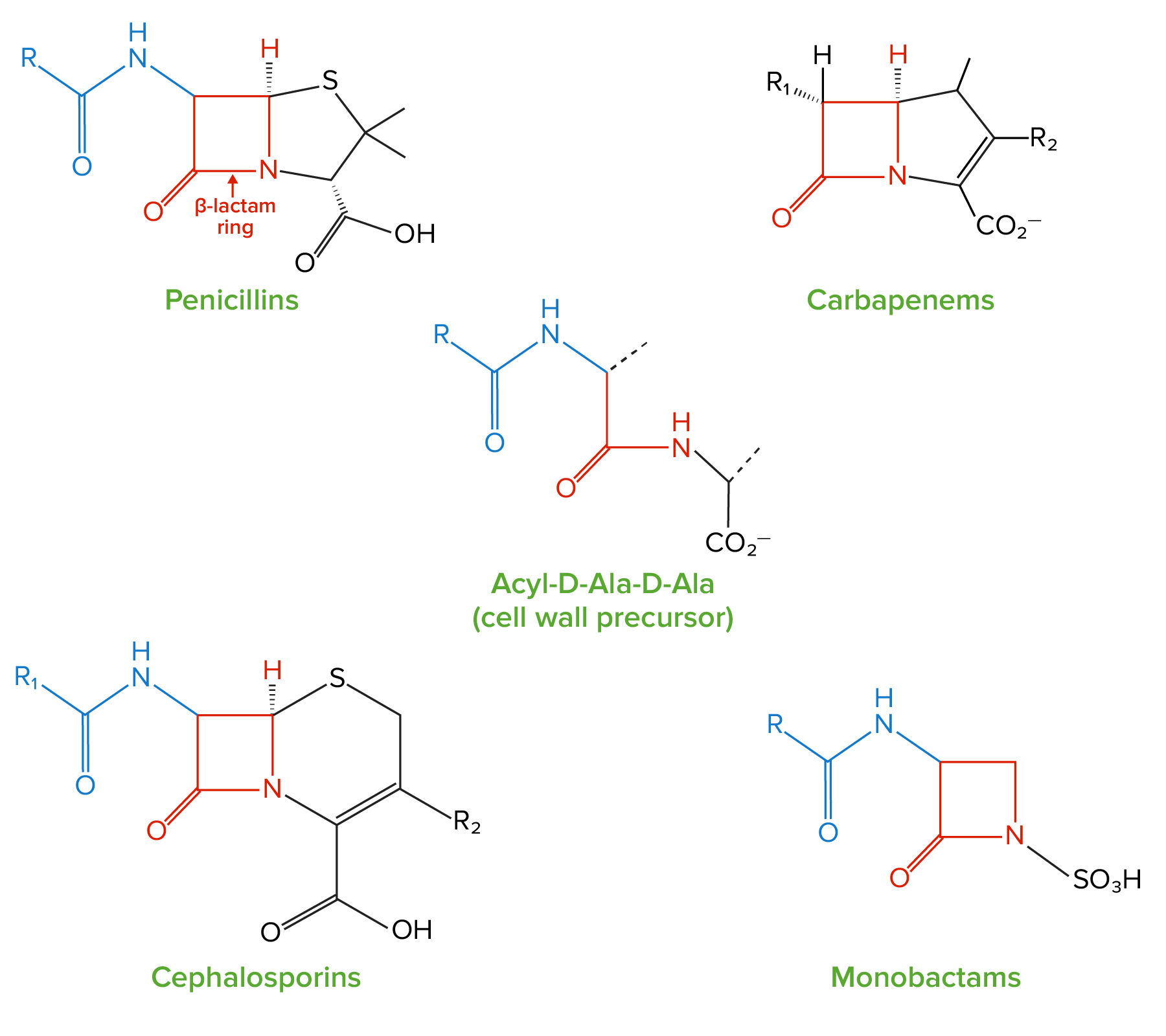
  • Un anillo betalactámico: un anillo de 4 miembros que contiene 2 carbonos (carbonos α y β), un nitrógeno y un grupo carbonilo (un carbono con doble enlace al AL Amyloidosis oxígeno)
    • El grupo betalactámico del compuesto es responsable de la actividad antibacteriana.
    • Puede ser hidrolizado (i.e., descompuesto) por las betalactamasas, que son producidas por ciertas bacterias resistentes.
    • Si se rompe el anillo betalactámico, el medicamento pierde sus propiedades antibacterianas.
    • Todos los LOS Neisseria betalactámicos contienen un anillo betalactámico.
  • Anillo de tiazolidina: un anillo de 5 miembros que contiene azufre y nitrógeno.
  • Cadena lateral:
    • Unido al AL Amyloidosis carbono α en EN Erythema nodosum is an immune-mediated panniculitis (inflammation of the subcutaneous fat) caused by a type IV (delayed-type) hypersensitivity reaction. It commonly manifests in young women as tender, erythematous nodules on the shins. Erythema Nodosum el anillo betalactámico
    • Diferencia las penicilinas entre sí.
    • Responsable de su farmacocinética única y espectros de actividad.
    • Ciertas estructuras pueden inhibir estéricamente la hidrólisis del anillo betalactámico por las betalactamasas.
    • Ciertos compuestos pueden ser absorbidos más fácilmente por bacterias gramnegativas que otros.
Estructura de los betalactámicos

Estructura de los betalactámicos:
Todos los antibióticos betalactámicos contienen el mismo anillo central “betalactámico” de 4 miembros (resaltado en rojo). Este anillo es responsable de las propiedades antibacterianas del medicamento porque es la región que se une e inhibe las proteínas de unión a penicilina. Las proteínas de unión a penicilina catalizan la formación de la pared celular al generar enlaces cruzados entre las cadenas peptídicas en las moléculas de peptidoglicano; Las proteínas de unión a penicilina forman estos enlaces cruzados entre los péptidos acil-D-Ala-D-Ala, que tienen una estructura similar al anillo betalactámico.
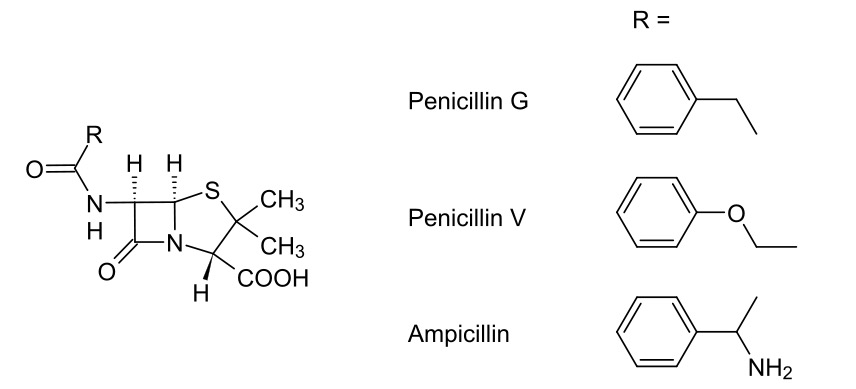
Imagen por Lecturio. Licencia: CC BY-NC-SA 4.0
Estructura química de la penicilina

Penicilinas

Imagen: “Strukturen verschiedener Penicillinen” por Roland Mattern. Licencia: Dominio Público

Mecanismo de Acción y Resistencia

Todos los LOS Neisseria betalactámicos, incluidas las penicilinas, ejercen sus efectos al AL Amyloidosis inhibir la síntesis de la pared celular bacteriana.
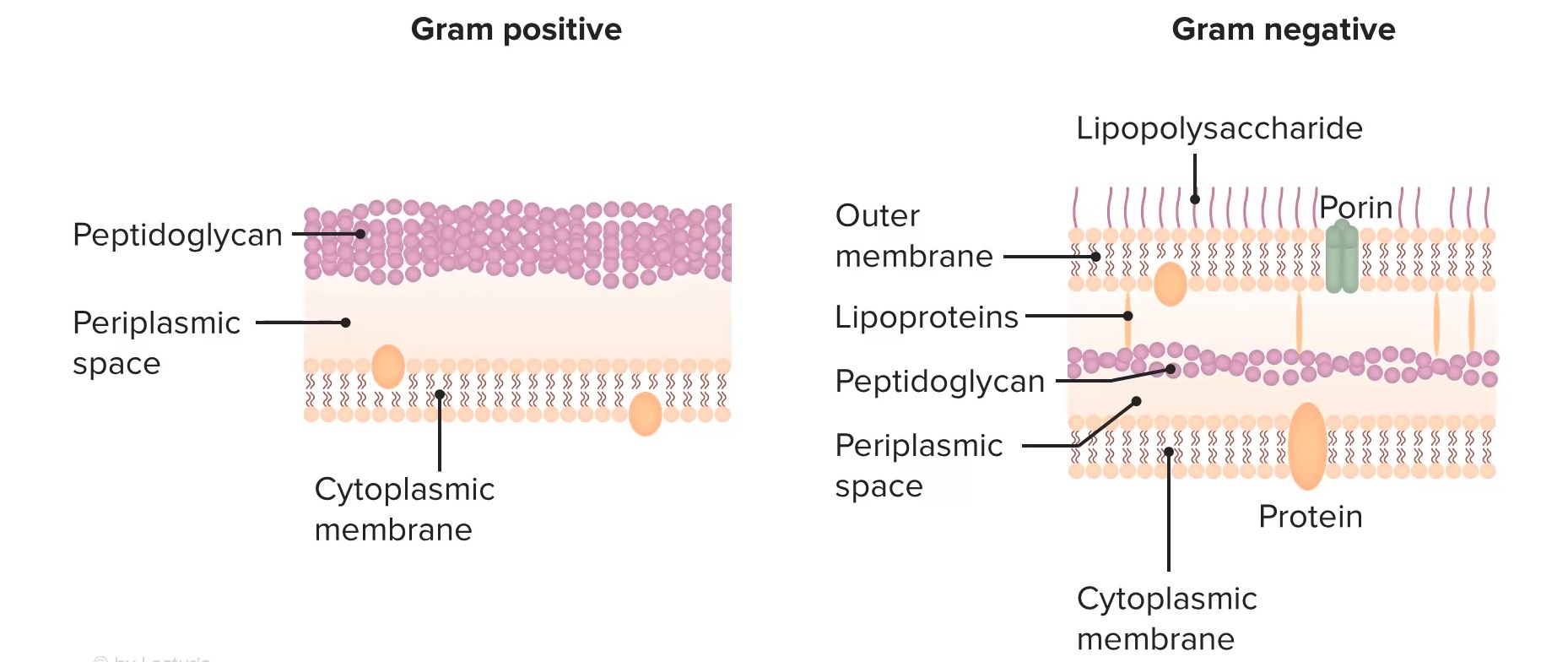
Antecedentes: comprensión de las paredes celulares

  • Las paredes celulares bacterianas contienen cadenas de peptidoglicano (capas grandes y gruesas en EN Erythema nodosum is an immune-mediated panniculitis (inflammation of the subcutaneous fat) caused by a type IV (delayed-type) hypersensitivity reaction. It commonly manifests in young women as tender, erythematous nodules on the shins. Erythema Nodosum organismos grampositivos y capas relativamente más pequeñas/delgadas en EN Erythema nodosum is an immune-mediated panniculitis (inflammation of the subcutaneous fat) caused by a type IV (delayed-type) hypersensitivity reaction. It commonly manifests in young women as tender, erythematous nodules on the shins. Erythema Nodosum organismos gramnegativos).
  • Las cadenas de peptidoglicano están compuestas por:
    • Una columna vertebral de azúcar con 2 azúcares alternos:
      • Ácido N-acetilmurámico
      • Ácido N-acetilglucosamina
    • Cadenas laterales peptídicas cortas que se ramifican de los LOS Neisseria azúcares ácido N-acetilmurámico
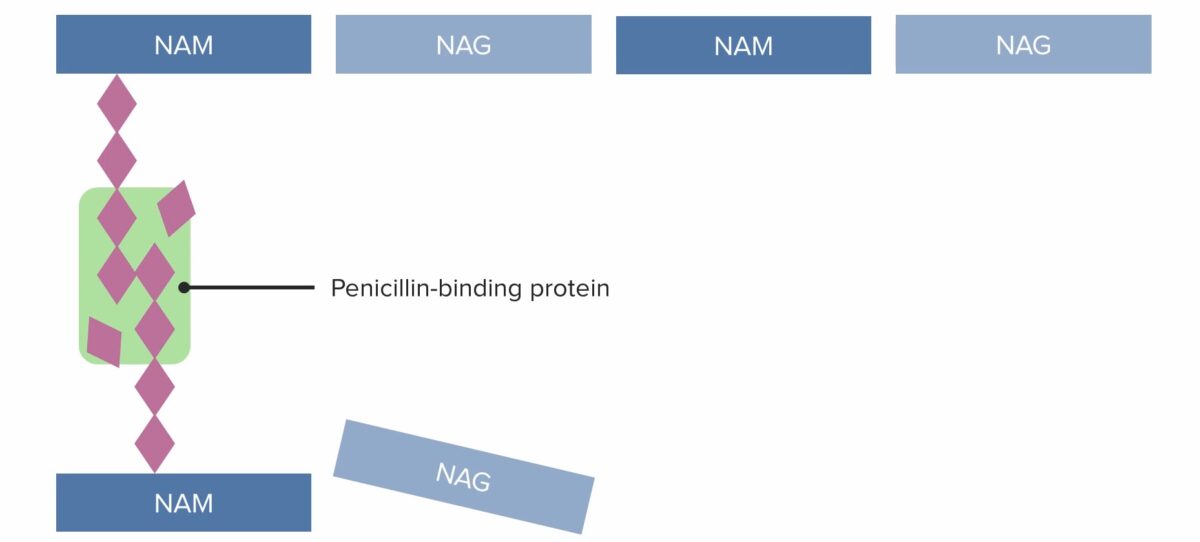
  • Los LOS Neisseria péptidos cortos forman puentes entrecruzados entre cadenas de peptidoglicano adyacentes y crean una estructura de red:
    • Los LOS Neisseria puentes entrecruzados son necesarios para la estructura del peptidoglucano (y, por lo tanto, de la pared celular).
    • Las proteínas de unión a penicilina son enzimas que crean estos puentes entrecruzados.
Estructura de las paredes celulares bacterianas

Estructura de las paredes celulares bacterianas

Imagen por Lecturio. Licencia: CC BY-NC-SA 4.0

Mecanismo de acción

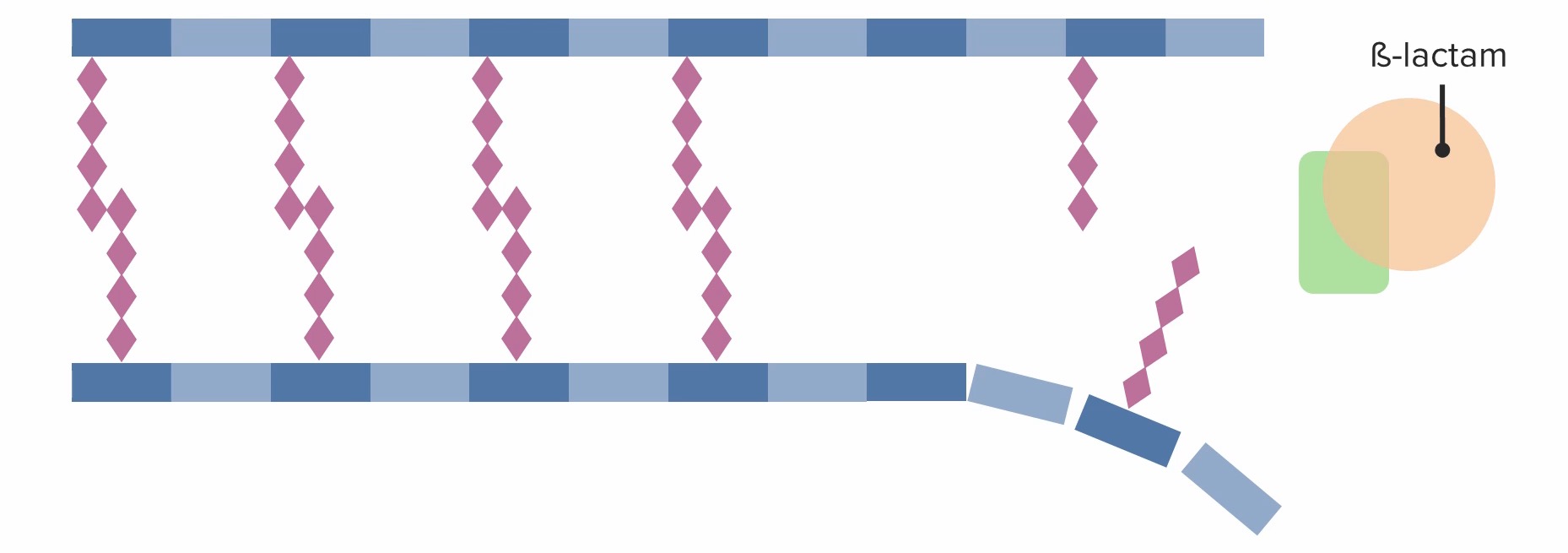
Todos los LOS Neisseria betalactámicos actúan inhibiendo irreversiblemente las proteínas de unión a penicilina → los LOS Neisseria antibióticos betalactámicos inhiben la síntesis de la pared celular
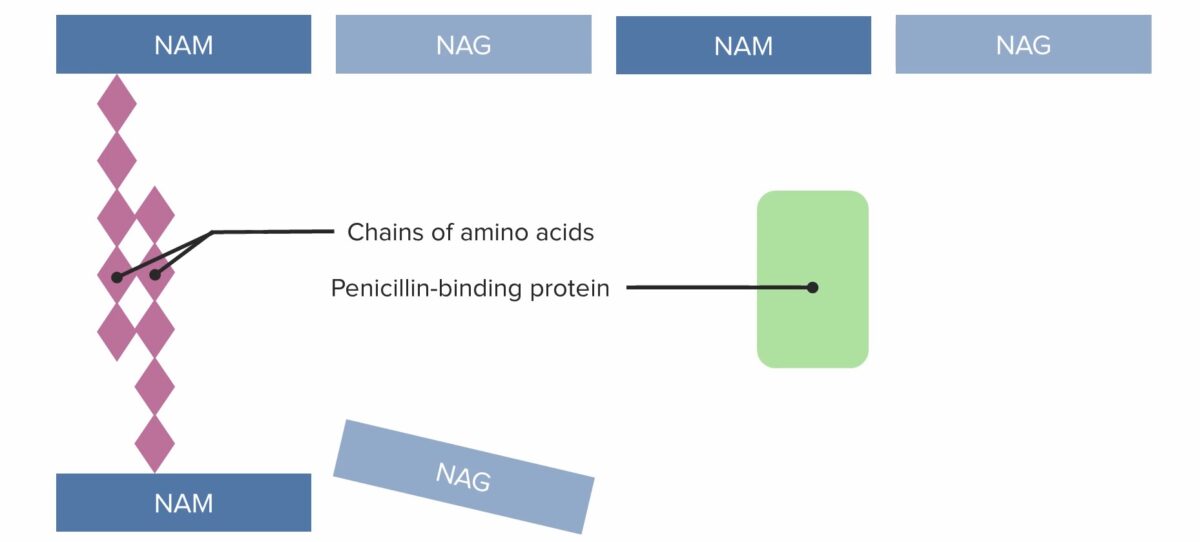
Presencia de un antibiótico betalactámico, que se une e inhibe irreversiblemente a la PBP

Presencia de un antibiótico betalactámico, que se une de forma irreversible e inhibe la proteína de unión a penicilina, evitando que forme nuevos enlaces cruzados:
El antibiótico betalactámico inhibe eficazmente la síntesis de la pared celular y, en última instancia, conduce a la muerte celular.

NAM: ácido N-acetilmurámico
NAG: N-acetilglucosamina
Imagen por Lecturio. Licencia: CC BY-NC-SA 4.0

Actividad bactericida

Los LOS Neisseria betalactámicos, incluidas las penicilinas, ejercen un efecto bactericida ( en EN Erythema nodosum is an immune-mediated panniculitis (inflammation of the subcutaneous fat) caused by a type IV (delayed-type) hypersensitivity reaction. It commonly manifests in young women as tender, erythematous nodules on the shins. Erythema Nodosum lugar de bacteriostático).
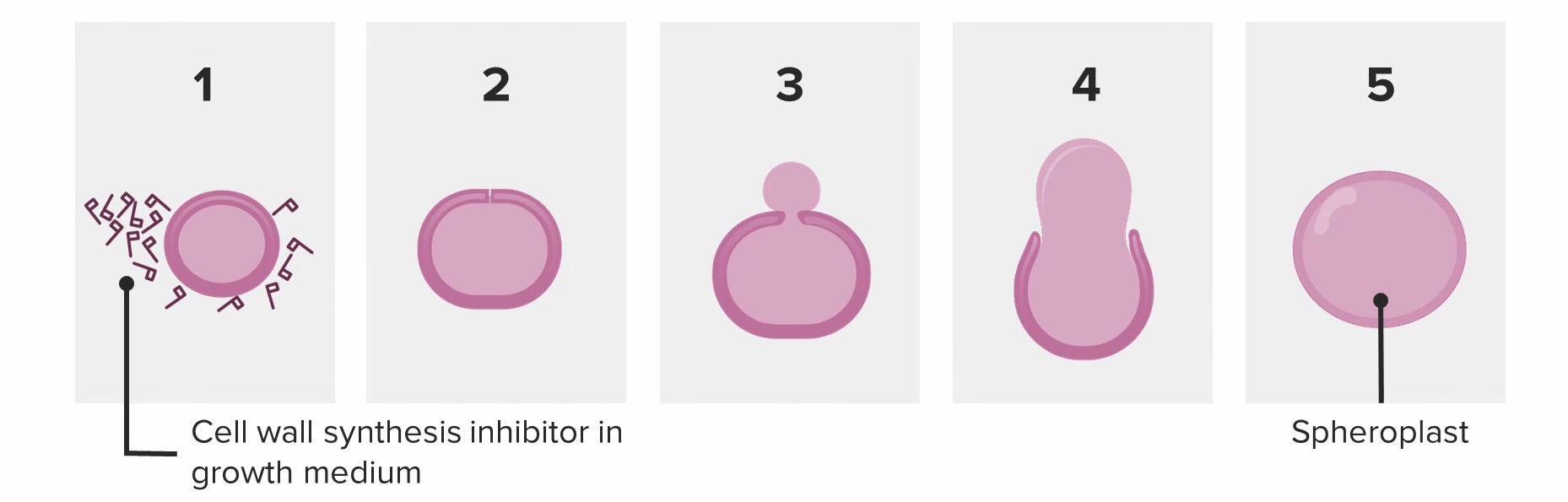
  • La pared celular bacteriana es necesaria para su supervivencia → si falta, se inicia la muerte celular
  • Cuando las bacterias intentan replicarse, se desprenden de sus paredes celulares.
  • Sin embargo, en EN Erythema nodosum is an immune-mediated panniculitis (inflammation of the subcutaneous fat) caused by a type IV (delayed-type) hypersensitivity reaction. It commonly manifests in young women as tender, erythematous nodules on the shins. Erythema Nodosum presencia de penicilinas, las bacterias no pueden formar una nueva pared celular.
  • Las bacterias no pueden dividirse de manera efectiva y la célula restante se autocataliza y muere.
Bacterias que intentan dividirse en presencia de penicilina

Bacteria que intenta dividirse en presencia de penicilina:
La bacteria se despoja de su pared y se convierte en un esferoplasto. El esferoplasto no puede sobrevivir y se autocataliza (muere).

Imagen por Lecturio. Licencia: CC BY-NC-SA 4.0

Mecanismos de resistencia

Las bacterias utilizan 3 mecanismos principales para resistir las penicilinas:

  • Resistencia a las betalactamasas (las penicilinas están inactivadas):
    • La betalactamasa es una enzima que escinde el anillo betalactámico e inactiva el antibiótico.
    • En EN Erythema nodosum is an immune-mediated panniculitis (inflammation of the subcutaneous fat) caused by a type IV (delayed-type) hypersensitivity reaction. It commonly manifests in young women as tender, erythematous nodules on the shins. Erythema Nodosum el caso de la resistencia a la penicilina, las enzimas suelen denominarse penicilinasas.
    • Puede ser producido por organismos grampositivos y gramnegativos
    • Generalmente secretado
    • Puede secretarse solo en EN Erythema nodosum is an immune-mediated panniculitis (inflammation of the subcutaneous fat) caused by a type IV (delayed-type) hypersensitivity reaction. It commonly manifests in young women as tender, erythematous nodules on the shins. Erythema Nodosum presencia de un antibiótico betalactámico.
    • Tipo de resistencia más común.
    • La mayoría de los LOS Neisseria bacilos gramnegativos poseen un gen de betalactamasa.
  • Resistencia mediada por la proteína de unión a penicilina (↓ unión de penicilina a la proteína de unión a penicilina):
    • Mutaciones en EN Erythema nodosum is an immune-mediated panniculitis (inflammation of the subcutaneous fat) caused by a type IV (delayed-type) hypersensitivity reaction. It commonly manifests in young women as tender, erythematous nodules on the shins. Erythema Nodosum proteína de unión a penicilina → ↓ afinidad de las penicilinas por la proteína de unión a penicilina
    • A pesar de las mutaciones, la proteína de unión a penicilina aún pueden producir una pared celular.
  • Resistencia mediada por porinas (↓ captación de penicilina):
    • Las penicilinas ingresan a las bacterias a través de canales llamados porinas en EN Erythema nodosum is an immune-mediated panniculitis (inflammation of the subcutaneous fat) caused by a type IV (delayed-type) hypersensitivity reaction. It commonly manifests in young women as tender, erythematous nodules on the shins. Erythema Nodosum las paredes celulares.
    • Las bacterias pueden ↓ producción de porinas → ↓ niveles de antibióticos dentro de la célula → resistencia a los LOS Neisseria antibióticos
    • Mecanismo común de resistencia en EN Erythema nodosum is an immune-mediated panniculitis (inflammation of the subcutaneous fat) caused by a type IV (delayed-type) hypersensitivity reaction. It commonly manifests in young women as tender, erythematous nodules on the shins. Erythema Nodosum Pseudomonas aeruginosa Pseudomonas aeruginosa A species of gram-negative, aerobic, rod-shaped bacteria commonly isolated from clinical specimens (wound, burn, and urinary tract infections). It is also found widely distributed in soil and water. P. Aeruginosa is a major agent of nosocomial infection. Pseudomonas

Medicamentos resistentes a la penicilinasa

  • Algunos medicamentos pueden ayudar a superar la penicilinasa al AL Amyloidosis actuar como inhibidores de la penicilinasa.
  • Los LOS Neisseria medicamentos resistentes a la penicilinasa a menudo se combinan con penicilinas sensibles a la penicilinasa para mejorar la actividad.
  • Los LOS Neisseria inhibidores de la penicilinasa incluyen:
    • Ácido clavulanico
    • Sulbactam Sulbactam A beta-lactamase inhibitor with very weak antibacterial action. The compound prevents antibiotic destruction of beta-lactam antibiotics by inhibiting beta-lactamases, thus extending their spectrum activity. Combinations of sulbactam with beta-lactam antibiotics have been used successfully for the therapy of infections caused by organisms resistant to the antibiotic alone. Cephalosporins
    • Tazobactam Tazobactam A penicillanic acid and sulfone derivative and potent beta-lactamase inhibitor that enhances the activity of other anti-bacterial agents against beta-lactamase producing bacteria. Cephalosporins

Clasificación

Las penicilinas se pueden clasificar en EN Erythema nodosum is an immune-mediated panniculitis (inflammation of the subcutaneous fat) caused by a type IV (delayed-type) hypersensitivity reaction. It commonly manifests in young women as tender, erythematous nodules on the shins. Erythema Nodosum penicilinas naturales, penicilinas antiestafilocócicas y penicilinas de amplio espectro. Las penicilinas también se pueden clasificar como compuestos sensibles a la penicilinasa o resistentes a la penicilinasa.

Penicilinas sensibles a la penicilinasa

  • Penicilinas naturales (sustancias químicas que se producen naturalmente):
    • Penicilina G
    • Penicilina V
  • Penicilinas de amplio espectro (mucho mejor actividad contra bacilos gram-negativos):
    • 2da generación (aminopenicilinas):
      • Ampicilina (intravenosa/oral)
      • Amoxicilina (oral)
    • Los LOS Neisseria medicamentos de 3ra generación (carbenicilina y ticarcilina) no están disponibles en EN Erythema nodosum is an immune-mediated panniculitis (inflammation of the subcutaneous fat) caused by a type IV (delayed-type) hypersensitivity reaction. It commonly manifests in young women as tender, erythematous nodules on the shins. Erythema Nodosum los LOS Neisseria EE.UU.
    • 4ta generación (también conocidas como penicilinas antipseudomonas):
      • Piperacilina
      • Mezlocilina

Penicilinas resistentes a la penicilinasa

Las penicilinas resistentes a la penicilinasa tienen un gran grupo R junto al AL Amyloidosis anillo betalactámico, lo que impide la degradación de los LOS Neisseria medicamentos por la penicilinasa. Las penicilinas resistentes a la penicilinasa son eficaces contra los LOS Neisseria estafilococos sensibles a la meticilina; por lo tanto, se les conoce comúnmente como penicilinas antiestafilocócicas.

  • Dicloxacilina
  • Cloxacilina
  • Oxacilina
  • Nafcilina
  • Meticilina (rara vez se usa debido a la resistencia y el riesgo de nefritis intersticial)

Combinaciones de inhibidores de penicilina-penicilinasa

  • Ampicilina-sulbactam (Unasyn)
  • Amoxicilina-clavulanato (Augmentin)
  • Piperacilina-tazobactam (Zosyn)

Farmacocinética

Distribución

  • Todas las penicilinas se distribuyen en EN Erythema nodosum is an immune-mediated panniculitis (inflammation of the subcutaneous fat) caused by a type IV (delayed-type) hypersensitivity reaction. It commonly manifests in young women as tender, erythematous nodules on the shins. Erythema Nodosum:
    • Cavidad pleural/pulmones
    • líquido pericárdico
    • Líquido peritoneal/ascitis
    • Líquido sinovial
    • Orina
    • Bilis (especialmente mezlocilina)
  • Mala penetración a través de la barrera hematoencefálica (excepción: durante la inflamación en EN Erythema nodosum is an immune-mediated panniculitis (inflammation of the subcutaneous fat) caused by a type IV (delayed-type) hypersensitivity reaction. It commonly manifests in young women as tender, erythematous nodules on the shins. Erythema Nodosum la meningitis Meningitis Meningitis is inflammation of the meninges, the protective membranes of the brain, and spinal cord. The causes of meningitis are varied, with the most common being bacterial or viral infection. The classic presentation of meningitis is a triad of fever, altered mental status, and nuchal rigidity. Meningitis)

Enlace proteico

  • Varía según el medicamento.
  • Penicilinas resistentes a la penicilinasa (nafcilina, oxacilina, cloxacilina): > 90% se une a proteínas.
  • Penicilina V: > 80% se une a proteínas.
  • Amoxicilina, ampicilina y piperacilina: 15%–20% se une a proteínas.

Media vida

  • Relativamente corto para todas las penicilinas (generalmente < 1 hora)
  • Los LOS Neisseria agentes parenterales normalmente se administran cada 4 horas.
  • Excepción: la piperacilina tiene una vida media más larga cuando se administra en EN Erythema nodosum is an immune-mediated panniculitis (inflammation of the subcutaneous fat) caused by a type IV (delayed-type) hypersensitivity reaction. It commonly manifests in young women as tender, erythematous nodules on the shins. Erythema Nodosum dosis más altas.

Metabolismo

  • Las penicilinas resistentes a la penicilinasa (nafcilina, oxacilina, cloxacilina) sufren metabolismo hepático.
  • La mayoría de los LOS Neisseria demás no se metabolizan extensamente.

Excreción

  • La mayoría se excreta principalmente en EN Erythema nodosum is an immune-mediated panniculitis (inflammation of the subcutaneous fat) caused by a type IV (delayed-type) hypersensitivity reaction. It commonly manifests in young women as tender, erythematous nodules on the shins. Erythema Nodosum la orina:
    • La mayoría se excreta sin cambios.
    • La ampicilina y la piperacilina requieren ajustes de dosis en EN Erythema nodosum is an immune-mediated panniculitis (inflammation of the subcutaneous fat) caused by a type IV (delayed-type) hypersensitivity reaction. It commonly manifests in young women as tender, erythematous nodules on the shins. Erythema Nodosum pacientes con insuficiencia renal.
  • Algunos se excretan principalmente en EN Erythema nodosum is an immune-mediated panniculitis (inflammation of the subcutaneous fat) caused by a type IV (delayed-type) hypersensitivity reaction. It commonly manifests in young women as tender, erythematous nodules on the shins. Erythema Nodosum la bilis o las heces, incluidos:
    • Penicilinas resistentes a la penicilinasa (nafcilina, oxacilina y cloxacilina)
    • Mezlocilina

Indicaciones

Tabla: Espectro de actividad y usos clínicos de las penicilinas
Medicamento (vía de administración) Espectro de actividad Usos clínicos
Penicilina G (intravenosa/intramuscular) y penicilina V (oral) Estrecho:
  • Cocos grampositivos:
    • Streptococcus Streptococcus Streptococcus is one of the two medically important genera of gram-positive cocci, the other being Staphylococcus. Streptococci are identified as different species on blood agar on the basis of their hemolytic pattern and sensitivity to optochin and bacitracin. There are many pathogenic species of streptococci, including S. pyogenes, S. agalactiae, S. pneumoniae, and the viridans streptococci. Streptococcus pyogenes
    • S. pneumoniae
    • S. agalactiae
  • Bacilos grampositivos:
    • Listeria Listeria Listeria spp. are motile, flagellated, gram-positive, facultative intracellular bacilli. The major pathogenic species is Listeria monocytogenes. Listeria are part of the normal gastrointestinal flora of domestic mammals and poultry and are transmitted to humans through the ingestion of contaminated food, especially unpasteurized dairy products. Listeria Monocytogenes/Listeriosis monocytogenes
    • Actinomyces Actinomyces Actinomyces is an anaerobic, gram-positive, branching, filamentous rod. Actinomyces israelii is the most common species involved in human disease. The organism is commonly found as part of the normal flora in the oral cavity, gastrointestinal tract, and reproductive tract. Actinomyces/Actinomycosis israeli
  • Cocos gramnegativos:
    • Neisserria meningitidis
    • N. gonorrhoeae N. gonorrhoeae A species of gram-negative, aerobic bacteria primarily found in purulent venereal discharges. It is the causative agent of gonorrhea. Neisseria
  • Espiroquetas:
    • Treponema pallidum Treponema pallidum The causative agent of venereal and non-venereal syphilis as well as yaws. Treponema
    • Leptospira Leptospira Leptospira is a spiral or question mark-shaped, gram-negative spirochete with hook-shaped ends. The disease, leptospirosis, is a zoonosis, infecting animals. Rodents are the most important reservoir. Bacteria shed in the urine of rodents and other animals can be transmitted to humans via contaminated water. Leptospira/Leptospirosis spp.
  • Faringitis estreptocócica (i.e., faringitis estreptocócica)
  • Endocarditis Endocarditis Endocarditis is an inflammatory disease involving the inner lining (endometrium) of the heart, most commonly affecting the cardiac valves. Both infectious and noninfectious etiologies lead to vegetations on the valve leaflets. Patients may present with nonspecific symptoms such as fever and fatigue. Endocarditis
  • Síndrome de shock Shock Shock is a life-threatening condition associated with impaired circulation that results in tissue hypoxia. The different types of shock are based on the underlying cause: distributive (↑ cardiac output (CO), ↓ systemic vascular resistance (SVR)), cardiogenic (↓ CO, ↑ SVR), hypovolemic (↓ CO, ↑ SVR), obstructive (↓ CO), and mixed. Types of Shock tóxico causado por Streptococcus Streptococcus Streptococcus is one of the two medically important genera of gram-positive cocci, the other being Staphylococcus. Streptococci are identified as different species on blood agar on the basis of their hemolytic pattern and sensitivity to optochin and bacitracin. There are many pathogenic species of streptococci, including S. pyogenes, S. agalactiae, S. pneumoniae, and the viridans streptococci. Streptococcus spp.
  • Profilaxis de la fiebre reumática
  • Meningitis Meningitis Meningitis is inflammation of the meninges, the protective membranes of the brain, and spinal cord. The causes of meningitis are varied, with the most common being bacterial or viral infection. The classic presentation of meningitis is a triad of fever, altered mental status, and nuchal rigidity. Meningitis bacteriana causada por L. monocytogenes L. monocytogenes A species of gram-positive, rod-shaped bacteria widely distributed in nature. It has been isolated from sewage, soil, silage, and from feces of healthy animals and man. Infection with this bacterium leads to encephalitis, meningitis, endocarditis, and abortion. Listeria Monocytogenes/Listeriosis o N. meningitidis N. meningitidis A species of gram-negative, aerobic bacteria. It is a commensal and pathogen only of humans, and can be carried asymptomatically in the nasopharynx. When found in cerebrospinal fluid it is the causative agent of cerebrospinal meningitis. It is also found in venereal discharges and blood. There are at least 13 serogroups based on antigenic differences in the capsular polysaccharides; the ones causing most meningitis infections being a, b, c, y, and w-135. Each serogroup can be further classified by serotype, serosubtype, and immunotype. Neisseria
  • Gonorrea
  • Infecciones por S. agalactiae en EN Erythema nodosum is an immune-mediated panniculitis (inflammation of the subcutaneous fat) caused by a type IV (delayed-type) hypersensitivity reaction. It commonly manifests in young women as tender, erythematous nodules on the shins. Erythema Nodosum el embarazo
  • Sífilis (penicilina G)
  • Leptospirosis Leptospirosis Leptospira is a spiral or question mark-shaped, gram-negative spirochete with hook-shaped ends. The major clinical species is Leptospira interrogans, which causes a mild flu-like illness in a majority of cases. The manifestations are biphasic, with Leptospira found in the blood initially. Leptospira/Leptospirosis
  • Ántrax
  • Botulismo (complemento)
  • Difteria (complemento)
  • Tétanos (adyuvante)
Cloxacilina y dicloxacilina Estrecho:
Cocos grampositivos:
  • Staphylococcus Staphylococcus Staphylococcus is a medically important genera of Gram-positive, aerobic cocci. These bacteria form clusters resembling grapes on culture plates. Staphylococci are ubiquitous for humans, and many strains compose the normal skin flora. Staphylococcus spp. (excluyendo MRSA MRSA A strain of Staphylococcus aureus that is non-susceptible to the action of methicillin. The mechanism of resistance usually involves modification of normal or the presence of acquired penicillin binding proteins. Staphylococcus)
  • Streptococcus Streptococcus Streptococcus is one of the two medically important genera of gram-positive cocci, the other being Staphylococcus. Streptococci are identified as different species on blood agar on the basis of their hemolytic pattern and sensitivity to optochin and bacitracin. There are many pathogenic species of streptococci, including S. pyogenes, S. agalactiae, S. pneumoniae, and the viridans streptococci. Streptococcus spp.
  • Infecciones de piel y tejidos blandos
    • Impétigo
    • Celulitis
    • Mastitis Mastitis Mastitis is inflammation of the breast tissue with or without infection. The most common form of mastitis is associated with lactation in the first few weeks after birth. Non-lactational mastitis includes periductal mastitis and idiopathic granulomatous mastitis (IGM). Mastitis
  • Otitis externa Otitis externa Otitis externa (also known as external otitis or swimmer’s ear) is an infection of the external auditory canal that is most often caused by acute bacterial infection and is frequently associated with hot, humid weather and water exposure. Patients commonly present with ear pain, pruritus, discharge, and hearing loss. Otitis Externa
  • Artritis séptica
  • Neumonía por bacterias susceptibles
Ampicilina (intravenosa/oral) y amoxicilina (oral) Más amplio:
  • Bacterias grampositivas:
    • Streptococcus Streptococcus Streptococcus is one of the two medically important genera of gram-positive cocci, the other being Staphylococcus. Streptococci are identified as different species on blood agar on the basis of their hemolytic pattern and sensitivity to optochin and bacitracin. There are many pathogenic species of streptococci, including S. pyogenes, S. agalactiae, S. pneumoniae, and the viridans streptococci. Streptococcus spp.
    • L. monocytogenes L. monocytogenes A species of gram-positive, rod-shaped bacteria widely distributed in nature. It has been isolated from sewage, soil, silage, and from feces of healthy animals and man. Infection with this bacterium leads to encephalitis, meningitis, endocarditis, and abortion. Listeria Monocytogenes/Listeriosis
  • Bacterias Gram-negativo:
    • Helicobacter pylori Helicobacter pylori A spiral bacterium active as a human gastric pathogen. It is a gram-negative, urease-positive, curved or slightly spiral organism initially isolated in 1982 from patients with lesions of gastritis or peptic ulcers in Western Australia. Helicobacter pylori was originally classified in the genus campylobacter, but RNA sequencing, cellular fatty acid profiles, growth patterns, and other taxonomic characteristics indicate that the micro-organism should be included in the genus Helicobacter. It has been officially transferred to Helicobacter gen. Helicobacter
    • Haemophilus influenzae Haemophilus Influenzae A species of Haemophilus found on the mucous membranes of humans and a variety of animals. The species is further divided into biotypes I through viii. Haemophilus
    • Escherichia coli Escherichia coli The gram-negative bacterium Escherichia coli is a key component of the human gut microbiota. Most strains of E. coli are avirulent, but occasionally they escape the GI tract, infecting the urinary tract and other sites. Less common strains of E. coli are able to cause disease within the GI tract, most commonly presenting as abdominal pain and diarrhea. Escherichia coli
    • Proteus mirabilis Proteus mirabilis A species of gram-negative, facultatively anaerobic, rod-shaped bacteria that is frequently isolated from clinical specimens. Its most common site of infection is the urinary tract. Proteus
    • Salmonella Salmonella Salmonellae are gram-negative bacilli of the family Enterobacteriaceae. Salmonellae are flagellated, non-lactose-fermenting, and hydrogen sulfide-producing microbes. Salmonella enterica, the most common disease-causing species in humans, is further classified based on serotype as typhoidal (S. typhi and paratyphi) and nontyphoidal (S. enteritidis and typhimurium). Salmonella spp.
    • Shigella Shigella Shigella is a genus of gram-negative, non-lactose-fermenting facultative intracellular bacilli. Infection spreads most commonly via person-to-person contact or through contaminated food and water. Humans are the only known reservoir. Shigella spp.
  • La actividad se mejora con el uso de clavulanato.
  • Infecciones otorrinolaringológicas:
    • Faringitis
    • Amigdalitis
    • Otitis media
    • Rinosinusitis
  • Infecciones gastrointestinales:
    • Erradicación de H. pylori H. pylori A spiral bacterium active as a human gastric pathogen. It is a gram-negative, urease-positive, curved or slightly spiral organism initially isolated in 1982 from patients with lesions of gastritis or peptic ulcers in Western Australia. Helicobacter pylori was originally classified in the genus campylobacter, but RNA sequencing, cellular fatty acid profiles, growth patterns, and other taxonomic characteristics indicate that the micro-organism should be included in the genus Helicobacter. It has been officially transferred to Helicobacter gen. Helicobacter
    • Salmonela
    • Complementario con aminoglucósidos para infecciones por enterococos
  • Neumonía adquirida en EN Erythema nodosum is an immune-mediated panniculitis (inflammation of the subcutaneous fat) caused by a type IV (delayed-type) hypersensitivity reaction. It commonly manifests in young women as tender, erythematous nodules on the shins. Erythema Nodosum la comunidad
  • Profilaxis de endocarditis Endocarditis Endocarditis is an inflammatory disease involving the inner lining (endometrium) of the heart, most commonly affecting the cardiac valves. Both infectious and noninfectious etiologies lead to vegetations on the valve leaflets. Patients may present with nonspecific symptoms such as fever and fatigue. Endocarditis
  • Meningitis Meningitis Meningitis is inflammation of the meninges, the protective membranes of the brain, and spinal cord. The causes of meningitis are varied, with the most common being bacterial or viral infection. The classic presentation of meningitis is a triad of fever, altered mental status, and nuchal rigidity. Meningitis bacteriana
  • Septicemia
  • Infecciones genitourinarias:
    • Infecciones del tracto urinario (no de 1ra línea)
    • Infecciones intraamnióticas
    • Endometritis Endometritis Endometritis is an inflammation of the endometrium, the inner layer of the uterus. The most common subtype is postpartum endometritis, resulting from the ascension of normal vaginal flora to the previously aseptic uterus. Postpartum Endometritis postparto
    • Absceso tubo-ovárico
Piperacilina (solo disponible como piperacilina/ tazobactam Tazobactam A penicillanic acid and sulfone derivative and potent beta-lactamase inhibitor that enhances the activity of other anti-bacterial agents against beta-lactamase producing bacteria. Cephalosporins en EN Erythema nodosum is an immune-mediated panniculitis (inflammation of the subcutaneous fat) caused by a type IV (delayed-type) hypersensitivity reaction. It commonly manifests in young women as tender, erythematous nodules on the shins. Erythema Nodosum los LOS Neisseria EE. UU.) Más ancho:
  • Bacterias grampositivas:
    • Streptococcus Streptococcus Streptococcus is one of the two medically important genera of gram-positive cocci, the other being Staphylococcus. Streptococci are identified as different species on blood agar on the basis of their hemolytic pattern and sensitivity to optochin and bacitracin. There are many pathogenic species of streptococci, including S. pyogenes, S. agalactiae, S. pneumoniae, and the viridans streptococci. Streptococcus spp.
    • Staphylococcus Staphylococcus Staphylococcus is a medically important genera of Gram-positive, aerobic cocci. These bacteria form clusters resembling grapes on culture plates. Staphylococci are ubiquitous for humans, and many strains compose the normal skin flora. Staphylococcus spp. (excluyendo MRSA MRSA A strain of Staphylococcus aureus that is non-susceptible to the action of methicillin. The mechanism of resistance usually involves modification of normal or the presence of acquired penicillin binding proteins. Staphylococcus)
  • Bacterias Gram-negativo:
    • P. aeruginosa P. aeruginosa A species of gram-negative, aerobic, rod-shaped bacteria commonly isolated from clinical specimens (wound, burn, and urinary tract infections). It is also found widely distributed in soil and water. P. Aeruginosa is a major agent of nosocomial infection. Pseudomonas
    • Muchas enterobacterias
  • Combinado con el inhibidor de la penicilinasa tazobactam Tazobactam A penicillanic acid and sulfone derivative and potent beta-lactamase inhibitor that enhances the activity of other anti-bacterial agents against beta-lactamase producing bacteria. Cephalosporins para mejorar la actividad.
  • Septicemia
  • Fiebre neutropénica en EN Erythema nodosum is an immune-mediated panniculitis (inflammation of the subcutaneous fat) caused by a type IV (delayed-type) hypersensitivity reaction. It commonly manifests in young women as tender, erythematous nodules on the shins. Erythema Nodosum pacientes de alto riesgo
  • Infecciones intraabdominales/pélvicas:
    • Apendicitis
    • Enfermedad pélvica inflamatoria
    • Endometritis Endometritis Endometritis is an inflammation of the endometrium, the inner layer of the uterus. The most common subtype is postpartum endometritis, resulting from the ascension of normal vaginal flora to the previously aseptic uterus. Postpartum Endometritis postparto
  • Infecciones de piel y tejidos blandos:
    • Celulitis
    • Abscesos
    • Infecciones del pie isquémico/diabético
Mezlocilina Amplio: buena cobertura de gramnegativos Infecciones del tracto biliar (e.g., colangitis biliar)

Efectos Secundarios y Contraindicaciones

Efectos secundarios

Los LOS Neisseria efectos más comunes están relacionados con reacciones alérgicas.

  • Reacciones alérgicas mediadas por IgE IgE An immunoglobulin associated with mast cells. Overexpression has been associated with allergic hypersensitivity. Immunoglobulins: Types and Functions:
    • Se presenta con:
      • Prurito
      • Urticaria Urticaria Urticaria is raised, well-circumscribed areas (wheals) of edema (swelling) and erythema (redness) involving the dermis and epidermis with associated pruritus (itch). Urticaria is not a single disease but rather is a reaction pattern representing cutaneous mast cell degranulation. Urticaria (Hives)
      • Angioedema Angioedema Angioedema is a localized, self-limited (but potentially life-threatening), nonpitting, asymmetrical edema occurring in the deep layers of the skin and mucosal tissue. The common underlying pathophysiology involves inflammatory mediators triggering significant vasodilation and increased capillary permeability. Angioedema
      • Hipotensión
      • Anafilaxia.
    • Los LOS Neisseria síntomas generalmente aparecen dentro de las 4 horas posteriores a la administración (a menudo en EN Erythema nodosum is an immune-mediated panniculitis (inflammation of the subcutaneous fat) caused by a type IV (delayed-type) hypersensitivity reaction. It commonly manifests in young women as tender, erythematous nodules on the shins. Erythema Nodosum minutos).
  • Enfermedad del suero:
    • Una reacción alérgica tardía debida a inmunocomplejos circulantes
    • Caracterizado por:
      • Fiebre
      • Urticaria Urticaria Urticaria is raised, well-circumscribed areas (wheals) of edema (swelling) and erythema (redness) involving the dermis and epidermis with associated pruritus (itch). Urticaria is not a single disease but rather is a reaction pattern representing cutaneous mast cell degranulation. Urticaria (Hives)
      • Adenopatía
      • Artritis
      • Glomerulonefritis (ocasionalmente)
  • Reacciones dermatológicas:
    • Erupción morbiliforme: erupción maculopapular Maculopapular Dermatologic Examination debida a una reacción de hipersensibilidad
    • Eritema multiforme: lesiones en EN Erythema nodosum is an immune-mediated panniculitis (inflammation of the subcutaneous fat) caused by a type IV (delayed-type) hypersensitivity reaction. It commonly manifests in young women as tender, erythematous nodules on the shins. Erythema Nodosum diana que se desarrollan con un inicio agudo
    • Síndrome de Stevens-Johnson: una afección cutánea descamativa que afecta a las superficies mucosas
  • Reacciones neurológicas:
    • Encefalopatía
    • Neurotoxicidad por penicilina:
      • Disminución del nivel de conciencia (e.g., somnolencia, coma Coma Coma is defined as a deep state of unarousable unresponsiveness, characterized by a score of 3 points on the GCS. A comatose state can be caused by a multitude of conditions, making the precise epidemiology and prognosis of coma difficult to determine. Coma)
      • Hiperreflexia generalizada
      • Mioclono
      • Convulsiones
  • Reacciones gastrointestinales y hepáticas:
    • Diarrea (especialmente con ampicilina y amoxicilina)
    • Colitis Colitis Inflammation of the colon section of the large intestine, usually with symptoms such as diarrhea (often with blood and mucus), abdominal pain, and fever. Pseudomembranous Colitis por Clostridioides difficile
    • Supresión de la flora intestinal que conduce a la deficiencia de vitamina K
    • Hepatitis por hipersensibilidad (especialmente con oxacilina y nafcilina)
  • Reacciones renales:
    • Glomerulonefritis (que ocurre en EN Erythema nodosum is an immune-mediated panniculitis (inflammation of the subcutaneous fat) caused by a type IV (delayed-type) hypersensitivity reaction. It commonly manifests in young women as tender, erythematous nodules on the shins. Erythema Nodosum asociación con reacciones alérgicas)
    • Nefritis intersticial alérgica (especialmente con nafcilina y meticilina)
    • IRA (asociada al AL Amyloidosis uso concomitante de piperacilina-tazobactam y vancomicina)
  • Reacciones hematológicas:
    • Neutropenia Neutropenia Neutrophils are an important component of the immune system and play a significant role in the eradication of infections. Low numbers of circulating neutrophils, referred to as neutropenia, predispose the body to recurrent infections or sepsis, though patients can also be asymptomatic. Neutropenia debida a la destrucción inmunomediada de leucocitos polimorfonucleares
    • Anemia Anemia Anemia is a condition in which individuals have low Hb levels, which can arise from various causes. Anemia is accompanied by a reduced number of RBCs and may manifest with fatigue, shortness of breath, pallor, and weakness. Subtypes are classified by the size of RBCs, chronicity, and etiology. Anemia: Overview and Types hemolítica
    • Trombocitopenia inmune, especialmente con ticarcilina
    • Supresión de la flora intestinal→ deficiencia de vitamina K → coagulopatía

Contraindicaciones

  • Reacciones hipersensibles
  • Reacciones cutáneas graves (e.g., síndrome de Stevens-Johnson)

Comparación de Cobertura y Clasificación de Antibióticos

Comparación basada en EN Erythema nodosum is an immune-mediated panniculitis (inflammation of the subcutaneous fat) caused by a type IV (delayed-type) hypersensitivity reaction. It commonly manifests in young women as tender, erythematous nodules on the shins. Erythema Nodosum mecanismos de acción

Los LOS Neisseria antibióticos se pueden clasificar de varias maneras. Una forma es clasificarlos según su mecanismo de acción:

Tabla: Antibióticos clasificados por mecanismo de acción primario
Mecanismo Clases de antibióticos
Inhibidores de la síntesis de la pared celular bacteriana
  • Penicilinas
  • Cefalosporinas
  • Penemas
  • Misceláneos
Inhibidores de la síntesis de proteínas bacterianas
  • Tetraciclinas
  • Macrólidos
  • Cetólido
  • Lincosamidas
  • Estreptograminas
  • Linezolida
Agentes que actúan contra el ADN y/o el folato
  • Sulfonamidas
  • Trimetoprim
  • Fluoroquinolonas
Agentes antimicobacterianos
  • Agentes antituberculosos
  • Agentes antileprosos
  • Agentes micobacterianos atípicos

Comparación basada en EN Erythema nodosum is an immune-mediated panniculitis (inflammation of the subcutaneous fat) caused by a type IV (delayed-type) hypersensitivity reaction. It commonly manifests in young women as tender, erythematous nodules on the shins. Erythema Nodosum cobertura

Diferentes antibióticos tienen diferentes grados de actividad contra diferentes bacterias. La siguiente tabla describe los LOS Neisseria antibióticos que son activos contra 3 clases importantes de bacterias, que incluyen cocos grampositivos, bacilos gramnegativos y anaerobios.
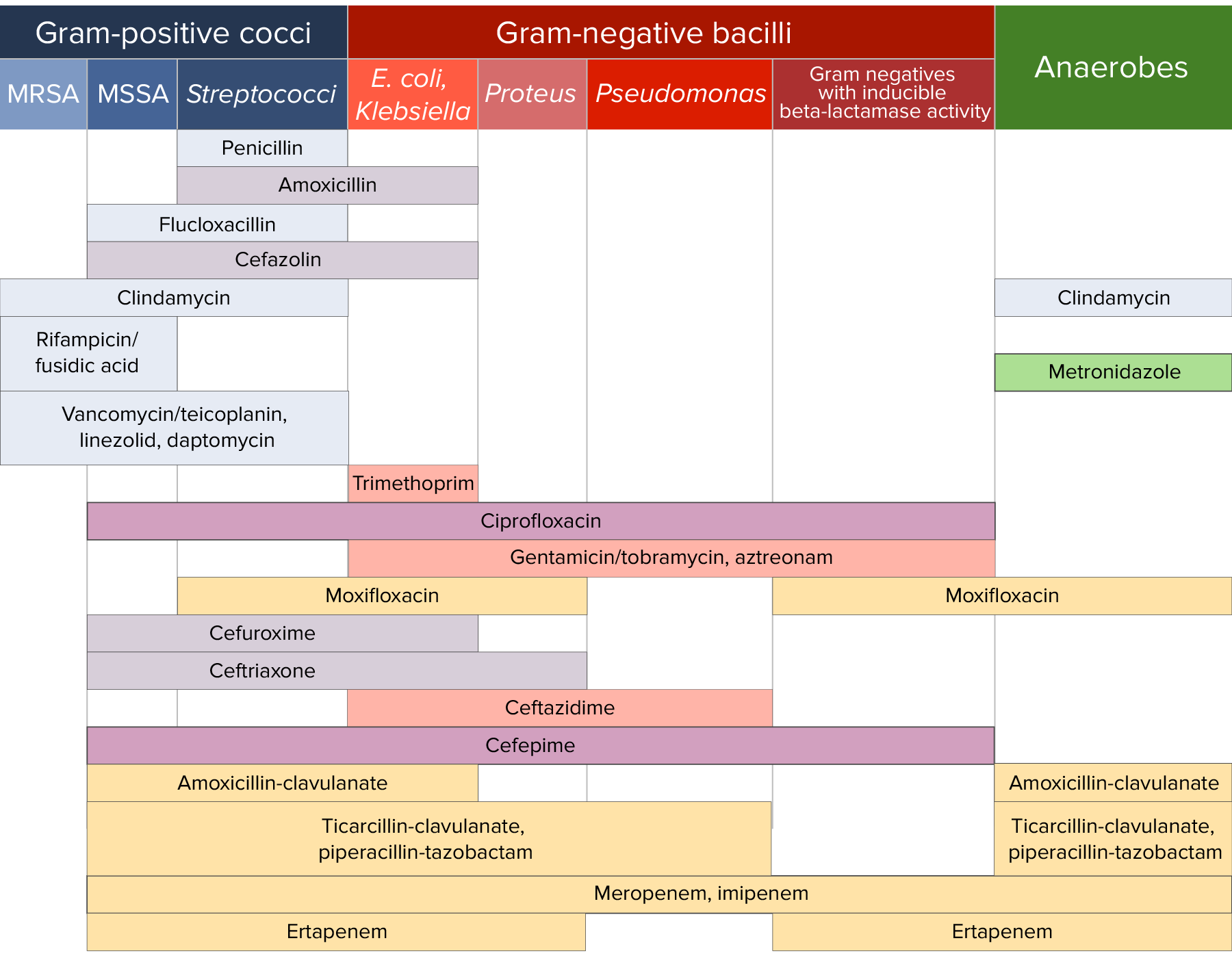
Tabla de sensibilidad a los antibióticos

Sensibilidad a los antibióticos:
Gráfico que compara la cobertura microbiana de diferentes antibióticos para cocos grampositivos, bacilos gramnegativos y anaerobios.

Imagen por Lecturio. Licencia: CC BY-NC-SA 4.0

Referencias

  1. Letourneau, A.R. (2023). Beta-lactam antibiotics: Mechanisms of action and resistance and adverse effects. In Bloom, A. (Ed.), UpToDate. Retrieved October 17, 2025, from https://www.uptodate.com/contents/beta-lactam-antibiotics-mechanisms-of-action-and-resistance-and-adverse-effects
  2. Letourneau, A.R. (2024). Penicillin, antistaphylococcal penicillins, and broad-spectrum penicillins. In Bloom, A. (Ed.), UpToDate. Retrieved October 17, 2025, from https://www.uptodate.com/contents/penicillin-antistaphylococcal-penicillins-and-broad-spectrum-penicillins 
  3. Letourneau, A.R. (2025). Cephalosporins. UpToDate. Retrieved October 17, 2025, from https://www.uptodate.com/contents/cephalosporins
  4. Medscape. (n.d.). Penicillin G benzathine. Retrieved October 17, 2025, from https://reference.medscape.com/drug/bicillin-la-permapen-penicillin-g-benzathine-999573
  5. Deck, D.H., Winston, L.G. (2012). Beta-lactam & other cell wall- & membrane-active antibiotics (Chapter 43). In: Basic and Clinical Pharmacology. 12e. Katzung, B.G., Masters, S.B., Trevor, A.J. (Editors). McGraw-Hill/Lange.
  6. Hauser, A.R. (2013). Antibiotic basics for clinicians. The ABCs of choosing the right antibacterial agent. 2nd Ed. Lippincott Williams & Wilkins. ISBN-13: 978-1-4511-1221-4

¡Crea tu cuenta gratis o inicia una sesión para seguir leyendo!

Regístrate ahora y obtén acceso gratuito a Lecturio con páginas de concepto, videos médicos y cuestionarios para tu educación médica.

User Reviews

Que tengas una sesión de estudio alegre y navideña 🎁 Ahorra 50% en todos los planes >>

Details