Domina Conceptos Médicos

Estudia para la escuela de medicina y tus examenes con Lecturio.

Metabolismo de Cuerpos Cetónicos

Los LOS Neisseria cuerpos cetónicos son una importante fuente de energía y su metabolismo es un proceso estrictamente regulado. Cuando las reservas de glucosa en EN Erythema nodosum is an immune-mediated panniculitis (inflammation of the subcutaneous fat) caused by a type IV (delayed-type) hypersensitivity reaction. It commonly manifests in young women as tender, erythematous nodules on the shins. Erythema Nodosum el cuerpo se agotan, más ácidos grasos se ponen a disposición del hígado para su oxidación, lo que lleva a la producción de moléculas altas en EN Erythema nodosum is an immune-mediated panniculitis (inflammation of the subcutaneous fat) caused by a type IV (delayed-type) hypersensitivity reaction. It commonly manifests in young women as tender, erythematous nodules on the shins. Erythema Nodosum energía, sobre todo acetil-CoA. El acetil-CoA puede entrar al AL Amyloidosis ciclo del ácido cítrico en EN Erythema nodosum is an immune-mediated panniculitis (inflammation of the subcutaneous fat) caused by a type IV (delayed-type) hypersensitivity reaction. It commonly manifests in young women as tender, erythematous nodules on the shins. Erythema Nodosum el hígado o puede ser utilizado para la síntesis de cuerpos cetónicos. Los LOS Neisseria cuerpos cetónicos pueden viajar a través de la sangre por todo el cuerpo. Las células (especialmente en EN Erythema nodosum is an immune-mediated panniculitis (inflammation of the subcutaneous fat) caused by a type IV (delayed-type) hypersensitivity reaction. It commonly manifests in young women as tender, erythematous nodules on the shins. Erythema Nodosum el músculo esquelético y el cerebro) pueden volver a convertir los LOS Neisseria cuerpos cetónicos en EN Erythema nodosum is an immune-mediated panniculitis (inflammation of the subcutaneous fat) caused by a type IV (delayed-type) hypersensitivity reaction. It commonly manifests in young women as tender, erythematous nodules on the shins. Erythema Nodosum acetil-CoA, que puede entrar en EN Erythema nodosum is an immune-mediated panniculitis (inflammation of the subcutaneous fat) caused by a type IV (delayed-type) hypersensitivity reaction. It commonly manifests in young women as tender, erythematous nodules on the shins. Erythema Nodosum el ciclo del ácido cítrico para producir ATP. Los LOS Neisseria cuerpos cetónicos son una forma de que el cuerpo utilice la energía almacenada en EN Erythema nodosum is an immune-mediated panniculitis (inflammation of the subcutaneous fat) caused by a type IV (delayed-type) hypersensitivity reaction. It commonly manifests in young women as tender, erythematous nodules on the shins. Erythema Nodosum la grasa cuando la glucosa no está disponible o no puede utilizarse.

Last updated: Apr 17, 2025
Editorial responsibility: Stanley Oiseth, Lindsay Jones, Evelin Maza

Cuerpos Cetónicos y su Función

  • En EN Erythema nodosum is an immune-mediated panniculitis (inflammation of the subcutaneous fat) caused by a type IV (delayed-type) hypersensitivity reaction. It commonly manifests in young women as tender, erythematous nodules on the shins. Erythema Nodosum el hígado se producen 3 tipos principales de cetonas:
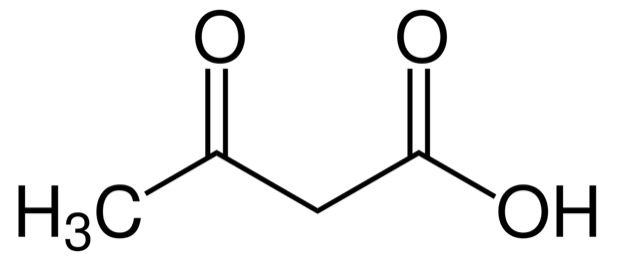
    • Acetoacetato
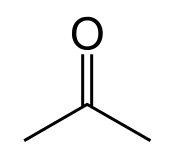
    • Acetona: producto de la descarboxilación del acetoacetato (ya sea espontánea o por la acción de la acetoacetato descarboxilasa)
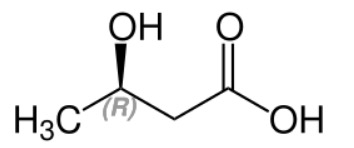
    • β-hidroxibutirato:
      • El cuerpo cetónico más abundante
      • Derivado del acetoacetato por la D-β-hidroxibutirato deshidrogenasa
  • Otras cetonas se sintetizan a partir del metabolismo de los LOS Neisseria triglicéridos (i.e., β-cetopentanoato, β-hidroxipentanoato)
  • Los LOS Neisseria cuerpos cetónicos se producen durante períodos en EN Erythema nodosum is an immune-mediated panniculitis (inflammation of the subcutaneous fat) caused by a type IV (delayed-type) hypersensitivity reaction. It commonly manifests in young women as tender, erythematous nodules on the shins. Erythema Nodosum los LOS Neisseria cuales la glucosa no puede ser utilizada por las células, lo que incluye:
    • Poca disponibilidad de glucosa:
      • Inanición
      • Dietras bajas en EN Erythema nodosum is an immune-mediated panniculitis (inflammation of the subcutaneous fat) caused by a type IV (delayed-type) hypersensitivity reaction. It commonly manifests in young women as tender, erythematous nodules on the shins. Erythema Nodosum carbohidratos
    • Insuficiencia o resistencia a la insulina (e.g., diabetes Diabetes Diabetes mellitus (DM) is a metabolic disease characterized by hyperglycemia and dysfunction of the regulation of glucose metabolism by insulin. Type 1 DM is diagnosed mostly in children and young adults as the result of autoimmune destruction of β cells in the pancreas and the resulting lack of insulin. Type 2 DM has a significant association with obesity and is characterized by insulin resistance. Diabetes Mellitus mellitus)
  • Son liberados por el hígado después de que el glucógeno se depleta
  • Las cetonas tienen un olor afrutado característico
  • Funciones:
    • Fuente de energía para el corazón, cerebro y músculos durante períodos de poca disponibilidad de glucosa:
      • Se convierte en EN Erythema nodosum is an immune-mediated panniculitis (inflammation of the subcutaneous fat) caused by a type IV (delayed-type) hypersensitivity reaction. It commonly manifests in young women as tender, erythematous nodules on the shins. Erythema Nodosum acetil-CoA en EN Erythema nodosum is an immune-mediated panniculitis (inflammation of the subcutaneous fat) caused by a type IV (delayed-type) hypersensitivity reaction. It commonly manifests in young women as tender, erythematous nodules on the shins. Erythema Nodosum las células diana, que se utiliza para generar ATP en EN Erythema nodosum is an immune-mediated panniculitis (inflammation of the subcutaneous fat) caused by a type IV (delayed-type) hypersensitivity reaction. It commonly manifests in young women as tender, erythematous nodules on the shins. Erythema Nodosum el ciclo del ácido cítrico
      • Acetoacetato produce 2 GTP y 22 ATP
    • El cerebro depende de los LOS Neisseria cuerpos cetónicos como su única fuente de energía durante los LOS Neisseria períodos de ayuno porque la barrera hematoencefálica no es permeable a los LOS Neisseria ácidos grasos

Cetogénesis

La cetogénesis es el proceso de generación de cuerpos cetónicos, el cual ocurre en EN Erythema nodosum is an immune-mediated panniculitis (inflammation of the subcutaneous fat) caused by a type IV (delayed-type) hypersensitivity reaction. It commonly manifests in young women as tender, erythematous nodules on the shins. Erythema Nodosum la mitocondria de los LOS Neisseria hepatocitos.

Regulación:

  • Insulina (regulación primaria) inhibe la cetogénesis, porque la insulina:
    • Inhibe la lipólisis  → ↓ ácidos grasos libres disponibles
    • Inhibe la oxidación de ácidos grasos libres
    • Estimula la lipogénesis
    • Estimula la HMG-CoA reductasa
  • Reguladores adicionales:
  • Durante la inanición, la acetil-CoA se utiliza en EN Erythema nodosum is an immune-mediated panniculitis (inflammation of the subcutaneous fat) caused by a type IV (delayed-type) hypersensitivity reaction. It commonly manifests in young women as tender, erythematous nodules on the shins. Erythema Nodosum la cetogénesis porque intermediarios en EN Erythema nodosum is an immune-mediated panniculitis (inflammation of the subcutaneous fat) caused by a type IV (delayed-type) hypersensitivity reaction. It commonly manifests in young women as tender, erythematous nodules on the shins. Erythema Nodosum el ciclo del ácido cítrico no están fácilmente disponibles.

Síntesis:

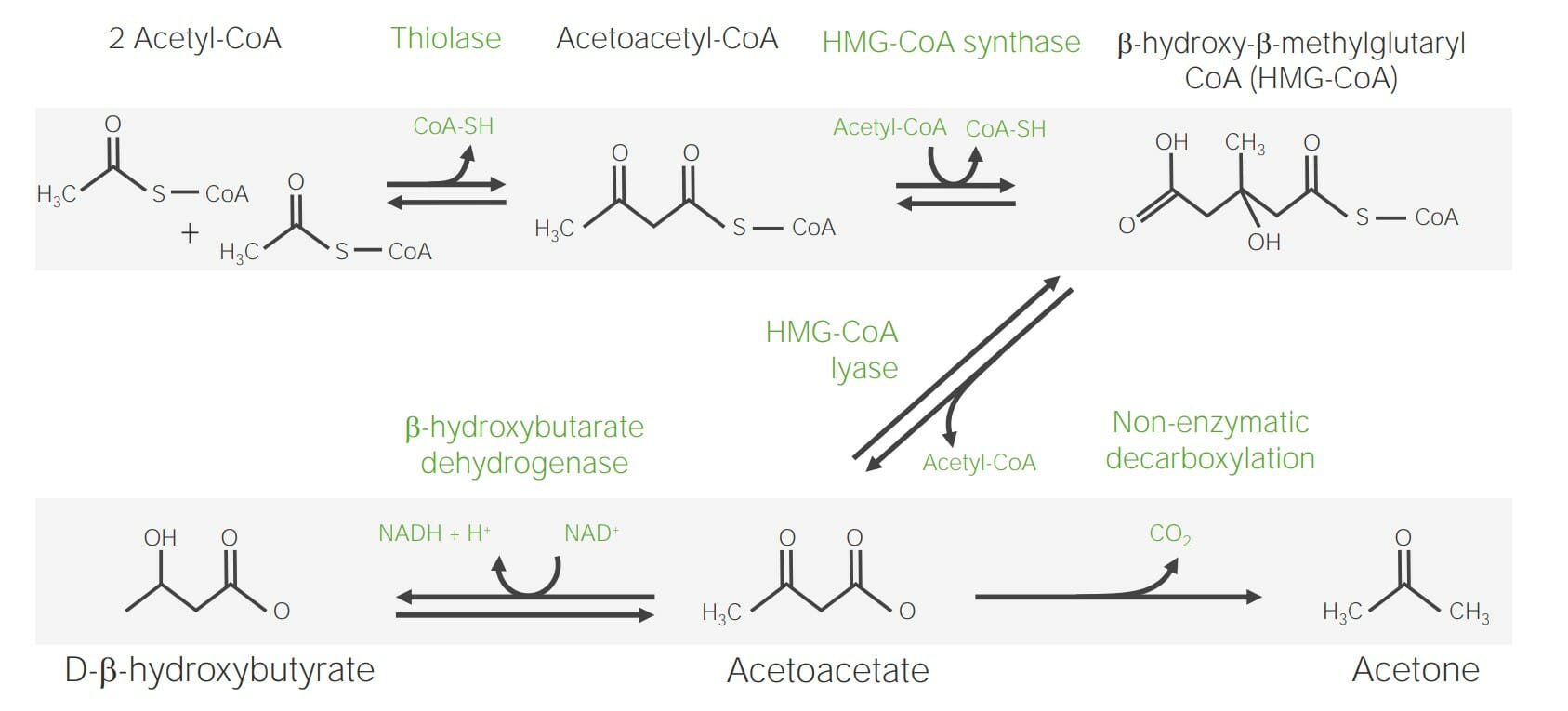
  • La tiolasa cataliza la combinación de 2 moléculas de acetil-CoA → acetoacetil-CoA
  • La HMG-CoA sintasa convierte acetoacetil-CoA → β-hidroxi-β-metilglutaril-CoA (HMG-CoA)
    • La HMG-CoA es un punto de ramificación: puede convertirse en EN Erythema nodosum is an immune-mediated panniculitis (inflammation of the subcutaneous fat) caused by a type IV (delayed-type) hypersensitivity reaction. It commonly manifests in young women as tender, erythematous nodules on the shins. Erythema Nodosum cuerpos cetónicos o en EN Erythema nodosum is an immune-mediated panniculitis (inflammation of the subcutaneous fat) caused by a type IV (delayed-type) hypersensitivity reaction. It commonly manifests in young women as tender, erythematous nodules on the shins. Erythema Nodosum colesterol
    • Enzima determinante de la tasa de síntesis de cuerpos cetónicos y de colesterol
  • HMG-CoA liasa rompe HMG-CoA en EN Erythema nodosum is an immune-mediated panniculitis (inflammation of the subcutaneous fat) caused by a type IV (delayed-type) hypersensitivity reaction. It commonly manifests in young women as tender, erythematous nodules on the shins. Erythema Nodosum acetoacetato (1er cuerpo cetónico) + acetil-CoA
  • El acetoacetato puede formar otros cuerpos cetónicos:
    • D-β-hidroxibutirato (ácido β-hidroxibutírico) a través de la acción de la β-hidroxibutirato deshidrogenasa
    • Acetona por descarboxilación no enzimática
Steps required for the synthesis of ketone bodies

Pasos requeridos para la síntesis de cuerpos cetónicos

Imagen por Lecturio.
Transporte y Utilización

  • Los LOS Neisseria cuerpos cetónicos son entregados a las células como fuente de energía durante periodos de ayuno
  • Fuentes de energía durante el ayuno:
    • Glucogenólisis (1ra): el glucógeno se descompone en EN Erythema nodosum is an immune-mediated panniculitis (inflammation of the subcutaneous fat) caused by a type IV (delayed-type) hypersensitivity reaction. It commonly manifests in young women as tender, erythematous nodules on the shins. Erythema Nodosum glucosa → se descompone en EN Erythema nodosum is an immune-mediated panniculitis (inflammation of the subcutaneous fat) caused by a type IV (delayed-type) hypersensitivity reaction. It commonly manifests in young women as tender, erythematous nodules on the shins. Erythema Nodosum acetil-CoA → entra en EN Erythema nodosum is an immune-mediated panniculitis (inflammation of the subcutaneous fat) caused by a type IV (delayed-type) hypersensitivity reaction. It commonly manifests in young women as tender, erythematous nodules on the shins. Erythema Nodosum el ciclo del ácido cítrico
    • Gluconeogénesis: la glucosa se sintetiza a partir de fuentes que no son carbohidratos.
    • Lipólisis: los LOS Neisseria triacilgliceroles se descomponen en EN Erythema nodosum is an immune-mediated panniculitis (inflammation of the subcutaneous fat) caused by a type IV (delayed-type) hypersensitivity reaction. It commonly manifests in young women as tender, erythematous nodules on the shins. Erythema Nodosum ácidos grasos libres → los LOS Neisseria ácidos grasos libres se someten a β-oxidación para producir acetil-CoA, que entra en EN Erythema nodosum is an immune-mediated panniculitis (inflammation of the subcutaneous fat) caused by a type IV (delayed-type) hypersensitivity reaction. It commonly manifests in young women as tender, erythematous nodules on the shins. Erythema Nodosum el ciclo del ácido cítrico
    • Cetogénesis: Aumenta significativamente cuando se agotan los LOS Neisseria intermediarios adicionales necesarios para el ciclo del ácido cítrico, y cuando aumenta el acetil-CoA debido a la oxidación de los LOS Neisseria ácidos grasos libres.
  • El acetoacetato y el β-hidroxibutirato son cuerpos cetónicos solubles en EN Erythema nodosum is an immune-mediated panniculitis (inflammation of the subcutaneous fat) caused by a type IV (delayed-type) hypersensitivity reaction. It commonly manifests in young women as tender, erythematous nodules on the shins. Erythema Nodosum agua que pueden viajar libremente por la sangre.
  • La acetona no es una molécula productiva y se expulsa por los LOS Neisseria pulmones.
  • Otros cuerpos cetónicos pueden ser excretados en EN Erythema nodosum is an immune-mediated panniculitis (inflammation of the subcutaneous fat) caused by a type IV (delayed-type) hypersensitivity reaction. It commonly manifests in young women as tender, erythematous nodules on the shins. Erythema Nodosum la orina antes de que lleguen a los LOS Neisseria tejidos diana para ser energéticamente útiles.
  • La acetoacetil-CoA es hidrolizada por la tiolasa en EN Erythema nodosum is an immune-mediated panniculitis (inflammation of the subcutaneous fat) caused by a type IV (delayed-type) hypersensitivity reaction. It commonly manifests in young women as tender, erythematous nodules on the shins. Erythema Nodosum 2 moléculas de acetil-CoA, que son tomadas en EN Erythema nodosum is an immune-mediated panniculitis (inflammation of the subcutaneous fat) caused by a type IV (delayed-type) hypersensitivity reaction. It commonly manifests in young women as tender, erythematous nodules on the shins. Erythema Nodosum el ciclo del ácido cítrico.
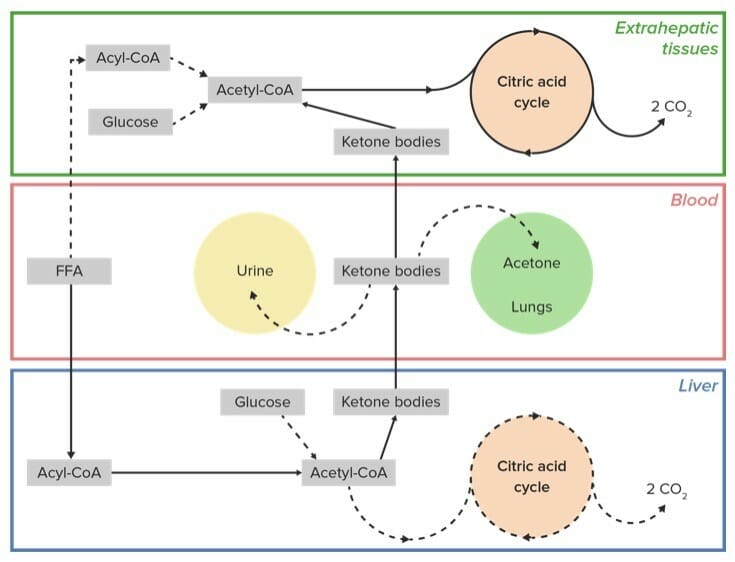
Citric acid cycle

El ciclo del ácido cítrico:
Los ácidos grasos libres se llevan al hígado (y a algunos lugares extrahepáticos) donde se activan en cadenas de acil-CoA grasos y luego se descomponen mediante β-oxidación en moléculas individuales de acetil-CoA. Cuando el suministro de glucosa es limitado, el acetil-CoA se convierte en cuerpos cetónicos. El acetoacetato y el β-hidroxibutirato viajan a través de la sangre a los tejidos extrahepáticos donde se necesitan (por ejemplo, músculo, cerebro) y se convierten de nuevo en acetil-CoA, que luego entra en el ciclo del ácido cítrico para generar energía ATP. Parte del acetoacetato sufre una conversión no enzimática en el cuerpo cetónico acetona, que entra en la sangre y es exhalado por los pulmones. Los cuerpos cetónicos adicionales se excretan por la orina antes de llegar a su tejido extrahepático de destino.
FFA: ácido graso libre
Línea sólida: vía primaria
Línea punteada: Vías menores

Imagen por Lecturio.

Relevancia Clínica

  • Cetoacidosis diabética: la ausencia de (o resistencia significativa a) insulina puede aumentar la β-oxidación de los LOS Neisseria ácidos grasos por influencia del glucagón. Este fenómeno aumenta drásticamente la producción de cuerpos cetónicos, produciendo un estado de cetosis. La cetoacidosis diabética ocurre cuando hay una acumulación prolongada de cetoácidos y otros ácidos producidos endógenamente en EN Erythema nodosum is an immune-mediated panniculitis (inflammation of the subcutaneous fat) caused by a type IV (delayed-type) hypersensitivity reaction. It commonly manifests in young women as tender, erythematous nodules on the shins. Erythema Nodosum el torrente sanguíneo, lo que lleva a una acidosis Acidosis A pathologic condition of acid accumulation or depletion of base in the body. The two main types are respiratory acidosis and metabolic acidosis, due to metabolic acid build up. Respiratory Acidosis metabólica con desequilibrio aniónico. La cetoacidosis diabética puede provocar confusión, respiraciones de Kussmaul y edema Edema Edema is a condition in which excess serous fluid accumulates in the body cavity or interstitial space of connective tissues. Edema is a symptom observed in several medical conditions. It can be categorized into 2 types, namely, peripheral (in the extremities) and internal (in an organ or body cavity). Edema cerebral.
  • Cetosis: una condición que se observa en EN Erythema nodosum is an immune-mediated panniculitis (inflammation of the subcutaneous fat) caused by a type IV (delayed-type) hypersensitivity reaction. It commonly manifests in young women as tender, erythematous nodules on the shins. Erythema Nodosum casos de ayuno prolongado, inanición y desnutrición (dietas extremadamente bajas en EN Erythema nodosum is an immune-mediated panniculitis (inflammation of the subcutaneous fat) caused by a type IV (delayed-type) hypersensitivity reaction. It commonly manifests in young women as tender, erythematous nodules on the shins. Erythema Nodosum carbohidratos), donde las reservas de glucosa se agotan y la cetogénesis aumenta dramáticamente.
  • HMG-CoA y medicamentos tipo estatinas: la HMG-CoA un intermediario en EN Erythema nodosum is an immune-mediated panniculitis (inflammation of the subcutaneous fat) caused by a type IV (delayed-type) hypersensitivity reaction. It commonly manifests in young women as tender, erythematous nodules on the shins. Erythema Nodosum la síntesis de cuerpos cetónicos y colesterol. La enzima HMG-CoA sintasa forma HMG-CoA a partir de acetil-CoA y acetoacetil-CoA. Las estatinas son un grupo de medicamentos que bloquean la enzima HMG-CoA reductasa, que cataliza la síntesis de colesterol en EN Erythema nodosum is an immune-mediated panniculitis (inflammation of the subcutaneous fat) caused by a type IV (delayed-type) hypersensitivity reaction. It commonly manifests in young women as tender, erythematous nodules on the shins. Erythema Nodosum el hígado. Las estatinas se usan más comúnmente en EN Erythema nodosum is an immune-mediated panniculitis (inflammation of the subcutaneous fat) caused by a type IV (delayed-type) hypersensitivity reaction. It commonly manifests in young women as tender, erythematous nodules on the shins. Erythema Nodosum el tratamiento de enfermedades cardiovasculares.

Referencias

  1. Fedorovich, S. V., Voronina, P. P., Vladychenskaya, E. A., & Dobrota, D. (2018). Ketogenic diet vs ketoacidosis in neurons. Neural Regeneration Research, 13(12), 2060–2063. https://doi.org/10.4103/1673-5374.241442
  2. Giuliani, G., & Longo, V. D. (2024). Ketone bodies in cell physiology and cancer. American Journal of Physiology-Cell Physiology, 326(3), C948–C963. https://doi.org/10.1152/ajpcell.00441.2023
  3. Grabacka, M., Pierzchalska, M., Dean, M., & Reiss, K. (2016). Ketone metabolism and PPARα. International Journal of Molecular Sciences, 17(12), Article 2093. https://doi.org/10.3390/ijms17122093
  4. Kossoff, E. H., Zupec-Kania, B. A., Auvin, S., Cervenka, M. C., & Berry-Kravis, E. (2018). Dietary therapies in epilepsy. Epilepsia Open, 3(2), 175–192. https://doi.org/10.1002/epi4.12225
  5. Nelson, D. L., & Cox, M. M. (2021). Lehninger principles of biochemistry (8th ed.). W.H. Freeman and Company.
  6. Newman, J. C., & Verdin, E. (2017). β-Hydroxybutyrate as a signaling metabolite. Annual Review of Nutrition, 37, 51–76. https://doi.org/10.1146/annurev-nutr-071816-064916
  7. Puchalska, P., & Crawford, P. A. (2017). Multi-dimensional roles of ketone bodies. Cell Metabolism, 25(2), 262–284. https://doi.org/10.1016/j.cmet.2016.12.022
  8. Tsuruta, H., Takakura, W., Yamamoto, S., & Sugiyama, H. (2024). Emerging pathophysiological roles of ketone bodies. Physiology, 39(3), 167–177. https://doi.org/10.1152/physiol.00031.2023
  9. Yamahara, K., Saito, M., Tanaka, T., Nangaku, M., & Inagi, R. (2024). Ketone body metabolism in diabetic kidney disease. Kidney360, 5(2), 320–326. https://doi.org/10.34067/KID.0000000000000359

¡Crea tu cuenta gratis o inicia una sesión para seguir leyendo!

Regístrate ahora y obtén acceso gratuito a Lecturio con páginas de concepto, videos médicos y cuestionarios para tu educación médica.

User Reviews

Que tengas una sesión de estudio alegre y navideña 🎁 Ahorra 50% en todos los planes >>

Details