
Domina Conceptos Médicos

Estudia para la escuela de medicina y tus examenes con Lecturio.

Meningioma

Los LOS Neisseria meningiomas son tumores de crecimiento lento que surgen de las meninges Meninges The brain and the spinal cord are enveloped by 3 overlapping layers of connective tissue called the meninges. The layers are, from the most external layer to the most internal layer, the dura mater, arachnoid mater, and pia mater. Between these layers are 3 potential spaces called the epidural, subdural, and subarachnoid spaces. Meninges: Anatomy del cerebro y la médula espinal. La gran mayoría son benignos. Estos tumores suelen aparecer en EN Erythema nodosum is an immune-mediated panniculitis (inflammation of the subcutaneous fat) caused by a type IV (delayed-type) hypersensitivity reaction. It commonly manifests in young women as tender, erythematous nodules on the shins. Erythema Nodosum individuos con antecedentes de dosis altas de radiación craneal, traumatismos craneales y neurofibromatosis tipo 2. Los LOS Neisseria síntomas clínicos del meningioma Meningioma Meningiomas are slow-growing tumors that arise from the meninges of the brain and spinal cord. The vast majority are benign. These tumors commonly occur in individuals with a history of high doses of skull radiation, head trauma, and neurofibromatosis 2. Meningioma dependen de la localización y la progresión del tumor Tumor Inflammation y una gran proporción de los LOS Neisseria meningiomas son asintomáticos. Cuando los LOS Neisseria síntomas se desarrollan, lo más común es que incluyan cefalea, convulsiones, alteraciones visuales y otros déficits neurológicos focales. El diagnóstico se realiza a partir de la neuroimagenología (la resonancia magnética es el estándar de oro) y la biopsia. El tratamiento consiste en EN Erythema nodosum is an immune-mediated panniculitis (inflammation of the subcutaneous fat) caused by a type IV (delayed-type) hypersensitivity reaction. It commonly manifests in young women as tender, erythematous nodules on the shins. Erythema Nodosum la vigilancia de los LOS Neisseria pacientes asintomáticos y en EN Erythema nodosum is an immune-mediated panniculitis (inflammation of the subcutaneous fat) caused by a type IV (delayed-type) hypersensitivity reaction. It commonly manifests in young women as tender, erythematous nodules on the shins. Erythema Nodosum el caso de los LOS Neisseria sintomáticos, es la resección quirúrgica. En EN Erythema nodosum is an immune-mediated panniculitis (inflammation of the subcutaneous fat) caused by a type IV (delayed-type) hypersensitivity reaction. It commonly manifests in young women as tender, erythematous nodules on the shins. Erythema Nodosum algunos casos también se utiliza la radiación.

Last updated: Dec 15, 2025

Editorial responsibility: Stanley Oiseth, Lindsay Jones, Evelin Maza

Descripción General

Definición

Un meningioma Meningioma Meningiomas are slow-growing tumors that arise from the meninges of the brain and spinal cord. The vast majority are benign. These tumors commonly occur in individuals with a history of high doses of skull radiation, head trauma, and neurofibromatosis 2. Meningioma es un tumor Tumor Inflammation de crecimiento lento que surge de las meninges Meninges The brain and the spinal cord are enveloped by 3 overlapping layers of connective tissue called the meninges. The layers are, from the most external layer to the most internal layer, the dura mater, arachnoid mater, and pia mater. Between these layers are 3 potential spaces called the epidural, subdural, and subarachnoid spaces. Meninges: Anatomy del cerebro y la médula espinal.

  • Las meninges Meninges The brain and the spinal cord are enveloped by 3 overlapping layers of connective tissue called the meninges. The layers are, from the most external layer to the most internal layer, the dura mater, arachnoid mater, and pia mater. Between these layers are 3 potential spaces called the epidural, subdural, and subarachnoid spaces. Meninges: Anatomy son las capas fibrosas que recubren el cerebro y la médula espinal y constan de 3 capas:
    • Duramadre: la capa externa, que forma una vaina colágena resistente
    • Aracnoides: capa intermedia, que consiste en EN Erythema nodosum is an immune-mediated panniculitis (inflammation of the subcutaneous fat) caused by a type IV (delayed-type) hypersensitivity reaction. It commonly manifests in young women as tender, erythematous nodules on the shins. Erythema Nodosum un epitelio escamoso simple con una malla poco densa de colágeno y fibras elásticas
    • Piamadre: fina capa interna, que está en EN Erythema nodosum is an immune-mediated panniculitis (inflammation of the subcutaneous fat) caused by a type IV (delayed-type) hypersensitivity reaction. It commonly manifests in young women as tender, erythematous nodules on the shins. Erythema Nodosum contacto con el cerebro y la médula espinal
  • Los LOS Neisseria meningiomas surgen de la capa aracnoidea .
Tabla: Clasificación de los LOS Neisseria tumores del sistema nervioso
Categorías Tumores específicos
Tumores neuroepiteliales en EN Erythema nodosum is an immune-mediated panniculitis (inflammation of the subcutaneous fat) caused by a type IV (delayed-type) hypersensitivity reaction. It commonly manifests in young women as tender, erythematous nodules on the shins. Erythema Nodosum el SNC
  • Astrocitomas, incluido el glioblastoma multiforme Glioblastoma multiforme Glioblastoma multiforme is a high-grade astrocytoma, an aggressive brain tumor arising from astrocytes, with an unknown cause and a poorly understood link to risk factors. There are two main types: primary, a more aggressive form seen more commonly in older patients, and secondary, developing from lower-grade astrocytomas and seen more commonly in younger patients. Glioblastoma Multiforme
  • Oligodendrogliomas
  • Ependimoma y tumores del plexo coroideo
  • Meduloblastomas (tumores embrionarios)
Tumores meníngeos
  • Meningiomas
  • Hemangioblastomas Hemangioblastomas A benign tumor of the nervous system that may occur sporadically or in association with von Hippel-Lindau disease. It accounts for approximately 2% of intracranial tumors, arising most frequently in the cerebellar hemispheres and vermis. Histologically, the tumors are composed of multiple capillary and sinusoidal channels lined with endothelial cells and clusters of lipid-laden pseudoxanthoma cells. Usually solitary, these tumors can be multiple and may also occur in the brain stem, spinal cord, retina, and supratentorial compartment. Cerebellar hemangioblastomas usually present in the third decade with intracranial hypertension, and ataxia. Von Hippel-Lindau Disease
Tumores de la región selar
  • Craneofaringioma
  • Adenoma hipofisario
  • Pinealoma/pinealoblastoma
Otros tumores primarios del SNC Linfoma primario del SNC
Metástasis al AL Amyloidosis cerebro (5 veces más común que los LOS Neisseria tumores cerebrales primarios) Más comúnmente surgen de:
  • Carcinomas de pulmón, mama y células renales
  • Melanoma Melanoma Melanoma is a malignant tumor arising from melanocytes, the melanin-producing cells of the epidermis. These tumors are most common in fair-skinned individuals with a history of excessive sun exposure and sunburns. Melanoma
Tumores periféricos
  • Schwannomas, incluido el neurinoma del acústico
  • Neuroblastoma Neuroblastoma Neuroblastoma is a malignancy that arises from the neural crest cell derivatives along the sympathetic chain (neuroblasts) and is most commonly located in the adrenal medulla. The tumor often presents in childhood with a flank mass that crosses the midline. Neuroblastoma

Epidemiología

  • Incidencia:
    • Los LOS Neisseria meningiomas son el tipo más común de los LOS Neisseria tumores primarios del SNC.
    • Representan alrededor de ⅓ de todos los LOS Neisseria tumores cerebrales y espinales primarios
    • Meningiomas craneales: 90%.
    • Meningiomas espinales: 10%.
  • La edad media de diagnóstico es de 65 años:
    • La incidencia aumenta progresivamente con la edad.
    • Es poco frecuente en EN Erythema nodosum is an immune-mediated panniculitis (inflammation of the subcutaneous fat) caused by a type IV (delayed-type) hypersensitivity reaction. It commonly manifests in young women as tender, erythematous nodules on the shins. Erythema Nodosum los LOS Neisseria niños, excepto cuando hay una asociación con la neurofibromatosis tipo 2
  • Sexo: más frecuente en EN Erythema nodosum is an immune-mediated panniculitis (inflammation of the subcutaneous fat) caused by a type IV (delayed-type) hypersensitivity reaction. It commonly manifests in young women as tender, erythematous nodules on the shins. Erythema Nodosum las mujeres
  • Incidencia por grado de la OMS:
    • Grado 1: 80%–85%
    • Grado 2: 15%–18%
    • Grado 3: 1%–3%

Clasificación

Los LOS Neisseria meningiomas son clasificados morfológicamente por la OMS en EN Erythema nodosum is an immune-mediated panniculitis (inflammation of the subcutaneous fat) caused by a type IV (delayed-type) hypersensitivity reaction. It commonly manifests in young women as tender, erythematous nodules on the shins. Erythema Nodosum 3 grados:

  • Grado 1: tumores benignos de las meninges Meninges The brain and the spinal cord are enveloped by 3 overlapping layers of connective tissue called the meninges. The layers are, from the most external layer to the most internal layer, the dura mater, arachnoid mater, and pia mater. Between these layers are 3 potential spaces called the epidural, subdural, and subarachnoid spaces. Meninges: Anatomy, que incluyen muchos subtipos
  • Grado 2: tumores que muestran cierta invasión cerebral y más actividad mitótica
    • Meningioma Meningioma Meningiomas are slow-growing tumors that arise from the meninges of the brain and spinal cord. The vast majority are benign. These tumors commonly occur in individuals with a history of high doses of skull radiation, head trauma, and neurofibromatosis 2. Meningioma atípico
    • Meningioma Meningioma Meningiomas are slow-growing tumors that arise from the meninges of the brain and spinal cord. The vast majority are benign. These tumors commonly occur in individuals with a history of high doses of skull radiation, head trauma, and neurofibromatosis 2. Meningioma de células claras
    • Meningioma Meningioma Meningiomas are slow-growing tumors that arise from the meninges of the brain and spinal cord. The vast majority are benign. These tumors commonly occur in individuals with a history of high doses of skull radiation, head trauma, and neurofibromatosis 2. Meningioma coroideo
  • Grado 3: tumores malignos más agresivos
    • Meningioma Meningioma Meningiomas are slow-growing tumors that arise from the meninges of the brain and spinal cord. The vast majority are benign. These tumors commonly occur in individuals with a history of high doses of skull radiation, head trauma, and neurofibromatosis 2. Meningioma papilar
    • Meningioma Meningioma Meningiomas are slow-growing tumors that arise from the meninges of the brain and spinal cord. The vast majority are benign. These tumors commonly occur in individuals with a history of high doses of skull radiation, head trauma, and neurofibromatosis 2. Meningioma anaplásico
    • Meningioma Meningioma Meningiomas are slow-growing tumors that arise from the meninges of the brain and spinal cord. The vast majority are benign. These tumors commonly occur in individuals with a history of high doses of skull radiation, head trauma, and neurofibromatosis 2. Meningioma rabdoide

Factores de riesgo

No se han establecido las causas del meningioma Meningioma Meningiomas are slow-growing tumors that arise from the meninges of the brain and spinal cord. The vast majority are benign. These tumors commonly occur in individuals with a history of high doses of skull radiation, head trauma, and neurofibromatosis 2. Meningioma. Sin embargo, se han identificado ciertos factores de alto riesgo para causar meningiomas:
  • Exposición a la radiación: radiación ionizante en EN Erythema nodosum is an immune-mediated panniculitis (inflammation of the subcutaneous fat) caused by a type IV (delayed-type) hypersensitivity reaction. It commonly manifests in young women as tender, erythematous nodules on the shins. Erythema Nodosum el cráneo
  • Traumatismo craneal
  • Hormonas femeninas: alta incidencia en EN Erythema nodosum is an immune-mediated panniculitis (inflammation of the subcutaneous fat) caused by a type IV (delayed-type) hypersensitivity reaction. It commonly manifests in young women as tender, erythematous nodules on the shins. Erythema Nodosum mujeres pospúberes y durante los LOS Neisseria años reproductivos
  • Cáncer de mama: mayor riesgo de aparición
  • Trastornos hereditarios del sistema nervioso:
    • Neurofibromatosis tipo 2
    • Schwannomatosis
  • Obesidad

Fisiopatología

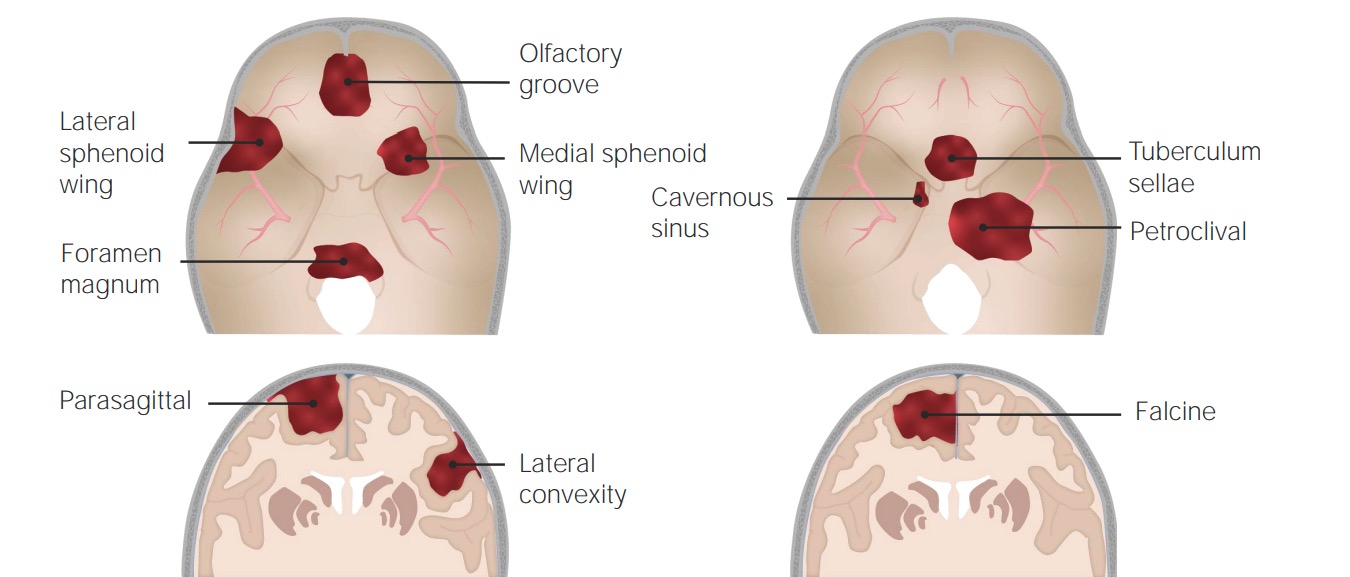
Localización del meningioma Meningioma Meningiomas are slow-growing tumors that arise from the meninges of the brain and spinal cord. The vast majority are benign. These tumors commonly occur in individuals with a history of high doses of skull radiation, head trauma, and neurofibromatosis 2. Meningioma

  • Parasagital y falcino
  • Convexidad cerebral
  • Ala del esfenoides
  • Bulbo olfatorio
  • Senos cavernosos
  • Supraselar
  • Foramen magno
  • Fosa posterior
  • Intraventricular
  • Intraorbitario
  • Espinal
Localización de meningiomas

Localizaciones habituales de aparición de los meningiomas

Imagen por Lecturio. Licencia: CC BY-NC-SA 4.0

Fisiopatología

Los LOS Neisseria meningiomas suelen surgir de las células aracnoideas cercanas a los LOS Neisseria senos venosos. A medida que el tumor Tumor Inflammation se agranda, puede causar síntomas debido a:

  • Aumento de la presión intracraneal
  • Compresión directa del tumor Tumor Inflammation sobre las estructuras adyacentes
  • Invasión en EN Erythema nodosum is an immune-mediated panniculitis (inflammation of the subcutaneous fat) caused by a type IV (delayed-type) hypersensitivity reaction. It commonly manifests in young women as tender, erythematous nodules on the shins. Erythema Nodosum el tejido cerebral circundante (grados 2 y 3)

Presentación Clínica

Algunos pacientes son asintomáticos. Para los LOS Neisseria pacientes sintomáticos, la presentación clínica de los LOS Neisseria meningiomas depende de la localización del tumor Tumor Inflammation.

  • Cefaleas
  • Convulsiones
  • Alteración del estado mental
  • Déficits neurológicos focales:
    • Subfrontal: apatía, incontinencia urinaria
    • Seno cavernoso: disminución de la visión, diplopía, adormecimiento facial
    • Lóbulo occipital Occipital Part of the back and base of the cranium that encloses the foramen magnum. Skull: Anatomy: Hemianopsia contralateral
    • Fosa posterior: hidrocefalia obstructiva → papiledema y cefaleas matutinas
    • Médula espinal: dolor Dolor Inflammation localizado, defectos de la hemimédula espinal
    • Surco olfativo: anosmia Anosmia Complete or severe loss of the subjective sense of smell. Loss of smell may be caused by many factors such as a cold, allergy, olfactory nerve diseases, viral respiratory tract infections (e.g., COVID-19), aging and various neurological disorders (e.g., Alzheimer disease). Cranial Nerve Palsies, papiledema, atrofia óptica
    • Esfenoides: convulsiones, parálisis de los LOS Neisseria nervios craneales
    • Tentorial: cefaleas, convulsiones, dificultad para caminar

Diagnóstico

Los LOS Neisseria estudios de laboratorio son de poca utilidad en EN Erythema nodosum is an immune-mediated panniculitis (inflammation of the subcutaneous fat) caused by a type IV (delayed-type) hypersensitivity reaction. It commonly manifests in young women as tender, erythematous nodules on the shins. Erythema Nodosum el diagnóstico de los LOS Neisseria meningiomas; la imagenología es una herramienta diagnóstica más útil. Se requiere una biopsia para confirmar el diagnóstico.
Imagenología

  • Modalidades de imagen:
    • RM con contraste (estándar de oro); también se puede considerar:
      • Angiografía por resonancia magnética ( MRA MRA Imaging of the Heart and Great Vessels, por sus siglas en EN Erythema nodosum is an immune-mediated panniculitis (inflammation of the subcutaneous fat) caused by a type IV (delayed-type) hypersensitivity reaction. It commonly manifests in young women as tender, erythematous nodules on the shins. Erythema Nodosum inglés)
      • Venografía por resonancia magnética (MNV, por sus siglas en EN Erythema nodosum is an immune-mediated panniculitis (inflammation of the subcutaneous fat) caused by a type IV (delayed-type) hypersensitivity reaction. It commonly manifests in young women as tender, erythematous nodules on the shins. Erythema Nodosum inglés)
    • TC con contraste
  • Hallazgos en EN Erythema nodosum is an immune-mediated panniculitis (inflammation of the subcutaneous fat) caused by a type IV (delayed-type) hypersensitivity reaction. It commonly manifests in young women as tender, erythematous nodules on the shins. Erythema Nodosum la imagen:
    • Contorno liso adyacente a las estructuras durales
    • Imágenes ponderadas en EN Erythema nodosum is an immune-mediated panniculitis (inflammation of the subcutaneous fat) caused by a type IV (delayed-type) hypersensitivity reaction. It commonly manifests in young women as tender, erythematous nodules on the shins. Erythema Nodosum T1: isointensas o hipointensas
    • Imágenes ponderadas en EN Erythema nodosum is an immune-mediated panniculitis (inflammation of the subcutaneous fat) caused by a type IV (delayed-type) hypersensitivity reaction. It commonly manifests in young women as tender, erythematous nodules on the shins. Erythema Nodosum T2: isointensas o hiperintensas
    • Aumento uniforme del realce cuando se realiza una exploración con contraste
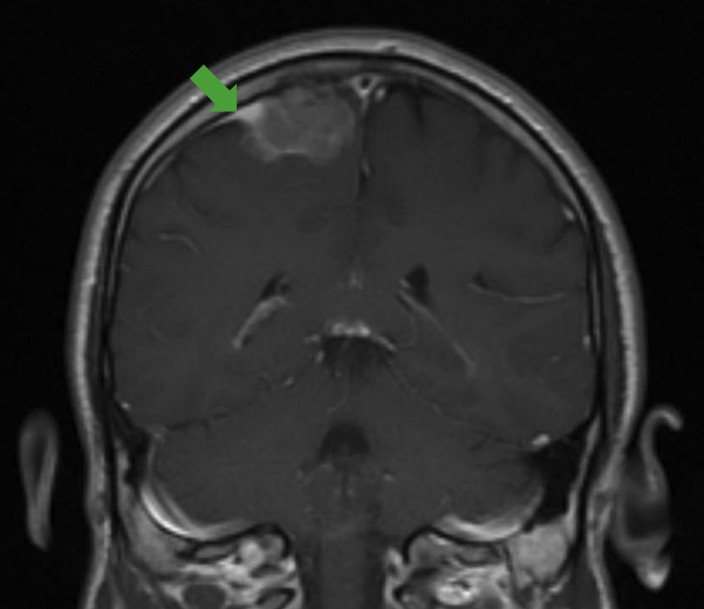
    • Signo de la cola dural: engrosamiento dural marginal que se estrecha periféricamente
  • Hallazgos sugestivos de un meningioma Meningioma Meningiomas are slow-growing tumors that arise from the meninges of the brain and spinal cord. The vast majority are benign. These tumors commonly occur in individuals with a history of high doses of skull radiation, head trauma, and neurofibromatosis 2. Meningioma maligno:
    • Cambios quísticos
    • Destrucción del hueso adyacente
    • Edema Edema Edema is a condition in which excess serous fluid accumulates in the body cavity or interstitial space of connective tissues. Edema is a symptom observed in several medical conditions. It can be categorized into 2 types, namely, peripheral (in the extremities) and internal (in an organ or body cavity). Edema cerebral circundante
    • ↑ Volumen sanguíneo cerebral
Signo de la cola dural

Signo de la cola dural:
RM que muestra el signo clásico de la cola dural (flecha verde), que puede verse en los estudios de imagen de un meningioma.

Imagen por Roy Strowd, MD. Licencia: CC BY-NC-SA 4.0

Biopsia

La biopsia proporciona un diagnóstico definitivo. Los LOS Neisseria hallazgos histológicos incluyen:
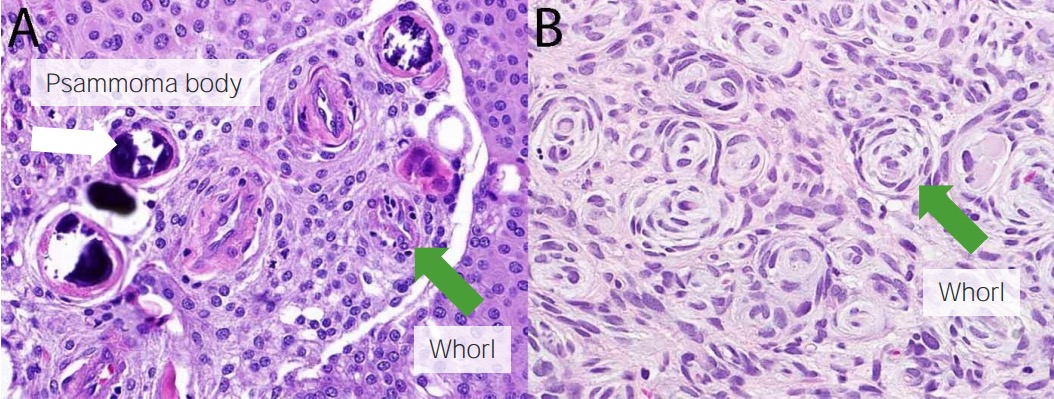
  • Arquitectura lobulada con verticilos meningoteliales
  • Cuerpos de psamoma
  • Células sinciciales
  • Citoplasma eosinofílico
  • Núcleos uniformes
  • Tumores de grado 2:
    • ↑ Actividad mitótica (≥ 4 figuras mitóticas por campo de alta potencia)
    • Muestra 3 o más de las siguientes características:
      • ↑ Celularidad
      • Células pequeñas con una relación nuclear/citoplasmática ↑.
      • Nucléolos prominentes
      • Crecimiento en EN Erythema nodosum is an immune-mediated panniculitis (inflammation of the subcutaneous fat) caused by a type IV (delayed-type) hypersensitivity reaction. It commonly manifests in young women as tender, erythematous nodules on the shins. Erythema Nodosum forma de hoja
      • Áreas de necrosis Necrosis The death of cells in an organ or tissue due to disease, injury or failure of the blood supply. Ischemic Cell Damage
  • Tumores de grado 3:
    • Actividad mitótica (≥ 20 figuras mitóticas por campo de alta potencia)
    • Infiltración subyacente en EN Erythema nodosum is an immune-mediated panniculitis (inflammation of the subcutaneous fat) caused by a type IV (delayed-type) hypersensitivity reaction. It commonly manifests in young women as tender, erythematous nodules on the shins. Erythema Nodosum el cerebro
    • Células atípicas
    • Múltiples áreas de necrosis Necrosis The death of cells in an organ or tissue due to disease, injury or failure of the blood supply. Ischemic Cell Damage
    • Arquitectura lobulada con verticilos meningoteliales
  • Cuerpos de psamoma
  • Calcificaciones redondas
  • Células sinciciales
  • Citoplasma eosinofílico
  • Núcleos uniformes
  • Tumores de grado 2:
    • ↑ Actividad mitótica (≥ 4 figuras mitóticas por campo de alta potencia)
    • Muestra 3 o más de las siguientes características:
      • ↑ Celularidad
      • Células pequeñas con una relación nuclear/citoplasmática ↑.
      • Nucléolos prominentes
      • Crecimiento en EN Erythema nodosum is an immune-mediated panniculitis (inflammation of the subcutaneous fat) caused by a type IV (delayed-type) hypersensitivity reaction. It commonly manifests in young women as tender, erythematous nodules on the shins. Erythema Nodosum forma de hoja
      • Áreas de necrosis Necrosis The death of cells in an organ or tissue due to disease, injury or failure of the blood supply. Ischemic Cell Damage
  • Tumores de grado 3:
    • Actividad mitótica (≥ 20 figuras mitóticas por campo de alta potencia)
    • Infiltración subyacente en EN Erythema nodosum is an immune-mediated panniculitis (inflammation of the subcutaneous fat) caused by a type IV (delayed-type) hypersensitivity reaction. It commonly manifests in young women as tender, erythematous nodules on the shins. Erythema Nodosum el cerebro
    • Células atípicas
    • Múltiples áreas de necrosis Necrosis The death of cells in an organ or tissue due to disease, injury or failure of the blood supply. Ischemic Cell Damage

Histología del meningioma

Histología del meningioma:
Se observan cuerpos de psamoma (flecha blanca) y verticilos (flechas verdes).

Imagen por Roy Strowd, MD. Licencia: CC BY-NC-SA 4.0

Tratamiento

Observación

La mayoría de los LOS Neisseria meningiomas pueden estar bajo observación, al AL Amyloidosis menos de manera inicial.

  • La observación es apropiada en EN Erythema nodosum is an immune-mediated panniculitis (inflammation of the subcutaneous fat) caused by a type IV (delayed-type) hypersensitivity reaction. It commonly manifests in young women as tender, erythematous nodules on the shins. Erythema Nodosum pacientes que:
    • Son asintomáticos (con meningiomas descubiertos incidentalmente por imagenología)
    • Tienen tumores pequeños (generalmente ≤ 2 cm) sin evidencia de invasión
  • Reevaluar en EN Erythema nodosum is an immune-mediated panniculitis (inflammation of the subcutaneous fat) caused by a type IV (delayed-type) hypersensitivity reaction. It commonly manifests in young women as tender, erythematous nodules on the shins. Erythema Nodosum 3-6 meses → si está estable, se pueden espaciar las imágenes de seguimiento
  • Indicaciones para tratamiento:
    • Agrandamiento significativo de un tumor Tumor Inflammation ya conocido
    • Si el paciente se vuelve sintomático

Intervención quirúrgica y pronóstico posquirúrgico

  • Indicaciones:
    • Tumores grandes o en EN Erythema nodosum is an immune-mediated panniculitis (inflammation of the subcutaneous fat) caused by a type IV (delayed-type) hypersensitivity reaction. It commonly manifests in young women as tender, erythematous nodules on the shins. Erythema Nodosum expansión
    • Tumores infiltrantes
    • Asociado a un edema Edema Edema is a condition in which excess serous fluid accumulates in the body cavity or interstitial space of connective tissues. Edema is a symptom observed in several medical conditions. It can be categorized into 2 types, namely, peripheral (in the extremities) and internal (in an organ or body cavity). Edema circundante
  • Se utiliza en EN Erythema nodosum is an immune-mediated panniculitis (inflammation of the subcutaneous fat) caused by a type IV (delayed-type) hypersensitivity reaction. It commonly manifests in young women as tender, erythematous nodules on the shins. Erythema Nodosum meningiomas no complicados y de fácil acceso
  • El enfoque quirúrgico del meningioma Meningioma Meningiomas are slow-growing tumors that arise from the meninges of the brain and spinal cord. The vast majority are benign. These tumors commonly occur in individuals with a history of high doses of skull radiation, head trauma, and neurofibromatosis 2. Meningioma se basa en EN Erythema nodosum is an immune-mediated panniculitis (inflammation of the subcutaneous fat) caused by a type IV (delayed-type) hypersensitivity reaction. It commonly manifests in young women as tender, erythematous nodules on the shins. Erythema Nodosum:
    • Tamaño y localización del meningioma Meningioma Meningiomas are slow-growing tumors that arise from the meninges of the brain and spinal cord. The vast majority are benign. These tumors commonly occur in individuals with a history of high doses of skull radiation, head trauma, and neurofibromatosis 2. Meningioma
    • Ritmo de crecimiento del tumor Tumor Inflammation
    • Riesgos de la cirugía para el paciente en EN Erythema nodosum is an immune-mediated panniculitis (inflammation of the subcutaneous fat) caused by a type IV (delayed-type) hypersensitivity reaction. It commonly manifests in young women as tender, erythematous nodules on the shins. Erythema Nodosum función de la edad, la salud y las comorbilidades
  • La resección quirúrgica de los LOS Neisseria meningiomas se considera una cura permanente.
  • La resección completa del tumor Tumor Inflammation y de su fijación dural es importante para prevenir la recidiva.
  • Pronóstico basado en EN Erythema nodosum is an immune-mediated panniculitis (inflammation of the subcutaneous fat) caused by a type IV (delayed-type) hypersensitivity reaction. It commonly manifests in young women as tender, erythematous nodules on the shins. Erythema Nodosum la extensión de la resección quirúrgica, según la escala de clasificación de Simpson.
    • Grados bajos (I-III): una extirpación más completa del tumor Tumor Inflammation con menor riesgo de recurrencia
    • Grados altos (IV-V): una resección menos completa con mayor riesgo de recurrencia
Tabla: Clasificación de la resección quirúrgica: Escala de clasificación de Simpson (tasa de recurrencia basada en EN Erythema nodosum is an immune-mediated panniculitis (inflammation of the subcutaneous fat) caused by a type IV (delayed-type) hypersensitivity reaction. It commonly manifests in young women as tender, erythematous nodules on the shins. Erythema Nodosum la extensión de la resección)
Grado Extensión de la resección Riesgo de recurrencia (intervalo de 10 años)
I Extirpación macroscópica completa del tumor Tumor Inflammation, de los LOS Neisseria huesos implicados, de los LOS Neisseria senos venosos y de la cola dural 9%
II Extirpación macroscópica completa del tumor Tumor Inflammation, coagulación de la cola dural 19%
III Extirpación macroscópica completa del tumor Tumor Inflammation, resección de la cola dural 29%
IV Extirpación parcial del tumor Tumor Inflammation, sin resección de la cola dural 44%
V Descompresión simple, sin resección de la cola dural 100%

Radiación

  • Indicaciones:
    • Cuando el tumor Tumor Inflammation es inoperable
    • En EN Erythema nodosum is an immune-mediated panniculitis (inflammation of the subcutaneous fat) caused by a type IV (delayed-type) hypersensitivity reaction. It commonly manifests in young women as tender, erythematous nodules on the shins. Erythema Nodosum caso de una resección incompleta
    • Tumores de alto grado (grados II y III)
  • Objetivos:
Tabla: Radioterapia para los LOS Neisseria meningiomas: Necesidad de radioterapia según el grado de la OMS y el tipo de cirugía realizada
Grado Tipo de cirugía Necesidad de radioterapia
OMS grado I Resección total macroscópica Observación
Resección subtotal Observación contra radioterapia
No hay cirugía Radioterapia
Grado II de la OMS Resección total macroscópica Observación contra radioterapia
Resección subtotal Radioterapia
Grado III de la OMS Cualquier cirugía Radioterapia

Diagnóstico Diferencial

  • Hemangioblastoma Hemangioblastoma Hemangioblastomas are vascular neoplasms of the CNS. Hemangioblastomas are rare and are often associated with von Hippel-Lindau disease (VHL). The most common presentation is a headache and, depending on the size and location of the tumor, patients may present with sensory deficits and motor weakness. Hemangioblastoma: tumores vasculares raros del SNC, a menudo asociados a la enfermedad de von Hippel-Lindau, que suelen afectar al AL Amyloidosis cerebro pero que también pueden afectar a la médula espinal o a la retina Retina The ten-layered nervous tissue membrane of the eye. It is continuous with the optic nerve and receives images of external objects and transmits visual impulses to the brain. Its outer surface is in contact with the choroid and the inner surface with the vitreous body. The outermost layer is pigmented, whereas the inner nine layers are transparent. Eye: Anatomy. Los LOS Neisseria síntomas que se presentan incluyen cefalea y déficits neurológicos según la localización del tumor Tumor Inflammation. El diagnóstico se basa en EN Erythema nodosum is an immune-mediated panniculitis (inflammation of the subcutaneous fat) caused by a type IV (delayed-type) hypersensitivity reaction. It commonly manifests in young women as tender, erythematous nodules on the shins. Erythema Nodosum la imagenología y la biopsia. El tratamiento incluye la escisión quirúrgica del tumor Tumor Inflammation y potencialmente, la radioterapia.
  • Glioblastoma multiforme Glioblastoma multiforme Glioblastoma multiforme is a high-grade astrocytoma, an aggressive brain tumor arising from astrocytes, with an unknown cause and a poorly understood link to risk factors. There are two main types: primary, a more aggressive form seen more commonly in older patients, and secondary, developing from lower-grade astrocytomas and seen more commonly in younger patients. Glioblastoma Multiforme: astrocitoma de grado IV de la OMS, rápidamente progresivo, que surge de los LOS Neisseria astrocitos (células gliales del cerebro) y se presenta clínicamente con cefalea, náuseas, somnolencia, visión borrosa, cambios de personalidad y convulsiones. La imagenología, la presentación clínica y la biopsia son los LOS Neisseria pilares del diagnóstico. El tratamiento incluye radioterapia, quimioterapia y escisión quirúrgica. El pronóstico es malo.
  • Oligodendroglioma Oligodendroglioma Oligodendrogliomas are malignant CNS tumors arising from neural glial cell precursors. Oligodendrogliomas often arise in the frontal lobes of the brain and have a generally favorable prognosis when compared to other gliomas. Oligodendrogliomas are the 3rd most common CNS tumor. The most frequent presenting symptom is a seizure. Oligodendroglioma: tumor Tumor Inflammation del sistema nervioso central que surge de los LOS Neisseria oligodendrocitos y que puede presentarse con déficits neurológicos focales, convulsiones y cambios de personalidad, dependiendo de la localización exacta. El diagnóstico se realiza mediante resonancia magnética y biopsia. El contacto con las meninges Meninges The brain and the spinal cord are enveloped by 3 overlapping layers of connective tissue called the meninges. The layers are, from the most external layer to the most internal layer, the dura mater, arachnoid mater, and pia mater. Between these layers are 3 potential spaces called the epidural, subdural, and subarachnoid spaces. Meninges: Anatomy y la presencia de la cola dural pueden ayudar a diferenciar muchos meningiomas de los LOS Neisseria oligodendrogliomas, que se desarrollan con mayor frecuencia en EN Erythema nodosum is an immune-mediated panniculitis (inflammation of the subcutaneous fat) caused by a type IV (delayed-type) hypersensitivity reaction. It commonly manifests in young women as tender, erythematous nodules on the shins. Erythema Nodosum los LOS Neisseria hemisferios cerebrales, normalmente en EN Erythema nodosum is an immune-mediated panniculitis (inflammation of the subcutaneous fat) caused by a type IV (delayed-type) hypersensitivity reaction. It commonly manifests in young women as tender, erythematous nodules on the shins. Erythema Nodosum el lóbulo frontal Frontal The bone that forms the frontal aspect of the skull. Its flat part forms the forehead, articulating inferiorly with the nasal bone and the cheek bone on each side of the face. Skull: Anatomy. El tratamiento implica la resección quirúrgica, posiblemente acompañada de radiación y/o quimioterapia.
  • Craneofaringioma: un tumor Tumor Inflammation hipofisario raro derivado del tejido embrionario. Clínicamente se presenta con cefalea, hipersomnia, polidipsia, poliuria, pérdida de la visión y vómitos. Diagnosticado por resonancia magnética y biopsia. El tratamiento incluye la escisión quirúrgica del tumor Tumor Inflammation y la radioterapia si está indicada.
  • Tumor Tumor Inflammation metastásico: células neoplásicas que se han extendido al AL Amyloidosis cerebro a partir de tumores primarios en EN Erythema nodosum is an immune-mediated panniculitis (inflammation of the subcutaneous fat) caused by a type IV (delayed-type) hypersensitivity reaction. It commonly manifests in young women as tender, erythematous nodules on the shins. Erythema Nodosum otra parte del cuerpo. Las neoplasias metastásicas son las más frecuentes en EN Erythema nodosum is an immune-mediated panniculitis (inflammation of the subcutaneous fat) caused by a type IV (delayed-type) hypersensitivity reaction. It commonly manifests in young women as tender, erythematous nodules on the shins. Erythema Nodosum el cerebro. La neuroimagenología suele mostrar múltiples focos del carcinoma, lo que sugiere un origen no cerebral. La presentación clínica depende del tumor Tumor Inflammation primario, de la localización y extensión de la metástasis cerebral. El tratamiento se dirige a la neoplasia subyacente y puede incluir la resección quirúrgica, la radioterapia y la quimioterapia.
  • Migraña: dolor Dolor Inflammation de cabeza que suele ser intenso y suele ir acompañado de náuseas, fotosensibilidad y sensibilidad al AL Amyloidosis sonido. El diagnóstico se basa en EN Erythema nodosum is an immune-mediated panniculitis (inflammation of the subcutaneous fat) caused by a type IV (delayed-type) hypersensitivity reaction. It commonly manifests in young women as tender, erythematous nodules on the shins. Erythema Nodosum los LOS Neisseria antecedentes familiares, la historia clínica y la presentación. La migraña puede diferenciarse de los LOS Neisseria meningiomas con base en EN Erythema nodosum is an immune-mediated panniculitis (inflammation of the subcutaneous fat) caused by a type IV (delayed-type) hypersensitivity reaction. It commonly manifests in young women as tender, erythematous nodules on the shins. Erythema Nodosum los LOS Neisseria hallazgos encontrados en EN Erythema nodosum is an immune-mediated panniculitis (inflammation of the subcutaneous fat) caused by a type IV (delayed-type) hypersensitivity reaction. It commonly manifests in young women as tender, erythematous nodules on the shins. Erythema Nodosum la neuroimagenología. El tratamiento incluye analgésicos y medicamentos preventivos como los LOS Neisseria alfabloqueadores.

Referencias

  1. Mayo Clinic Staff. (2024). Meningioma. Mayo Clinic. Retrieved March 25, 2025, from https://www.mayoclinic.org/diseases-conditions/meningioma/symptoms-causes/syc-20355643
  2. The Johns Hopkins University. (2021). Meningioma. https://www.hopkinsmedicine.org/health/conditions-and-diseases/meningioma
  3. Haddad, G. (2022). Meningioma. Medscape. Retrieved March 25, 2025, from https://emedicine.medscape.com/article/1156552-overview
  4. Park, J. K. (2025). Epidemiology, pathology, clinical features, and diagnosis of meningioma. UpToDate. Retrieved March 25, 2025, from https://www.uptodate.com/contents/epidemiology-pathology-clinical-features-and-diagnosis-of-meningioma
  5. Park, J. K., & Shih, H. A. (2025). Management of known or presumed benign (WHO grade 1) meningioma. UpToDate. Retrieved March 25, 2025, from https://www.uptodate.com/contents/management-of-known-or-presumed-benign-who-grade-1-meningioma
  6. Shih, H. A., & Park, J. K. (2025). Management of atypical and malignant (WHO grade 2 and 3) meningioma. UpToDate. Retrieved March 25, 2025, from https://www.uptodate.com/contents/management-of-atypical-and-malignant-who-grade-2-and-3-meningioma

¡Crea tu cuenta gratis o inicia una sesión para seguir leyendo!

Regístrate ahora y obtén acceso gratuito a Lecturio con páginas de concepto, videos médicos y cuestionarios para tu educación médica.

User Reviews

Que tengas una sesión de estudio alegre y navideña 🎁 Ahorra 50% en todos los planes >>

Details