
Domina Conceptos Médicos

Estudia para la escuela de medicina y tus examenes con Lecturio.

Mecanismos de Reparación del ADN

Aunque la fidelidad del ácido desoxirribonucleico (ADN) está muy protegida, este puede resultar dañado por una serie de factores ambientales, especies reactivas de oxígeno y errores en EN Erythema nodosum is an immune-mediated panniculitis (inflammation of the subcutaneous fat) caused by a type IV (delayed-type) hypersensitivity reaction. It commonly manifests in young women as tender, erythematous nodules on the shins. Erythema Nodosum la replicación del ADN. La reparación del ADN es un proceso continuo en EN Erythema nodosum is an immune-mediated panniculitis (inflammation of the subcutaneous fat) caused by a type IV (delayed-type) hypersensitivity reaction. It commonly manifests in young women as tender, erythematous nodules on the shins. Erythema Nodosum el que la célula corrige los LOS Neisseria daños. La célula tiene múltiples mecanismos que puede utilizar para reparar el ADN. Durante la replicación, la célula dispone de una maquinaria de revisión dentro de la propia ADN polimerasa. Para los LOS Neisseria daños de una sola cadena de ADN, la célula puede usar técnicas de reparación por escisión y fotorreparación. Para las roturas de ambas cadenas del ADN, la célula puede emplear la recombinación homóloga o la unión de extremos no homólogos. Cuando los LOS Neisseria procesos normales de reparación del ADN fallan debido a la edad, a una disfunción o a una sobrecarga del sistema, los LOS Neisseria daños en EN Erythema nodosum is an immune-mediated panniculitis (inflammation of the subcutaneous fat) caused by a type IV (delayed-type) hypersensitivity reaction. It commonly manifests in young women as tender, erythematous nodules on the shins. Erythema Nodosum el ADN no reparados pueden provocar apoptosis Apoptosis A regulated cell death mechanism characterized by distinctive morphologic changes in the nucleus and cytoplasm, including the endonucleolytic cleavage of genomic DNA, at regularly spaced, internucleosomal sites, I.e., DNA fragmentation. It is genetically-programmed and serves as a balance to mitosis in regulating the size of animal tissues and in mediating pathologic processes associated with tumor growth. Ischemic Cell Damage, senescencia celular o tumores malignos.

Last updated: Dec 15, 2025

Editorial responsibility: Stanley Oiseth, Lindsay Jones, Evelin Maza

Descripción General del Daño y Reparación del ADN

Etiología

El daño al AL Amyloidosis ADN puede ser causado por:

  • Exposiciones ambientales:
    • Luz solar/radiación ultravioleta (UV)
    • Radiación
    • Productos químicos
    • Virus Virus Viruses are infectious, obligate intracellular parasites composed of a nucleic acid core surrounded by a protein capsid. Viruses can be either naked (non-enveloped) or enveloped. The classification of viruses is complex and based on many factors, including type and structure of the nucleoid and capsid, the presence of an envelope, the replication cycle, and the host range. Virology
    • Dieta
  • Especies reactivas de oxígeno producidas durante los LOS Neisseria procesos metabólicos normales
  • Errores de replicación
  • Edad

Tipos de daños en EN Erythema nodosum is an immune-mediated panniculitis (inflammation of the subcutaneous fat) caused by a type IV (delayed-type) hypersensitivity reaction. It commonly manifests in young women as tender, erythematous nodules on the shins. Erythema Nodosum el ADN

  • Daño a una sola cadena:
    • Los LOS Neisseria daños en EN Erythema nodosum is an immune-mediated panniculitis (inflammation of the subcutaneous fat) caused by a type IV (delayed-type) hypersensitivity reaction. It commonly manifests in young women as tender, erythematous nodules on the shins. Erythema Nodosum 1 cadena permiten utilizar la otra cadena como plantilla para la reparación.
    • Algunos ejemplos de daños de una sola cadena son:
      • Rupturas en EN Erythema nodosum is an immune-mediated panniculitis (inflammation of the subcutaneous fat) caused by a type IV (delayed-type) hypersensitivity reaction. It commonly manifests in young women as tender, erythematous nodules on the shins. Erythema Nodosum 1 cadena del ADN
      • Pares de bases Bases Usually a hydroxide of lithium, sodium, potassium, rubidium or cesium, but also the carbonates of these metals, ammonia, and the amines. Acid-Base Balance mal emparejadas
      • Incorporación de uracilo en EN Erythema nodosum is an immune-mediated panniculitis (inflammation of the subcutaneous fat) caused by a type IV (delayed-type) hypersensitivity reaction. It commonly manifests in young women as tender, erythematous nodules on the shins. Erythema Nodosum el ADN
      • Oxidación o alquilación del ADN
  • Rotura de dos cadenas:
    • Las dos cadenas de ADN están cortadas.
    • Peligroso para la estabilidad del genoma (daño cromosómico)
    • El entrecruzamiento de las cadenas rotas puede detener la mitosis Mitosis A type of cell nucleus division by means of which the two daughter nuclei normally receive identical complements of the number of chromosomes of the somatic cells of the species. Cell Cycle, provocar la muerte de la célula o una mutación.

Mecanismos de reparación del ADN

  • Mecanismos utilizados para corregir los LOS Neisseria errores de replicación durante la replicación del ADN:
    • Revisión de errores (proofreading, en EN Erythema nodosum is an immune-mediated panniculitis (inflammation of the subcutaneous fat) caused by a type IV (delayed-type) hypersensitivity reaction. It commonly manifests in young women as tender, erythematous nodules on the shins. Erythema Nodosum inglés)
  • Mecanismos para el daño de una sola cadena de ADN (después de la replicación):
    • Fotoreparación (no presente en EN Erythema nodosum is an immune-mediated panniculitis (inflammation of the subcutaneous fat) caused by a type IV (delayed-type) hypersensitivity reaction. It commonly manifests in young women as tender, erythematous nodules on the shins. Erythema Nodosum humanos)
    • Reparación por escisión de bases Bases Usually a hydroxide of lithium, sodium, potassium, rubidium or cesium, but also the carbonates of these metals, ammonia, and the amines. Acid-Base Balance
    • Reparación por escisión de nucleótidos
    • Reparación de bases Bases Usually a hydroxide of lithium, sodium, potassium, rubidium or cesium, but also the carbonates of these metals, ammonia, and the amines. Acid-Base Balance mal emparejadas
  • Mecanismos para la rotura de las dos cadenas del ADN (después de la replicación):
    • Recombinación homóloga
    • Unión de extremos no homólogos

Revisión de Errores y Fotoreparación

Revisión de errores

La revisión de errores se realiza durante la replicación del ADN. La ADN polimerasa (el complejo enzimático que replica el ADN):
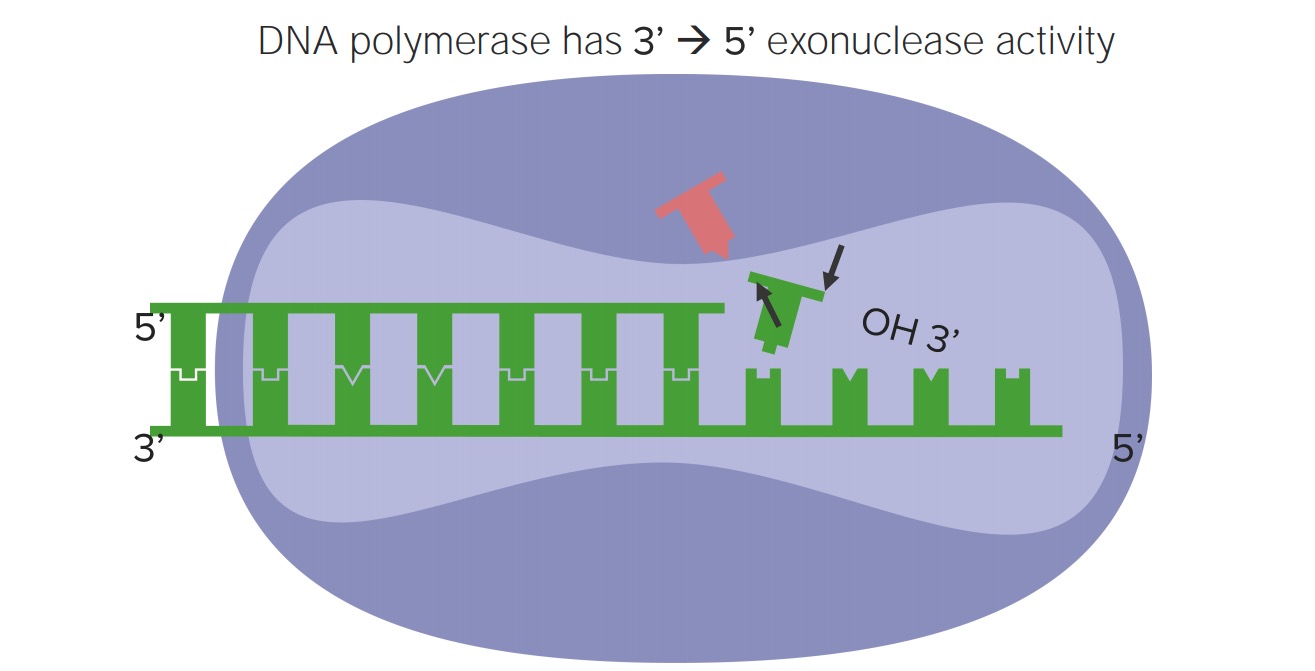
  • Tiene actividad de “revisión”, capaz de corregir errores de replicación
  • Puede “retroceder” cuando se detecta un error Error Refers to any act of commission (doing something wrong) or omission (failing to do something right) that exposes patients to potentially hazardous situations. Disclosure of Information, eliminar el nucleótido incorrecto e insertar el correcto:
    • Tiene una actividad exonucleasa de 3’ a 5’ que permite la escisión del nucleótido incorrecto
  • Mejora la fidelidad de la copia del ADN 100 veces
Actividad de corrección de la ADN polimerasa

Actividad de revisión de errores de la ADN polimerasa

Imagen por Lecturio.

Fotoreparación

La radiación de la luz UV hace HACE Altitude Sickness que se formen dímeros de pirimidina (T o C) a través de enlaces covalentes entre bases Bases Usually a hydroxide of lithium, sodium, potassium, rubidium or cesium, but also the carbonates of these metals, ammonia, and the amines. Acid-Base Balance adyacentes, creando un cambio conformacional (“abultamiento”) en EN Erythema nodosum is an immune-mediated panniculitis (inflammation of the subcutaneous fat) caused by a type IV (delayed-type) hypersensitivity reaction. It commonly manifests in young women as tender, erythematous nodules on the shins. Erythema Nodosum el ADN. Estos defectos pueden repararse mediante un proceso denominado fotoreparación o fotoreactivación.
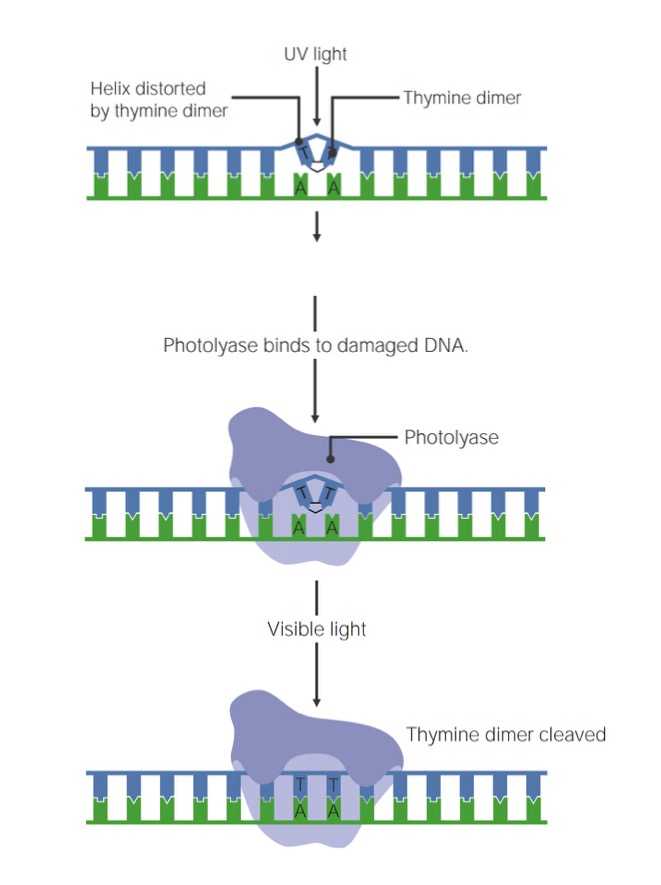
  • La fotoliasa del ADN es una enzima que utiliza la energía de la luz visible para romper el enlace covalente entre las pirimidinas, restaurando el ADN a su estado original:
    • Obsérvese que la luz UV causa el daño, mientras que la luz visible proporciona la energía para reparar el daño.
  • La fotoreparación es un ejemplo de reversión directa (o química) del daño en EN Erythema nodosum is an immune-mediated panniculitis (inflammation of the subcutaneous fat) caused by a type IV (delayed-type) hypersensitivity reaction. It commonly manifests in young women as tender, erythematous nodules on the shins. Erythema Nodosum el ADN (i.e., no rompe la estructura central del fosfodiéster).
  • No necesita una plantilla de ADN
  • Solo se puede reparar 1 base a la vez
  • Este proceso no está presente en EN Erythema nodosum is an immune-mediated panniculitis (inflammation of the subcutaneous fat) caused by a type IV (delayed-type) hypersensitivity reaction. It commonly manifests in young women as tender, erythematous nodules on the shins. Erythema Nodosum los LOS Neisseria mamíferos placentarios (como los LOS Neisseria humanos).
Pasos de la foto reparación del ADN

Pasos de la fotoreparación

Imagen por Lecturio.

Reparación de Daños en una Sola Cadena de ADN

La célula dispone de 3 mecanismos principales para reparar los LOS Neisseria daños en EN Erythema nodosum is an immune-mediated panniculitis (inflammation of the subcutaneous fat) caused by a type IV (delayed-type) hypersensitivity reaction. It commonly manifests in young women as tender, erythematous nodules on the shins. Erythema Nodosum una sola cadena de ADN:

  • Reparación por escisión de bases Bases Usually a hydroxide of lithium, sodium, potassium, rubidium or cesium, but also the carbonates of these metals, ammonia, and the amines. Acid-Base Balance
  • Reparación por escisión de nucleótidos
  • Reparación de bases Bases Usually a hydroxide of lithium, sodium, potassium, rubidium or cesium, but also the carbonates of these metals, ammonia, and the amines. Acid-Base Balance mal emparejadas.

Proceso general de reparación de daños en EN Erythema nodosum is an immune-mediated panniculitis (inflammation of the subcutaneous fat) caused by a type IV (delayed-type) hypersensitivity reaction. It commonly manifests in young women as tender, erythematous nodules on the shins. Erythema Nodosum una sola cadena de ADN

Los LOS Neisseria 3 mecanismos siguen el mismo proceso general:
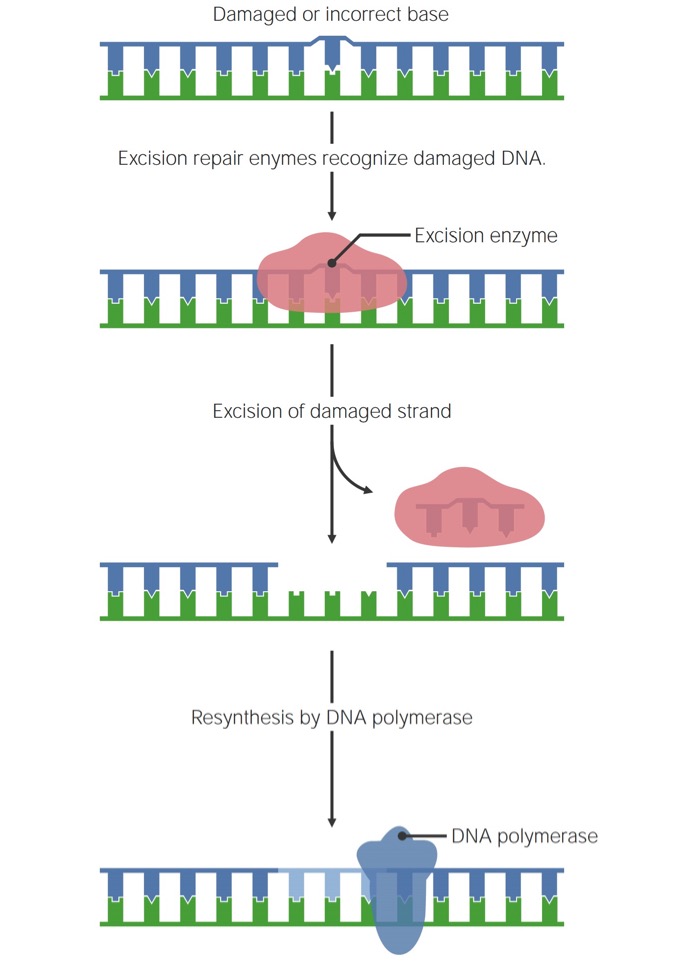
  1. Se identifican las bases Bases Usually a hydroxide of lithium, sodium, potassium, rubidium or cesium, but also the carbonates of these metals, ammonia, and the amines. Acid-Base Balance dañadas o anormalmente emparejadas.
  2. Las enzimas de escisión extirpan la base anormal, nucleótido o una pequeña región que lo rodea.
  3. La ADN polimerasa rellena el espacio añadiendo los LOS Neisseria nucleótidos correctos.
  4. La ADN ligasa sella el esqueleto de azúcar-fosfato con un nuevo enlace fosfodiéster.
Mecanismo general de reparación del ADN monocatenario

Mecanismo general de reparación de una sola cadena de ADN

Imagen por Lecturio.

Reparación por escisión de bases Bases Usually a hydroxide of lithium, sodium, potassium, rubidium or cesium, but also the carbonates of these metals, ammonia, and the amines. Acid-Base Balance

En EN Erythema nodosum is an immune-mediated panniculitis (inflammation of the subcutaneous fat) caused by a type IV (delayed-type) hypersensitivity reaction. It commonly manifests in young women as tender, erythematous nodules on the shins. Erythema Nodosum la reparación por escisión de bases Bases Usually a hydroxide of lithium, sodium, potassium, rubidium or cesium, but also the carbonates of these metals, ammonia, and the amines. Acid-Base Balance, se extirpa una única base dañada y se sustituye.

  • Enzimas glicosilasas:
    • Rompen la unión entre la base dañada y la desoxirribosa, eliminándola
    • Las glicosilasas del ADN son específicas para diferentes tipos de lesiones.
    • Las células tienen múltiples glicosilasas de ADN con diferentes especificidades.
    • Ejemplos de enzimas glicosilasas:
      • La uracilo-ADN glicosilasa elimina el uracilo de las cadenas de ADN.
      • La oxoguanina glicosilasa elimina las bases Bases Usually a hydroxide of lithium, sodium, potassium, rubidium or cesium, but also the carbonates of these metals, ammonia, and the amines. Acid-Base Balance oxidadas.
  • Las endonucleasas eliminan la porción de azúcar-fosfato restante del nucleótido.
  • La ADN polimerasa elimina el único nucleótido anormal y lo sustituye por el correcto.
  • La ADN ligasa sella el esqueleto.
  • Es el mecanismo de reparación de daños por luz UV en EN Erythema nodosum is an immune-mediated panniculitis (inflammation of the subcutaneous fat) caused by a type IV (delayed-type) hypersensitivity reaction. It commonly manifests in young women as tender, erythematous nodules on the shins. Erythema Nodosum humanos

Reparación por escisión de nucleótidos

  • Proceso similar a la reparación por escisión de bases Bases Usually a hydroxide of lithium, sodium, potassium, rubidium or cesium, but also the carbonates of these metals, ammonia, and the amines. Acid-Base Balance, pero con secciones más grandes de ADN extirpadas
  • Un complejo de endonucleasas elimina toda la sección de ADN (normalmente, unos 12–30 pares de bases Bases Usually a hydroxide of lithium, sodium, potassium, rubidium or cesium, but also the carbonates of these metals, ammonia, and the amines. Acid-Base Balance) que rodea la zona anormal.
  • El ADN es resintetizado por la ADN polimerasa y sellado por la ADN ligasa.

Reparación de bases Bases Usually a hydroxide of lithium, sodium, potassium, rubidium or cesium, but also the carbonates of these metals, ammonia, and the amines. Acid-Base Balance mal emparejadas del ADN

  • Corrige los LOS Neisseria errores de emparejamiento de bases Bases Usually a hydroxide of lithium, sodium, potassium, rubidium or cesium, but also the carbonates of these metals, ammonia, and the amines. Acid-Base Balance que se produjeron durante la replicación del ADN y que no fueron reparados por la revisión de errores:
    • A menudo se debe a la tautomerización (isómeros estructurales) durante la replicación
    • Pueden ser pares de bases Bases Usually a hydroxide of lithium, sodium, potassium, rubidium or cesium, but also the carbonates of these metals, ammonia, and the amines. Acid-Base Balance individuales o secciones más grandes de ADN
  • Proteínas de reparación de bases Bases Usually a hydroxide of lithium, sodium, potassium, rubidium or cesium, but also the carbonates of these metals, ammonia, and the amines. Acid-Base Balance mal emparejadas del ADN:
    • Localizan los LOS Neisseria nucleótidos mal emparejados
    • Reclutan exonucleasas para extirpar las bases Bases Usually a hydroxide of lithium, sodium, potassium, rubidium or cesium, but also the carbonates of these metals, ammonia, and the amines. Acid-Base Balance mal emparejadas
  • Una vez que la base mal emparejada es extirpada:
    • La ADN polimerasa puede colocar la(s) base(s) correcta(s).
    • La ADN ligasa sella el esqueleto de azúcar-fosfato.

Reparación de Daños en Dos Cadenas de ADN

En EN Erythema nodosum is an immune-mediated panniculitis (inflammation of the subcutaneous fat) caused by a type IV (delayed-type) hypersensitivity reaction. It commonly manifests in young women as tender, erythematous nodules on the shins. Erythema Nodosum general, los LOS Neisseria daños en EN Erythema nodosum is an immune-mediated panniculitis (inflammation of the subcutaneous fat) caused by a type IV (delayed-type) hypersensitivity reaction. It commonly manifests in young women as tender, erythematous nodules on the shins. Erythema Nodosum dos cadenas de ADN son más difíciles de reparar porque no hay una cadena molde con la que trabajar. Los LOS Neisseria dos mecanismos principales para fijar las roturas de dos cadenas de ADN son la recombinación homóloga y la unión de extremos no homólogos.

Recombinación homóloga

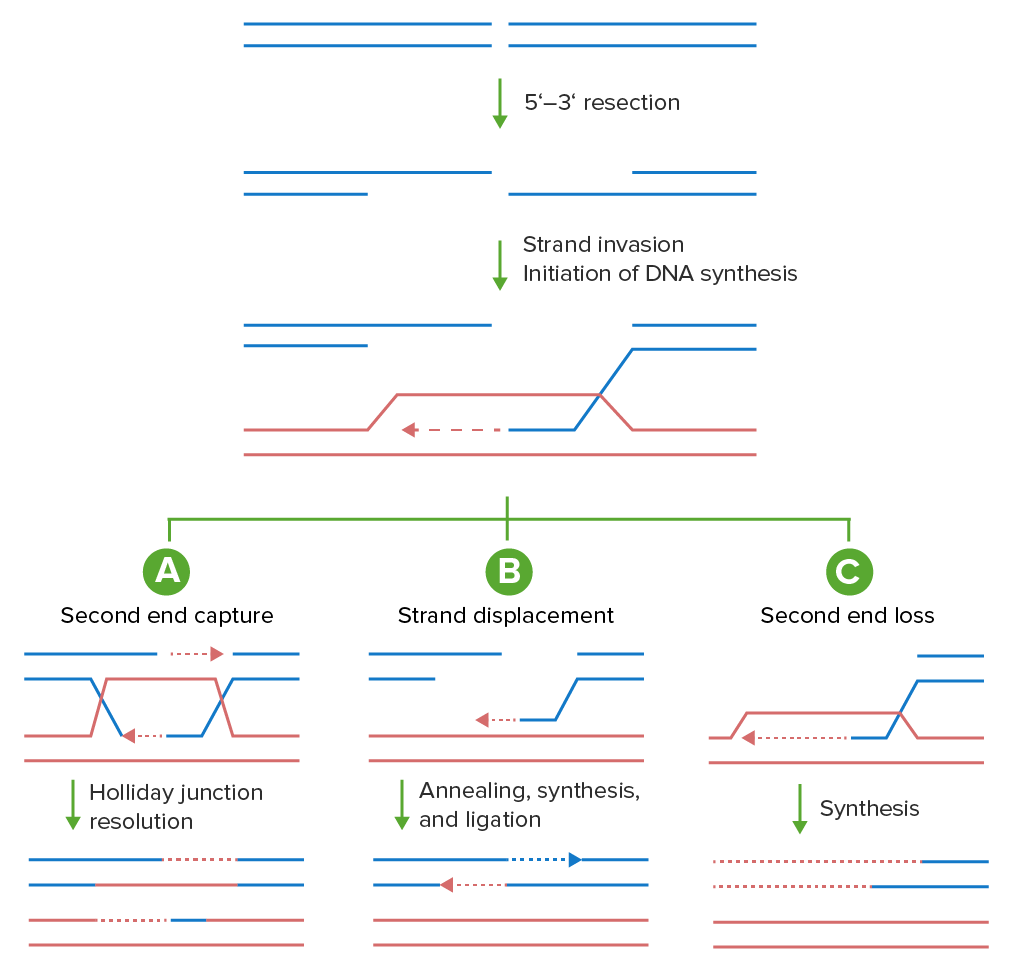
En EN Erythema nodosum is an immune-mediated panniculitis (inflammation of the subcutaneous fat) caused by a type IV (delayed-type) hypersensitivity reaction. It commonly manifests in young women as tender, erythematous nodules on the shins. Erythema Nodosum la recombinación homóloga, la cromátida hermana casi idéntica o el cromosoma homólogo se utiliza como plantilla:
  • La mecánica y las enzimas son similares al AL Amyloidosis cruce de cromosomas que se produce durante la meiosis Meiosis The creation of eukaryotic gametes involves a DNA replication phase followed by 2 cellular division stages: meiosis I and meiosis II. Meiosis I separates homologous chromosomes into separate cells (1n, 2c), while meiosis II separates sister chromatids into gametes (1n, 1c). Meiosis.
  • Para la recombinación homóloga es necesario:
    • Extensas regiones de secuencias homólogas entre las 2 cromátidas
    • Múltiples complejos enzimáticos, incluyendo:
      • Exonucleasas: comienzan a digerir los LOS Neisseria extremos 5’ → generan colas 3′ de una sola cadena de ADN en EN Erythema nodosum is an immune-mediated panniculitis (inflammation of the subcutaneous fat) caused by a type IV (delayed-type) hypersensitivity reaction. It commonly manifests in young women as tender, erythematous nodules on the shins. Erythema Nodosum las cadenas rotas
      • Enzimas recombinasas: catalizan la inserción del extremo 3’ en EN Erythema nodosum is an immune-mediated panniculitis (inflammation of the subcutaneous fat) caused by a type IV (delayed-type) hypersensitivity reaction. It commonly manifests in young women as tender, erythematous nodules on the shins. Erythema Nodosum la secuencia complementaria del ADN en EN Erythema nodosum is an immune-mediated panniculitis (inflammation of the subcutaneous fat) caused by a type IV (delayed-type) hypersensitivity reaction. It commonly manifests in young women as tender, erythematous nodules on the shins. Erythema Nodosum la cromátida homóloga
  • La ADN polimerasa es capaz de sintetizar nuevo ADN a partir de la cromátida homóloga.
  • La cadena “invasora” puede terminar:
    • Intercambiada con su región homóloga en EN Erythema nodosum is an immune-mediated panniculitis (inflammation of the subcutaneous fat) caused by a type IV (delayed-type) hypersensitivity reaction. It commonly manifests in young women as tender, erythematous nodules on the shins. Erythema Nodosum la cromátida opuesta:
      • Este intercambio se conoce como unión de Holliday, captura del segundo extremo o cruce.
    • Desplazada después de haber sintetizado suficiente ADN para “cerrar el espacio” de su ruptura original:
      • El extremo 3′ original se vuelve a conectar con su extremo 5′ original y se utiliza como plantilla para rellenar los LOS Neisseria espacios.
      • Conocido como alineamiento de cadena dependiente de síntesis
    • Copiando todo el resto de su cromátida hermana si se pierde su extremo 5′ original:
      • Una vez que el extremo 3’ invasor ha HA Hemolytic anemia (HA) is the term given to a large group of anemias that are caused by the premature destruction/hemolysis of circulating red blood cells (RBCs). Hemolysis can occur within (intravascular hemolysis) or outside the blood vessels (extravascular hemolysis). Hemolytic Anemia copiado el resto de la cromátida, se libera y se utiliza como cadena molde para rehacer su cadena complementaria.
      • Este proceso se conoce como replicación inducida por rotura.
Models of homologous recombination

Modelos de recombinación homóloga:
Las roturas de doble cadena pueden repararse mediante la maquinaria de recombinación homóloga de diversas maneras. Los extremos del ADN se procesan primero en colas de ADN de una sola cadena 3’. Estas colas invaden una plantilla homóloga (rojo), iniciando una nueva síntesis de ADN (línea discontinua). Se muestran 3 posibles resultados de esta invasión.
A: En la reparación canónica de la rotura de doble cadena, tanto la cadena invasora inicial como el segundo extremo capturado se unen a la plantilla homóloga y preparan la nueva síntesis de ADN, dando lugar a una doble unión Holliday que puede ser resuelta por las nucleasas en un producto cruzado o no cruzado (se muestra el producto no cruzado).
B: Alternativamente, después de que la cola de ADN de una sola cadena invada la plantilla homóloga, se prepara una ronda de síntesis de ADN a partir del extremo 3′ (línea roja discontinua). El alineamiento de la cadena dependiente de la síntesis se produce cuando la cadena invasora, junto con el segmento recién sintetizado, es desenrollada por una helicasa y es alineada con el otro extremo resecado.
C: En la replicación inducida por rotura, 1 extremo de la rotura de doble cadena se pierde y el extremo restante invade la plantilla homóloga, iniciando la síntesis de ADN hasta el final del cromosoma.

Imagen por Lecturio.

Unión de extremos no homólogos

  • La ADN ligasa IV y un cofactor, XRCC4, unen directamente los LOS Neisseria extremos rotos.
  • Se basa en EN Erythema nodosum is an immune-mediated panniculitis (inflammation of the subcutaneous fat) caused by a type IV (delayed-type) hypersensitivity reaction. It commonly manifests in young women as tender, erythematous nodules on the shins. Erythema Nodosum microhomologías (secuencias homólogas cortas) en EN Erythema nodosum is an immune-mediated panniculitis (inflammation of the subcutaneous fat) caused by a type IV (delayed-type) hypersensitivity reaction. It commonly manifests in young women as tender, erythematous nodules on the shins. Erythema Nodosum las colas monocatenarias de las hebras rotas
  • Las deleciones, inserciones y translocaciones son más comunes con este tipo de reparación.
  • Un mecanismo similar está implicado en EN Erythema nodosum is an immune-mediated panniculitis (inflammation of the subcutaneous fat) caused by a type IV (delayed-type) hypersensitivity reaction. It commonly manifests in young women as tender, erythematous nodules on the shins. Erythema Nodosum la recombinación V(D)J (recombinación somática) para crear diversidad de células B y T.

Relevancia Clínica

  • Trastornos genéticos: cuando los LOS Neisseria pares de bases Bases Usually a hydroxide of lithium, sodium, potassium, rubidium or cesium, but also the carbonates of these metals, ammonia, and the amines. Acid-Base Balance erróneamente emparejadas no se reparan dentro de los LOS Neisseria gametos, pueden crear mutaciones que se transmiten a la descendencia.
  • Cáncer: clase de enfermedades causadas por cambios en EN Erythema nodosum is an immune-mediated panniculitis (inflammation of the subcutaneous fat) caused by a type IV (delayed-type) hypersensitivity reaction. It commonly manifests in young women as tender, erythematous nodules on the shins. Erythema Nodosum la secuencia genética y la expresión de los LOS Neisseria genes Genes A category of nucleic acid sequences that function as units of heredity and which code for the basic instructions for the development, reproduction, and maintenance of organisms. DNA Types and Structure. Estos cambios suelen deberse a mutaciones o daños en EN Erythema nodosum is an immune-mediated panniculitis (inflammation of the subcutaneous fat) caused by a type IV (delayed-type) hypersensitivity reaction. It commonly manifests in young women as tender, erythematous nodules on the shins. Erythema Nodosum el ADN. Hay 4 clases de genes Genes A category of nucleic acid sequences that function as units of heredity and which code for the basic instructions for the development, reproduction, and maintenance of organisms. DNA Types and Structure reguladores normales que suelen estar dañados en EN Erythema nodosum is an immune-mediated panniculitis (inflammation of the subcutaneous fat) caused by a type IV (delayed-type) hypersensitivity reaction. It commonly manifests in young women as tender, erythematous nodules on the shins. Erythema Nodosum las células cancerosas: oncogenes Oncogenes Genes whose gain-of-function alterations lead to neoplastic cell transformation. They include, for example, genes for activators or stimulators of cell proliferation such as growth factors, growth factor receptors, protein kinases, signal transducers, nuclear phosphoproteins, and transcription factors. A prefix of ‘v-‘ before oncogene symbols indicates oncogenes captured and transmitted by retroviruses; the prefix ‘c-‘ before the gene symbol of an oncogene indicates it is the cellular homolog (proto-oncogenes) of a v-oncogene. Carcinogenesis que promueven el crecimiento, genes Genes A category of nucleic acid sequences that function as units of heredity and which code for the basic instructions for the development, reproduction, and maintenance of organisms. DNA Types and Structure supresores de tumores que inhiben el crecimiento, genes Genes A category of nucleic acid sequences that function as units of heredity and which code for the basic instructions for the development, reproduction, and maintenance of organisms. DNA Types and Structure que regulan la apoptosis Apoptosis A regulated cell death mechanism characterized by distinctive morphologic changes in the nucleus and cytoplasm, including the endonucleolytic cleavage of genomic DNA, at regularly spaced, internucleosomal sites, I.e., DNA fragmentation. It is genetically-programmed and serves as a balance to mitosis in regulating the size of animal tissues and in mediating pathologic processes associated with tumor growth. Ischemic Cell Damage y genes Genes A category of nucleic acid sequences that function as units of heredity and which code for the basic instructions for the development, reproduction, and maintenance of organisms. DNA Types and Structure que participan en EN Erythema nodosum is an immune-mediated panniculitis (inflammation of the subcutaneous fat) caused by a type IV (delayed-type) hypersensitivity reaction. It commonly manifests in young women as tender, erythematous nodules on the shins. Erythema Nodosum la reparación del ADN.
  • Síndrome de Lynch: también llamado cáncer colorrectal hereditario no poliposo. El síndrome de Lynch está causado por una mutación autosómica dominante en EN Erythema nodosum is an immune-mediated panniculitis (inflammation of the subcutaneous fat) caused by a type IV (delayed-type) hypersensitivity reaction. It commonly manifests in young women as tender, erythematous nodules on the shins. Erythema Nodosum los LOS Neisseria genes Genes A category of nucleic acid sequences that function as units of heredity and which code for the basic instructions for the development, reproduction, and maintenance of organisms. DNA Types and Structure de reparación de bases Bases Usually a hydroxide of lithium, sodium, potassium, rubidium or cesium, but also the carbonates of these metals, ammonia, and the amines. Acid-Base Balance mal emparejadas del ADN. El síndrome de Lynch es el síndrome de cáncer de colon Colon The large intestines constitute the last portion of the digestive system. The large intestine consists of the cecum, appendix, colon (with ascending, transverse, descending, and sigmoid segments), rectum, and anal canal. The primary function of the colon is to remove water and compact the stool prior to expulsion from the body via the rectum and anal canal. Colon, Cecum, and Appendix: Anatomy hereditario más común, y conlleva un riesgo significativamente mayor de padecer cáncer de endometrio y otros tumores malignos. El diagnóstico se realiza mediante pruebas genéticas. Es necesario realizar un tamizaje temprano y frecuente del cáncer de colon Colon The large intestines constitute the last portion of the digestive system. The large intestine consists of the cecum, appendix, colon (with ascending, transverse, descending, and sigmoid segments), rectum, and anal canal. The primary function of the colon is to remove water and compact the stool prior to expulsion from the body via the rectum and anal canal. Colon, Cecum, and Appendix: Anatomy, y a menudo se recomienda la histerectomía profiláctica para las mujeres que superan la edad reproductiva.
  • Cáncer de piel: los LOS Neisseria tipos más frecuentes de cáncer de piel son el carcinoma de células basales, el carcinoma de células escamosas de la piel y el melanoma Melanoma Melanoma is a malignant tumor arising from melanocytes, the melanin-producing cells of the epidermis. These tumors are most common in fair-skinned individuals with a history of excessive sun exposure and sunburns. Melanoma. Las mutaciones de estos cánceres suelen producirse por daños en EN Erythema nodosum is an immune-mediated panniculitis (inflammation of the subcutaneous fat) caused by a type IV (delayed-type) hypersensitivity reaction. It commonly manifests in young women as tender, erythematous nodules on the shins. Erythema Nodosum el ADN debidos a una exposición excesiva a la radiación UV. Cuando se produce una sobrecarga de los LOS Neisseria sistemas de reparación de escisión de bases Bases Usually a hydroxide of lithium, sodium, potassium, rubidium or cesium, but also the carbonates of these metals, ammonia, and the amines. Acid-Base Balance debido a la frecuente exposición al AL Amyloidosis sol, aumenta el riesgo de cánceres de piel. Este riesgo es más frecuente en EN Erythema nodosum is an immune-mediated panniculitis (inflammation of the subcutaneous fat) caused by a type IV (delayed-type) hypersensitivity reaction. It commonly manifests in young women as tender, erythematous nodules on the shins. Erythema Nodosum personas de piel clara con antecedentes de exposición excesiva al AL Amyloidosis sol y quemaduras solares. El diagnóstico definitivo se establece con una biopsia. El tratamiento se basa principalmente en EN Erythema nodosum is an immune-mediated panniculitis (inflammation of the subcutaneous fat) caused by a type IV (delayed-type) hypersensitivity reaction. It commonly manifests in young women as tender, erythematous nodules on the shins. Erythema Nodosum la escisión quirúrgica.
  • Xeroderma pigmentoso: raro trastorno autosómico recesivo caracterizado por cambios de pigmentación en EN Erythema nodosum is an immune-mediated panniculitis (inflammation of the subcutaneous fat) caused by a type IV (delayed-type) hypersensitivity reaction. It commonly manifests in young women as tender, erythematous nodules on the shins. Erythema Nodosum la piel. La presencia de xeroderma pigmentoso conlleva un mayor riesgo de cáncer de piel y de mucosas inducido por los LOS Neisseria rayos UV y, ocasionalmente, de neurodegeneración progresiva. Este trastorno está causado por 1 de varias mutaciones, que en EN Erythema nodosum is an immune-mediated panniculitis (inflammation of the subcutaneous fat) caused by a type IV (delayed-type) hypersensitivity reaction. It commonly manifests in young women as tender, erythematous nodules on the shins. Erythema Nodosum última instancia conducen a una reparación de escisión de nucleótido disfuncional. El diagnóstico debe sospecharse en EN Erythema nodosum is an immune-mediated panniculitis (inflammation of the subcutaneous fat) caused by a type IV (delayed-type) hypersensitivity reaction. It commonly manifests in young women as tender, erythematous nodules on the shins. Erythema Nodosum niños con sensibilidad solar severa, pecas significativas antes de los LOS Neisseria 2 años y/o cáncer de piel antes de los LOS Neisseria 10 años.

Referencias

  1. Alberts, B., Heald, R., Johnson, A., Morgan, D., Raff, M., Roberts, K., Walter, P., & Wilson, J. (2022). Molecular biology of the cell (7th ed.). W.W. Norton & Company.
  2. de Luca, K., Brown, T., Harrison, M., & Liu, Y. (2024). DNA repair by cooperation between proteins: A look inside the cell’s ‘repair café’. Nature Communications, 15(1), 1234. https://doi.org/10.1038/s41467-024-54159-4
  3. Donnio, L.-M., & Giglia-Mari, G. (2025). Keep calm and reboot – How cells restart transcription after DNA damage and DNA repair. FEBS Letters, 599(2), 275–294. https://doi.org/10.1002/1873-3468.14964
  4. Friedberg, E. C. (2003). DNA damage and repair. Nature, 421(6921), 436–440. https://doi.org/10.1038/nature01408
  5. Mentani, A., Huang, Y., Wei, J., & Li, Q. (2025). Prime editing: Mechanistic insights and DNA repair modulation. Cells, 14(4), 277. https://doi.org/10.3390/cells14040277
  6. Musunuru, K., Yu, H., Smith, J. R., & Tang, Q. (2025). Patient-specific in vivo gene editing to treat a rare genetic disease. New England Journal of Medicine, NEJMoa2504747. https://doi.org/10.1056/NEJMoa2504747
  7. Panier, S., Reusch, F., Patel, P., & Garraway, L. A. (2024). Genome instability and DNA repair in somatic and reproductive aging. Annual Review of Pathology: Mechanisms of Disease, 19(1), 261–290. https://doi.org/10.1146/annurev-pathmechdis-051122-093128
  8. Vats, A., & Laimins, L. (2025). How human papillomavirus (HPV) targets DNA repair pathways for viral replication: From guardian to accomplice. Microbiology and Molecular Biology Reviews, 89(1), e00153-23. https://doi.org/10.1128/mmbr.00153-23

¡Crea tu cuenta gratis o inicia una sesión para seguir leyendo!

Regístrate ahora y obtén acceso gratuito a Lecturio con páginas de concepto, videos médicos y cuestionarios para tu educación médica.

User Reviews

Que tengas una sesión de estudio alegre y navideña 🎁 Ahorra 50% en todos los planes >>

Details