Domina Conceptos Médicos

Estudia para la escuela de medicina y tus examenes con Lecturio.

Linfocitos T: Tipos y Funciones

Los LOS Neisseria linfocitos T, también llamados células T, son componentes importantes del sistema inmunitario adaptativo. Su producción inicia en EN Erythema nodosum is an immune-mediated panniculitis (inflammation of the subcutaneous fat) caused by a type IV (delayed-type) hypersensitivity reaction. It commonly manifests in young women as tender, erythematous nodules on the shins. Erythema Nodosum las células madre hematopoyéticas de la médula ósea, de las que surgen las células progenitoras de linfocitos T. Estas células migran al AL Amyloidosis timo para seguir madurando. Un linfocito T maduro funcional se desarrolla a partir de un proceso pautado que crea un complejo de receptores de linfocitos T, seleccionando linfocitos T con la afinidad adecuada a los LOS Neisseria autoantígenos asociados a las principales moléculas de histocompatibilidad (selección positiva) y expresando CD4 o CD8. En EN Erythema nodosum is an immune-mediated panniculitis (inflammation of the subcutaneous fat) caused by a type IV (delayed-type) hypersensitivity reaction. It commonly manifests in young women as tender, erythematous nodules on the shins. Erythema Nodosum este proceso, las células predispuestas a la autoinmunidad sufren apoptosis Apoptosis A regulated cell death mechanism characterized by distinctive morphologic changes in the nucleus and cytoplasm, including the endonucleolytic cleavage of genomic DNA, at regularly spaced, internucleosomal sites, I.e., DNA fragmentation. It is genetically-programmed and serves as a balance to mitosis in regulating the size of animal tissues and in mediating pathologic processes associated with tumor growth. Ischemic Cell Damage (selección negativa). Cuando se liberan del timo, los LOS Neisseria linfocitos T maduros vírgenes se desplazan a los LOS Neisseria órganos linfoides secundarios para su activación. Se requieren dos señales, una unión del antígeno específico del receptor Receptor Receptors are proteins located either on the surface of or within a cell that can bind to signaling molecules known as ligands (e.g., hormones) and cause some type of response within the cell. Receptors de linfocitos T y la coestimulación, para que esté activado (listo para organizar una respuesta inmune). En EN Erythema nodosum is an immune-mediated panniculitis (inflammation of the subcutaneous fat) caused by a type IV (delayed-type) hypersensitivity reaction. It commonly manifests in young women as tender, erythematous nodules on the shins. Erythema Nodosum el caso de los LOS Neisseria linfocitos T CD8+, es necesaria una estimulación adicional con citoquinas. Dependiendo de las citoquinas a las que se exponen durante la estimulación antigénica, los LOS Neisseria linfocitos T maduros indiferenciados (Th0, por sus siglas en EN Erythema nodosum is an immune-mediated panniculitis (inflammation of the subcutaneous fat) caused by a type IV (delayed-type) hypersensitivity reaction. It commonly manifests in young women as tender, erythematous nodules on the shins. Erythema Nodosum inglés) se convierten en EN Erythema nodosum is an immune-mediated panniculitis (inflammation of the subcutaneous fat) caused by a type IV (delayed-type) hypersensitivity reaction. It commonly manifests in young women as tender, erythematous nodules on the shins. Erythema Nodosum células con diferentes funciones: los LOS Neisseria CD4+ se convierten en EN Erythema nodosum is an immune-mediated panniculitis (inflammation of the subcutaneous fat) caused by a type IV (delayed-type) hypersensitivity reaction. It commonly manifests in young women as tender, erythematous nodules on the shins. Erythema Nodosum linfocitos T colaboradores (Th, por sus siglas en EN Erythema nodosum is an immune-mediated panniculitis (inflammation of the subcutaneous fat) caused by a type IV (delayed-type) hypersensitivity reaction. It commonly manifests in young women as tender, erythematous nodules on the shins. Erythema Nodosum inglés) y los LOS Neisseria CD8+ en EN Erythema nodosum is an immune-mediated panniculitis (inflammation of the subcutaneous fat) caused by a type IV (delayed-type) hypersensitivity reaction. It commonly manifests in young women as tender, erythematous nodules on the shins. Erythema Nodosum linfocitos citotóxicos o citolíticos. Los LOS Neisseria linfocitos Th tienen otros subtipos; los LOS Neisseria más caracterizados son Th1 Th1 A subset of helper-inducer T-lymphocytes which synthesize and secrete interleukin-2; interferon-gamma; and interleukin-12. Due to their ability to kill antigen-presenting cells and their lymphokine-mediated effector activity, th1 cells are associated with vigorous delayed-type hypersensitivity reactions. T cells: Types and Functions, Th2 Th2 A subset of helper-inducer T-lymphocytes which synthesize and secrete the interleukins il-4; il-5; il-6; and il-10. These cytokines influence b-cell development and antibody production as well as augmenting humoral responses. T cells: Types and Functions, Th17 Th17 A subset of helper-effector T-lymphocytes which synthesize and secrete interleukins il-17; il-17f; and il-22. These cytokines are involved in host defenses and tissue inflammation in autoimmune diseases. T cells: Types and Functions, linfocitos Th foliculares y linfocitos T reguladores. Otros tipos son los LOS Neisseria linfocitos T asesinos naturales y los LOS Neisseria linfocitos T de memoria. Estos linfocitos T maduros y diferenciados garantizan una vigilancia efectiva y una respuesta inmediata a agentes patógenos, células tumorales y tejidos extraños, y proporcionan memoria inmunológica.

Last updated: Dec 15, 2025

Editorial responsibility: Stanley Oiseth, Lindsay Jones, Evelin Maza

Desarrollo de Linfocitos T

Introducción

  • Linfocitos T (derivados del timo): responsables de la inmunidad celular
  • Producción: células madre hematopoyéticas ( en EN Erythema nodosum is an immune-mediated panniculitis (inflammation of the subcutaneous fat) caused by a type IV (delayed-type) hypersensitivity reaction. It commonly manifests in young women as tender, erythematous nodules on the shins. Erythema Nodosum la médula ósea) → progenitores linfoides comunes → células progenitoras tímicas tempranas → timo
  • En EN Erythema nodosum is an immune-mediated panniculitis (inflammation of the subcutaneous fat) caused by a type IV (delayed-type) hypersensitivity reaction. It commonly manifests in young women as tender, erythematous nodules on the shins. Erythema Nodosum el timo:
    • Los LOS Neisseria progenitores de los LOS Neisseria linfocitos T se observan a las 9 semanas de gestación.
    • Los LOS Neisseria linfocitos T en EN Erythema nodosum is an immune-mediated panniculitis (inflammation of the subcutaneous fat) caused by a type IV (delayed-type) hypersensitivity reaction. It commonly manifests in young women as tender, erythematous nodules on the shins. Erythema Nodosum desarrollo en EN Erythema nodosum is an immune-mediated panniculitis (inflammation of the subcutaneous fat) caused by a type IV (delayed-type) hypersensitivity reaction. It commonly manifests in young women as tender, erythematous nodules on the shins. Erythema Nodosum el timo también se denominan timocitos.
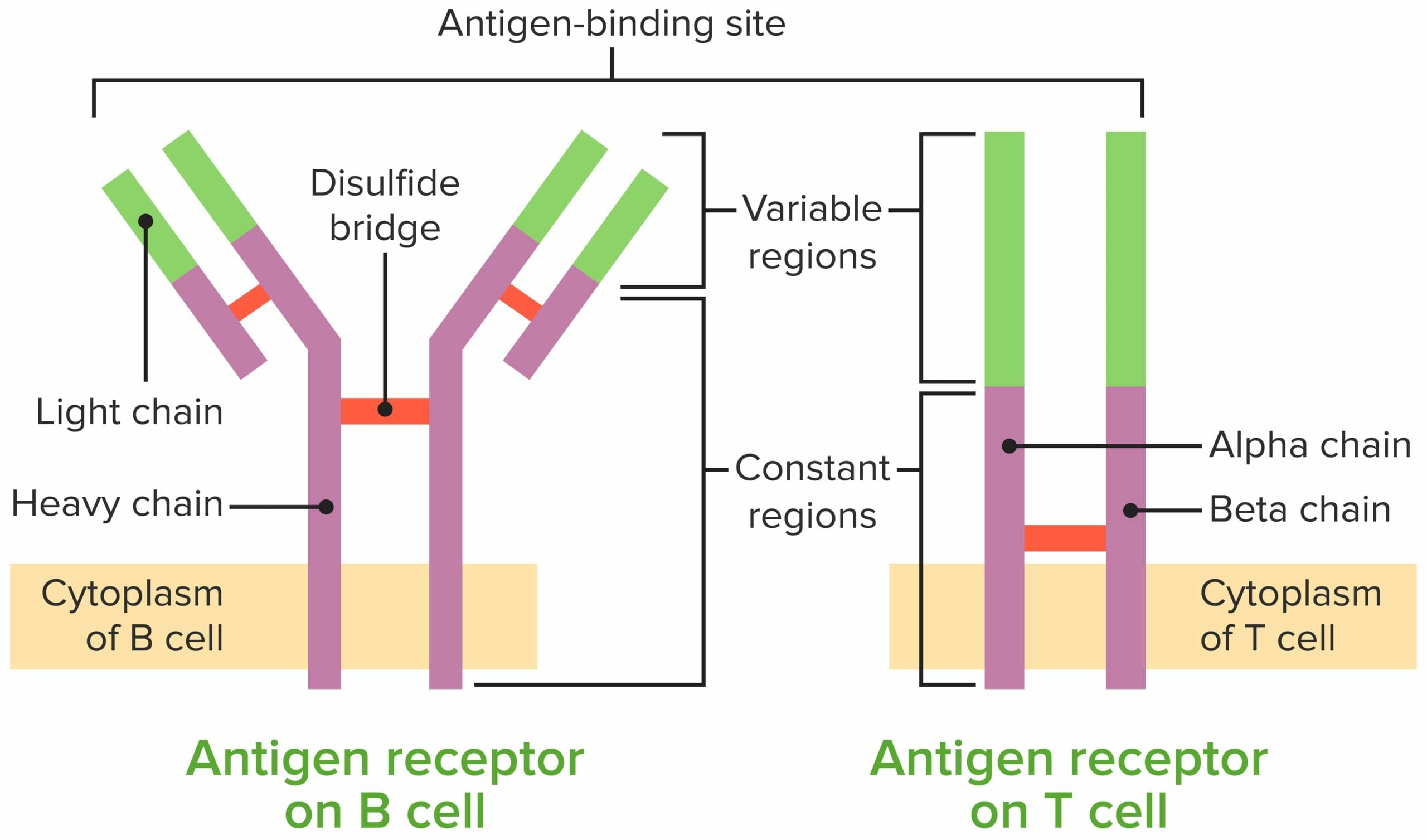
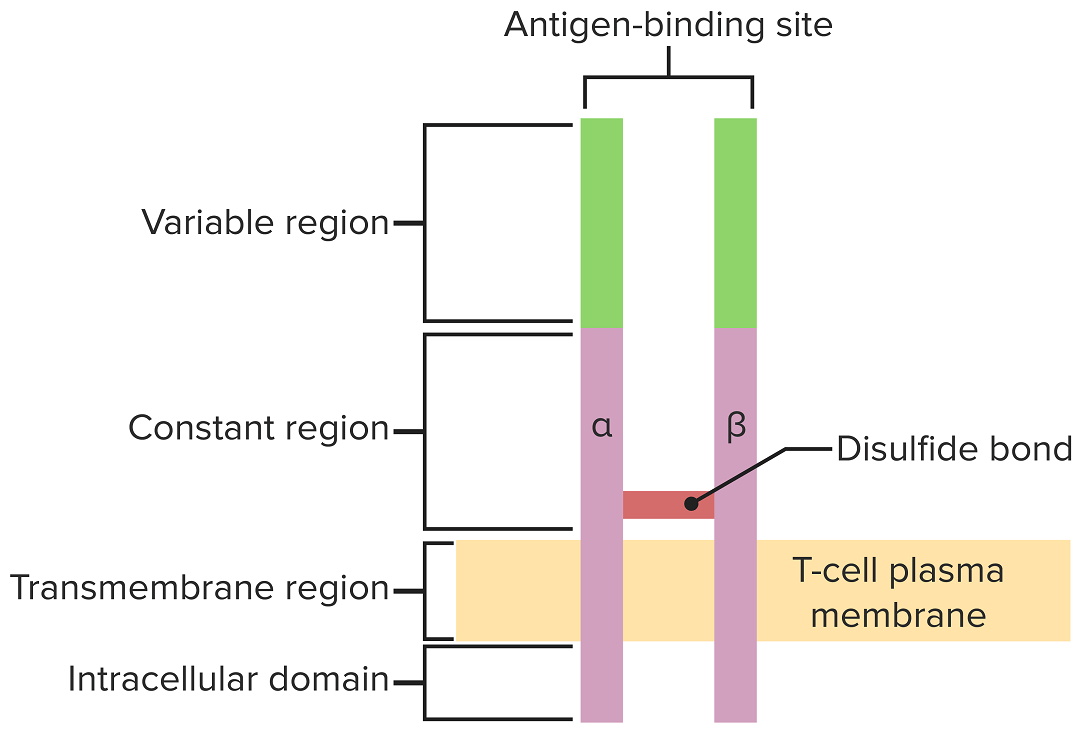
    • Se producen reordenamientos genéticos para formar el receptor Receptor Receptors are proteins located either on the surface of or within a cell that can bind to signaling molecules known as ligands (e.g., hormones) and cause some type of response within the cell. Receptors de linfocitos T:
      • La mayoría (> 85%) de los LOS Neisseria linfocitos T contienen cadenas ɑ y β, así como 1 de los LOS Neisseria correceptores CD4 o CD8.
      • El resto de los LOS Neisseria linfocitos T contienen cadenas ɣ y δ.
      • Receptor Receptor Receptors are proteins located either on the surface of or within a cell that can bind to signaling molecules known as ligands (e.g., hormones) and cause some type of response within the cell. Receptors de linfocitos T + CD3 CD3 Complex of at least five membrane-bound polypeptides in mature T-lymphocytes that are non-covalently associated with one another and with the T-cell receptor. The CD3 complex includes the gamma, delta, epsilon, zeta, and eta chains (subunits). When antigen binds to the T-cell receptor, the CD3 complex transduces the activating signals to the cytoplasm of the T-cell. The CD3 gamma and delta chains (subunits) are separate from and not related to the gamma/delta chains of the T-cell receptor. T cells: Types and Functions forman el complejo del receptor Receptor Receptors are proteins located either on the surface of or within a cell that can bind to signaling molecules known as ligands (e.g., hormones) and cause some type of response within the cell. Receptors de linfocitos T.
      • CD3 CD3 Complex of at least five membrane-bound polypeptides in mature T-lymphocytes that are non-covalently associated with one another and with the T-cell receptor. The CD3 complex includes the gamma, delta, epsilon, zeta, and eta chains (subunits). When antigen binds to the T-cell receptor, the CD3 complex transduces the activating signals to the cytoplasm of the T-cell. The CD3 gamma and delta chains (subunits) are separate from and not related to the gamma/delta chains of the T-cell receptor. T cells: Types and Functions: marcador más utilizado para identificar los LOS Neisseria linfocitos T

Desarrollo

El proceso inicial tiene lugar en EN Erythema nodosum is an immune-mediated panniculitis (inflammation of the subcutaneous fat) caused by a type IV (delayed-type) hypersensitivity reaction. It commonly manifests in young women as tender, erythematous nodules on the shins. Erythema Nodosum la corteza externa del timo, y las células se desplazan a la corteza más profunda a medida que maduran.
  • En EN Erythema nodosum is an immune-mediated panniculitis (inflammation of the subcutaneous fat) caused by a type IV (delayed-type) hypersensitivity reaction. It commonly manifests in young women as tender, erythematous nodules on the shins. Erythema Nodosum el timo, las células progenitoras expresan CD3 CD3 Complex of at least five membrane-bound polypeptides in mature T-lymphocytes that are non-covalently associated with one another and with the T-cell receptor. The CD3 complex includes the gamma, delta, epsilon, zeta, and eta chains (subunits). When antigen binds to the T-cell receptor, the CD3 complex transduces the activating signals to the cytoplasm of the T-cell. The CD3 gamma and delta chains (subunits) are separate from and not related to the gamma/delta chains of the T-cell receptor. T cells: Types and Functions, pero carecen de la expresión de moléculas CD4 y CD8 en EN Erythema nodosum is an immune-mediated panniculitis (inflammation of the subcutaneous fat) caused by a type IV (delayed-type) hypersensitivity reaction. It commonly manifests in young women as tender, erythematous nodules on the shins. Erythema Nodosum la superficie celular, por lo que son células/timocitos dobles negativos (DN).
  • Los LOS Neisseria genes Genes A category of nucleic acid sequences that function as units of heredity and which code for the basic instructions for the development, reproduction, and maintenance of organisms. DNA Types and Structure del receptor Receptor Receptors are proteins located either on the surface of or within a cell that can bind to signaling molecules known as ligands (e.g., hormones) and cause some type of response within the cell. Receptors de linfocitos T de estas células DN son reordenados.
    • Al AL Amyloidosis igual que las inmunoglobulinas, las proteínas del receptor Receptor Receptors are proteins located either on the surface of or within a cell that can bind to signaling molecules known as ligands (e.g., hormones) and cause some type of response within the cell. Receptors de linfocitos T son codificadas en EN Erythema nodosum is an immune-mediated panniculitis (inflammation of the subcutaneous fat) caused by a type IV (delayed-type) hypersensitivity reaction. It commonly manifests in young women as tender, erythematous nodules on the shins. Erythema Nodosum las siguientes regiones genéticas:
      • Variable Variable Variables represent information about something that can change. The design of the measurement scales, or of the methods for obtaining information, will determine the data gathered and the characteristics of that data. As a result, a variable can be qualitative or quantitative, and may be further classified into subgroups. Types of Variables (V)
      • Diversidad (D)
      • Acoplamiento (J, por su inicial en EN Erythema nodosum is an immune-mediated panniculitis (inflammation of the subcutaneous fat) caused by a type IV (delayed-type) hypersensitivity reaction. It commonly manifests in young women as tender, erythematous nodules on the shins. Erythema Nodosum inglés)
      • Constante (C)
    • La cadena β tiene reordenamientos VDJ, que implican al AL Amyloidosis sitio de unión al AL Amyloidosis antígeno.
    • La cadena ɑ implica reordenamientos VJ en EN Erythema nodosum is an immune-mediated panniculitis (inflammation of the subcutaneous fat) caused by a type IV (delayed-type) hypersensitivity reaction. It commonly manifests in young women as tender, erythematous nodules on the shins. Erythema Nodosum el sitio de unión al AL Amyloidosis antígeno.
    • También se producen reordenamientos en EN Erythema nodosum is an immune-mediated panniculitis (inflammation of the subcutaneous fat) caused by a type IV (delayed-type) hypersensitivity reaction. It commonly manifests in young women as tender, erythematous nodules on the shins. Erythema Nodosum una minoría de linfocitos T con cadenas δ y ɣ.
    • Este proceso da lugar a la diversidad del receptor Receptor Receptors are proteins located either on the surface of or within a cell that can bind to signaling molecules known as ligands (e.g., hormones) and cause some type of response within the cell. Receptors de linfocitos T.
  • Existen 4 estadios DN, que se distinguen por la expresión de CD44 CD44 T cells: Types and Functions y CD25:
  • En EN Erythema nodosum is an immune-mediated panniculitis (inflammation of the subcutaneous fat) caused by a type IV (delayed-type) hypersensitivity reaction. It commonly manifests in young women as tender, erythematous nodules on the shins. Erythema Nodosum el estadio DN3, se producen reordenamientos de la cadena β (pre-receptor de linfocitos T); si no se producen, ocurre la apoptosis Apoptosis A regulated cell death mechanism characterized by distinctive morphologic changes in the nucleus and cytoplasm, including the endonucleolytic cleavage of genomic DNA, at regularly spaced, internucleosomal sites, I.e., DNA fragmentation. It is genetically-programmed and serves as a balance to mitosis in regulating the size of animal tissues and in mediating pathologic processes associated with tumor growth. Ischemic Cell Damage.
  • En EN Erythema nodosum is an immune-mediated panniculitis (inflammation of the subcutaneous fat) caused by a type IV (delayed-type) hypersensitivity reaction. It commonly manifests in young women as tender, erythematous nodules on the shins. Erythema Nodosum el DN4, se completa el reordenamiento genético de la cadena ɑ:
    • Con esto, se producen señales para proseguir con la maduración.
    • El reordenamiento de los LOS Neisseria genes Genes A category of nucleic acid sequences that function as units of heredity and which code for the basic instructions for the development, reproduction, and maintenance of organisms. DNA Types and Structure de la cadena α del receptor Receptor Receptors are proteins located either on the surface of or within a cell that can bind to signaling molecules known as ligands (e.g., hormones) and cause some type of response within the cell. Receptors de linfocitos T corresponde a la regulación al AL Amyloidosis alza de la expresión de CD4 y CD8 (convirtiéndose en EN Erythema nodosum is an immune-mediated panniculitis (inflammation of the subcutaneous fat) caused by a type IV (delayed-type) hypersensitivity reaction. It commonly manifests in young women as tender, erythematous nodules on the shins. Erythema Nodosum células dobles positivas (DP)).
    • Si no se producen reordenamientos genéticos de la cadena ɑ, la célula muere.
  • El complejo α-β del receptor Receptor Receptors are proteins located either on the surface of or within a cell that can bind to signaling molecules known as ligands (e.g., hormones) and cause some type of response within the cell. Receptors de linfocitos T-CD3 se completa cuando las cadenas ɑ se ensamblan con las cadenas β.
  • Estadios posteriores de maduración:
    • Selección positiva:
      • En EN Erythema nodosum is an immune-mediated panniculitis (inflammation of the subcutaneous fat) caused by a type IV (delayed-type) hypersensitivity reaction. It commonly manifests in young women as tender, erythematous nodules on the shins. Erythema Nodosum la corteza tímica
      • Se seleccionan los LOS Neisseria linfocitos T con receptor Receptor Receptors are proteins located either on the surface of or within a cell that can bind to signaling molecules known as ligands (e.g., hormones) and cause some type of response within the cell. Receptors de linfocitos T que tienen una interacción moderada (apenas afinidad suficiente) con los LOS Neisseria autoantígenos ( en EN Erythema nodosum is an immune-mediated panniculitis (inflammation of the subcutaneous fat) caused by a type IV (delayed-type) hypersensitivity reaction. It commonly manifests in young women as tender, erythematous nodules on the shins. Erythema Nodosum el contexto de las moléculas del CMH).
    • Selección negativa:
      • En EN Erythema nodosum is an immune-mediated panniculitis (inflammation of the subcutaneous fat) caused by a type IV (delayed-type) hypersensitivity reaction. It commonly manifests in young women as tender, erythematous nodules on the shins. Erythema Nodosum la médula
      • Linfocitos T con receptor Receptor Receptors are proteins located either on the surface of or within a cell that can bind to signaling molecules known as ligands (e.g., hormones) and cause some type of response within the cell. Receptors de linfocitos T con alta afinidad o fuerte interacción con autoantígenos → apoptosis Apoptosis A regulated cell death mechanism characterized by distinctive morphologic changes in the nucleus and cytoplasm, including the endonucleolytic cleavage of genomic DNA, at regularly spaced, internucleosomal sites, I.e., DNA fragmentation. It is genetically-programmed and serves as a balance to mitosis in regulating the size of animal tissues and in mediating pathologic processes associated with tumor growth. Ischemic Cell Damage
      • Este mecanismo central de tolerancia ( en EN Erythema nodosum is an immune-mediated panniculitis (inflammation of the subcutaneous fat) caused by a type IV (delayed-type) hypersensitivity reaction. It commonly manifests in young women as tender, erythematous nodules on the shins. Erythema Nodosum el timo) es donde se eliminan los LOS Neisseria linfocitos T que reaccionan fuertemente a los LOS Neisseria autoantígenos identificados.
      • Previene la liberación de linfocitos T disfuncionales (que reconocen autoantígenos y pueden activar autoinmunidad)
      • Facilitada por la proteína regulador autoinmune

Estadios

Para alcanzar la funcionalidad, el linfocito T pasa por estadios, liberándose de la médula ósea como células progenitoras para continuar su desarrollo en EN Erythema nodosum is an immune-mediated panniculitis (inflammation of the subcutaneous fat) caused by a type IV (delayed-type) hypersensitivity reaction. It commonly manifests in young women as tender, erythematous nodules on the shins. Erythema Nodosum el timo. El cuadro resume los LOS Neisseria principales pasos.

  • En EN Erythema nodosum is an immune-mediated panniculitis (inflammation of the subcutaneous fat) caused by a type IV (delayed-type) hypersensitivity reaction. It commonly manifests in young women as tender, erythematous nodules on the shins. Erythema Nodosum los LOS Neisseria estadios iniciales, el objetivo es construir el receptor Receptor Receptors are proteins located either on the surface of or within a cell that can bind to signaling molecules known as ligands (e.g., hormones) and cause some type of response within the cell. Receptors (que no requiere ningún antígeno).
  • Otros pasos implican la interacción del linfocito T con autoantígenos y la diferenciación en EN Erythema nodosum is an immune-mediated panniculitis (inflammation of the subcutaneous fat) caused by a type IV (delayed-type) hypersensitivity reaction. It commonly manifests in young women as tender, erythematous nodules on the shins. Erythema Nodosum linfocitos T colaboradores o citotóxicos.
Tabla: Estadios de maduración de linfocitos T
Estadios de maduración Receptor Receptor Receptors are proteins located either on the surface of or within a cell that can bind to signaling molecules known as ligands (e.g., hormones) and cause some type of response within the cell. Receptors de linfocitos T Eventos asociados
Célula progenitora Ninguno
  • De la médula ósea → al AL Amyloidosis timo para su posterior maduración
  • Se convierten en EN Erythema nodosum is an immune-mediated panniculitis (inflammation of the subcutaneous fat) caused by a type IV (delayed-type) hypersensitivity reaction. It commonly manifests in young women as tender, erythematous nodules on the shins. Erythema Nodosum células DN (aún careciendo de CD4 y CD8)
Células DN Reordenamiento de la cadena β (pre-receptor de linfocitos T): la falta de reordenamiento conduce a apoptosis Apoptosis A regulated cell death mechanism characterized by distinctive morphologic changes in the nucleus and cytoplasm, including the endonucleolytic cleavage of genomic DNA, at regularly spaced, internucleosomal sites, I.e., DNA fragmentation. It is genetically-programmed and serves as a balance to mitosis in regulating the size of animal tissues and in mediating pathologic processes associated with tumor growth. Ischemic Cell Damage
  • Expresa CD3 CD3 Complex of at least five membrane-bound polypeptides in mature T-lymphocytes that are non-covalently associated with one another and with the T-cell receptor. The CD3 complex includes the gamma, delta, epsilon, zeta, and eta chains (subunits). When antigen binds to the T-cell receptor, the CD3 complex transduces the activating signals to the cytoplasm of the T-cell. The CD3 gamma and delta chains (subunits) are separate from and not related to the gamma/delta chains of the T-cell receptor. T cells: Types and Functions
  • CD4-, CD8- (sin CD4 y CD8)
Células DP Reordenamiento de la cadena ɑ → las cadenas ɑ se ensamblan con las cadenas β → complejo de receptor Receptor Receptors are proteins located either on the surface of or within a cell that can bind to signaling molecules known as ligands (e.g., hormones) and cause some type of response within the cell. Receptors de linfocitos T-CD3 ɑ-β completo (expresado en EN Erythema nodosum is an immune-mediated panniculitis (inflammation of the subcutaneous fat) caused by a type IV (delayed-type) hypersensitivity reaction. It commonly manifests in young women as tender, erythematous nodules on the shins. Erythema Nodosum la superficie)
  • CD4+, CD8+
  • Las células DP interactúan entonces con los LOS Neisseria autoantígenos ( en EN Erythema nodosum is an immune-mediated panniculitis (inflammation of the subcutaneous fat) caused by a type IV (delayed-type) hypersensitivity reaction. It commonly manifests in young women as tender, erythematous nodules on the shins. Erythema Nodosum el contexto de las moléculas CMH).
  • Con la presentación del CMH, algunas células experimentan selección positiva en EN Erythema nodosum is an immune-mediated panniculitis (inflammation of the subcutaneous fat) caused by a type IV (delayed-type) hypersensitivity reaction. It commonly manifests in young women as tender, erythematous nodules on the shins. Erythema Nodosum la corteza tímica:
    • Se produce una interacción intermedia o moderada entre el CMH y el receptor Receptor Receptors are proteins located either on the surface of or within a cell that can bind to signaling molecules known as ligands (e.g., hormones) and cause some type of response within the cell. Receptors de linfocitos T.
    • Produce las células funcionales
  • Algunas células sufren selección negativa en EN Erythema nodosum is an immune-mediated panniculitis (inflammation of the subcutaneous fat) caused by a type IV (delayed-type) hypersensitivity reaction. It commonly manifests in young women as tender, erythematous nodules on the shins. Erythema Nodosum la médula tímica:
    • Se produce una alta afinidad o una fuerte interacción entre el CMH y el receptor Receptor Receptors are proteins located either on the surface of or within a cell that can bind to signaling molecules known as ligands (e.g., hormones) and cause some type of response within the cell. Receptors de linfocitos T.
    • Las células mueren ( apoptosis Apoptosis A regulated cell death mechanism characterized by distinctive morphologic changes in the nucleus and cytoplasm, including the endonucleolytic cleavage of genomic DNA, at regularly spaced, internucleosomal sites, I.e., DNA fragmentation. It is genetically-programmed and serves as a balance to mitosis in regulating the size of animal tissues and in mediating pathologic processes associated with tumor growth. Ischemic Cell Damage).
    • Evita la liberación de linfocitos T disfuncionales (pueden activar la autoinmunidad)
  • Algunos no llegan a interactuar → apoptosis Apoptosis A regulated cell death mechanism characterized by distinctive morphologic changes in the nucleus and cytoplasm, including the endonucleolytic cleavage of genomic DNA, at regularly spaced, internucleosomal sites, I.e., DNA fragmentation. It is genetically-programmed and serves as a balance to mitosis in regulating the size of animal tissues and in mediating pathologic processes associated with tumor growth. Ischemic Cell Damage
Linfocitos T simple positivos
  • Señales celulares hacen que las células expresen CD4 o CD8, pero no ambas:
    • Th: con CD4 e interactúan con células que expresan CMH clase II
    • Tc: con CD8 e interactúan con células que expresan CMH clase I
  • Los LOS Neisseria Th y Tc vírgenes circulan (de la sangre a los LOS Neisseria tejidos linfoides y a la linfa) y esperan ser activados por las células presentadoras de antígeno que llevan un complejo péptido-CMH complementario.
Tc: linfocitos T citotóxicos
Th: Linfocitos T colaboradores (por sus siglas en inglés)
Etapas de diferenciación de los linfocitos T

Estadios de diferenciación de los linfocitos T:
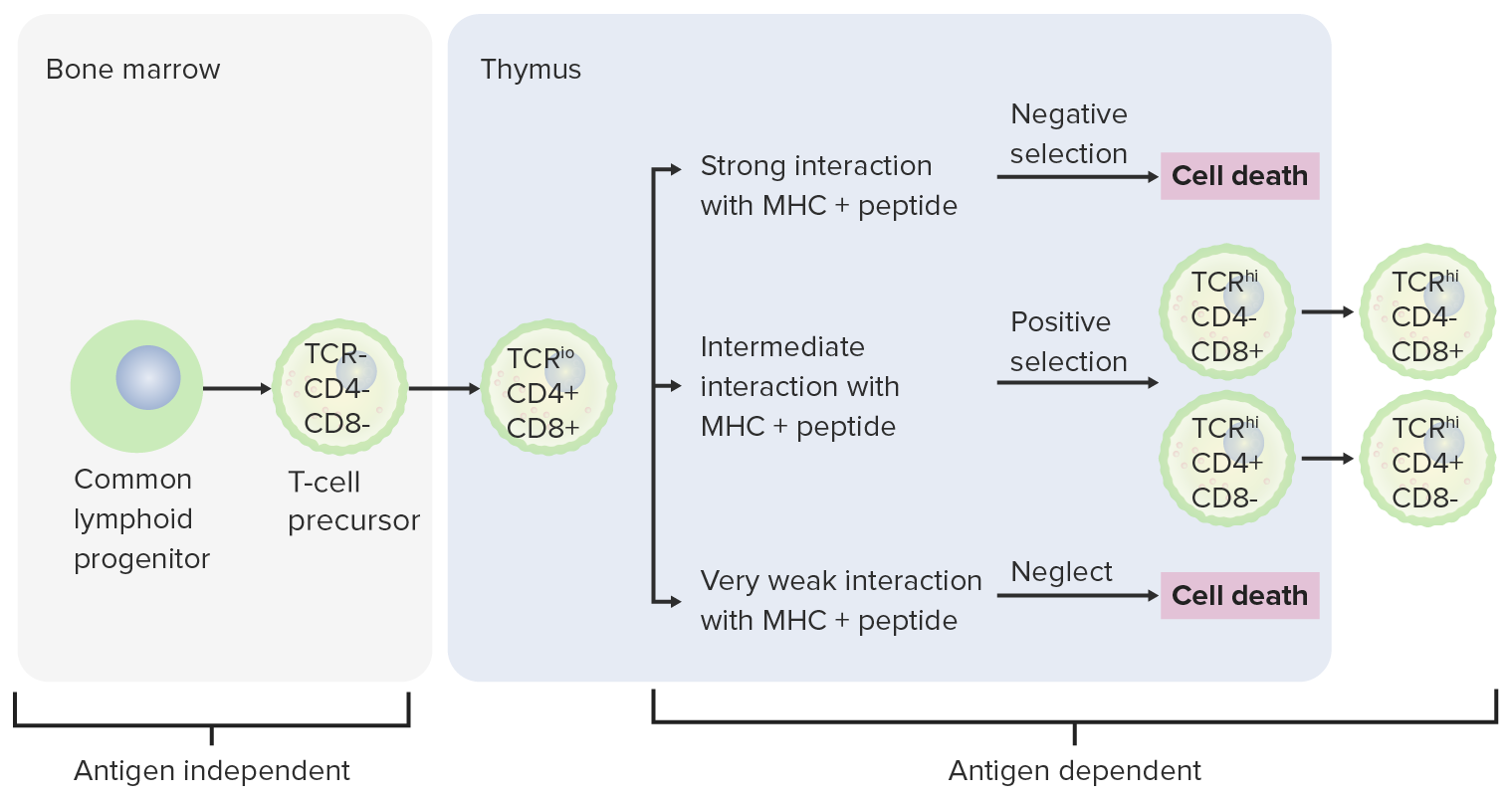
Desde la médula ósea, las células progenitoras pasan al timo para su posterior maduración. Las células DN (sin expresión de CD4/CD8 o CD4-/CD8-) no han desarrollado el receptor de linfocitos T. Las células DN experimentan un reordenamiento del gen del receptor de linfocitos T y se convierten en prolinfocitos T y luego en prelinfocitos T. A través del proceso, se expresan CD4 y CD8, y el receptor de linfocitos T se ensambla a través de reordenamientos genéticos (células DP). El timo presenta entonces moléculas CMH a los linfocitos T en desarrollo. Algunas células experimentan selección positiva (se produce una interacción intermedia entre el CMH y el receptor de linfocitos T) y producen células funcionales. Algunas células experimentan selección negativa (fuerte interacción entre el CMH y el receptor de linfocitos T), lo que provoca la muerte celular. Se evita la liberación de linfocitos T disfuncionales, que pueden activar la autoinmunidad. Algunos linfocitos T no logran interactuar, lo que conduce a la apoptosis. Los linfocitos T maduros expresan CD4 (linfocitos T colaboradores) o CD8 (linfocitos T citotóxicos), pero no ambos.

Imagen por Lecturio. Licencia: CC BY-NC-SA 4.0

Mnemotecnia

Recuerde la “regla del 8”:

  • Restricción del CMH: el linfocito T está “restringido” a unirse a un antígeno solo cuando se presenta por la clase apropiada de proteína CMH.
  • Los LOS Neisseria linfocitos T CD4 positivos reconocen el antígeno asociado a las proteínas CMH de clase II (4 × 2 = 8).
  • Los LOS Neisseria linfocitos T CD8 positivos reconocen el antígeno asociado a las proteínas CMH de clase I (8 × 1 = 8).

Activación y Diferenciación de Linfocitos T

Liberación del timo

  • Antes de que los LOS Neisseria linfocitos T salgan del timo, han interactuado con antígenos propios, se han sometido a la restricción del CMH y expresan CD4 o CD8.
  • Los LOS Neisseria linfocitos T liberados que expresan el complejo receptor Receptor Receptors are proteins located either on the surface of or within a cell that can bind to signaling molecules known as ligands (e.g., hormones) and cause some type of response within the cell. Receptors de linfocitos T-CD3 α-β de superficie con correceptores CD4 o CD8 se consideran linfocitos T maduros vírgenes:
    • No es suficiente para la proliferación y activación, ya que los LOS Neisseria linfocitos T liberados no han interactuado con un antígeno extraño
    • Estos linfocitos T circulan por la sangre y se dirigen a los LOS Neisseria tejidos linfoides secundarios.
    • Estos órganos linfoides secundarios (e.g., ganglios linfáticos) filtran el material antigénico, permitiendo que los LOS Neisseria linfocitos T maduros vírgenes:
      • Interactúen con células presentadoras de antígeno, como macrófagos o células dendríticas
      • Muestreen los LOS Neisseria antígenos para activarse
    • Si no se produce la activación, los LOS Neisseria linfocitos T recirculan.
Estructura y regiones funcionales de un ganglio linfático

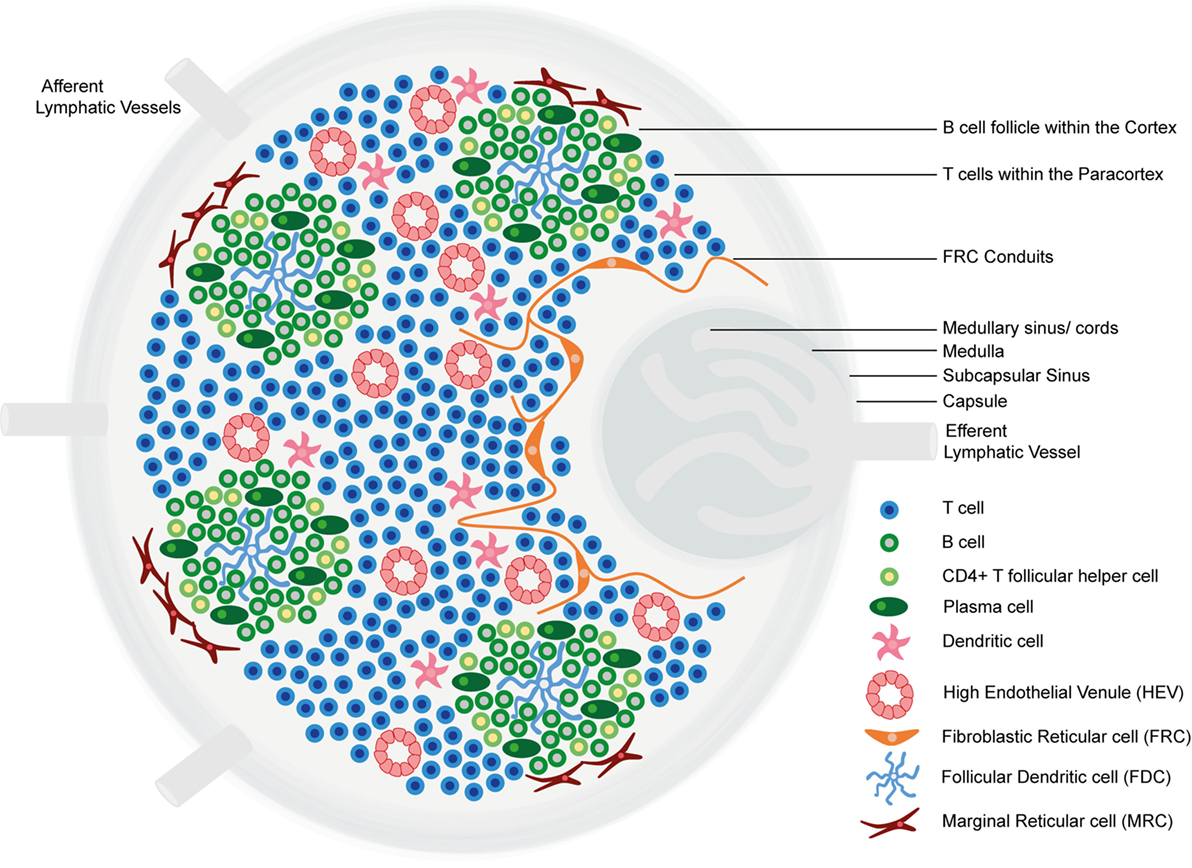
Estructura y regiones funcionales de un ganglio linfático que consta de una cápsula fibrosa rica en colágeno y un seno subcapsular subyacente.
Las células se segregan en (1) la corteza (que consiste en linfocitos B, linfocitos T colaboradores foliculares y células dendríticas foliculares dispuestas en folículos primarios, en los que los linfocitos B examinan los antígenos presentados en la red estromal de células dendríticas foliculares); y en (2) la paracorteza (que aloja a linfocitos T, células dendríticas y células reticulares fibroblásticas, que forman redes de células estromales y fibras reticulares).
La médula interna está compuesta por tejidos linfáticos (cordones medulares) separados por senos medulares compuestos por linfa.
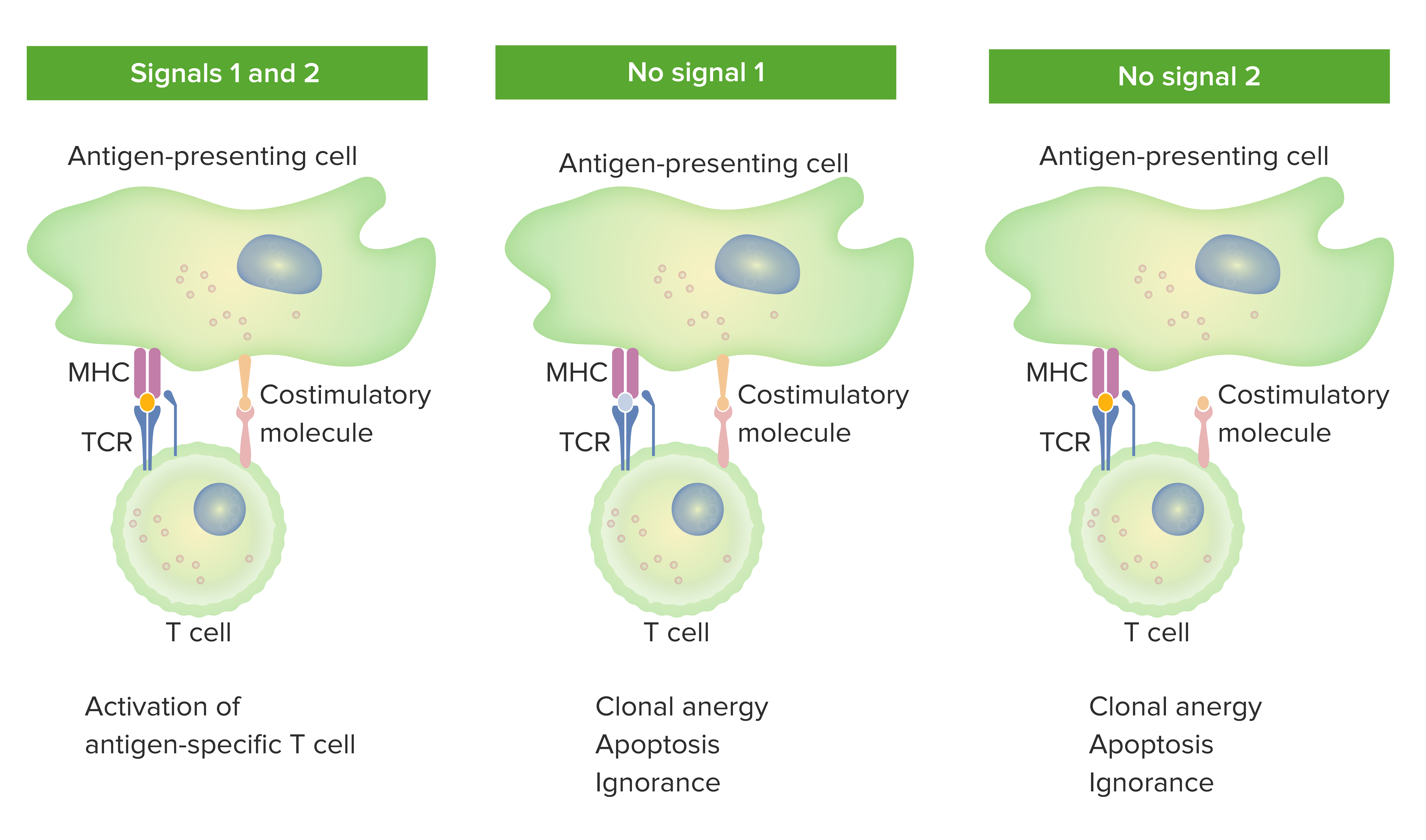
Imagen: “The structure of the lymph node” por Colbeck, Ager, Gallimore and Jones. Licencia: CC BY 4.0

Activación

  • La activación completa de linfocitos T listos para organizar una respuesta inmune requiere 2 señales:
    1. El receptor Receptor Receptors are proteins located either on the surface of or within a cell that can bind to signaling molecules known as ligands (e.g., hormones) and cause some type of response within the cell. Receptors de linfocitos T reconoce su antígeno afín, tal TAL Renal Sodium and Water Regulation y como lo presenta la célula presentadora de antígeno (e.g., célula dendrítica).
    2. Coestimulación:
      • Provista por una molécula coestimuladora (e.g., CD28 CD28 Costimulatory t-lymphocyte receptors that have specificity for CD80 antigen and CD86 antigen. Activation of this receptor results in increased t-cell proliferation, cytokine production and promotion of t-cell survival. T cells: Types and Functions)
      • Se caracteriza por la proteína B7 en EN Erythema nodosum is an immune-mediated panniculitis (inflammation of the subcutaneous fat) caused by a type IV (delayed-type) hypersensitivity reaction. It commonly manifests in young women as tender, erythematous nodules on the shins. Erythema Nodosum la célula presentadora de antígeno que interactúa con el CD28 CD28 Costimulatory t-lymphocyte receptors that have specificity for CD80 antigen and CD86 antigen. Activation of this receptor results in increased t-cell proliferation, cytokine production and promotion of t-cell survival. T cells: Types and Functions del linfocito T
      • Necesaria para la supervivencia y proliferación
      • Requerida para inducir diferenciación (estado efector o de memoria)
      • Permite la cooperación entre células
  • Sin la señal coestimuladora, el linfocito T puede adoptar un estado de anergia (la célula está viva pero con falta de respuesta parcial o total debido a una activación parcial).
  • Efectos:
    • La coestimulación ayuda a evitar la activación de linfocitos T por antígenos benignos.
    • Además, los linfocitos T CD8+, que son citotóxicos, requieren una “señal” adicional dada por las citoquinas de los LOS Neisseria linfocitos T CD4+ (lo que evita una activación inadvertida).
  • Mecanismos inhibidores o “puntos de control” en EN Erythema nodosum is an immune-mediated panniculitis (inflammation of the subcutaneous fat) caused by a type IV (delayed-type) hypersensitivity reaction. It commonly manifests in young women as tender, erythematous nodules on the shins. Erythema Nodosum los LOS Neisseria linfocitos T impiden la activación incontrolada de los LOS Neisseria mismos:
    • Antígeno-4 asociado al AL Amyloidosis linfocito T citotóxico
    • Muerte celular programada-1
Modelo de 2 señales - Dependencia de las linfocitos T de la coestimulación

Modelo de 2 señales de la dependencia de los linfocitos T de la coestimulación:
Cuando están presentes tanto la señal 1 (unión del receptor de linfocitos T con el antígeno afín presentado por la molécula del CMH en la célula presentadora del antígeno) como la señal 2 (interacción de la molécula coestimuladora entre la célula presentadora del antígeno y el linfocito T), el linfocito T maduro está totalmente activado.
El punto naranja en el panel de la izquierda indica la unión adecuada entre el antígeno y el receptor de linfocitos T. Sin embargo, cuando falta la señal 1 (la imagen del medio muestra la ausencia de la unión entre el antígeno y el receptor de linfocitos T) o la señal 2 (la imagen de la derecha muestra la ausencia de coestimulación), el linfocito T no se activará completamente.
Los resultados serían anergia (falta de respuesta), apoptosis (muerte celular) o ignorancia (el linfocito T no se da cuenta o no se ve afectado por el antígeno).

Imagen por Lecturio. Licencia: CC BY-NC-SA 4.0

Proliferación y diferenciación

  • Proliferación clonal:
    • Final de la activación
    • La liberación de IL-2 (el factor de crecimiento de los LOS Neisseria linfocitos T) por parte de los LOS Neisseria linfocitos T conduce a la multiplicación de los LOS Neisseria mismos.
  • Dependiendo de las citoquinas a las que se exponen durante la estimulación del antígeno, los LOS Neisseria linfocitos T maduros indiferenciados (Th0, por sus siglas en EN Erythema nodosum is an immune-mediated panniculitis (inflammation of the subcutaneous fat) caused by a type IV (delayed-type) hypersensitivity reaction. It commonly manifests in young women as tender, erythematous nodules on the shins. Erythema Nodosum inglés) se convierten en EN Erythema nodosum is an immune-mediated panniculitis (inflammation of the subcutaneous fat) caused by a type IV (delayed-type) hypersensitivity reaction. It commonly manifests in young women as tender, erythematous nodules on the shins. Erythema Nodosum células con diferentes funciones:
    • Los LOS Neisseria linfocitos T CD4+ se convierten en EN Erythema nodosum is an immune-mediated panniculitis (inflammation of the subcutaneous fat) caused by a type IV (delayed-type) hypersensitivity reaction. It commonly manifests in young women as tender, erythematous nodules on the shins. Erythema Nodosum:
      • Linfocitos colaboradores foliculares (Tfh, por sus siglas en EN Erythema nodosum is an immune-mediated panniculitis (inflammation of the subcutaneous fat) caused by a type IV (delayed-type) hypersensitivity reaction. It commonly manifests in young women as tender, erythematous nodules on the shins. Erythema Nodosum inglés)
      • Linfocitos T efectores/colaboradores (Th, por sus siglas en EN Erythema nodosum is an immune-mediated panniculitis (inflammation of the subcutaneous fat) caused by a type IV (delayed-type) hypersensitivity reaction. It commonly manifests in young women as tender, erythematous nodules on the shins. Erythema Nodosum inglés)
      • Linfocitos T reguladores (Treg) o supresores
    • Los LOS Neisseria linfocitos T CD8+ se convierten en EN Erythema nodosum is an immune-mediated panniculitis (inflammation of the subcutaneous fat) caused by a type IV (delayed-type) hypersensitivity reaction. It commonly manifests in young women as tender, erythematous nodules on the shins. Erythema Nodosum linfocitos T citotóxicos.
  • Un cierto número de linfocitos T activados permanecen en EN Erythema nodosum is an immune-mediated panniculitis (inflammation of the subcutaneous fat) caused by a type IV (delayed-type) hypersensitivity reaction. It commonly manifests in young women as tender, erythematous nodules on the shins. Erythema Nodosum el órgano linfoide secundario, y algunos se dirigen a zonas de inflamación tisular para realizar funciones efectoras.

Linfocitos T CD4+

Descripción general de la diferenciación de los LOS Neisseria linfocitos T colaboradores

Los LOS Neisseria linfocitos T colaboradores tienen diferentes perfiles de citoquinas y funciones en EN Erythema nodosum is an immune-mediated panniculitis (inflammation of the subcutaneous fat) caused by a type IV (delayed-type) hypersensitivity reaction. It commonly manifests in young women as tender, erythematous nodules on the shins. Erythema Nodosum la respuesta inmune.

Tabla: Descripción general de la diferenciación de los LOS Neisseria linfocitos Th
Linfocitos T CD4+ Diferenciación estimulada por Funciones Citoquinas producidas
Th1 Th1 A subset of helper-inducer T-lymphocytes which synthesize and secrete interleukin-2; interferon-gamma; and interleukin-12. Due to their ability to kill antigen-presenting cells and their lymphokine-mediated effector activity, th1 cells are associated with vigorous delayed-type hypersensitivity reactions. T cells: Types and Functions
  • IL-12
  • IFN-γ
  • Activar macrófagos
  • Activar linfocitos T citotóxicos
  • IFN-γ
  • TNF TNF Tumor necrosis factor (TNF) is a major cytokine, released primarily by macrophages in response to stimuli. The presence of microbial products and dead cells and injury are among the stimulating factors. This protein belongs to the TNF superfamily, a group of ligands and receptors performing functions in inflammatory response, morphogenesis, and cell proliferation. Tumor Necrosis Factor (TNF)
  • IL-2
Th2 Th2 A subset of helper-inducer T-lymphocytes which synthesize and secrete the interleukins il-4; il-5; il-6; and il-10. These cytokines influence b-cell development and antibody production as well as augmenting humoral responses. T cells: Types and Functions
  • IL-2
  • IL-4
  • Activar eosinófilos, ↑ IgE IgE An immunoglobulin associated with mast cells. Overexpression has been associated with allergic hypersensitivity. Immunoglobulins: Types and Functions
  • Activar mastocitos
  • IL-4
  • IL-5
  • IL-6
  • IL-9
  • IL-10
  • IL-13
Th17 Th17 A subset of helper-effector T-lymphocytes which synthesize and secrete interleukins il-17; il-17f; and il-22. These cytokines are involved in host defenses and tissue inflammation in autoimmune diseases. T cells: Types and Functions
  • IL-1
  • IL-6
  • IL-23
  • TGF-β
Promover la inflamación neutrofílica
  • IL-17
  • IL-21
  • IL-22
Tfh IL-6 Facilitar la activación y maduración de linfocitos B
  • IL-4
  • IL-21
Treg
  • TGF-β
  • IL-2
  • Suprimir la respuesta inmune
  • Promover la autotolerancia
  • TGF-β
  • IL-10
  • IL-35
IFN: interferón
TGF: factor de crecimiento transformante (por sus siglas en inglés)
TNF: factor de necrosis tumoral (por sus siglas en inglés)
Subconjuntos de linfocitos T colaboradores CD4-+

Subconjuntos de linfocitos T colaboradores CD4-positivos:
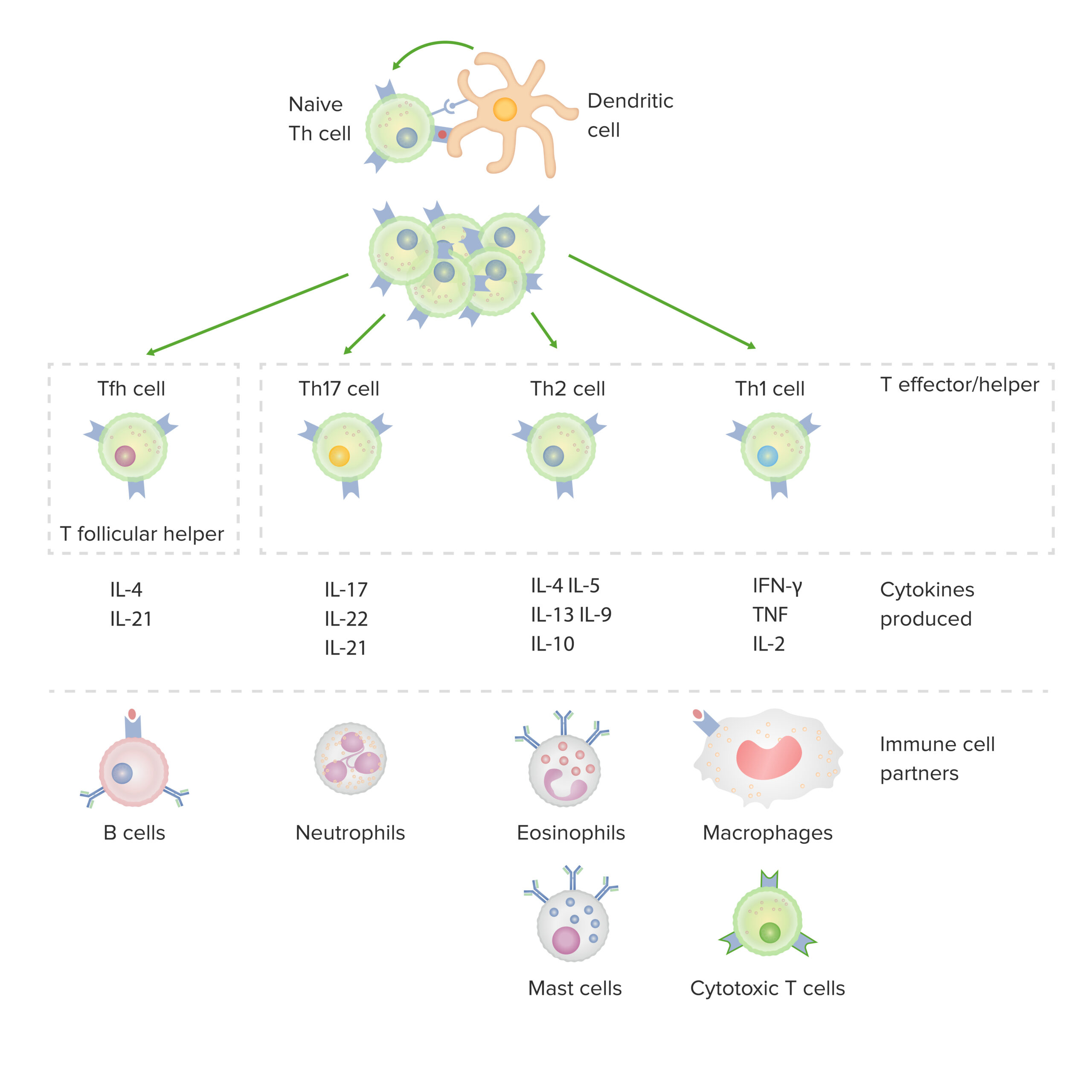
Tras la activación por parte de una célula dendrítica, en presencia de determinadas citoquinas, un linfocito T CD4-positivo virgen se divide y se diferencia en subconjuntos efector/colaborador (Th1, Th2 o Th17) o colaborador folicular (Tfh). Cada tipo de célula produce citoquinas que facilitan la activación de otras células inmunitarias.
IFN: interferón
TNF: factor de necrosis tumoral (en inglés)
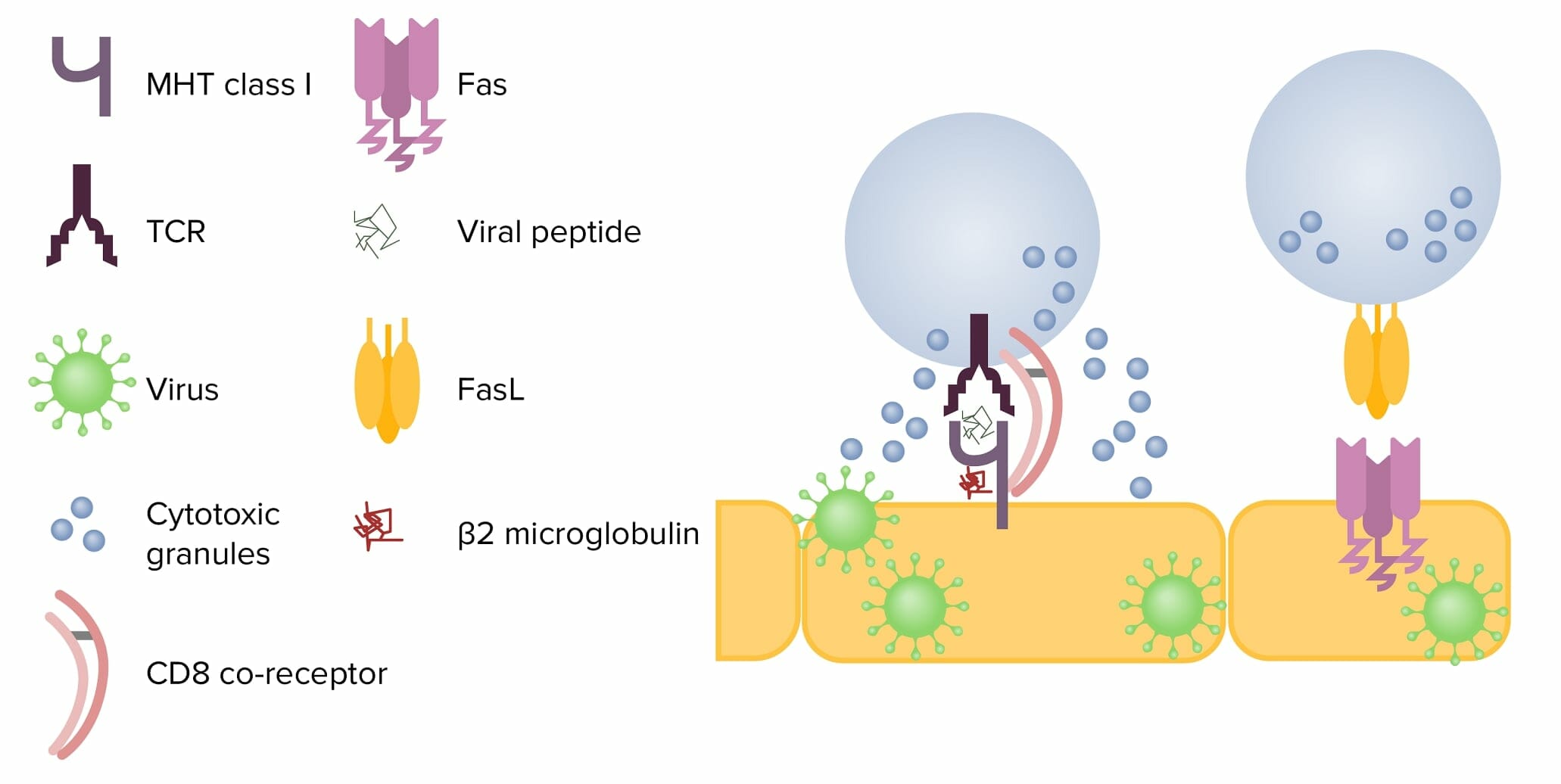
Imagen por Lecturio. Licencia: CC BY-NC-SA 4.0

Th1 Th1 A subset of helper-inducer T-lymphocytes which synthesize and secrete interleukin-2; interferon-gamma; and interleukin-12. Due to their ability to kill antigen-presenting cells and their lymphokine-mediated effector activity, th1 cells are associated with vigorous delayed-type hypersensitivity reactions. T cells: Types and Functions

  • Diferenciación estimulada por: IL-12 e IFN-γ
  • Inhibidos por: IL-4 e IL-10 (de Th2 Th2 A subset of helper-inducer T-lymphocytes which synthesize and secrete the interleukins il-4; il-5; il-6; and il-10. These cytokines influence b-cell development and antibody production as well as augmenting humoral responses. T cells: Types and Functions)
  • Producen las citoquinas IFN-γ, IL-2 y factor de necrosis Necrosis The death of cells in an organ or tissue due to disease, injury or failure of the blood supply. Ischemic Cell Damage tumoral ( TNF TNF Tumor necrosis factor (TNF) is a major cytokine, released primarily by macrophages in response to stimuli. The presence of microbial products and dead cells and injury are among the stimulating factors. This protein belongs to the TNF superfamily, a group of ligands and receptors performing functions in inflammatory response, morphogenesis, and cell proliferation. Tumor Necrosis Factor (TNF), por sus siglas en EN Erythema nodosum is an immune-mediated panniculitis (inflammation of the subcutaneous fat) caused by a type IV (delayed-type) hypersensitivity reaction. It commonly manifests in young women as tender, erythematous nodules on the shins. Erythema Nodosum inglés)
  • Expresa los LOS Neisseria factores de transcripción T-BET y el transductor de señal y activador de la transcripción 4
  • Funciones:
    • Activa los LOS Neisseria macrófagos → mejora la fagocitosis, formación de granulomas Granulomas A relatively small nodular inflammatory lesion containing grouped mononuclear phagocytes, caused by infectious and noninfectious agents. Sarcoidosis
    • Activa los LOS Neisseria linfocitos citotóxicos
    • Ayuda a los LOS Neisseria linfocitos B a producir anticuerpos
    • Inhibe los LOS Neisseria linfocitos Th2 Th2 A subset of helper-inducer T-lymphocytes which synthesize and secrete the interleukins il-4; il-5; il-6; and il-10. These cytokines influence b-cell development and antibody production as well as augmenting humoral responses. T cells: Types and Functions
    • Defensa contra bacterias, hongos y virus Virus Viruses are infectious, obligate intracellular parasites composed of a nucleic acid core surrounded by a protein capsid. Viruses can be either naked (non-enveloped) or enveloped. The classification of viruses is complex and based on many factors, including type and structure of the nucleoid and capsid, the presence of an envelope, the replication cycle, and the host range. Virology
  • Relevancia clínica:
    • Participan en EN Erythema nodosum is an immune-mediated panniculitis (inflammation of the subcutaneous fat) caused by a type IV (delayed-type) hypersensitivity reaction. It commonly manifests in young women as tender, erythematous nodules on the shins. Erythema Nodosum las reacciones de hipersensibilidad retardada
    • Las deficiencias de IL-12 o IFN-γ predisponen a infecciones por micobacterias, especialmente a la tuberculosis Tuberculosis Tuberculosis (TB) is an infectious disease caused by Mycobacterium tuberculosis complex bacteria. The bacteria usually attack the lungs but can also damage other parts of the body. Approximately 30% of people around the world are infected with this pathogen, with the majority harboring a latent infection. Tuberculosis spreads through the air when a person with active pulmonary infection coughs or sneezes. Tuberculosis.
    • Sobreactividad de linfocitos Th1 Th1 A subset of helper-inducer T-lymphocytes which synthesize and secrete interleukin-2; interferon-gamma; and interleukin-12. Due to their ability to kill antigen-presenting cells and their lymphokine-mediated effector activity, th1 cells are associated with vigorous delayed-type hypersensitivity reactions. T cells: Types and Functions: enfermedades autoinmunes e inflamatorias relacionadas (e.g., enfermedad de Crohn, artritis reumatoide)

Th2 Th2 A subset of helper-inducer T-lymphocytes which synthesize and secrete the interleukins il-4; il-5; il-6; and il-10. These cytokines influence b-cell development and antibody production as well as augmenting humoral responses. T cells: Types and Functions

  • Diferenciación estimulada por: IL-2 e IL-4
  • Inhibidos por: IFN-γ (de Th1 Th1 A subset of helper-inducer T-lymphocytes which synthesize and secrete interleukin-2; interferon-gamma; and interleukin-12. Due to their ability to kill antigen-presenting cells and their lymphokine-mediated effector activity, th1 cells are associated with vigorous delayed-type hypersensitivity reactions. T cells: Types and Functions)
  • Producen las citoquinas IL-4, IL-5, IL-6, IL-9, IL-10 e IL-13
  • Expresan factores de transcripción GATA3 y STAT6.
  • Funciones:
    • Activar los LOS Neisseria eosinófilos y los LOS Neisseria mastocitos
    • Inhibir los LOS Neisseria linfocitos Th1 Th1 A subset of helper-inducer T-lymphocytes which synthesize and secrete interleukin-2; interferon-gamma; and interleukin-12. Due to their ability to kill antigen-presenting cells and their lymphokine-mediated effector activity, th1 cells are associated with vigorous delayed-type hypersensitivity reactions. T cells: Types and Functions
    • Ayudar a los LOS Neisseria linfocitos B
  • Relevancia clínica:
    • La desregulación de los LOS Neisseria linfocitos Th2 Th2 A subset of helper-inducer T-lymphocytes which synthesize and secrete the interleukins il-4; il-5; il-6; and il-10. These cytokines influence b-cell development and antibody production as well as augmenting humoral responses. T cells: Types and Functions provoca enfermedades alérgicas (e.g., asma ASMA Autoimmune Hepatitis alérgica, dermatitis Dermatitis Any inflammation of the skin. Atopic Dermatitis (Eczema) atópica).
    • Responde a la infección por ciertos helmintos, como Schistosoma Schistosoma Schistosomiasis is an infection caused by Schistosoma, a trematode. Schistosomiasis occurs in developing countries with poor sanitation. Freshwater snails are the intermediate host and are transmitted to humans through skin contact with contaminated fresh water. The clinical presentation occurs as a result of the host’s immune response to antigens from the eggs. Schistosoma/Schistosomiasis y Strongyloides

Th17 Th17 A subset of helper-effector T-lymphocytes which synthesize and secrete interleukins il-17; il-17f; and il-22. These cytokines are involved in host defenses and tissue inflammation in autoimmune diseases. T cells: Types and Functions

  • Diferenciación estimulada por: IL-1, IL-6, IL-23 y TGF-β
  • Inhibidos por: IL-4 e IFN-γ
  • Producen las citoquinas IL-17, IL-21 e IL-22
  • Expresan factores de transcripción RORC y STAT3.
  • Funciones:
    • Activar la respuesta neutrofílica
    • Defensa del tejido de barrera
  • Relevancia clínica:
    • Mayor susceptibilidad a infecciones mucocutáneas por la levadura Candida albicans Candida albicans A unicellular budding fungus which is the principal pathogenic species causing candidiasis (moniliasis). Candida/Candidiasis en EN Erythema nodosum is an immune-mediated panniculitis (inflammation of the subcutaneous fat) caused by a type IV (delayed-type) hypersensitivity reaction. It commonly manifests in young women as tender, erythematous nodules on the shins. Erythema Nodosum deficiencia de IL-17
    • Su sobreactividad está asociada a enfermedades autoinmunes.

Tfh

  • Diferenciación estimulada por: IL-6
  • Inhibidos por: IL-2
  • Producen las citoquinas IL-4 e IL-21
  • Expresan el factor de transcripción Bcl-6.
  • Otros marcadores: CXCR5, CXCL13, PD-1 PD-1 An inhibitory t-lymphocyte receptor that has specificity for CD274 antigen and programmed cell death 1 ligand 2 protein. Signaling by the receptor limits T cell proliferation and interferon gamma synthesis. The receptor also may play an essential role in the regulatory pathway that induces peripheral tolerance. T cells: Types and Functions e ICOS
  • Funciones:
    • Se encuentran en EN Erythema nodosum is an immune-mediated panniculitis (inflammation of the subcutaneous fat) caused by a type IV (delayed-type) hypersensitivity reaction. It commonly manifests in young women as tender, erythematous nodules on the shins. Erythema Nodosum los LOS Neisseria centros germinales de los LOS Neisseria tejidos linfoides secundarios y ayudan a la activación de los LOS Neisseria linfocitos B.
    • La expresión del ligando CD40 CD40 Members of the tumor necrosis factor receptor superfamily with specificity for CD40 ligand. They are found on mature B-lymphocytes, some epithelial cells; and lymphoid dendritic cells. Evidence suggests that CD40-dependent activation of B-cells is important for generation of memory B-cells within the germinal centers. Mutations in the CD40 antigen gene result in hyper-igm immunodeficiency syndrome, type 3. Signaling of the receptor occurs through its association with tnf receptor-associated factors. Hyper-IgM Syndrome (CD40L) interactúa con el CD40 CD40 Members of the tumor necrosis factor receptor superfamily with specificity for CD40 ligand. They are found on mature B-lymphocytes, some epithelial cells; and lymphoid dendritic cells. Evidence suggests that CD40-dependent activation of B-cells is important for generation of memory B-cells within the germinal centers. Mutations in the CD40 antigen gene result in hyper-igm immunodeficiency syndrome, type 3. Signaling of the receptor occurs through its association with tnf receptor-associated factors. Hyper-IgM Syndrome del linfocito B.
  • Relevancia clínica:
    • La mutación del gen que codifica CD40L conduce al AL Amyloidosis síndrome de hiper-IgM.
    • Su sobreactividad conduce a una enfermedad autoinmune.

Treg

  • Diferenciación estimulada por: TGF-β e IL-2
  • Inhibidos por: IL-6
  • Producen citoquinas TGF-β, IL-10 e IL-35
  • Expresan el factor de transcripción FOXP3.
  • Funciones:
    • Una respuesta sin control de los LOS Neisseria linfocitos T puede volverse patológica, por lo que los LOS Neisseria Treg están presentes para prevenir la inflamación excesiva y el daño tisular.
    • Parte del mecanismo de tolerancia periférica
    • Puede regular Regular Insulin a la baja la actividad de muchas células inmunitarias, incluyendo:
      • Linfocitos CD4+
      • Linfocitos T CD8+
      • Células dendríticas (a través del CTLA-4 de la superficie celular y del gen de activación linfocitaria (LAG-3))
      • Linfocitos B
      • Células asesinas naturales
      • Eosinófilos, basófilos, mastocitos
  • Relevancia clínica:
    • Impulsar la actividad de los LOS Neisseria Treg (o ↓ respuesta inmune) puede ayudar a combatir rechazo de trasplantes y enfermedades autoinmunes.
    • Reducir la actividad de los LOS Neisseria Treg (o ↑ respuesta inmune) es útil en EN Erythema nodosum is an immune-mediated panniculitis (inflammation of the subcutaneous fat) caused by a type IV (delayed-type) hypersensitivity reaction. It commonly manifests in young women as tender, erythematous nodules on the shins. Erythema Nodosum inmunoterapia del cáncer e infecciones crónicas.
    • Rol importante en EN Erythema nodosum is an immune-mediated panniculitis (inflammation of the subcutaneous fat) caused by a type IV (delayed-type) hypersensitivity reaction. It commonly manifests in young women as tender, erythematous nodules on the shins. Erythema Nodosum la prevención del rechazo de injerto y de la enfermedad del injerto contra el huésped
    • La mutación del gen que codifica FOXP3 da lugar al AL Amyloidosis síndrome de inmunodesregulación – poliendocrinopatía – enteropatía ligada al AL Amyloidosis cromosoma X.

Linfocitos T CD8+

  • Linfocitos T citotóxicos o citolíticos
  • Requiere la estimulación por citoquinas (IL-2) (de linfocitos Th1 Th1 A subset of helper-inducer T-lymphocytes which synthesize and secrete interleukin-2; interferon-gamma; and interleukin-12. Due to their ability to kill antigen-presenting cells and their lymphokine-mediated effector activity, th1 cells are associated with vigorous delayed-type hypersensitivity reactions. T cells: Types and Functions) para activarse, luego sale del órgano linfoide secundario, circulando en EN Erythema nodosum is an immune-mediated panniculitis (inflammation of the subcutaneous fat) caused by a type IV (delayed-type) hypersensitivity reaction. It commonly manifests in young women as tender, erythematous nodules on the shins. Erythema Nodosum busca de dianas
  • Producen citoquinas IFNγ, TNF-α y TNF-β
  • Expresan factor de transcripción RUNX3
  • Sus funciones incluyen eliminar:
    • Patógenos
    • Células infectadas
    • Células tumorales
    • Aloinjertos
  • Su citotoxicidad se produce a través de:
    • Exocitosis de gránulos:
      • Tras el contacto con la célula diana, se reúnen gránulos líticos cerca de la sinapsis inmunológica.
      • Las membranas de los LOS Neisseria gránulos se fusionan con la membrana celular.
      • El contenido de los LOS Neisseria gránulos, incluidas granzimas y perforinas, entra en EN Erythema nodosum is an immune-mediated panniculitis (inflammation of the subcutaneous fat) caused by a type IV (delayed-type) hypersensitivity reaction. It commonly manifests in young women as tender, erythematous nodules on the shins. Erythema Nodosum la célula diana.
      • Se activa la vía de las caspasas, lo que conduce a la apoptosis Apoptosis A regulated cell death mechanism characterized by distinctive morphologic changes in the nucleus and cytoplasm, including the endonucleolytic cleavage of genomic DNA, at regularly spaced, internucleosomal sites, I.e., DNA fragmentation. It is genetically-programmed and serves as a balance to mitosis in regulating the size of animal tissues and in mediating pathologic processes associated with tumor growth. Ischemic Cell Damage.
    • Expresión del ligando Fas (FasL):
      • El Fas se expresa en EN Erythema nodosum is an immune-mediated panniculitis (inflammation of the subcutaneous fat) caused by a type IV (delayed-type) hypersensitivity reaction. It commonly manifests in young women as tender, erythematous nodules on the shins. Erythema Nodosum la superficie de muchas células.
      • FasL, expresado en EN Erythema nodosum is an immune-mediated panniculitis (inflammation of the subcutaneous fat) caused by a type IV (delayed-type) hypersensitivity reaction. It commonly manifests in young women as tender, erythematous nodules on the shins. Erythema Nodosum la superficie de linfocitos T CD8+, es inducido cuando se reconoce un antígeno afín.
      • Se produce la interacción Fas-FasL, se activa la vía de las caspasas y se produce la muerte celular.
    • Reclutamiento y modulación de células efectoras inflamatorias adicionales, como los LOS Neisseria macrófagos
  • Relevancia clínica:
    • Rol destacado en EN Erythema nodosum is an immune-mediated panniculitis (inflammation of the subcutaneous fat) caused by a type IV (delayed-type) hypersensitivity reaction. It commonly manifests in young women as tender, erythematous nodules on the shins. Erythema Nodosum relación con patógenos intracelulares (e.g., Listeria Listeria Listeria spp. are motile, flagellated, gram-positive, facultative intracellular bacilli. The major pathogenic species is Listeria monocytogenes. Listeria are part of the normal gastrointestinal flora of domestic mammals and poultry and are transmitted to humans through the ingestion of contaminated food, especially unpasteurized dairy products. Listeria Monocytogenes/Listeriosis monocytogenes), ya que estos patógenos pasan poco tiempo en EN Erythema nodosum is an immune-mediated panniculitis (inflammation of the subcutaneous fat) caused by a type IV (delayed-type) hypersensitivity reaction. It commonly manifests in young women as tender, erythematous nodules on the shins. Erythema Nodosum la circulación (menor susceptibilidad a anticuerpos).
    • Importancia similar en EN Erythema nodosum is an immune-mediated panniculitis (inflammation of the subcutaneous fat) caused by a type IV (delayed-type) hypersensitivity reaction. It commonly manifests in young women as tender, erythematous nodules on the shins. Erythema Nodosum la defensa inmune contra virus Virus Viruses are infectious, obligate intracellular parasites composed of a nucleic acid core surrounded by a protein capsid. Viruses can be either naked (non-enveloped) or enveloped. The classification of viruses is complex and based on many factors, including type and structure of the nucleoid and capsid, the presence of an envelope, the replication cycle, and the host range. Virology (e.g., VIH)
Mechanisms of cytotoxicity by CD8+ T cells

Mecanismos de citotoxicidad de las células T CD8+:
Izquierda: Tras entrar en contacto con una célula infectada, la célula T libera gránulos citotóxicos, perforina y granzimas. La perforina crea un poro en la membrana de la célula objetivo, permitiendo que las granzimas entren en la célula. Éstas escinden las proteínas dentro de la célula, lo que finalmente provoca la apoptosis.
A la derecha: Cuando FasL interactúa con Fas en una célula diana, se activa la cascada de caspasas y se produce la apoptosis.
FasL: ligando de Fas
TCR: receptor de células T
MHC: complejo mayor de histocompatibilidad
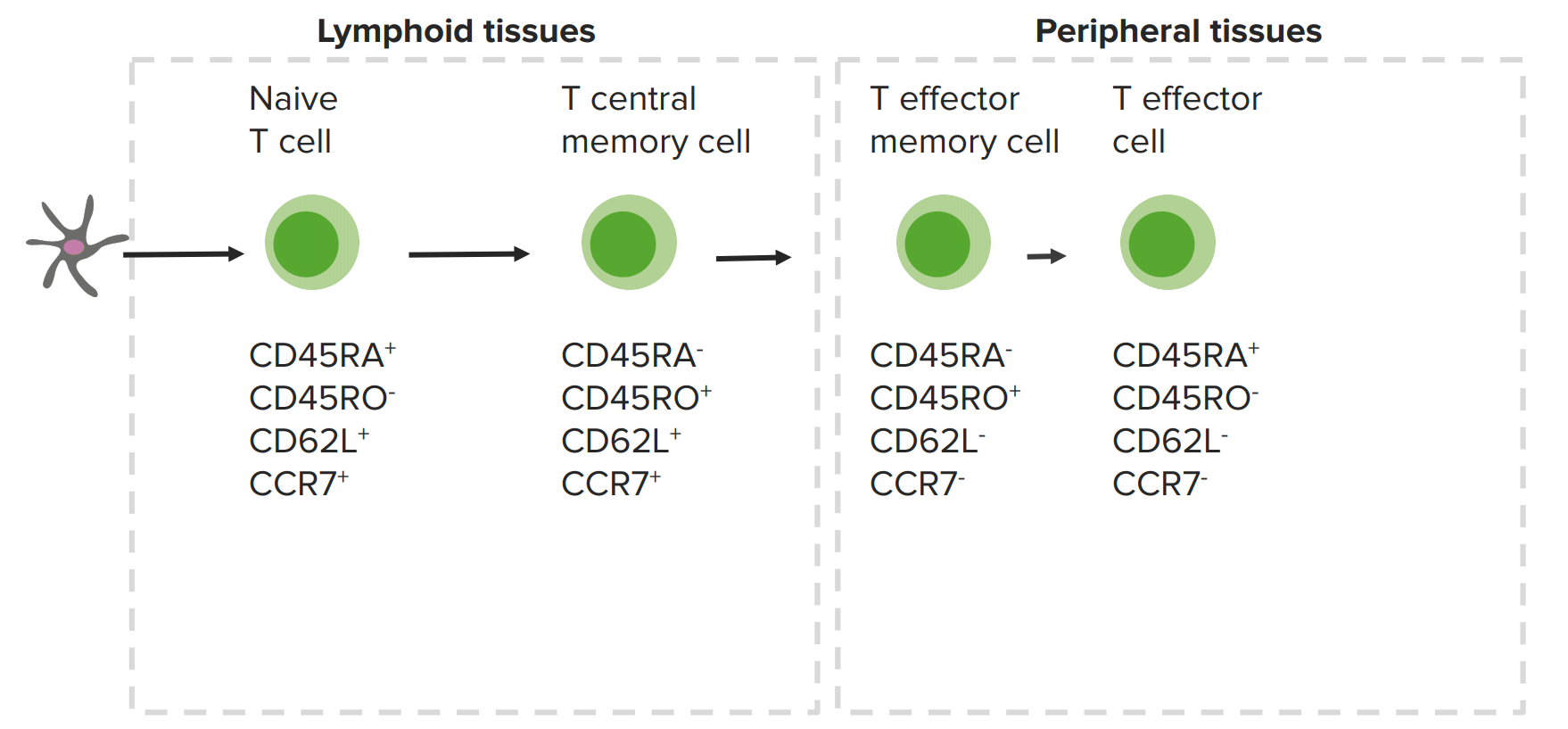
Imagen por Lecturio.

Otros Tipos de Linfocitos T

Linfocitos T gamma-delta

  • Sus receptores de linfocitos T están formados por cadenas γ y δ.
  • No pasan por el estadio doble positivo, pero tienen una función distinta y complementaria a la de los LOS Neisseria linfocitos T αβ
  • Representan < 5% de los LOS Neisseria linfocitos T
  • Se encuentra en EN Erythema nodosum is an immune-mediated panniculitis (inflammation of the subcutaneous fat) caused by a type IV (delayed-type) hypersensitivity reaction. It commonly manifests in young women as tender, erythematous nodules on the shins. Erythema Nodosum mucosa intestinal, piel, pulmones y útero
  • Para su activación, pueden unirse a moléculas que no son del CMH
  • Reconocen los LOS Neisseria fosfoantígenos de:
    • Mycobacterium tuberculosis Mycobacterium tuberculosis Tuberculosis (TB) is an infectious disease caused by Mycobacterium tuberculosis complex bacteria. The bacteria usually attack the lungs but can also damage other parts of the body. Approximately 30% of people around the world are infected with this pathogen, with the majority harboring a latent infection. Tuberculosis spreads through the air when a person with active pulmonary infection coughs or sneezes. Tuberculosis
    • Plasmodium Plasmodium A genus of protozoa that comprise the malaria parasites of mammals. Four species infect humans (although occasional infections with primate malarias may occur). These are plasmodium falciparum; plasmodium malariae; plasmodium ovale, and plasmodium vivax. Species causing infection in vertebrates other than man include: plasmodium berghei; plasmodium chabaudi; p. Vinckei, and plasmodium yoelii in rodents; p. Brasilianum, plasmodium cynomolgi; and plasmodium knowlesi in monkeys; and plasmodium gallinaceum in chickens. Antimalarial Drugs spp.

Linfocitos T asesinos naturales

  • Se ramifican de los LOS Neisseria linfocitos T en EN Erythema nodosum is an immune-mediated panniculitis (inflammation of the subcutaneous fat) caused by a type IV (delayed-type) hypersensitivity reaction. It commonly manifests in young women as tender, erythematous nodules on the shins. Erythema Nodosum el estadio de desarrollo doble positivo (CD4+, CD8+).
  • Tienen características morfológicas y funcionales de linfocitos T y células asesinas naturales
  • Reconocen el antígeno presentado por las moléculas CD1d de clase I del CMH
  • Producen citoquinas Th1 Th1 A subset of helper-inducer T-lymphocytes which synthesize and secrete interleukin-2; interferon-gamma; and interleukin-12. Due to their ability to kill antigen-presenting cells and their lymphokine-mediated effector activity, th1 cells are associated with vigorous delayed-type hypersensitivity reactions. T cells: Types and Functions y Th2 Th2 A subset of helper-inducer T-lymphocytes which synthesize and secrete the interleukins il-4; il-5; il-6; and il-10. These cytokines influence b-cell development and antibody production as well as augmenting humoral responses. T cells: Types and Functions cuando se activan

Linfocitos T de memoria

  • Pueden ser CD4+ o CD8+
  • Organizan una respuesta inmune años después de la exposición inicial
  • Los LOS Neisseria linfocitos T vírgenes no expuestos a las células dendríticas portadoras de antígenos, expresan los LOS Neisseria siguientes marcadores:
    • Positivo para CD45RA
    • Negativo para CD45RO
    • Expresan CD62L y CCR7
  • Tras la exposición a los LOS Neisseria antígenos, algunos linfocitos T se convierten en EN Erythema nodosum is an immune-mediated panniculitis (inflammation of the subcutaneous fat) caused by a type IV (delayed-type) hypersensitivity reaction. It commonly manifests in young women as tender, erythematous nodules on the shins. Erythema Nodosum linfocitos de memoria:
    • Inicialmente residen en EN Erythema nodosum is an immune-mediated panniculitis (inflammation of the subcutaneous fat) caused by a type IV (delayed-type) hypersensitivity reaction. It commonly manifests in young women as tender, erythematous nodules on the shins. Erythema Nodosum los LOS Neisseria tejidos linfoides (linfocitos T de memoria central).
    • Se convierten en EN Erythema nodosum is an immune-mediated panniculitis (inflammation of the subcutaneous fat) caused by a type IV (delayed-type) hypersensitivity reaction. It commonly manifests in young women as tender, erythematous nodules on the shins. Erythema Nodosum CD45RO+ y CD45RA-
    • CD62L+ y CCR7+
  • Linfocitos T de memoria que se instalan en EN Erythema nodosum is an immune-mediated panniculitis (inflammation of the subcutaneous fat) caused by a type IV (delayed-type) hypersensitivity reaction. It commonly manifests in young women as tender, erythematous nodules on the shins. Erythema Nodosum los LOS Neisseria tejidos periféricos (linfocitos efectores de memoria):
    • CD45RO+ y CD45RA-
    • CD62L- y CCR7-
  • Tras la reinfección por el mismo antígeno, se convierten en EN Erythema nodosum is an immune-mediated panniculitis (inflammation of the subcutaneous fat) caused by a type IV (delayed-type) hypersensitivity reaction. It commonly manifests in young women as tender, erythematous nodules on the shins. Erythema Nodosum linfocitos T efectores:
    • CD45RA+, CD45RO-, CD62L- y CCR7-
    • Componentes esenciales de la inmunidad secundaria.
    • Pueden activarse inmediatamente tras la invasión de patógenos.
Linfocitos T de memoria y marcadores celulares expresados

Linfocitos T de memoria y marcadores celulares expresados:
Los linfocitos T de memoria centrales están en los órganos linfoides, mientras que los linfocitos T de memoria periféricos están en los tejidos periféricos.

Imagen por Lecturio. Licencia: CC BY-NC-SA 4.0

Relevancia Clínica

  • Candidiasis Candidiasis Candida is a genus of dimorphic, opportunistic fungi. Candida albicans is part of the normal human flora and is the most common cause of candidiasis. The clinical presentation varies and can include localized mucocutaneous infections (e.g., oropharyngeal, esophageal, intertriginous, and vulvovaginal candidiasis) and invasive disease (e.g., candidemia, intraabdominal abscess, pericarditis, and meningitis). Candida/Candidiasis mucocutánea crónica: síndrome autoinmune con características que incluyen infecciones crónicas no invasivas por Candida Candida Candida is a genus of dimorphic, opportunistic fungi. Candida albicans is part of the normal human flora and is the most common cause of candidiasis. The clinical presentation varies and can include localized mucocutaneous infections (e.g., oropharyngeal, esophageal, intertriginous, and vulvovaginal candidiasis) and invasive disease (e.g., candidemia, intraabdominal abscess, pericarditis, and meningitis). Candida/Candidiasis en EN Erythema nodosum is an immune-mediated panniculitis (inflammation of the subcutaneous fat) caused by a type IV (delayed-type) hypersensitivity reaction. It commonly manifests in young women as tender, erythematous nodules on the shins. Erythema Nodosum piel, uñas y membranas mucosas. La afección está asociada a manifestaciones autoinmunes (más comúnmente endocrinopatías). El hipoparatiroidismo es la anomalía endocrina más frecuente, estando presente en EN Erythema nodosum is an immune-mediated panniculitis (inflammation of the subcutaneous fat) caused by a type IV (delayed-type) hypersensitivity reaction. It commonly manifests in young women as tender, erythematous nodules on the shins. Erythema Nodosum el 30% de los LOS Neisseria individuos. Se produce insuficiencia suprarrenal en EN Erythema nodosum is an immune-mediated panniculitis (inflammation of the subcutaneous fat) caused by a type IV (delayed-type) hypersensitivity reaction. It commonly manifests in young women as tender, erythematous nodules on the shins. Erythema Nodosum > 60% de casos a la edad de 15 años. La candidiasis Candidiasis Candida is a genus of dimorphic, opportunistic fungi. Candida albicans is part of the normal human flora and is the most common cause of candidiasis. The clinical presentation varies and can include localized mucocutaneous infections (e.g., oropharyngeal, esophageal, intertriginous, and vulvovaginal candidiasis) and invasive disease (e.g., candidemia, intraabdominal abscess, pericarditis, and meningitis). Candida/Candidiasis mucocutánea crónica se debe a defectos genéticos en EN Erythema nodosum is an immune-mediated panniculitis (inflammation of the subcutaneous fat) caused by a type IV (delayed-type) hypersensitivity reaction. It commonly manifests in young women as tender, erythematous nodules on the shins. Erythema Nodosum el sistema inmunitario, incluidos los LOS Neisseria que afectan al AL Amyloidosis regulador autoinmune, al AL Amyloidosis transductor de señal y activador de la transcripción 1, y a la vía de la IL-17, entre otros.
  • Síndrome de inmunodesregulación – poliendocrinopatía – enteropatía ligada al AL Amyloidosis cromosoma X: causado por mutaciones en EN Erythema nodosum is an immune-mediated panniculitis (inflammation of the subcutaneous fat) caused by a type IV (delayed-type) hypersensitivity reaction. It commonly manifests in young women as tender, erythematous nodules on the shins. Erythema Nodosum el gen del factor de transcripción FOXP3. La característica que define al AL Amyloidosis síndrome de inmunodesregulación – poliendocrinopatía – enteropatía ligada al AL Amyloidosis cromosoma X es la alteración de los LOS Neisseria linfocitos T reguladores, manifestándose como una enfermedad autoinmune con inflamación alérgica. El síndrome se presenta típicamente en EN Erythema nodosum is an immune-mediated panniculitis (inflammation of the subcutaneous fat) caused by a type IV (delayed-type) hypersensitivity reaction. It commonly manifests in young women as tender, erythematous nodules on the shins. Erythema Nodosum lactantes varones con una tríada de enteropatía, dermatitis Dermatitis Any inflammation of the skin. Atopic Dermatitis (Eczema) y endocrinopatía autoinmune (generalmente diabetes Diabetes Diabetes mellitus (DM) is a metabolic disease characterized by hyperglycemia and dysfunction of the regulation of glucose metabolism by insulin. Type 1 DM is diagnosed mostly in children and young adults as the result of autoimmune destruction of β cells in the pancreas and the resulting lack of insulin. Type 2 DM has a significant association with obesity and is characterized by insulin resistance. Diabetes Mellitus tipo 1 o tiroiditis). La diarrea puede ser significativa, asociada a deshidratación, malabsorción, acidosis Acidosis A pathologic condition of acid accumulation or depletion of base in the body. The two main types are respiratory acidosis and metabolic acidosis, due to metabolic acid build up. Respiratory Acidosis metabólica, insuficiencia renal y retraso en EN Erythema nodosum is an immune-mediated panniculitis (inflammation of the subcutaneous fat) caused by a type IV (delayed-type) hypersensitivity reaction. It commonly manifests in young women as tender, erythematous nodules on the shins. Erythema Nodosum el crecimiento. Otras manifestaciones incluyen alergias alimentarias severas, hepatitis autoinmune crónica, citopenias autoinmunes, nefritis intersticial y retrasos en EN Erythema nodosum is an immune-mediated panniculitis (inflammation of the subcutaneous fat) caused by a type IV (delayed-type) hypersensitivity reaction. It commonly manifests in young women as tender, erythematous nodules on the shins. Erythema Nodosum el desarrollo. El diagnóstico se realiza mediante análisis mutacional del gen FOXP3. El trasplante de células hematopoyéticas es la única terapia curativa disponible.
  • Leucemia/linfoma de linfocitos T en adultos: malignidad de linfocitos T maduros rara, pero a menudo agresiva, causada por la infección crónica de linfocitos T CD4+ con el virus linfotrópico T humano, tipo I (HTLV-I, por sus siglas en inglés). La infección es endémica en Japón, la región del Caribe y África Central. La presentación general es la afectación generalizada de los ganglios linfáticos, la sangre periférica y/o la piel. Se conocen múltiples variantes clínicas —aguda, linfomatosa, crónica y latente— y cada una tiene un curso clínico diferente. Los rasgos más característicos que se observan en sangre periférica son “células en hoja de trébol” o “células en flor” (células con núcleos hiperlobulados). El diagnóstico se basa en EN Erythema nodosum is an immune-mediated panniculitis (inflammation of the subcutaneous fat) caused by a type IV (delayed-type) hypersensitivity reaction. It commonly manifests in young women as tender, erythematous nodules on the shins. Erythema Nodosum la presentación clínica, los LOS Neisseria cambios morfológicos e inmunofenotípicos de las células malignas y la confirmación de la infección por HTLV-I HTLV-I Acute Lymphoblastic Leukemia. El tratamiento se adapta al AL Amyloidosis subtipo, y las opciones incluyen agentes antivirales, terapia con anticuerpos monoclonales, quimioterapia y trasplante alogénico de células madre.

Referencias

  1. Braskett, M.J., Chatila, T. (2024). IPEX: immune dysregulation, polyendocrinopathy, enteropathy, X-linked. UpToDate. Retrieved October 28, 2025, from https://www.uptodate.com/contents/ipex-immune-dysregulation-polyendocrinopathy-enteropathy-x-linked
  2. Freedman, A.S., Aster, J.C., Suzuki, R. (2022). Clinical manifestations, pathologic features, and diagnosis of adult T cell leukemia-lymphoma. UpToDate. Retrieved October 28, 2025, from https://www.uptodate.com/contents/clinical-manifestations-pathologic-features-and-diagnosis-of-adult-T cell-leukemia-lymphoma
  3. Kumar, B.V., Connors, T.J., Farber, D.L. (2018). Human T cell development, localization, and function throughout life. Immunity 48: 202–213. https://pubmed.ncbi.nlm.nih.gov/29466753/
  4. (2024). Adaptive immunity: t-cell–mediated immunity. Chin-Hong P, & Joyce E.A., & Karandikar M, & Matloubian M, & Rubio L, & Schwartz B.S., & Levinson W(Eds.), Levinson’s Review of Medical Microbiology & Immunology, A Guide to Clinical Infectious Diseases, 18th Edition. McGraw Hill. https://accessmedicine.mhmedical.com/content.aspx?bookid=3428&sectionid=284627858
  5. Lucas, F., Gribben, J. (2021). Functions of T lymphocytes: T cell receptors for antigen. In Kaushansky, K., et al. (Eds.), Williams Hematology, 10e. McGraw Hill. https://accessmedicine.mhmedical.com/content.aspx?bookid=2962&sectionid=252540548
  6. Martin, M.D., Badovinac, V.P. (2018). Defining memory CD8 T cell. Front Immunol 9:2692. https://doi.org/10.3389/fimmu.2018.02692
  7. Shah, K., Al-Haidari, A., Sun, J., & Kazi, J. U. (2021). T cell receptor (TCR) signaling in health and disease. Signal Transduction and Targeted Therapy, 6(1), Article 412. https://doi.org/10.1038/s41392-021-00823-w
  8. Raphael, I., Nalawade, S., Eagar, T. N., & Forsthuber, T. G. (2015). T cell subsets and their signature cytokines in autoimmune and inflammatory diseases. Cytokine. 74(1), 5–17. https://doi.org/10.1016/j.cyto.2014.09.011
  9. Roifman, C.M. (2024). Chronic mucocutaneous candidiasis. UpToDate. Retrieved October 28, 2025, from https://www.uptodate.com/contents/chronic-mucocutaneous-candidiasis
  10. Salaman, M., Gould, K. (2020). Breakdown of T cell ignorance: the tolerance failure responsible for mainstream autoimmune diseases? In: Gershwin, E., et al. (Eds.), Journal of Translational Autoimmunity. https://doi.org/10.1016/j.jtauto.2020.100070

¡Crea tu cuenta gratis o inicia una sesión para seguir leyendo!

Regístrate ahora y obtén acceso gratuito a Lecturio con páginas de concepto, videos médicos y cuestionarios para tu educación médica.

User Reviews

Que tengas una sesión de estudio alegre y navideña 🎁 Ahorra 50% en todos los planes >>

Details