
Domina Conceptos Médicos

Estudia para la escuela de medicina y tus examenes con Lecturio.

Leucemia Eosinofílica Crónica

La leucemia eosinofílica crónica es una neoplasia mieloproliferativa crónica causada por la proliferación clonal autónoma de los LOS Neisseria eosinófilos con apariencia normal, lo que da como resultado un aumento de eosinófilos en EN Erythema nodosum is an immune-mediated panniculitis (inflammation of the subcutaneous fat) caused by a type IV (delayed-type) hypersensitivity reaction. It commonly manifests in young women as tender, erythematous nodules on the shins. Erythema Nodosum la sangre periférica y la médula ósea. El trastorno es una variante mieloide del síndrome hipereosinofílico y está asociado con la infiltración tisular que conduce al AL Amyloidosis daño de los LOS Neisseria órganos diana. Los LOS Neisseria pacientes presentan síntomas constitucionales junto con signos y síntomas de anemia Anemia Anemia is a condition in which individuals have low Hb levels, which can arise from various causes. Anemia is accompanied by a reduced number of RBCs and may manifest with fatigue, shortness of breath, pallor, and weakness. Subtypes are classified by the size of RBCs, chronicity, and etiology. Anemia: Overview and Types y trombocitopenia. Los LOS Neisseria estudios muestran un recuento absoluto de eosinófilos ≥ 1,5 x 10⁹/L, con blastos en EN Erythema nodosum is an immune-mediated panniculitis (inflammation of the subcutaneous fat) caused by a type IV (delayed-type) hypersensitivity reaction. It commonly manifests in young women as tender, erythematous nodules on the shins. Erythema Nodosum la médula ósea (5%–19%). Se necesita evidencia de anormalidad clonal o blastos elevados; sin ninguno de los LOS Neisseria dos, el síndrome hipereosinofílico idiopático es el diagnóstico apropiado. Sin embargo, ambos tienen un enfoque de tratamiento similar. El tratamiento tiene como objetivo reducir la carga de la hipercelularidad para prevenir el daño de los LOS Neisseria órganos diana. Las opciones de tratamiento incluyen corticosteroides, agentes quimioterapéuticos e interferón- α.

Last updated: Aug 2, 2022

Editorial responsibility: Stanley Oiseth, Lindsay Jones, Evelin Maza

Descripción General

Definición

La leucemia eosinofílica crónica, no especificada de otra manera es una neoplasia mieloproliferativa crónica poco frecuente tipificada por la expansión clonal eosinofílica en EN Erythema nodosum is an immune-mediated panniculitis (inflammation of the subcutaneous fat) caused by a type IV (delayed-type) hypersensitivity reaction. It commonly manifests in young women as tender, erythematous nodules on the shins. Erythema Nodosum la médula ósea con aumento de blastos (< 20%).

Clasificación leucemia eosinofílica crónica, no especificada de otra manera

Basada en EN Erythema nodosum is an immune-mediated panniculitis (inflammation of the subcutaneous fat) caused by a type IV (delayed-type) hypersensitivity reaction. It commonly manifests in young women as tender, erythematous nodules on the shins. Erythema Nodosum la eosinofilia:

  • Hipereosinofilia: recuento absoluto de eosinófilos de ≥ 1,5 x 10⁹/L
  • Síndrome hipereosinofílico: hipereosinofilia con daño orgánico asociado
    • Variantes mieloides del síndrome hipereosinofílico:
      • Leucemia eosinofílica crónica, no especificada de otra manera: hipereosinofilia con anomalía clonal comprobada o exceso de mieloblastos
      • Neoplasias mieloides/linfoides con eosinofilia y reordenamiento de PDGFRA, PDGFRB , FGFR1 o con PCM1-JAK2
    • Síndrome hipereosinofílico idiopático es el término apropiado si el síndrome eosinofílico tiene:
      • Ausencia de clonalidad comprobada o no asociada con blastos elevados
      • Ausencia de causas secundarias
    • Otras variantes clínicamente relevantes (e.g., variantes linfocíticas, variantes familiares)

La leucemia eosinofílica crónica, no especificada de otra manera, se clasifica en EN Erythema nodosum is an immune-mediated panniculitis (inflammation of the subcutaneous fat) caused by a type IV (delayed-type) hypersensitivity reaction. It commonly manifests in young women as tender, erythematous nodules on the shins. Erythema Nodosum neoplasias mieloproliferativas crónicas (clasificación de la OMS):

  • LMC
  • Policitemia vera
  • Mielofibrosis primaria
  • Trombocitemia esencial
  • Leucemia neutrofílica crónica
  • Leucemia eosinofílica crónica, no especificada de otra manera
  • Neoplasia mieloproliferativa, sin clasificar

Epidemiología y etiología

  • Condición poco frecuente
  • Debido a la dificultad de probar la clonalidad o distinguir la leucemia eosinofílica crónica, no especificada de otra manera del síndrome hipereosinofílico idiopático, se desconoce la prevalencia exacta.
  • En EN Erythema nodosum is an immune-mediated panniculitis (inflammation of the subcutaneous fat) caused by a type IV (delayed-type) hypersensitivity reaction. It commonly manifests in young women as tender, erythematous nodules on the shins. Erythema Nodosum alrededor del 10% de los LOS Neisseria pacientes, la eosinofilia se observa de manera incidental.
  • Datos limitados sugieren la predilección masculina.

Fisiopatología

Hematopoyesis

La hematopoyesis comienza con una célula madre hematopoyética, que se incita a dividirse y diferenciarse con estímulos químicos apropiados (factores de crecimiento hematopoyéticos).
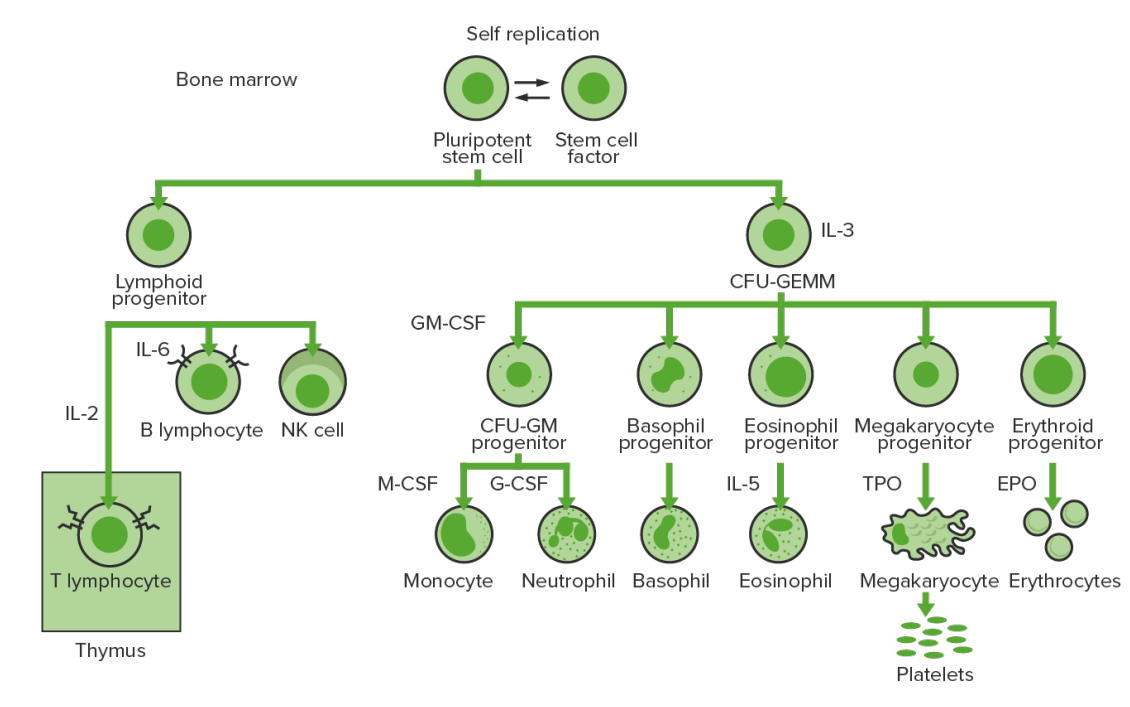
  • Célula madre linfoide: da lugar a los LOS Neisseria linfocitos
  • Célula madre mieloide: eventualmente se diferencia en EN Erythema nodosum is an immune-mediated panniculitis (inflammation of the subcutaneous fat) caused by a type IV (delayed-type) hypersensitivity reaction. It commonly manifests in young women as tender, erythematous nodules on the shins. Erythema Nodosum plaquetas, eritrocitos, granulocitos (neutrófilos, basófilos, eosinófilos) y monocitos
    • IL-3 estimula la diferenciación de células madre hematopoyéticas multipotentes en EN Erythema nodosum is an immune-mediated panniculitis (inflammation of the subcutaneous fat) caused by a type IV (delayed-type) hypersensitivity reaction. It commonly manifests in young women as tender, erythematous nodules on the shins. Erythema Nodosum células progenitoras mieloides.
    • Factor estimulante de colonias de granulocitos y macrófagos ( GM-CSF GM-CSF An acidic glycoprotein of mw 23 kda with internal disulfide bonds. The protein is produced in response to a number of inflammatory mediators by mesenchymal cells present in the hemopoietic environment and at peripheral sites of inflammation. GM-CSF is able to stimulate the production of neutrophilic granulocytes, macrophages, and mixed granulocyte-macrophage colonies from bone marrow cells and can stimulate the formation of eosinophil colonies from fetal liver progenitor cells. GM-CSF can also stimulate some functional activities in mature granulocytes and macrophages. White Myeloid Cells: Histology) → diferenciación de progenitores mieloides a granulocitos (neutrófilos) y monocitos
    • IL-5 → diferenciación a eosinófilos
    • Trombopoyetina → diferenciación a trombocitos (plaquetas)
    • Eritropoyetina → diferenciación a eritrocitos
Hematopoyesis de la médula ósea

Hematopoyesis de la médula ósea: proliferación y diferenciación de los elementos formes de la sangre.
CFU-GEMM: unidad formadora de colonias de granulocitos, eritrocitos, monocitos, megacariocitos
CFU-GM: unidad formadora de colonias de granulocitos y macrófagos
GM-CSF: factor estimulante de colonias de granulocitos y macrófagos
M-CSF: factor estimulante de colonias de macrófagos
G-CSF: factor estimulante de colonias de granulocitos
NK: células asesinas naturales
TPO: trombopoyetina

Imagen por Lecturio. Licencia: CC BY-NC-SA 4.0

Eosinofilia

  • La sobreproducción de eosinófilos en EN Erythema nodosum is an immune-mediated panniculitis (inflammation of the subcutaneous fat) caused by a type IV (delayed-type) hypersensitivity reaction. It commonly manifests in young women as tender, erythematous nodules on the shins. Erythema Nodosum la médula ósea ocurre en EN Erythema nodosum is an immune-mediated panniculitis (inflammation of the subcutaneous fat) caused by a type IV (delayed-type) hypersensitivity reaction. It commonly manifests in young women as tender, erythematous nodules on the shins. Erythema Nodosum la leucemia eosinofílica crónica, no especificada de otra manera, pero el mecanismo subyacente que facilita este proceso no está claro.
  • Otras variantes asociadas con el síndrome hipereosinofílico tienen aberraciones cromosómicas asociadas (e.g., fusión de PDGFRA con otros genes Genes A category of nucleic acid sequences that function as units of heredity and which code for the basic instructions for the development, reproduction, and maintenance of organisms. DNA Types and Structure, reordenamientos que involucran PDGFRB ).
  • En EN Erythema nodosum is an immune-mediated panniculitis (inflammation of the subcutaneous fat) caused by a type IV (delayed-type) hypersensitivity reaction. It commonly manifests in young women as tender, erythematous nodules on the shins. Erythema Nodosum teoría, se sospecha una actividad aumentada o una regulación defectuosa de la síntesis de eosinófilos.
  • Con ↑ eosinófilos, sigue la infiltración de órganos → aumento de la fibrosis Fibrosis Any pathological condition where fibrous connective tissue invades any organ, usually as a consequence of inflammation or other injury. Bronchiolitis Obliterans → daño y disfunción de tejidos y órganos

Presentación Clínica

  • Inicio insidioso
  • Síntomas constitucionales (fiebre, pérdida de peso, sudores nocturnos)
  • Síntomas relacionados con:
    • Anemia Anemia Anemia is a condition in which individuals have low Hb levels, which can arise from various causes. Anemia is accompanied by a reduced number of RBCs and may manifest with fatigue, shortness of breath, pallor, and weakness. Subtypes are classified by the size of RBCs, chronicity, and etiology. Anemia: Overview and Types: fatiga, palpitaciones
    • Trombocitopenia: hematomas, petequias
  • Hepatoesplenomegalia
  • Pueden tener síntomas superpuestos (asociados con la activación eosinofílica):
    • Angioedema Angioedema Angioedema is a localized, self-limited (but potentially life-threatening), nonpitting, asymmetrical edema occurring in the deep layers of the skin and mucosal tissue. The common underlying pathophysiology involves inflammatory mediators triggering significant vasodilation and increased capillary permeability. Angioedema
    • Dermatológicos: lesiones cutáneas, erupciones
    • Pulmonares/respiratorios: tos TOS Thoracic outlet syndrome (TOS) is a broad term used for a spectrum of syndromes related to the general region of the thoracic outlet, which involves the compression or irritation of elements of the brachial plexus, subclavian artery, or subclavian vein. Thoracic Outlet Syndrome, asma ASMA Autoimmune Hepatitis
    • Gastrointestinales: gastroenteritis Gastroenteritis Gastroenteritis is inflammation of the stomach and intestines, commonly caused by infections from bacteria, viruses, or parasites. Transmission may be foodborne, fecal-oral, or through animal contact. Common clinical features include abdominal pain, diarrhea, vomiting, fever, and dehydration. Gastroenteritis/diarrea
    • Reumatológicos: vasculitis Vasculitis Inflammation of any one of the blood vessels, including the arteries; veins; and rest of the vasculature system in the body. Systemic Lupus Erythematosus, artralgia
    • Cardiacos:
      • Cardiomegalia, cardiomiopatía (la fibrosis Fibrosis Any pathological condition where fibrous connective tissue invades any organ, usually as a consequence of inflammation or other injury. Bronchiolitis Obliterans endomiocárdica es la complicación más grave)
      • La afectación cardiaca es impredecible (no se correlaciona con el nivel de eosinofilia).
      • Se encuentran también en EN Erythema nodosum is an immune-mediated panniculitis (inflammation of the subcutaneous fat) caused by a type IV (delayed-type) hypersensitivity reaction. It commonly manifests in young women as tender, erythematous nodules on the shins. Erythema Nodosum una variante diferente con fusión FIP1L1-PDGFRA
    • Neurológicos: neuropatía, pérdida de memoria

Diagnóstico

Diagnóstico

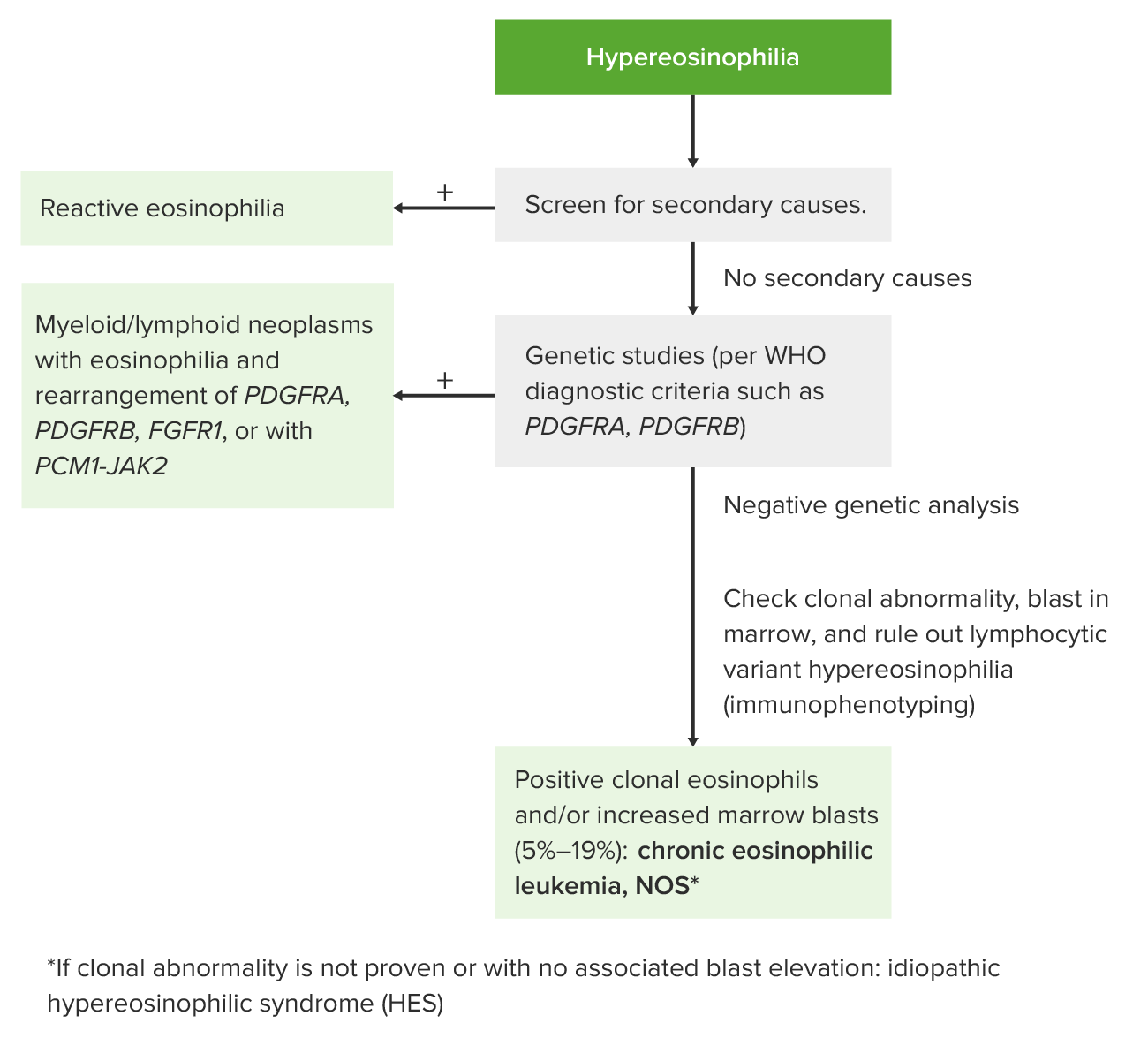
La leucemia eosinofílica crónica, no especificada de otra manera, es un diagnóstico de exclusión (requiere descartar otras afecciones eosinofílicas) y se define de acuerdo con los LOS Neisseria criterios de diagnóstico de la OMS:
  • Cumple con los LOS Neisseria siguientes criterios:
    • Recuento eosinofílico: recuento absoluto de eosinófilos ≥ 1,5 x 10⁹/L
    • Recuento de blastos en EN Erythema nodosum is an immune-mediated panniculitis (inflammation of the subcutaneous fat) caused by a type IV (delayed-type) hypersensitivity reaction. It commonly manifests in young women as tender, erythematous nodules on the shins. Erythema Nodosum sangre periférica: > 2 %
    • Recuento de células blásticas en EN Erythema nodosum is an immune-mediated panniculitis (inflammation of the subcutaneous fat) caused by a type IV (delayed-type) hypersensitivity reaction. It commonly manifests in young women as tender, erythematous nodules on the shins. Erythema Nodosum la médula ósea: 5%–19% de todas las células nucleadas
    • Evidencia de clonalidad:
      • Detección de anormalidad citogenética clonal O
      • Por demostración de una expresión muy sesgada de los LOS Neisseria genes Genes A category of nucleic acid sequences that function as units of heredity and which code for the basic instructions for the development, reproduction, and maintenance of organisms. DNA Types and Structure del cromosoma X.
  • No cumple con los LOS Neisseria criterios de diagnóstico de la OMS para:
    • Otras neoplasias mieloproliferativas:
      • LMC
      • Policitemia vera
      • Trombotictemia esencial
      • Mielofibrosis primaria
      • Leucemia neutrofílica crónica
    • inv(16)(p13q22) o t(16;16)(p13;q22)
    • Síndrome mielodisplásico/neoplasia mieloproliferativa (leucemia mielomonocítica crónica o LMC atípica)
    • Variante linfocítica de la hipereosinofilia
  • Sin reordenamiento de PDGFRA, PDGFRB, FGFR1 o con PCM1-JAK2
Hypereosinophilia

Abordaje de la hipereosinofilia

Imagen por Lecturio.
Pruebas de laboratorio

  • Características de laboratorio halladas en EN Erythema nodosum is an immune-mediated panniculitis (inflammation of the subcutaneous fat) caused by a type IV (delayed-type) hypersensitivity reaction. It commonly manifests in young women as tender, erythematous nodules on the shins. Erythema Nodosum la leucemia eosinofílica crónica, no especificada de otra manera (que también se encuentran en EN Erythema nodosum is an immune-mediated panniculitis (inflammation of the subcutaneous fat) caused by a type IV (delayed-type) hypersensitivity reaction. It commonly manifests in young women as tender, erythematous nodules on the shins. Erythema Nodosum otras variantes mieloides):
    • Hemograma y frotis de sangre periférica:
      • Eosinófilos: recuento absoluto de eosinófilos ≥ 1,5 x 10⁹/L
      • Anemia Anemia Anemia is a condition in which individuals have low Hb levels, which can arise from various causes. Anemia is accompanied by a reduced number of RBCs and may manifest with fatigue, shortness of breath, pallor, and weakness. Subtypes are classified by the size of RBCs, chronicity, and etiology. Anemia: Overview and Types
      • Trombocitopenia
      • Precursores de leucocitos circulantes
    • Vitamina sérica B12 (elevada)
    • Biopsia de médula ósea: médula hipercelular con incremento marcado de los LOS Neisseria precursores de eosinófilos y de los LOS Neisseria eosinófilos (maduración ordenada)
  • Verificar los LOS Neisseria estudios de anomalías cromosómicas o genéticas para descartar otros trastornos:
    • BCR-ABL /cromosoma Filadelfia
    • PDGFRA
    • PDGFRB
    • PCM1-JAK2
    • FGFR1
  • Evaluar la afectación de órganos diana según la presentación:
    • Panel metabólico
    • Perfil hepático
    • Ecocardiograma
    • Imagenología:
      • Ecocardiograma
      • Radiografía/TC de tórax
      • TC de abdomen
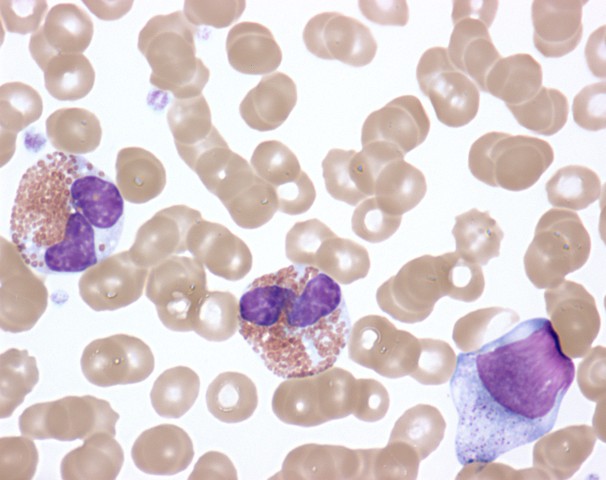
Eosinófilos activados en el síndrome hipereosinofílico

Eosinófilos activados en sangre periférica de un paciente con síndrome hipereosinofílico que muestra aclaramiento citoplasmático, displasia nuclear y presencia de formas inmaduras

Imagen: “Activated Eosinophils in Idiopathic Hypereosinophilic Syndrome (9125007255)” por NIAID. Licencia: CC BY 2.0

Tratamiento

  • Objetivos de la terapia:
    • Reducción del recuento absoluto de eosinófilos: mantener por debajo de 1.500 células/μl (para evitar daños en EN Erythema nodosum is an immune-mediated panniculitis (inflammation of the subcutaneous fat) caused by a type IV (delayed-type) hypersensitivity reaction. It commonly manifests in young women as tender, erythematous nodules on the shins. Erythema Nodosum los LOS Neisseria órganos diana)
    • Mejora de los LOS Neisseria signos y síntomas.
    • Prevención de la progresión de la enfermedad
  • Curso clínico de la leucemia eosinofílica crónica, no especificada de otra manera:
    • El curso es variable Variable Variables represent information about something that can change. The design of the measurement scales, or of the methods for obtaining information, will determine the data gathered and the characteristics of that data. As a result, a variable can be qualitative or quantitative, and may be further classified into subgroups. Types of Variables.
    • Se observa transformación a leucemia aguda
  • Tratamiento:
    • Debido a la rareza y la variabilidad en EN Erythema nodosum is an immune-mediated panniculitis (inflammation of the subcutaneous fat) caused by a type IV (delayed-type) hypersensitivity reaction. It commonly manifests in young women as tender, erythematous nodules on the shins. Erythema Nodosum el curso de la enfermedad, el tratamiento óptimo no está claro.
    • Abordaje inicial: corticoides (terapia de primera línea, como en EN Erythema nodosum is an immune-mediated panniculitis (inflammation of the subcutaneous fat) caused by a type IV (delayed-type) hypersensitivity reaction. It commonly manifests in young women as tender, erythematous nodules on the shins. Erythema Nodosum el síndrome hipereosinfílico idiopático)
    • Casos refractarios a esteroides:
      • Agentes quimioterapéuticos: hidroxiurea, ciclofosfamida, vincristina
      • Interferón
    • Algunos pacientes pueden beneficiarse de una prueba de imatinib Imatinib A tyrosine kinase inhibitor and antineoplastic agent that inhibits the bcr-abl kinase created by chromosome rearrangements in chronic myeloid leukemia and acute lymphoblastic leukemia, as well as pdg-derived tyrosine kinases that are overexpressed in gastrointestinal stromal tumors. Targeted and Other Nontraditional Antineoplastic Therapy, un inhibidor de la tirosina quinasa (que es eficaz para las variantes del síndrome hipereosinofílico positivas para PDGFRA).
    • Otras terapias que han demostrado cierta eficacia:

Diagnóstico Diferencial

Otras eosinofilias

  • Eosinofilia secundaria: Un fenómeno reactivo derivado de citoquinas (IL-5). A nivel mundial, las enfermedades parasitarias son la causa predominante, pero en EN Erythema nodosum is an immune-mediated panniculitis (inflammation of the subcutaneous fat) caused by a type IV (delayed-type) hypersensitivity reaction. It commonly manifests in young women as tender, erythematous nodules on the shins. Erythema Nodosum los LOS Neisseria países desarrollados, las enfermedades alérgicas son la etiología más común. Los LOS Neisseria signos y síntomas son constitucionales y se pueden observar presentaciones dependiendo a la afectación de órganos diana. Las pruebas de diagnóstico son hemograma con diferencial, química sanguínea y potencial evaluación mediante aspirado de médula ósea. El tratamiento es con esteroides, evitando el agente desencadenante subyacente e intervenciones de soporte.
  • Leucemia eosinofílica aguda: Una enfermedad neoplásica caracterizada por un marcado aumento en EN Erythema nodosum is an immune-mediated panniculitis (inflammation of the subcutaneous fat) caused by a type IV (delayed-type) hypersensitivity reaction. It commonly manifests in young women as tender, erythematous nodules on the shins. Erythema Nodosum el número de eosinófilos inmaduros (a diferencia de la leucemia eosinofílica crónica, no especificada de otra manera) en EN Erythema nodosum is an immune-mediated panniculitis (inflammation of the subcutaneous fat) caused by a type IV (delayed-type) hypersensitivity reaction. It commonly manifests in young women as tender, erythematous nodules on the shins. Erythema Nodosum la sangre y/o la médula, > 10% formas blásticas en EN Erythema nodosum is an immune-mediated panniculitis (inflammation of the subcutaneous fat) caused by a type IV (delayed-type) hypersensitivity reaction. It commonly manifests in young women as tender, erythematous nodules on the shins. Erythema Nodosum médula ósea e infiltración de tejidos (sistema nervioso y hueso) con formas eosinofílicas inmaduras. También se observan anemia Anemia Anemia is a condition in which individuals have low Hb levels, which can arise from various causes. Anemia is accompanied by a reduced number of RBCs and may manifest with fatigue, shortness of breath, pallor, and weakness. Subtypes are classified by the size of RBCs, chronicity, and etiology. Anemia: Overview and Types, trombocitopenia, hepatoesplenomegalia y susceptibilidad a infecciones. El diagnóstico se realiza mediante los LOS Neisseria antecedentes y los LOS Neisseria hallazgos del examen físico junto con evaluaciones sanguíneas y de médula ósea. El tratamiento es con quimioterapia y trasplante de células madre hematopoyéticas.
  • Mastocitosis sistémica con eosinofilia: Un tipo de enfermedad de los LOS Neisseria mastocitos causada por la acumulación de mastocitos funcionalmente defectuosos, asociada con mutaciones de KIT (a menudo KIT D816V) en EN Erythema nodosum is an immune-mediated panniculitis (inflammation of the subcutaneous fat) caused by a type IV (delayed-type) hypersensitivity reaction. It commonly manifests in young women as tender, erythematous nodules on the shins. Erythema Nodosum la mayoría de los LOS Neisseria pacientes. Se observa una erupción cutánea característica ( urticaria Urticaria Urticaria is raised, well-circumscribed areas (wheals) of edema (swelling) and erythema (redness) involving the dermis and epidermis with associated pruritus (itch). Urticaria is not a single disease but rather is a reaction pattern representing cutaneous mast cell degranulation. Urticaria (Hives) pigmentosa) y síntomas gastrointestinales junto con hepatoesplenomegalia. El diagnóstico se realiza mediante las lesiones cutáneas características y densos infiltrados de mastocitos en EN Erythema nodosum is an immune-mediated panniculitis (inflammation of the subcutaneous fat) caused by a type IV (delayed-type) hypersensitivity reaction. It commonly manifests in young women as tender, erythematous nodules on the shins. Erythema Nodosum la médula ósea o en EN Erythema nodosum is an immune-mediated panniculitis (inflammation of the subcutaneous fat) caused by a type IV (delayed-type) hypersensitivity reaction. It commonly manifests in young women as tender, erythematous nodules on the shins. Erythema Nodosum órganos extracutáneos. Las pruebas muestran triptasa sérica elevada y la detección de una mutación positiva para KIT D816V. El tratamiento es con corticosteroides, intervenciones sintomáticas y diferentes agentes (midostaurina, hidroxiurea y otros en EN Erythema nodosum is an immune-mediated panniculitis (inflammation of the subcutaneous fat) caused by a type IV (delayed-type) hypersensitivity reaction. It commonly manifests in young women as tender, erythematous nodules on the shins. Erythema Nodosum diferentes entornos).
  • Eosinofilia mutada en EN Erythema nodosum is an immune-mediated panniculitis (inflammation of the subcutaneous fat) caused by a type IV (delayed-type) hypersensitivity reaction. It commonly manifests in young women as tender, erythematous nodules on the shins. Erythema Nodosum PDGFRA: Eosinofilia prominente con receptores de factor de crecimiento derivados de plaquetas α ( PDGFRA en EN Erythema nodosum is an immune-mediated panniculitis (inflammation of the subcutaneous fat) caused by a type IV (delayed-type) hypersensitivity reaction. It commonly manifests in young women as tender, erythematous nodules on the shins. Erythema Nodosum el cromosoma 4q12) y β ( PDGFRB en EN Erythema nodosum is an immune-mediated panniculitis (inflammation of the subcutaneous fat) caused by a type IV (delayed-type) hypersensitivity reaction. It commonly manifests in young women as tender, erythematous nodules on the shins. Erythema Nodosum el cromosoma 5q31-q32) afectados por mutaciones activadoras. Los LOS Neisseria estudios genéticos en EN Erythema nodosum is an immune-mediated panniculitis (inflammation of the subcutaneous fat) caused by a type IV (delayed-type) hypersensitivity reaction. It commonly manifests in young women as tender, erythematous nodules on the shins. Erythema Nodosum casos con hipereosinofilia ayudan a distinguir estas condiciones. Tanto los LOS Neisseria trastornos relacionados con PDGFRA como con PDGFRB responden al AL Amyloidosis imatinib Imatinib A tyrosine kinase inhibitor and antineoplastic agent that inhibits the bcr-abl kinase created by chromosome rearrangements in chronic myeloid leukemia and acute lymphoblastic leukemia, as well as pdg-derived tyrosine kinases that are overexpressed in gastrointestinal stromal tumors. Targeted and Other Nontraditional Antineoplastic Therapy.

Otras neoplasias mieloproliferativas crónicas

  • Leucemia mieloide crónica: Una proliferación maligna de los LOS Neisseria leucocitos, un trastorno mieloproliferativo con una diferenciación bastante normal. La patología subyacente implica la translocación de material genético que da como resultado un cromosoma Filadelfia con producción desregulada de la tirosina cinasa. Los LOS Neisseria síntomas incluyen malestares constitucionales, saciedad temprana, hipersensibilidad esternal y hepatoesplenomegalia. Los LOS Neisseria estudios de laboratorio muestran leucocitosis y un frotis periférico con un mayor número de células inmaduras. El tratamiento se centra en EN Erythema nodosum is an immune-mediated panniculitis (inflammation of the subcutaneous fat) caused by a type IV (delayed-type) hypersensitivity reaction. It commonly manifests in young women as tender, erythematous nodules on the shins. Erythema Nodosum la inhibición de la tirosina quinasa.
  • Mielofibrosis primaria: Una neoplasia mieloproliferativa crónica caracterizada por fibrosis Fibrosis Any pathological condition where fibrous connective tissue invades any organ, usually as a consequence of inflammation or other injury. Bronchiolitis Obliterans de la médula ósea y hematopoyesis extramedular en EN Erythema nodosum is an immune-mediated panniculitis (inflammation of the subcutaneous fat) caused by a type IV (delayed-type) hypersensitivity reaction. It commonly manifests in young women as tender, erythematous nodules on the shins. Erythema Nodosum el bazo y el hígado. La condición está relacionada con mutaciones en EN Erythema nodosum is an immune-mediated panniculitis (inflammation of the subcutaneous fat) caused by a type IV (delayed-type) hypersensitivity reaction. It commonly manifests in young women as tender, erythematous nodules on the shins. Erythema Nodosum JAK2, CALR y MPL. Los LOS Neisseria hallazgos clínicos son fatiga intensa, esplenomegalia, hepatomegalia y anemia Anemia Anemia is a condition in which individuals have low Hb levels, which can arise from various causes. Anemia is accompanied by a reduced number of RBCs and may manifest with fatigue, shortness of breath, pallor, and weakness. Subtypes are classified by the size of RBCs, chronicity, and etiology. Anemia: Overview and Types. El frotis periférico es leucoeritroblástico y contiene precursores leucocitarios y eritrocitos nucleados y dacriocitos. El diagnóstico se realiza mediante examen de médula ósea y pruebas moleculares. El tratamiento incluye el trasplante alogénico de células hematopoyéticas y los LOS Neisseria medicamentos ruxolitinib Ruxolitinib Targeted and Other Nontraditional Antineoplastic Therapy y fedratinib.
  • Policitemia vera: Una sobreproducción no regulada de células madre hematopoyéticas, principalmente los LOS Neisseria eritrocitos, a pesar de los LOS Neisseria bajos niveles de eritropoyetina. Existe una mutación de ganancia de función en EN Erythema nodosum is an immune-mediated panniculitis (inflammation of the subcutaneous fat) caused by a type IV (delayed-type) hypersensitivity reaction. It commonly manifests in young women as tender, erythematous nodules on the shins. Erythema Nodosum el gen JAK2. La mayoría de los LOS Neisseria pacientes presentan síntomas de hiperviscosidad. El tratamiento incluye flebotomía, aspirina en EN Erythema nodosum is an immune-mediated panniculitis (inflammation of the subcutaneous fat) caused by a type IV (delayed-type) hypersensitivity reaction. It commonly manifests in young women as tender, erythematous nodules on the shins. Erythema Nodosum dosis bajas y terapias mielosupresoras.
  • Trombocitemia esencial: Una proliferación de megacariocitos generalmente debido a JAK2, CALR, y mutaciones de MPL que dan como resultado trombocitosis. Las manifestaciones clínicas son cefaleas, alteraciones visuales y eritromelalgia. Los LOS Neisseria recuentos excesivos de plaquetas provocan tanto trombosis como hemorragias. El objetivo del tratamiento es reducir el recuento de plaquetas (con medicamentos como la hidroxiurea) y disminuir el riesgo de trombosis (mediante anticoagulación sistémica y/o agentes antiplaquetarios).

Referencias

  1. Cheah, C.Y., Burbury, K., Apperley, J.F., et al. (2014). Patients with myeloid malignancies bearing PDGFRB fusion genes achieve durable long-term remissions with imatinib. Blood. 123(23),3574–3577. https://pubmed.ncbi.nlm.nih.gov/24687085/
  2. Crane, M.M., et al. (2010). Incidence of myeloproliferative hypereosinophilic syndrome in the United States and an estimate of all hypereosinophilic syndrome incidence. J Allergy Clin Immunol. 126(1),179–181. https://pubmed.ncbi.nlm.nih.gov/20639012/
  3. Gotlib, J. (2017). World Health Organization‐defined eosinophilic disorders: 2017 update on diagnosis, risk stratification, and management. Am J Hematol. 92(11),1243– 1259. https://doi.org/10.1002/ajh.24880
  4. Helbig, G., et al. (2012). Chronic eosinophilic leukemia-not otherwise specified has a poor prognosis with unresponsiveness to conventional treatment and high risk of acute transformation. Am J Hematol. 87(6),643–645. https://pubmed.ncbi.nlm.nih.gov/22473587/
  5. Nguyen, L., Zhang, L. (2021). Myeloproliferative neoplasms (MPN) Chronic eosinophilic leukemia. Pathologyoutlines. Retrieved May 2, 2021, from https://www.pathologyoutlines.com/topic/myeloproliferativeCEL.html
  6. Ogbogu, P.U., Bochner, B.S., Butterfield, J.H., et al. (2009). Hypereosinophilic syndrome: a multicenter, retrospective analysis of clinical characteristics and response to therapy. J Allergy Clin Immunol. 124(6),1319–1325.e3. https://pubmed.ncbi.nlm.nih.gov/19910029/
  7. Roufosse, F., Klion, A., and Weller, P. (2021). Hypereosinophilic syndromes: Clinical manifestations, pathophysiology, and diagnosis. In Larson, R. (Ed.), UpToDate. Retrieved April 17, 2021, from https://www.uptodate.com/contents/hypereosinophilic-syndromes-clinical-manifestations-pathophysiology-and-diagnosis
  8. Samavedi, A.V., (2020). Hypereosinophilic Syndrome. Medscape. Retrieved April 17, 2021, from https://reference.medscape.com/article/202030-overview
  9. Thakral, B., Wang, S. (2018). Myeloproliferative and “Overlap” Myelodysplastic/Myeloproliferative Neoplasm. In Hematopathology (Third Edition), Elsevier. https://www.sciencedirect.com/science/article/pii/B9780323479134000173
  10. Tefferi, A., Longo D.L. (2018). Less common hematologic malignancies. In Jameson, J., et al. (Eds.), Harrison’s Principles of Internal Medicine, 20e. McGraw-Hill. 
  11. Valent, P., Klion, A.D., Horny, H.P., et al. (2012). Contemporary consensus proposal on criteria and classification of eosinophilic disorders and related syndromes. J Allergy Clin Immunol. 130(3),607–612.e9. https://pubmed.ncbi.nlm.nih.gov/22460074/

¡Crea tu cuenta gratis o inicia una sesión para seguir leyendo!

Regístrate ahora y obtén acceso gratuito a Lecturio con páginas de concepto, videos médicos y cuestionarios para tu educación médica.

User Reviews

Que tengas una sesión de estudio alegre y navideña 🎁 Ahorra 50% en todos los planes >>

Details