Domina Conceptos Médicos

Estudia para la escuela de medicina y tus examenes con Lecturio.

Inmunoglobulinas: Tipos y Funciones

Las inmunoglobulinas ( Ig Ig X-linked Agammaglobulinemia), también conocidas como anticuerpos, son moléculas de glicoproteínas producidas por las células plasmáticas que actúan en EN Erythema nodosum is an immune-mediated panniculitis (inflammation of the subcutaneous fat) caused by a type IV (delayed-type) hypersensitivity reaction. It commonly manifests in young women as tender, erythematous nodules on the shins. Erythema Nodosum las respuestas inmunitarias al AL Amyloidosis reconocer y unirse a antígenos específicos. Los LOS Neisseria anticuerpos se someten a procesos que mejoran la afinidad por el antígeno y proporcionan una defensa adecuada mediante el cambio de clase. Las diversas clases de Ig Ig X-linked Agammaglobulinemia son IgG IgG The major immunoglobulin isotype class in normal human serum. There are several isotype subclasses of igg, for example, igg1, igg2a, and igg2b. Hypersensitivity Pneumonitis (la más abundante), IgM IgM A class of immunoglobulin bearing mu chains (immunoglobulin mu-chains). Igm can fix complement. The name comes from its high molecular weight and originally being called a macroglobulin. Immunoglobulins: Types and Functions, IgE IgE An immunoglobulin associated with mast cells. Overexpression has been associated with allergic hypersensitivity. Immunoglobulins: Types and Functions, IgD IgD An immunoglobulin which accounts for less than 1% of plasma immunoglobulin. It is found on the membrane of many circulating B lymphocytes. Immunoglobulins: Types and Functions e IgA IgA Represents 15-20% of the human serum immunoglobulins, mostly as the 4-chain polymer in humans or dimer in other mammals. Secretory iga is the main immunoglobulin in secretions. Immunoglobulins: Types and Functions, que difieren en EN Erythema nodosum is an immune-mediated panniculitis (inflammation of the subcutaneous fat) caused by a type IV (delayed-type) hypersensitivity reaction. It commonly manifests in young women as tender, erythematous nodules on the shins. Erythema Nodosum sus características biológicas, estructura, especificidad por su objetivo y distribución. Las funciones generales incluyen opsonización, neutralización de la infectividad de los LOS Neisseria patógenos, citotoxicidad y activación del complemento. Las clases específicas tienen mecanismos defensivos únicos.

Last updated: Dec 15, 2025
Editorial responsibility: Stanley Oiseth, Lindsay Jones, Evelin Maza

Descripción General

Inmunoglobulinas ( Ig Ig X-linked Agammaglobulinemia)

  • Moléculas de glicoproteínas producidas por las células plasmáticas que actúan en EN Erythema nodosum is an immune-mediated panniculitis (inflammation of the subcutaneous fat) caused by a type IV (delayed-type) hypersensitivity reaction. It commonly manifests in young women as tender, erythematous nodules on the shins. Erythema Nodosum las respuestas inmunitarias al AL Amyloidosis reconocer y unirse a antígenos particulares
  • Componentes estructurales:
    • 2 cadenas pesadas idénticas y 2 ligeras idénticas ( en EN Erythema nodosum is an immune-mediated panniculitis (inflammation of the subcutaneous fat) caused by a type IV (delayed-type) hypersensitivity reaction. It commonly manifests in young women as tender, erythematous nodules on the shins. Erythema Nodosum referencia a su peso molecular):
      • Cadenas ligeras: aproximadamente 25 kDa cada una
      • Cadenas pesadas: aproximadamente 50 kDa cada una
    • Los LOS Neisseria puentes disulfuro unen las cadenas pesadas con las cadenas ligeras (formando una molécula en EN Erythema nodosum is an immune-mediated panniculitis (inflammation of the subcutaneous fat) caused by a type IV (delayed-type) hypersensitivity reaction. It commonly manifests in young women as tender, erythematous nodules on the shins. Erythema Nodosum forma de Y).
    • Región bisagra (confiere flexibilidad)
    • Fracciones de carbohidratos (asociados con la región constante)
  • Diferentes cromosomas codifican las cadenas:
    • Cadenas pesadas (μ, δ, γ, α o ε): codificadas por el cromosoma 14
    • Cadenas ligeras (κ o λ):
      • Cadena ligera κ: cromosoma 2
      • Cadena ligera λ: cromosoma 22

Regiones y fragmentos de Ig Ig X-linked Agammaglobulinemia

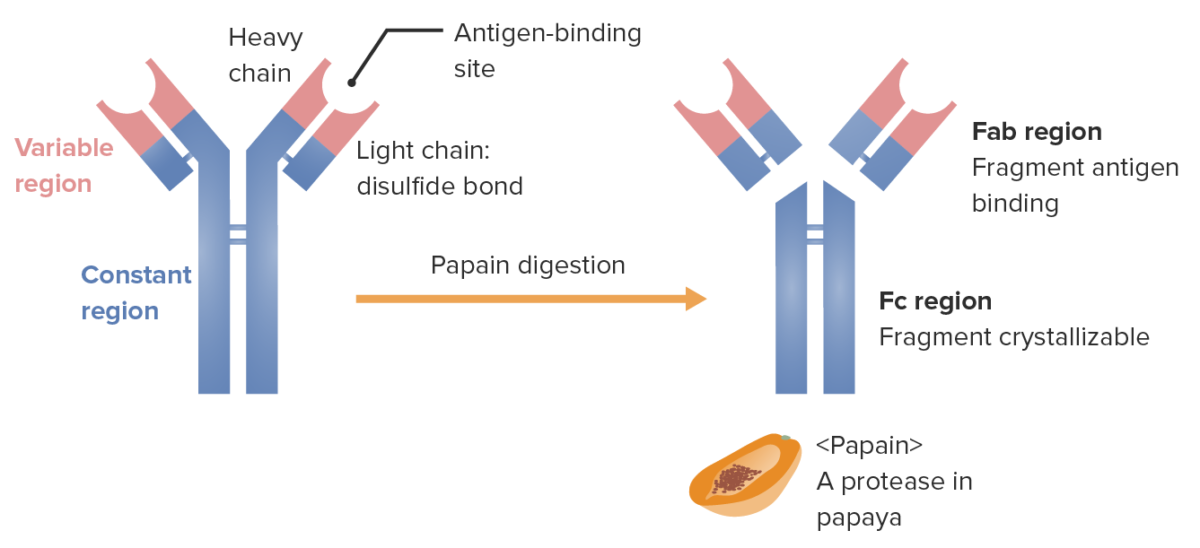
  • Tanto las cadenas pesadas como las ligeras en EN Erythema nodosum is an immune-mediated panniculitis (inflammation of the subcutaneous fat) caused by a type IV (delayed-type) hypersensitivity reaction. It commonly manifests in young women as tender, erythematous nodules on the shins. Erythema Nodosum las Ig Ig X-linked Agammaglobulinemia tienen regiones variables y constantes.
  • Regiones:
    • Región variable Variable Variables represent information about something that can change. The design of the measurement scales, or of the methods for obtaining information, will determine the data gathered and the characteristics of that data. As a result, a variable can be qualitative or quantitative, and may be further classified into subgroups. Types of Variables (unión al AL Amyloidosis antígeno):
      • La secuencia de aminoácidos en las puntas de la “Y”, que incluye los LOS Neisseria extremos de las cadenas ligera y pesada
      • Tiene región hipervariable o región determinante de la complementariedad en EN Erythema nodosum is an immune-mediated panniculitis (inflammation of the subcutaneous fat) caused by a type IV (delayed-type) hypersensitivity reaction. It commonly manifests in young women as tender, erythematous nodules on the shins. Erythema Nodosum cada terminal amino
      • La región determinante de la complementariedad proporciona especificidad de antígeno, ya que tiene una estructura complementaria al AL Amyloidosis determinante antigénico (epítopo).
    • Región constante (funciones efectoras):
      • Constituye el polipéptido restante
      • Se une a los LOS Neisseria receptores Fc Fc Crystallizable fragments composed of the carboxy-terminal halves of both immunoglobulin heavy chains linked to each other by disulfide bonds. Fc fragments contain the carboxy-terminal parts of the heavy chain constant regions that are responsible for the effector functions of an immunoglobulin (complement fixation, binding to the cell membrane via fc receptors, and placental transport). This fragment can be obtained by digestion of immunoglobulins with the proteolytic enzyme papain. Immunoglobulins: Types and Functions y al AL Amyloidosis complemento
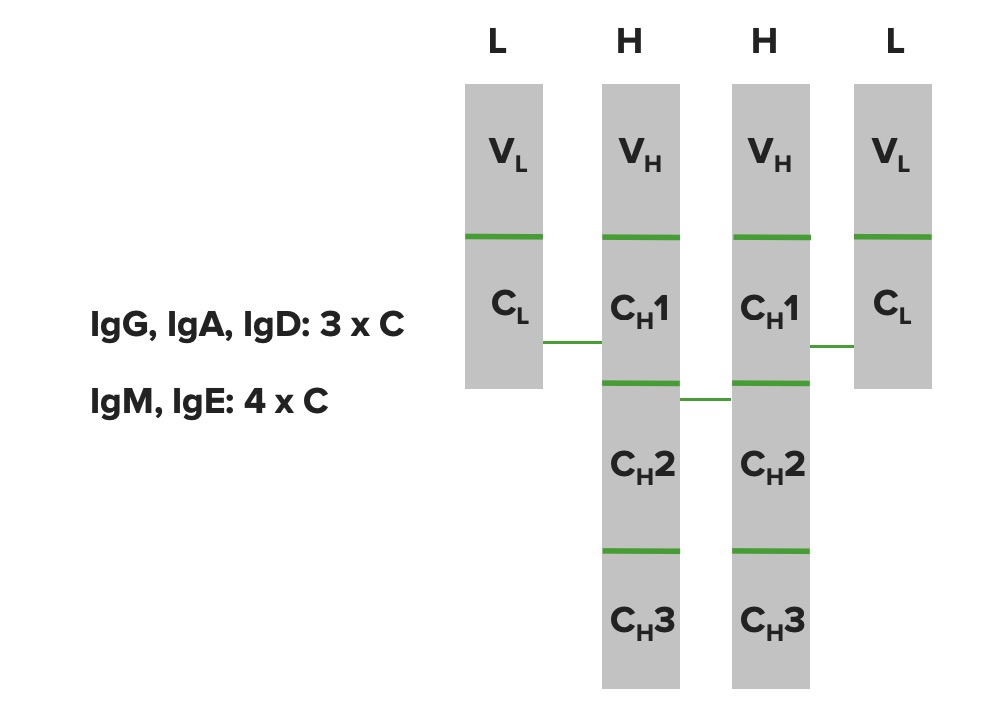
  • Las regiones de cadena pesada y cadena ligera se pliegan en EN Erythema nodosum is an immune-mediated panniculitis (inflammation of the subcutaneous fat) caused by a type IV (delayed-type) hypersensitivity reaction. It commonly manifests in young women as tender, erythematous nodules on the shins. Erythema Nodosum segmentos 3-dimensionales llamados dominios.
    • La cadena ligera tiene 1 dominio variable Variable Variables represent information about something that can change. The design of the measurement scales, or of the methods for obtaining information, will determine the data gathered and the characteristics of that data. As a result, a variable can be qualitative or quantitative, and may be further classified into subgroups. Types of Variables y 1 dominio constante.
    • La cadena pesada tiene 1 dominio variable Variable Variables represent information about something that can change. The design of the measurement scales, or of the methods for obtaining information, will determine the data gathered and the characteristics of that data. As a result, a variable can be qualitative or quantitative, and may be further classified into subgroups. Types of Variables, pero tiene diferentes números de dominios constantes:
      • IgG IgG The major immunoglobulin isotype class in normal human serum. There are several isotype subclasses of igg, for example, igg1, igg2a, and igg2b. Hypersensitivity Pneumonitis, IgA IgA Represents 15-20% of the human serum immunoglobulins, mostly as the 4-chain polymer in humans or dimer in other mammals. Secretory iga is the main immunoglobulin in secretions. Immunoglobulins: Types and Functions, IgD IgD An immunoglobulin which accounts for less than 1% of plasma immunoglobulin. It is found on the membrane of many circulating B lymphocytes. Immunoglobulins: Types and Functions: 3 dominios constantes
      • IgM IgM A class of immunoglobulin bearing mu chains (immunoglobulin mu-chains). Igm can fix complement. The name comes from its high molecular weight and originally being called a macroglobulin. Immunoglobulins: Types and Functions e IgE IgE An immunoglobulin associated with mast cells. Overexpression has been associated with allergic hypersensitivity. Immunoglobulins: Types and Functions: 4 dominios constantes
  • Fragmentos (determinados por el lugar donde la enzima papaína divide la Ig Ig X-linked Agammaglobulinemia):
    • Fab Fab Univalent antigen-binding fragments composed of one entire immunoglobulin light chain and the amino terminal end of one of the immunoglobulin heavy chains from the hinge region, linked to each other by disulfide bonds. Fab contains the immunoglobulin variable regions, which are part of the antigen-binding site, and the first immunoglobulin constant regions. This fragment can be obtained by digestion of immunoglobulins with the proteolytic enzyme papain. Immunoglobulins: Types and Functions (fragmento de unión al AL Amyloidosis antígeno ( en EN Erythema nodosum is an immune-mediated panniculitis (inflammation of the subcutaneous fat) caused by a type IV (delayed-type) hypersensitivity reaction. It commonly manifests in young women as tender, erythematous nodules on the shins. Erythema Nodosum inglés)):
      • Contiene las regiones variables y partes de la región constante de cadenas pesadas y ligeras
      • Interactúa con el antígeno
    • Fc Fc Crystallizable fragments composed of the carboxy-terminal halves of both immunoglobulin heavy chains linked to each other by disulfide bonds. Fc fragments contain the carboxy-terminal parts of the heavy chain constant regions that are responsible for the effector functions of an immunoglobulin (complement fixation, binding to the cell membrane via fc receptors, and placental transport). This fragment can be obtained by digestion of immunoglobulins with the proteolytic enzyme papain. Immunoglobulins: Types and Functions (fragmento cristalizable):
      • La parte restante (cola) del anticuerpo (solo cadena pesada)
      • Región constante, fracciones de carbohidrato
      • Se une al AL Amyloidosis complemento
      • Confiere el isotipo de Ig Ig X-linked Agammaglobulinemia (e.g., IgM IgM A class of immunoglobulin bearing mu chains (immunoglobulin mu-chains). Igm can fix complement. The name comes from its high molecular weight and originally being called a macroglobulin. Immunoglobulins: Types and Functions, IgA IgA Represents 15-20% of the human serum immunoglobulins, mostly as the 4-chain polymer in humans or dimer in other mammals. Secretory iga is the main immunoglobulin in secretions. Immunoglobulins: Types and Functions)
  • La composición de la cadena pesada (región constante y Fc Fc Crystallizable fragments composed of the carboxy-terminal halves of both immunoglobulin heavy chains linked to each other by disulfide bonds. Fc fragments contain the carboxy-terminal parts of the heavy chain constant regions that are responsible for the effector functions of an immunoglobulin (complement fixation, binding to the cell membrane via fc receptors, and placental transport). This fragment can be obtained by digestion of immunoglobulins with the proteolytic enzyme papain. Immunoglobulins: Types and Functions) determina la clase/isotipo de Ig Ig X-linked Agammaglobulinemia:
    • µ: IgM IgM A class of immunoglobulin bearing mu chains (immunoglobulin mu-chains). Igm can fix complement. The name comes from its high molecular weight and originally being called a macroglobulin. Immunoglobulins: Types and Functions
    • δ: IgD IgD An immunoglobulin which accounts for less than 1% of plasma immunoglobulin. It is found on the membrane of many circulating B lymphocytes. Immunoglobulins: Types and Functions
    • γ: IgG IgG The major immunoglobulin isotype class in normal human serum. There are several isotype subclasses of igg, for example, igg1, igg2a, and igg2b. Hypersensitivity Pneumonitis
    • α: IgA IgA Represents 15-20% of the human serum immunoglobulins, mostly as the 4-chain polymer in humans or dimer in other mammals. Secretory iga is the main immunoglobulin in secretions. Immunoglobulins: Types and Functions
    • ε: IgE IgE An immunoglobulin associated with mast cells. Overexpression has been associated with allergic hypersensitivity. Immunoglobulins: Types and Functions
Dominios de inmunoglobulina

Dominios de una inmunoglobulina:
Las cadenas pesadas y las cadenas ligeras se pliegan en estructuras en forma de dominios. La cadena ligera tiene 1 dominio variable y 1 dominio constante. La cadena pesada tiene 1 dominio variable, pero tiene diferentes dominios constantes dependiendo de la molécula de Ig (IgG, IgA e IgD tienen 3 dominios constantes, mientras que IgM e IgE tienen 4 dominios constantes).
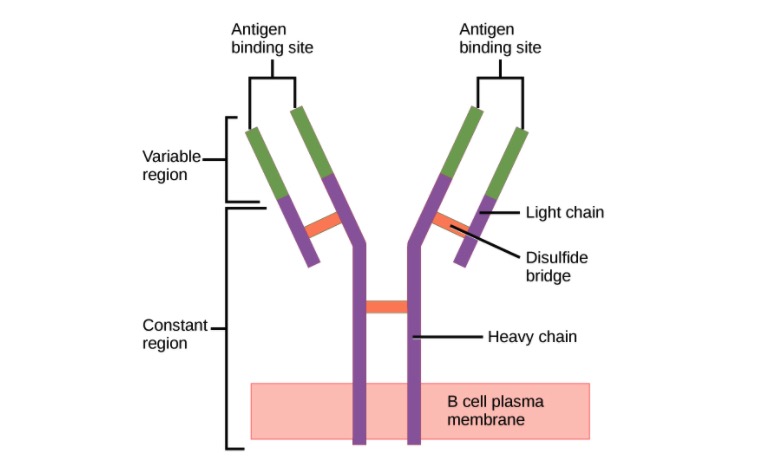
Imagen por Lecturio.

Genes de Inmunoglobulina

Segmentos de genes Genes A category of nucleic acid sequences that function as units of heredity and which code for the basic instructions for the development, reproduction, and maintenance of organisms. DNA Types and Structure de Ig Ig X-linked Agammaglobulinemia

  • Los LOS Neisseria genes Genes A category of nucleic acid sequences that function as units of heredity and which code for the basic instructions for the development, reproduction, and maintenance of organisms. DNA Types and Structure de cadena pesada (que se encuentran dentro de un locus Locus Specific regions that are mapped within a genome. Genetic loci are usually identified with a shorthand notation that indicates the chromosome number and the position of a specific band along the P or Q arm of the chromosome where they are found. For example the locus 6p21 is found within band 21 of the P-arm of chromosome 6. Many well known genetic loci are also known by common names that are associated with a genetic function or hereditary disease. Basic Terms of Genetics de un solo gen, IgH), se ensamblan a partir de 4 segmentos de genes Genes A category of nucleic acid sequences that function as units of heredity and which code for the basic instructions for the development, reproduction, and maintenance of organisms. DNA Types and Structure:
    • Región variable Variable Variables represent information about something that can change. The design of the measurement scales, or of the methods for obtaining information, will determine the data gathered and the characteristics of that data. As a result, a variable can be qualitative or quantitative, and may be further classified into subgroups. Types of Variables (V)
    • Región de diversidad (D)
    • Región de acoplamiento (J, por su nombre en EN Erythema nodosum is an immune-mediated panniculitis (inflammation of the subcutaneous fat) caused by a type IV (delayed-type) hypersensitivity reaction. It commonly manifests in young women as tender, erythematous nodules on the shins. Erythema Nodosum inglés)
    • Región constante (C)
  • Los LOS Neisseria genes Genes A category of nucleic acid sequences that function as units of heredity and which code for the basic instructions for the development, reproduction, and maintenance of organisms. DNA Types and Structure de cadena ligera (que se encuentran como 2 loci de genes Genes A category of nucleic acid sequences that function as units of heredity and which code for the basic instructions for the development, reproduction, and maintenance of organisms. DNA Types and Structure separados: el locus Locus Specific regions that are mapped within a genome. Genetic loci are usually identified with a shorthand notation that indicates the chromosome number and the position of a specific band along the P or Q arm of the chromosome where they are found. For example the locus 6p21 is found within band 21 of the P-arm of chromosome 6. Many well known genetic loci are also known by common names that are associated with a genetic function or hereditary disease. Basic Terms of Genetics κ (IgK) y el locus Locus Specific regions that are mapped within a genome. Genetic loci are usually identified with a shorthand notation that indicates the chromosome number and the position of a specific band along the P or Q arm of the chromosome where they are found. For example the locus 6p21 is found within band 21 of the P-arm of chromosome 6. Many well known genetic loci are also known by common names that are associated with a genetic function or hereditary disease. Basic Terms of Genetics λ (IgL)) provienen de 3 segmentos de genes Genes A category of nucleic acid sequences that function as units of heredity and which code for the basic instructions for the development, reproduction, and maintenance of organisms. DNA Types and Structure:
    • Región variable Variable Variables represent information about something that can change. The design of the measurement scales, or of the methods for obtaining information, will determine the data gathered and the characteristics of that data. As a result, a variable can be qualitative or quantitative, and may be further classified into subgroups. Types of Variables (V)
    • Región de acoplamiento (J)
    • Región constante (C)

Reordenamientos de genes Genes A category of nucleic acid sequences that function as units of heredity and which code for the basic instructions for the development, reproduction, and maintenance of organisms. DNA Types and Structure

  • En EN Erythema nodosum is an immune-mediated panniculitis (inflammation of the subcutaneous fat) caused by a type IV (delayed-type) hypersensitivity reaction. It commonly manifests in young women as tender, erythematous nodules on the shins. Erythema Nodosum los LOS Neisseria estadios de desarrollo de los LOS Neisseria linfocitos B, los LOS Neisseria reordenamientos genéticos proceden a ensamblar la molécula de Ig Ig X-linked Agammaglobulinemia.
    • En EN Erythema nodosum is an immune-mediated panniculitis (inflammation of the subcutaneous fat) caused by a type IV (delayed-type) hypersensitivity reaction. It commonly manifests in young women as tender, erythematous nodules on the shins. Erythema Nodosum las cadenas de IgH, el reordenamiento comienza con los LOS Neisseria segmentos D y J.
    • Entonces se produce la recombinación VDJ (regiones variable-diversidad-acoplamiento) del gen IgH, formando una célula pre-B.
    • Siguen los LOS Neisseria reordenamientos VJ de la cadena ligera.
  • A partir de este proceso, se expresa una molécula de anticuerpo IgM IgM A class of immunoglobulin bearing mu chains (immunoglobulin mu-chains). Igm can fix complement. The name comes from its high molecular weight and originally being called a macroglobulin. Immunoglobulins: Types and Functions completa y se forma el linfocito B maduro.
  • Los LOS Neisseria reordenamientos de genes Genes A category of nucleic acid sequences that function as units of heredity and which code for the basic instructions for the development, reproduction, and maintenance of organisms. DNA Types and Structure contribuyen a la diversidad de los LOS Neisseria anticuerpos.

Recombinación de cambio de clase

  • También llamado cambio de clase
  • Mecanismo biológico por el cual la producción de Ig Ig X-linked Agammaglobulinemia por parte de los LOS Neisseria linfocitos B cambia de una clase a otra.
    • IgM IgM A class of immunoglobulin bearing mu chains (immunoglobulin mu-chains). Igm can fix complement. The name comes from its high molecular weight and originally being called a macroglobulin. Immunoglobulins: Types and Functions a otras Ig Ig X-linked Agammaglobulinemia → la región constante (C) de la cadena pesada cambia el segmento μ ( IgM IgM A class of immunoglobulin bearing mu chains (immunoglobulin mu-chains). Igm can fix complement. The name comes from its high molecular weight and originally being called a macroglobulin. Immunoglobulins: Types and Functions) a γ ( IgG IgG The major immunoglobulin isotype class in normal human serum. There are several isotype subclasses of igg, for example, igg1, igg2a, and igg2b. Hypersensitivity Pneumonitis), ε ( IgE IgE An immunoglobulin associated with mast cells. Overexpression has been associated with allergic hypersensitivity. Immunoglobulins: Types and Functions) o α ( IgA IgA Represents 15-20% of the human serum immunoglobulins, mostly as the 4-chain polymer in humans or dimer in other mammals. Secretory iga is the main immunoglobulin in secretions. Immunoglobulins: Types and Functions).
    • El cambio está influenciado por citocinas.
      • Factor de crecimiento transformante β: cambia preferentemente a IgA IgA Represents 15-20% of the human serum immunoglobulins, mostly as the 4-chain polymer in humans or dimer in other mammals. Secretory iga is the main immunoglobulin in secretions. Immunoglobulins: Types and Functions
      • IL-4: IgE IgE An immunoglobulin associated with mast cells. Overexpression has been associated with allergic hypersensitivity. Immunoglobulins: Types and Functions
      • Interferón-γ, IL-4: IgG IgG The major immunoglobulin isotype class in normal human serum. There are several isotype subclasses of igg, for example, igg1, igg2a, and igg2b. Hypersensitivity Pneumonitis
  • La región constante de la cadena pesada de Ig Ig X-linked Agammaglobulinemia cambia, pero la región variable Variable Variables represent information about something that can change. The design of the measurement scales, or of the methods for obtaining information, will determine the data gathered and the characteristics of that data. As a result, a variable can be qualitative or quantitative, and may be further classified into subgroups. Types of Variables permanece sin cambios.
  • Debido a que la región variable Variable Variables represent information about something that can change. The design of the measurement scales, or of the methods for obtaining information, will determine the data gathered and the characteristics of that data. As a result, a variable can be qualitative or quantitative, and may be further classified into subgroups. Types of Variables está intacta, la especificidad del anticuerpo no cambia.

Procesos de recombinación de cambio de clase

  • Escisión de exones:
    • Cuando se encuentran antígenos, los LOS Neisseria linfocitos B maduros IgM-positivos se someten a la recombinación de cambio de clase.
    • Se escinden los LOS Neisseria exones que codifican el segmento del gen codificante constante (Cμ) de la IgH.
    • Estos exones se reemplazan con un nuevo segmento de gen constante (e.g., Cγ, Cε o Cα).
    • Da como resultado que el linfocito B (que originalmente expresaba IgM IgM A class of immunoglobulin bearing mu chains (immunoglobulin mu-chains). Igm can fix complement. The name comes from its high molecular weight and originally being called a macroglobulin. Immunoglobulins: Types and Functions) produzca IgG IgG The major immunoglobulin isotype class in normal human serum. There are several isotype subclasses of igg, for example, igg1, igg2a, and igg2b. Hypersensitivity Pneumonitis, IgE IgE An immunoglobulin associated with mast cells. Overexpression has been associated with allergic hypersensitivity. Immunoglobulins: Types and Functions o IgA IgA Represents 15-20% of the human serum immunoglobulins, mostly as the 4-chain polymer in humans or dimer in other mammals. Secretory iga is the main immunoglobulin in secretions. Immunoglobulins: Types and Functions
  • Reacción de recombinación por deleción del ADN:
    • Están presentes áreas repetitivas de ADN llamadas regiones de cambio:
      • Enzimas modificadoras del ADN (desaminasa de citidina inducida por activación y uracilo nucleósido glicosilasa) crean rupturas de doble cadena de ADN
      • Determinan dónde se une el segmento VDJ y la nueva región constante mediante una enzima reparadora
    • Se generan nuevas moléculas de Ig Ig X-linked Agammaglobulinemia con una región constante diferente (pero con la misma afinidad/especificidad por el antígeno dado que la región variable Variable Variables represent information about something that can change. The design of the measurement scales, or of the methods for obtaining information, will determine the data gathered and the characteristics of that data. As a result, a variable can be qualitative or quantitative, and may be further classified into subgroups. Types of Variables está intacta).
Class-switch recombination (CSR)

Recombinación de cambio de clase:
La cadena pesada tiene diferentes segmentos génicos: región variable (V), región de diversidad (D), región de acoplamiento (J) y región constante (C).
La región C de la cadena pesada determina la clase/isotipo de Ig. Cuando se encuentran antígenos, los linfocitos B maduros IgM-positivos se someten a recombinación de cambio de clase. Se escinden los exones que codifican el segmento del gen codificante constante (Cμ) de la IgH. Están presentes áreas repetitivas de ADN llamadas regiones de cambio (rombos negros).
Las regiones de cambio guían enzimas (e.g., desaminasa de citidina inducida por activación) en cuanto a dónde crear rupturas de doble cadena de ADN y dónde se une el segmento VDJ y la nueva región constante mediante una enzima reparadora. El Cμ se reemplaza con un nuevo segmento de gen constante (e.g., Cγ, Cε o Cα). En la imagen, Cγ1 se une al segmento VDJ, creando IgG1.

Imagen por Lecturio.

Diversidad y Especificidad de Anticuerpos

Los LOS Neisseria anticuerpos que se crean tienen propiedades importantes (diversidad y especificidad) que son esenciales en EN Erythema nodosum is an immune-mediated panniculitis (inflammation of the subcutaneous fat) caused by a type IV (delayed-type) hypersensitivity reaction. It commonly manifests in young women as tender, erythematous nodules on the shins. Erythema Nodosum la respuesta inmune.

Diversidad de anticuerpos

Los LOS Neisseria mecanismos únicos que crean diversidad de anticuerpos incluyen:
  • Tener múltiples segmentos V, D y J:
    • Como ya se mencionó, en EN Erythema nodosum is an immune-mediated panniculitis (inflammation of the subcutaneous fat) caused by a type IV (delayed-type) hypersensitivity reaction. It commonly manifests in young women as tender, erythematous nodules on the shins. Erythema Nodosum el desarrollo temprano de los LOS Neisseria linfocitos B, las cadenas pesadas y las cadenas ligeras tienen múltiples segmentos:
      • V, D, J y C para cadena pesada
      • V, J y C para cadena ligera
  • Reordenamientos de los LOS Neisseria segmentos V, D y J:
    • Las secuencias de ADN (llamadas secuencia señal de recombinación) flanquean cada segmento de gen.
    • Estas secuencias son sitios de reconocimiento para el proceso de acoplamiento.
    • Los LOS Neisseria complejos de enzimas recombinasa RAG1 RAG1 Immunoglobulins: Types and Functions y RAG2 RAG2 Immunoglobulins: Types and Functions ( genes Genes A category of nucleic acid sequences that function as units of heredity and which code for the basic instructions for the development, reproduction, and maintenance of organisms. DNA Types and Structure activadores de recombinación 1 y 2) reconocen la secuencia señal de recombinación y catalizan el proceso de acoplamiento.
    • La deficiencia en EN Erythema nodosum is an immune-mediated panniculitis (inflammation of the subcutaneous fat) caused by a type IV (delayed-type) hypersensitivity reaction. It commonly manifests in young women as tender, erythematous nodules on the shins. Erythema Nodosum RAG1 RAG1 Immunoglobulins: Types and Functions o RAG2 RAG2 Immunoglobulins: Types and Functions puede producir linfocitos B no funcionales.
    • Después de los LOS Neisseria segmentos de cadena pesada, también se recombinan los LOS Neisseria segmentos de cadena ligera.
  • Diversidad de acoplamiento:
    • El acoplamiento de segmentos de genes Genes A category of nucleic acid sequences that function as units of heredity and which code for the basic instructions for the development, reproduction, and maintenance of organisms. DNA Types and Structure de anticuerpos puede ser imprecisa.
    • Se pueden eliminar y/o insertar varios nucleótidos desde los LOS Neisseria extremos de los LOS Neisseria segmentos del gen recombinante.
  • Diversidad combinatoria:
    • La diversidad se crea mediante el emparejamiento aleatorio de las cadenas pesadas y ligeras.
  • Hipermutación somática:
    • Las mutaciones puntuales ocurren con la estimulación repetida de antígenos (de respuestas primarias a secundarias).
    • Aumenta la afinidad por el antígeno
    • Crea diversidad adicional al AL Amyloidosis anticuerpo

Especificidad

  • La hipermutación somática conduce a la maduración de la afinidad ( en EN Erythema nodosum is an immune-mediated panniculitis (inflammation of the subcutaneous fat) caused by a type IV (delayed-type) hypersensitivity reaction. It commonly manifests in young women as tender, erythematous nodules on the shins. Erythema Nodosum la región variable Variable Variables represent information about something that can change. The design of the measurement scales, or of the methods for obtaining information, will determine the data gathered and the characteristics of that data. As a result, a variable can be qualitative or quantitative, and may be further classified into subgroups. Types of Variables), creando una mayor capacidad para reconocer y unirse al AL Amyloidosis antígeno.
  • El cambio de clase (que afecta a la región constante) también contribuye a la especificidad del anticuerpo.
Procesos de activación y maduración de células B en el centro germinal

Procesos de activación y maduración de los linfocitos B que tienen lugar en el centro germinal:
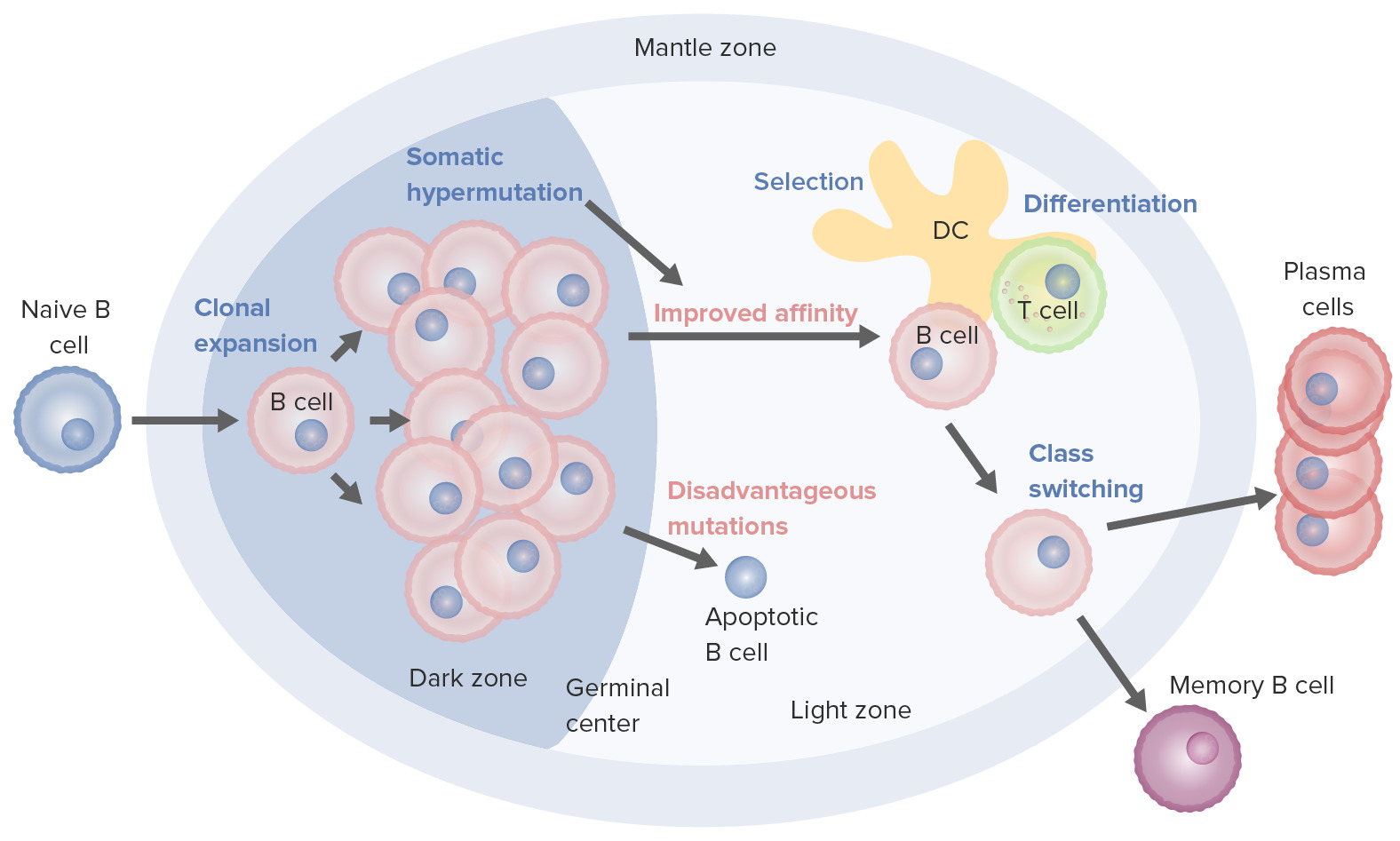
Al activarse, el linfocito B se mueve desde la zona del manto y entra al centro germinal. Tiene lugar la proliferación de linfocitos B (expansión clonal) y la afinidad del anticuerpo por el antígeno aumenta a través del proceso de hipermutación somática. Los ciclos repetidos de proliferación e hipermutación afinan el receptor de linfocito B. Sin embargo, no todos los linfocitos B continúan diferenciándose, especialmente si la afinidad es débil. La apoptosis ocurre si la unión antígeno-anticuerpo no está optimizada. Los linfocitos B con fuerte afinidad sobreviven (selección), con la ayuda de las señales de supervivencia de las células dendríticas foliculares y los linfocitos T. Estos linfocitos B seleccionados pasan al cambio de clase y la diferenciación en células plasmáticas o células de memoria.
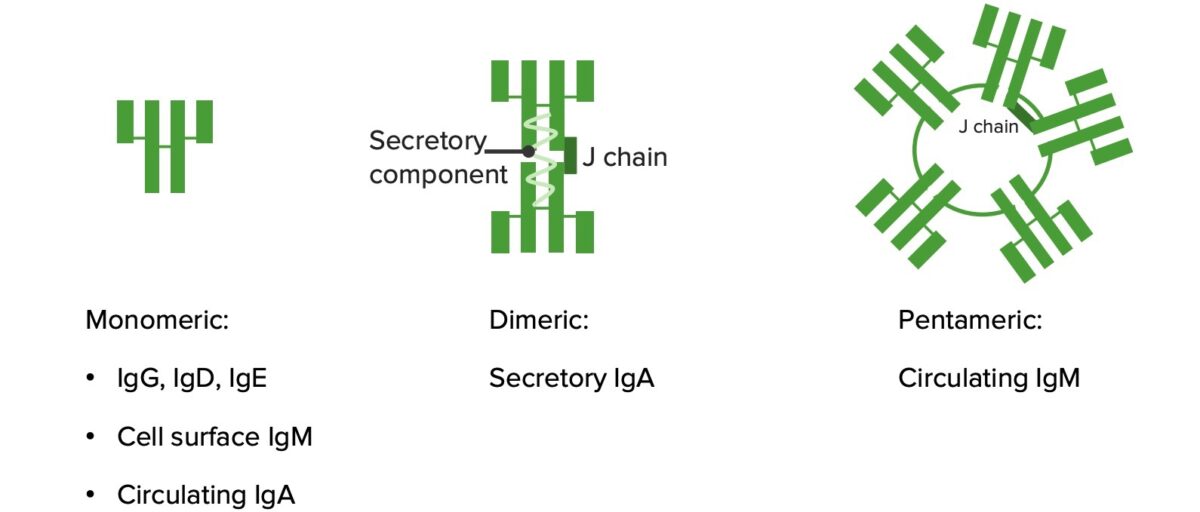
Imagen por Lecturio. Licencia: CC BY-NC-SA 4.0

Clases y Características

Clases

  • IgG IgG The major immunoglobulin isotype class in normal human serum. There are several isotype subclasses of igg, for example, igg1, igg2a, and igg2b. Hypersensitivity Pneumonitis:
    • Clase principal de Ig Ig X-linked Agammaglobulinemia en EN Erythema nodosum is an immune-mediated panniculitis (inflammation of the subcutaneous fat) caused by a type IV (delayed-type) hypersensitivity reaction. It commonly manifests in young women as tender, erythematous nodules on the shins. Erythema Nodosum el suero y espacios extravasculares
    • Subclases: IgG1 (65% de IgG IgG The major immunoglobulin isotype class in normal human serum. There are several isotype subclasses of igg, for example, igg1, igg2a, and igg2b. Hypersensitivity Pneumonitis), IgG2, IgG3, IgG4
    • Atraviesa la placenta Placenta A highly vascularized mammalian fetal-maternal organ and major site of transport of oxygen, nutrients, and fetal waste products. It includes a fetal portion (chorionic villi) derived from trophoblasts and a maternal portion (decidua) derived from the uterine endometrium. The placenta produces an array of steroid, protein and peptide hormones (placental hormones). Placenta, Umbilical Cord, and Amniotic Cavity; por lo tanto, es la Ig Ig X-linked Agammaglobulinemia más abundante en EN Erythema nodosum is an immune-mediated panniculitis (inflammation of the subcutaneous fat) caused by a type IV (delayed-type) hypersensitivity reaction. It commonly manifests in young women as tender, erythematous nodules on the shins. Erythema Nodosum los LOS Neisseria recién nacidos
  • IgM IgM A class of immunoglobulin bearing mu chains (immunoglobulin mu-chains). Igm can fix complement. The name comes from its high molecular weight and originally being called a macroglobulin. Immunoglobulins: Types and Functions:
    • 1er anticuerpo producido en EN Erythema nodosum is an immune-mediated panniculitis (inflammation of the subcutaneous fat) caused by a type IV (delayed-type) hypersensitivity reaction. It commonly manifests in young women as tender, erythematous nodules on the shins. Erythema Nodosum respuesta a un antígeno
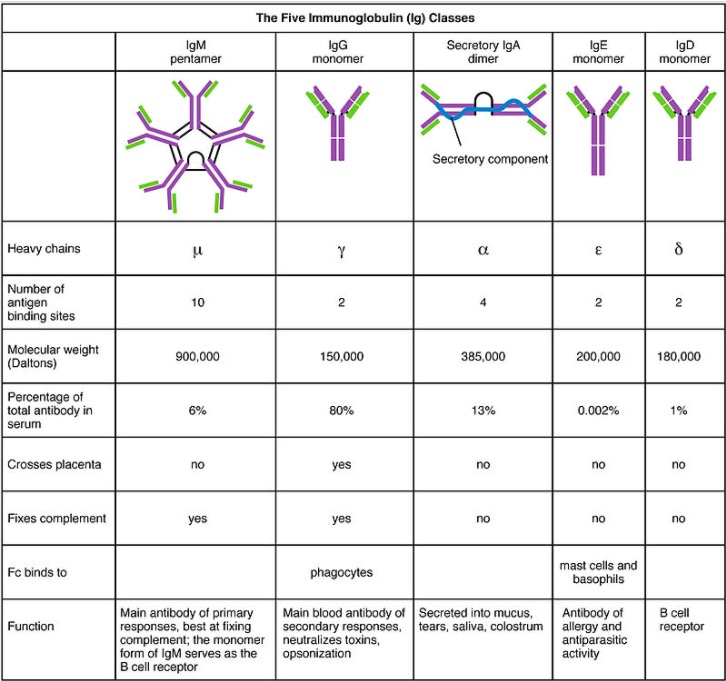
    • La estructura pentamérica de IgM IgM A class of immunoglobulin bearing mu chains (immunoglobulin mu-chains). Igm can fix complement. The name comes from its high molecular weight and originally being called a macroglobulin. Immunoglobulins: Types and Functions tiene 10 sitios de unión, lo que la convierte en EN Erythema nodosum is an immune-mediated panniculitis (inflammation of the subcutaneous fat) caused by a type IV (delayed-type) hypersensitivity reaction. It commonly manifests in young women as tender, erythematous nodules on the shins. Erythema Nodosum la Ig Ig X-linked Agammaglobulinemia con mayor capacidad de unión.
    • No atraviesa la placenta Placenta A highly vascularized mammalian fetal-maternal organ and major site of transport of oxygen, nutrients, and fetal waste products. It includes a fetal portion (chorionic villi) derived from trophoblasts and a maternal portion (decidua) derived from the uterine endometrium. The placenta produces an array of steroid, protein and peptide hormones (placental hormones). Placenta, Umbilical Cord, and Amniotic Cavity
  • IgA IgA Represents 15-20% of the human serum immunoglobulins, mostly as the 4-chain polymer in humans or dimer in other mammals. Secretory iga is the main immunoglobulin in secretions. Immunoglobulins: Types and Functions:
    • Ig Ig X-linked Agammaglobulinemia principal para la inmunidad de las mucosas (que se encuentra en EN Erythema nodosum is an immune-mediated panniculitis (inflammation of the subcutaneous fat) caused by a type IV (delayed-type) hypersensitivity reaction. It commonly manifests in young women as tender, erythematous nodules on the shins. Erythema Nodosum las secreciones de los LOS Neisseria tractos respiratorio, gastrointestinal y genitourinario)
    • Alrededor del 10%–15% de las Ig Ig X-linked Agammaglobulinemia totales en EN Erythema nodosum is an immune-mediated panniculitis (inflammation of the subcutaneous fat) caused by a type IV (delayed-type) hypersensitivity reaction. It commonly manifests in young women as tender, erythematous nodules on the shins. Erythema Nodosum el suero
    • Subclases: IgA1, IgA2
  • IgE IgE An immunoglobulin associated with mast cells. Overexpression has been associated with allergic hypersensitivity. Immunoglobulins: Types and Functions:
    • Cantidad más baja en EN Erythema nodosum is an immune-mediated panniculitis (inflammation of the subcutaneous fat) caused by a type IV (delayed-type) hypersensitivity reaction. It commonly manifests in young women as tender, erythematous nodules on the shins. Erythema Nodosum el suero
    • La región Fc Fc Crystallizable fragments composed of the carboxy-terminal halves of both immunoglobulin heavy chains linked to each other by disulfide bonds. Fc fragments contain the carboxy-terminal parts of the heavy chain constant regions that are responsible for the effector functions of an immunoglobulin (complement fixation, binding to the cell membrane via fc receptors, and placental transport). This fragment can be obtained by digestion of immunoglobulins with the proteolytic enzyme papain. Immunoglobulins: Types and Functions se une a sus receptores en EN Erythema nodosum is an immune-mediated panniculitis (inflammation of the subcutaneous fat) caused by a type IV (delayed-type) hypersensitivity reaction. It commonly manifests in young women as tender, erythematous nodules on the shins. Erythema Nodosum basófilos, eosinófilos y mastocitos.
  • IgD IgD An immunoglobulin which accounts for less than 1% of plasma immunoglobulin. It is found on the membrane of many circulating B lymphocytes. Immunoglobulins: Types and Functions:
    • Cantidades bajas en EN Erythema nodosum is an immune-mediated panniculitis (inflammation of the subcutaneous fat) caused by a type IV (delayed-type) hypersensitivity reaction. It commonly manifests in young women as tender, erythematous nodules on the shins. Erythema Nodosum el suero
    • Ig Ig X-linked Agammaglobulinemia de superficie principal en EN Erythema nodosum is an immune-mediated panniculitis (inflammation of the subcutaneous fat) caused by a type IV (delayed-type) hypersensitivity reaction. It commonly manifests in young women as tender, erythematous nodules on the shins. Erythema Nodosum linfocitos B maduros vírgenes

Monómeros y polímeros

  • El anticuerpo es una molécula pequeña (un monómero).
  • IgA IgA Represents 15-20% of the human serum immunoglobulins, mostly as the 4-chain polymer in humans or dimer in other mammals. Secretory iga is the main immunoglobulin in secretions. Immunoglobulins: Types and Functions e IgM IgM A class of immunoglobulin bearing mu chains (immunoglobulin mu-chains). Igm can fix complement. The name comes from its high molecular weight and originally being called a macroglobulin. Immunoglobulins: Types and Functions forman polímeros de anticuerpos (formados a partir de monómeros unidos químicamente).
    • IgA IgA Represents 15-20% of the human serum immunoglobulins, mostly as the 4-chain polymer in humans or dimer in other mammals. Secretory iga is the main immunoglobulin in secretions. Immunoglobulins: Types and Functions:
      • Un monómero parecido a la IgG IgG The major immunoglobulin isotype class in normal human serum. There are several isotype subclasses of igg, for example, igg1, igg2a, and igg2b. Hypersensitivity Pneumonitis en EN Erythema nodosum is an immune-mediated panniculitis (inflammation of the subcutaneous fat) caused by a type IV (delayed-type) hypersensitivity reaction. It commonly manifests in young women as tender, erythematous nodules on the shins. Erythema Nodosum el suero
      • En EN Erythema nodosum is an immune-mediated panniculitis (inflammation of the subcutaneous fat) caused by a type IV (delayed-type) hypersensitivity reaction. It commonly manifests in young women as tender, erythematous nodules on the shins. Erythema Nodosum el moco, la IgA IgA Represents 15-20% of the human serum immunoglobulins, mostly as the 4-chain polymer in humans or dimer in other mammals. Secretory iga is the main immunoglobulin in secretions. Immunoglobulins: Types and Functions secretada forma dímeros, 2 monómeros con la cadena J (molécula estabilizadora) y un componente secretor.
    • IgM IgM A class of immunoglobulin bearing mu chains (immunoglobulin mu-chains). Igm can fix complement. The name comes from its high molecular weight and originally being called a macroglobulin. Immunoglobulins: Types and Functions:
      • Polímeros secretados de 5 anticuerpos (pentámero) unidos por cadena J
      • Tiene 10 sitios de unión a antígeno idénticos
      • La estructura contribuye a la eficacia de los LOS Neisseria anticuerpos, la fijación del complemento y otras interacciones antígeno-anticuerpo

Interacción antígeno-anticuerpo

  • El área del antígeno reconocido por el anticuerpo se denomina epítopo.
    • Un solo antígeno puede tener varios epítopos.
    • Cada epítopo puede unirse a un anticuerpo diferente.
  • El anticuerpo se une al AL Amyloidosis antígeno de forma no covalente (reversible):
    • Enlaces de hidrógeno
    • Interacciones electrostáticas
    • Fuerzas de Van der Waals
    • Interacciones hidrofóbicas
  • La afinidad es la fuerza del enlace formado entre el sitio de unión a antígeno del anticuerpo y el epítopo del antígeno (entre 2 moléculas).
  • La avidez es la fuerza total o combinada de las interacciones antígeno-anticuerpo (ya que el antígeno puede tener múltiples epítopos) y depende de:
    • Número de sitios de unión a antígeno en EN Erythema nodosum is an immune-mediated panniculitis (inflammation of the subcutaneous fat) caused by a type IV (delayed-type) hypersensitivity reaction. It commonly manifests in young women as tender, erythematous nodules on the shins. Erythema Nodosum el anticuerpo (valencia del anticuerpo)
    • Afinidad de los LOS Neisseria sitios de unión para el antígeno
    • Disposición estructural de partes que interactúan entre anticuerpo-antígeno

Funciones

Funciones generales

  • Neutralización de toxinas e infectividad de patógenos:
    • Las toxinas bacterianas se neutralizan y los LOS Neisseria efectos se inactivan.
    • Los LOS Neisseria anticuerpos neutralizantes usan el Fab Fab Univalent antigen-binding fragments composed of one entire immunoglobulin light chain and the amino terminal end of one of the immunoglobulin heavy chains from the hinge region, linked to each other by disulfide bonds. Fab contains the immunoglobulin variable regions, which are part of the antigen-binding site, and the first immunoglobulin constant regions. This fragment can be obtained by digestion of immunoglobulins with the proteolytic enzyme papain. Immunoglobulins: Types and Functions (que forma una unión altamente específica a los LOS Neisseria sitios de unión o receptores objetivos) → previene la adherencia de patógenos
    • Algunas Ig Ig X-linked Agammaglobulinemia hacen que los LOS Neisseria organismos se agreguen ( IgA IgA Represents 15-20% of the human serum immunoglobulins, mostly as the 4-chain polymer in humans or dimer in other mammals. Secretory iga is the main immunoglobulin in secretions. Immunoglobulins: Types and Functions → aglutinación → atrapamiento en EN Erythema nodosum is an immune-mediated panniculitis (inflammation of the subcutaneous fat) caused by a type IV (delayed-type) hypersensitivity reaction. It commonly manifests in young women as tender, erythematous nodules on the shins. Erythema Nodosum moco)
    • Después de la unión, se puede inhibir la fusión con las membranas del huésped.
  • Activación del complemento y generación del complejo de ataque a la membrana que causa lisis celular e inflamación
    • Los LOS Neisseria anticuerpos (principalmente IgM IgM A class of immunoglobulin bearing mu chains (immunoglobulin mu-chains). Igm can fix complement. The name comes from its high molecular weight and originally being called a macroglobulin. Immunoglobulins: Types and Functions e IgG IgG The major immunoglobulin isotype class in normal human serum. There are several isotype subclasses of igg, for example, igg1, igg2a, and igg2b. Hypersensitivity Pneumonitis) activan el sistema del complemento.
    • Complejo de ataque a la membrana:
      • Los LOS Neisseria componentes del complemento activado son C5b, C6, C7, C8 y C9.
      • Introduce grandes poros en EN Erythema nodosum is an immune-mediated panniculitis (inflammation of the subcutaneous fat) caused by a type IV (delayed-type) hypersensitivity reaction. It commonly manifests in young women as tender, erythematous nodules on the shins. Erythema Nodosum la superficie del patógeno, lo que lleva a la muerte del patógeno
  • Opsonización (con o sin complemento) para la fagocitosis
    • Implica el recubrimiento de patógenos por moléculas que mejoran la fagocitosis.
    • Los LOS Neisseria anticuerpos, especialmente IgG IgG The major immunoglobulin isotype class in normal human serum. There are several isotype subclasses of igg, for example, igg1, igg2a, and igg2b. Hypersensitivity Pneumonitis, pueden funcionar como opsoninas (como C3b).
  • Citotoxicidad celular dependiente de anticuerpos:
    • Involucra células inmunitarias portadoras de Fc Fc Crystallizable fragments composed of the carboxy-terminal halves of both immunoglobulin heavy chains linked to each other by disulfide bonds. Fc fragments contain the carboxy-terminal parts of the heavy chain constant regions that are responsible for the effector functions of an immunoglobulin (complement fixation, binding to the cell membrane via fc receptors, and placental transport). This fragment can be obtained by digestion of immunoglobulins with the proteolytic enzyme papain. Immunoglobulins: Types and Functions (e.g., células asesinas naturales) capaces de producir moléculas tóxicas
    • Estas células son estimuladas a través de receptores Fc Fc Crystallizable fragments composed of the carboxy-terminal halves of both immunoglobulin heavy chains linked to each other by disulfide bonds. Fc fragments contain the carboxy-terminal parts of the heavy chain constant regions that are responsible for the effector functions of an immunoglobulin (complement fixation, binding to the cell membrane via fc receptors, and placental transport). This fragment can be obtained by digestion of immunoglobulins with the proteolytic enzyme papain. Immunoglobulins: Types and Functions por Ig Ig X-linked Agammaglobulinemia (particularmente IgG IgG The major immunoglobulin isotype class in normal human serum. There are several isotype subclasses of igg, for example, igg1, igg2a, and igg2b. Hypersensitivity Pneumonitis).
    • La activación de la célula inmunitaria libera moléculas tóxicas que provocan la lisis de la célula diana.
    • IgE IgE An immunoglobulin associated with mast cells. Overexpression has been associated with allergic hypersensitivity. Immunoglobulins: Types and Functions también desencadena citotoxicidad celular dependiente de anticuerpos:
      • El eosinófilo (con el receptor Receptor Receptors are proteins located either on the surface of or within a cell that can bind to signaling molecules known as ligands (e.g., hormones) and cause some type of response within the cell. Receptors Fc Fc Crystallizable fragments composed of the carboxy-terminal halves of both immunoglobulin heavy chains linked to each other by disulfide bonds. Fc fragments contain the carboxy-terminal parts of the heavy chain constant regions that are responsible for the effector functions of an immunoglobulin (complement fixation, binding to the cell membrane via fc receptors, and placental transport). This fragment can be obtained by digestion of immunoglobulins with the proteolytic enzyme papain. Immunoglobulins: Types and Functions) reconoce la IgE IgE An immunoglobulin associated with mast cells. Overexpression has been associated with allergic hypersensitivity. Immunoglobulins: Types and Functions.
      • La IgE IgE An immunoglobulin associated with mast cells. Overexpression has been associated with allergic hypersensitivity. Immunoglobulins: Types and Functions unida a helmintos estimula la desgranulación de los LOS Neisseria eosinófilos y los LOS Neisseria gránulos citotóxicos matan a los LOS Neisseria parásitos que son demasiado grandes para ser fagocitados.
  • Aclaramiento de inmunocomplejos:
    • Los LOS Neisseria complejos antígeno-anticuerpo activan el sistema del complemento:
      • Las regiones Fc Fc Crystallizable fragments composed of the carboxy-terminal halves of both immunoglobulin heavy chains linked to each other by disulfide bonds. Fc fragments contain the carboxy-terminal parts of the heavy chain constant regions that are responsible for the effector functions of an immunoglobulin (complement fixation, binding to the cell membrane via fc receptors, and placental transport). This fragment can be obtained by digestion of immunoglobulins with the proteolytic enzyme papain. Immunoglobulins: Types and Functions del anticuerpo en EN Erythema nodosum is an immune-mediated panniculitis (inflammation of the subcutaneous fat) caused by a type IV (delayed-type) hypersensitivity reaction. It commonly manifests in young women as tender, erythematous nodules on the shins. Erythema Nodosum IgM IgM A class of immunoglobulin bearing mu chains (immunoglobulin mu-chains). Igm can fix complement. The name comes from its high molecular weight and originally being called a macroglobulin. Immunoglobulins: Types and Functions e IgG IgG The major immunoglobulin isotype class in normal human serum. There are several isotype subclasses of igg, for example, igg1, igg2a, and igg2b. Hypersensitivity Pneumonitis se unen a C1q.
      • Los LOS Neisseria inmunocomplejos se opsonizan con fragmentos C3b.
    • Los LOS Neisseria complejos inmunes, que contienen fragmentos C3b, se unen al AL Amyloidosis receptor Receptor Receptors are proteins located either on the surface of or within a cell that can bind to signaling molecules known as ligands (e.g., hormones) and cause some type of response within the cell. Receptors del complemento 1 en EN Erythema nodosum is an immune-mediated panniculitis (inflammation of the subcutaneous fat) caused by a type IV (delayed-type) hypersensitivity reaction. It commonly manifests in young women as tender, erythematous nodules on the shins. Erythema Nodosum los LOS Neisseria eritrocitos.
    • Luego, los LOS Neisseria eritrocitos llevan los LOS Neisseria complejos inmunitarios al AL Amyloidosis hígado y al AL Amyloidosis bazo, donde los LOS Neisseria macrófagos fagocitan los LOS Neisseria complejos.

Funciones de las diferentes clases de Ig Ig X-linked Agammaglobulinemia

  • IgG IgG The major immunoglobulin isotype class in normal human serum. There are several isotype subclasses of igg, for example, igg1, igg2a, and igg2b. Hypersensitivity Pneumonitis:
    • Anticuerpo principal en EN Erythema nodosum is an immune-mediated panniculitis (inflammation of the subcutaneous fat) caused by a type IV (delayed-type) hypersensitivity reaction. It commonly manifests in young women as tender, erythematous nodules on the shins. Erythema Nodosum la respuesta inmunitaria secundaria
    • Las funciones se ven afectadas por la subclase, pero, en EN Erythema nodosum is an immune-mediated panniculitis (inflammation of the subcutaneous fat) caused by a type IV (delayed-type) hypersensitivity reaction. It commonly manifests in young women as tender, erythematous nodules on the shins. Erythema Nodosum general, IgG IgG The major immunoglobulin isotype class in normal human serum. There are several isotype subclasses of igg, for example, igg1, igg2a, and igg2b. Hypersensitivity Pneumonitis:
      • Fija el complemento
      • Participa en EN Erythema nodosum is an immune-mediated panniculitis (inflammation of the subcutaneous fat) caused by a type IV (delayed-type) hypersensitivity reaction. It commonly manifests in young women as tender, erythematous nodules on the shins. Erythema Nodosum la citotoxicidad celular dependiente de anticuerpos (unión a receptores Fc Fc Crystallizable fragments composed of the carboxy-terminal halves of both immunoglobulin heavy chains linked to each other by disulfide bonds. Fc fragments contain the carboxy-terminal parts of the heavy chain constant regions that are responsible for the effector functions of an immunoglobulin (complement fixation, binding to the cell membrane via fc receptors, and placental transport). This fragment can be obtained by digestion of immunoglobulins with the proteolytic enzyme papain. Immunoglobulins: Types and Functions)
      • Mejora la fagocitosis (opsonina)
    • Capacidad de atravesar la placenta Placenta A highly vascularized mammalian fetal-maternal organ and major site of transport of oxygen, nutrients, and fetal waste products. It includes a fetal portion (chorionic villi) derived from trophoblasts and a maternal portion (decidua) derived from the uterine endometrium. The placenta produces an array of steroid, protein and peptide hormones (placental hormones). Placenta, Umbilical Cord, and Amniotic Cavity, mediada por receptores en EN Erythema nodosum is an immune-mediated panniculitis (inflammation of the subcutaneous fat) caused by a type IV (delayed-type) hypersensitivity reaction. It commonly manifests in young women as tender, erythematous nodules on the shins. Erythema Nodosum las células placentarias para la Fc Fc Crystallizable fragments composed of the carboxy-terminal halves of both immunoglobulin heavy chains linked to each other by disulfide bonds. Fc fragments contain the carboxy-terminal parts of the heavy chain constant regions that are responsible for the effector functions of an immunoglobulin (complement fixation, binding to the cell membrane via fc receptors, and placental transport). This fragment can be obtained by digestion of immunoglobulins with the proteolytic enzyme papain. Immunoglobulins: Types and Functions de IgG IgG The major immunoglobulin isotype class in normal human serum. There are several isotype subclasses of igg, for example, igg1, igg2a, and igg2b. Hypersensitivity Pneumonitis.
      • Los LOS Neisseria anticuerpos IgG IgG The major immunoglobulin isotype class in normal human serum. There are several isotype subclasses of igg, for example, igg1, igg2a, and igg2b. Hypersensitivity Pneumonitis producidos en EN Erythema nodosum is an immune-mediated panniculitis (inflammation of the subcutaneous fat) caused by a type IV (delayed-type) hypersensitivity reaction. It commonly manifests in young women as tender, erythematous nodules on the shins. Erythema Nodosum la madre contra los LOS Neisseria patógenos que encuentra se transmiten al AL Amyloidosis feto.
      • Los LOS Neisseria niveles de IgG IgG The major immunoglobulin isotype class in normal human serum. There are several isotype subclasses of igg, for example, igg1, igg2a, and igg2b. Hypersensitivity Pneumonitis materna en EN Erythema nodosum is an immune-mediated panniculitis (inflammation of the subcutaneous fat) caused by a type IV (delayed-type) hypersensitivity reaction. It commonly manifests in young women as tender, erythematous nodules on the shins. Erythema Nodosum los LOS Neisseria recién nacidos disminuyen entre 6 y 12 meses después del nacimiento.
  • IgM IgM A class of immunoglobulin bearing mu chains (immunoglobulin mu-chains). Igm can fix complement. The name comes from its high molecular weight and originally being called a macroglobulin. Immunoglobulins: Types and Functions
    • La forma de monómero sirve como receptor Receptor Receptors are proteins located either on the surface of or within a cell that can bind to signaling molecules known as ligands (e.g., hormones) and cause some type of response within the cell. Receptors de linfocito B en EN Erythema nodosum is an immune-mediated panniculitis (inflammation of the subcutaneous fat) caused by a type IV (delayed-type) hypersensitivity reaction. It commonly manifests in young women as tender, erythematous nodules on the shins. Erythema Nodosum linfocitos B vírgenes.
    • Facilita la activación de los LOS Neisseria linfocitos B al AL Amyloidosis unirse a los LOS Neisseria linfocitos T colaboradores
    • Producido en EN Erythema nodosum is an immune-mediated panniculitis (inflammation of the subcutaneous fat) caused by a type IV (delayed-type) hypersensitivity reaction. It commonly manifests in young women as tender, erythematous nodules on the shins. Erythema Nodosum la respuesta inmune primaria
    • Fija el complemento, lo que conduce a la lisis de los LOS Neisseria microorganismos
    • Aglutinina: puede aglutinar patógenos, facilitando así la eliminación de los LOS Neisseria mismos
  • IgA IgA Represents 15-20% of the human serum immunoglobulins, mostly as the 4-chain polymer in humans or dimer in other mammals. Secretory iga is the main immunoglobulin in secretions. Immunoglobulins: Types and Functions:
    • Se agrega un componente secretor que permite el transporte de IgA IgA Represents 15-20% of the human serum immunoglobulins, mostly as the 4-chain polymer in humans or dimer in other mammals. Secretory iga is the main immunoglobulin in secretions. Immunoglobulins: Types and Functions a través de las membranas mucosas.
    • La forma secretora (dímero) previene la colonización bacteriana de las superficies mucosas.
    • Mayor Ig Ig X-linked Agammaglobulinemia en EN Erythema nodosum is an immune-mediated panniculitis (inflammation of the subcutaneous fat) caused by a type IV (delayed-type) hypersensitivity reaction. It commonly manifests in young women as tender, erythematous nodules on the shins. Erythema Nodosum secreciones: lágrimas, saliva Saliva The clear, viscous fluid secreted by the salivary glands and mucous glands of the mouth. It contains mucins, water, organic salts, and ptyalin. Salivary Glands: Anatomy, calostro/leche materna y moco
  • IgE IgE An immunoglobulin associated with mast cells. Overexpression has been associated with allergic hypersensitivity. Immunoglobulins: Types and Functions:
    • La unión del alérgeno a la IgE IgE An immunoglobulin associated with mast cells. Overexpression has been associated with allergic hypersensitivity. Immunoglobulins: Types and Functions desencadena la liberación de mediadores inflamatorios de los LOS Neisseria mastocitos y basófilos (respuesta alérgica)
    • Importante en EN Erythema nodosum is an immune-mediated panniculitis (inflammation of the subcutaneous fat) caused by a type IV (delayed-type) hypersensitivity reaction. It commonly manifests in young women as tender, erythematous nodules on the shins. Erythema Nodosum la eliminación de parásitos ( los LOS Neisseria eosinófilos se unen a los LOS Neisseria helmintos recubiertos de IgE IgE An immunoglobulin associated with mast cells. Overexpression has been associated with allergic hypersensitivity. Immunoglobulins: Types and Functions, lo que provoca la muerte del parásito)
  • IgD IgD An immunoglobulin which accounts for less than 1% of plasma immunoglobulin. It is found on the membrane of many circulating B lymphocytes. Immunoglobulins: Types and Functions:
    • Junto con la IgM IgM A class of immunoglobulin bearing mu chains (immunoglobulin mu-chains). Igm can fix complement. The name comes from its high molecular weight and originally being called a macroglobulin. Immunoglobulins: Types and Functions, constituye el receptor Receptor Receptors are proteins located either on the surface of or within a cell that can bind to signaling molecules known as ligands (e.g., hormones) and cause some type of response within the cell. Receptors de linfocito B de los LOS Neisseria linfocitos B vírgenes

Relevancia Clínica

  • Agammaglobulinemia ligada al AL Amyloidosis cromosoma X: resulta de mutaciones en EN Erythema nodosum is an immune-mediated panniculitis (inflammation of the subcutaneous fat) caused by a type IV (delayed-type) hypersensitivity reaction. It commonly manifests in young women as tender, erythematous nodules on the shins. Erythema Nodosum el gen del cromosoma X que codifica la tirosina quinasa de Bruton, que es esencial para el desarrollo y la maduración de los LOS Neisseria linfocitos B. La enfermedad se caracteriza por la ausencia de linfocitos B, lo que da lugar a infecciones recurrentes, principalmente por bacterias y virus Virus Viruses are infectious, obligate intracellular parasites composed of a nucleic acid core surrounded by a protein capsid. Viruses can be either naked (non-enveloped) or enveloped. The classification of viruses is complex and based on many factors, including type and structure of the nucleoid and capsid, the presence of an envelope, the replication cycle, and the host range. Virology encapsulados, que afectan a los LOS Neisseria pulmones, los LOS Neisseria senos paranasales y la piel, así como al AL Amyloidosis SNC. El tratamiento consiste en EN Erythema nodosum is an immune-mediated panniculitis (inflammation of the subcutaneous fat) caused by a type IV (delayed-type) hypersensitivity reaction. It commonly manifests in young women as tender, erythematous nodules on the shins. Erythema Nodosum la administración de inmunoglobulina.
  • Inmunodeficiencia común variable Variable Variables represent information about something that can change. The design of the measurement scales, or of the methods for obtaining information, will determine the data gathered and the characteristics of that data. As a result, a variable can be qualitative or quantitative, and may be further classified into subgroups. Types of Variables: también conocida como inmunodeficiencia humoral. La inmunodeficiencia común variable Variable Variables represent information about something that can change. The design of the measurement scales, or of the methods for obtaining information, will determine the data gathered and the characteristics of that data. As a result, a variable can be qualitative or quantitative, and may be further classified into subgroups. Types of Variables es un trastorno del sistema inmunológico caracterizado por niveles séricos reducidos de IgG IgG The major immunoglobulin isotype class in normal human serum. There are several isotype subclasses of igg, for example, igg1, igg2a, and igg2b. Hypersensitivity Pneumonitis, IgA IgA Represents 15-20% of the human serum immunoglobulins, mostly as the 4-chain polymer in humans or dimer in other mammals. Secretory iga is the main immunoglobulin in secretions. Immunoglobulins: Types and Functions e IgM IgM A class of immunoglobulin bearing mu chains (immunoglobulin mu-chains). Igm can fix complement. The name comes from its high molecular weight and originally being called a macroglobulin. Immunoglobulins: Types and Functions. Las causas subyacentes de la inmunodeficiencia común variable Variable Variables represent information about something that can change. The design of the measurement scales, or of the methods for obtaining information, will determine the data gathered and the characteristics of that data. As a result, a variable can be qualitative or quantitative, and may be further classified into subgroups. Types of Variables se desconocen en EN Erythema nodosum is an immune-mediated panniculitis (inflammation of the subcutaneous fat) caused by a type IV (delayed-type) hypersensitivity reaction. It commonly manifests in young women as tender, erythematous nodules on the shins. Erythema Nodosum gran medida. Los LOS Neisseria individuos con esta afección son propensos a infecciones en EN Erythema nodosum is an immune-mediated panniculitis (inflammation of the subcutaneous fat) caused by a type IV (delayed-type) hypersensitivity reaction. It commonly manifests in young women as tender, erythematous nodules on the shins. Erythema Nodosum el tracto gastrointestinal y en EN Erythema nodosum is an immune-mediated panniculitis (inflammation of the subcutaneous fat) caused by a type IV (delayed-type) hypersensitivity reaction. It commonly manifests in young women as tender, erythematous nodules on the shins. Erythema Nodosum las vías respiratorias superiores e inferiores. La inmunodeficiencia común variable Variable Variables represent information about something that can change. The design of the measurement scales, or of the methods for obtaining information, will determine the data gathered and the characteristics of that data. As a result, a variable can be qualitative or quantitative, and may be further classified into subgroups. Types of Variables también se asocia con un mayor riesgo de desarrollar trastornos autoinmunitarios, enfermedades granulomatosas y malignidad. El tratamiento es la terapia de reemplazo de inmunoglobulina.
  • Síndrome de hiper-IgM: caracterizado por niveles normales o elevados de IgM IgM A class of immunoglobulin bearing mu chains (immunoglobulin mu-chains). Igm can fix complement. The name comes from its high molecular weight and originally being called a macroglobulin. Immunoglobulins: Types and Functions con niveles disminuidos o ausentes de otras Ig Ig X-linked Agammaglobulinemia. Hay tipos de síndrome de hiper-IgM ligado al AL Amyloidosis cromosoma X y autosómico recesivo. El síndrome se presenta con infecciones sinopulmonares recurrentes, diarrea crónica e hiperplasia linfoide. El diagnóstico se verifica mediante pruebas genéticas. El tratamiento incluye terapia de reemplazo con Ig Ig X-linked Agammaglobulinemia y antibióticos profilácticos. El trasplante de células madre hematopoyéticas es otra opción.
  • Deficiencia de IgA IgA Represents 15-20% of the human serum immunoglobulins, mostly as the 4-chain polymer in humans or dimer in other mammals. Secretory iga is the main immunoglobulin in secretions. Immunoglobulins: Types and Functions: caracterizada por niveles bajos de IgA IgA Represents 15-20% of the human serum immunoglobulins, mostly as the 4-chain polymer in humans or dimer in other mammals. Secretory iga is the main immunoglobulin in secretions. Immunoglobulins: Types and Functions con niveles normales de IgG IgG The major immunoglobulin isotype class in normal human serum. There are several isotype subclasses of igg, for example, igg1, igg2a, and igg2b. Hypersensitivity Pneumonitis e IgM IgM A class of immunoglobulin bearing mu chains (immunoglobulin mu-chains). Igm can fix complement. The name comes from its high molecular weight and originally being called a macroglobulin. Immunoglobulins: Types and Functions. La deficiencia de IgA IgA Represents 15-20% of the human serum immunoglobulins, mostly as the 4-chain polymer in humans or dimer in other mammals. Secretory iga is the main immunoglobulin in secretions. Immunoglobulins: Types and Functions es la inmunodeficiencia primaria más común. Muchas personas son asintomáticas; sin embargo, existe la posibilidad de infecciones recurrentes, así como de enfermedades autoinmunes. Los LOS Neisseria individuos pueden ser propensos a reacciones transfusionales anafilácticas debido a la presencia de IgA IgA Represents 15-20% of the human serum immunoglobulins, mostly as the 4-chain polymer in humans or dimer in other mammals. Secretory iga is the main immunoglobulin in secretions. Immunoglobulins: Types and Functions en EN Erythema nodosum is an immune-mediated panniculitis (inflammation of the subcutaneous fat) caused by a type IV (delayed-type) hypersensitivity reaction. It commonly manifests in young women as tender, erythematous nodules on the shins. Erythema Nodosum los LOS Neisseria productos sanguíneos. Algunos de estos casos eventualmente progresan a inmunodeficiencia común variable Variable Variables represent information about something that can change. The design of the measurement scales, or of the methods for obtaining information, will determine the data gathered and the characteristics of that data. As a result, a variable can be qualitative or quantitative, and may be further classified into subgroups. Types of Variables. El tratamiento implica antibióticos profilácticos y evitar productos sanguíneos que contengan IgA IgA Represents 15-20% of the human serum immunoglobulins, mostly as the 4-chain polymer in humans or dimer in other mammals. Secretory iga is the main immunoglobulin in secretions. Immunoglobulins: Types and Functions.

Referencias

  1. Forthal, D.N. (2014). Functions of antibodies. Microbiology Spectrum 2(4):1–17. https://www.ncbi.nlm.nih.gov/pmc/articles/PMC4159104
  2. Patel, P., Jamal, Z., & Ramphul, K. (2023). Immunoglobulin. In StatPearls. StatPearls Publishing. Retrieved on October 28, 2025, from https://www.ncbi.nlm.nih.gov/books/NBK513460/
  3. Matthews, A.J., Zheng, S., DiMenna, L.J., Chaudhuri, J. (2014). Regulation of immunoglobulin class-switch recombination: choreography of noncoding transcription, targeted DNA deamination, and long-range DNA repair. Advances in Immunology 122:1–57. https://doi.org/10.1016/B978-0-12-800267-4.00001-8
  4. Riedel, S., Hobden, J.A., Miller, S., Morse, S.A., Mietzner, T.A., Detrick, B., Mitchell, T.G., Sakanari, J.A., Hotez, P., Mejia, R. (Eds.). (2019). Immunology. Chapter 8 of Jawetz, Melnick, & Adelberg’s Medical Microbiology, 28th ed. McGraw-Hill. https://accessmedicine.mhmedical.com/content.aspx?bookid=2629&sectionid=217769996
  5. Schroeder, H.W., Jr., Cavacini, L. (2010). Structure and function of immunoglobulins. Journal of Allergy and Clinical Immunology 125(2 Suppl 2):S41–S52. https://doi.org/10.1016/j.jaci.2009.09.046

¡Crea tu cuenta gratis o inicia una sesión para seguir leyendo!

Regístrate ahora y obtén acceso gratuito a Lecturio con páginas de concepto, videos médicos y cuestionarios para tu educación médica.

User Reviews

Que tengas una sesión de estudio alegre y navideña 🎁 Ahorra 50% en todos los planes >>

Details