
Domina Conceptos Médicos

Estudia para la escuela de medicina y tus examenes con Lecturio.

Inmunoensayos

Los inmunoensayos son técnicas basadas en placas que pueden detectar y cuantificar muchos tipos de moléculas a través de reacciones anticuerpo-antígeno. Un inmunoensayo generalmente involucra un analito, un anticuerpo específico y marcadores. La clasificación de los inmunoensayos se basa en el tipo de marcador utilizado, que incluye enzimas (ELISA, por sus siglas en inglés), moléculas/trazadores emisores de luz (e.g., inmunoensayos de quimioluminiscencia y fluorescencia) e isótopos radiactivos (radioinmunoensayos). Estos inmunoensayos especializados son relativamente sensibles, específicos, económicos y rápidos, y se usan ampliamente en un entorno clínico. Los inmunoensayos se utilizan en el diagnóstico de enfermedades infecciosas, la identificación de marcadores tumorales, las pruebas de alergia y el control de los niveles de medicamentos.

Last updated: Dec 15, 2025

Editorial responsibility: Stanley Oiseth, Lindsay Jones, Evelin Maza

Descripción General

Definición

Los LOS Neisseria inmunoensayos son técnicas de ensayo basadas en EN Erythema nodosum is an immune-mediated panniculitis (inflammation of the subcutaneous fat) caused by a type IV (delayed-type) hypersensitivity reaction. It commonly manifests in young women as tender, erythematous nodules on the shins. Erythema Nodosum placas diseñadas para detectar y cuantificar péptidos, proteínas, anticuerpos y hormonas. El elemento más crucial de la estrategia de detección es una reacción antígeno-anticuerpo altamente específica.

Componentes

  • Analito: la molécula de interés (antígeno)
  • Anticuerpo: cuidadosamente seleccionado para el analito específico
  • Marcadores:
    • Moléculas que tienen el potencial de conjugarse con el complejo antígeno-anticuerpo
    • Permiten la detección y cuantificación

Tipos de inmunoensayos

El tipo de marcador define el inmunoensayo que se está realizando:

  • Enzimas: ELISA ELISA An immunoassay utilizing an antibody labeled with an enzyme marker such as horseradish peroxidase. While either the enzyme or the antibody is bound to an immunosorbent substrate, they both retain their biologic activity; the change in enzyme activity as a result of the enzyme-antibody-antigen reaction is proportional to the concentration of the antigen and can be measured spectrophotometrically or with the naked eye. Many variations of the method have been developed. St. Louis Encephalitis Virus (Ensayo inmunoabsorbente ligado a enzimas)
  • Moléculas/trazadores especializados (junto con enzimas) que tienen la propiedad de emisión de luz:
    • Quimioluminiscencia
    • Inmunoensayo de fluorescencia
  • Isótopos radiactivos: radioinmunoensayo

Procedimiento

Proceso general

  • Se añade una muestra/analito a una placa.
  • Se añaden un anticuerpo y un marcador.
  • Se forma un complejo anticuerpo-antígeno.
  • En EN Erythema nodosum is an immune-mediated panniculitis (inflammation of the subcutaneous fat) caused by a type IV (delayed-type) hypersensitivity reaction. It commonly manifests in young women as tender, erythematous nodules on the shins. Erythema Nodosum algunos ensayos se realiza un paso de lavado para eliminar los LOS Neisseria antígenos y anticuerpos no unidos.
  • Se agrega un sustrato, que reacciona con el marcador y da como resultado:
    • Cambio de color ( ELISA ELISA An immunoassay utilizing an antibody labeled with an enzyme marker such as horseradish peroxidase. While either the enzyme or the antibody is bound to an immunosorbent substrate, they both retain their biologic activity; the change in enzyme activity as a result of the enzyme-antibody-antigen reaction is proportional to the concentration of the antigen and can be measured spectrophotometrically or with the naked eye. Many variations of the method have been developed. St. Louis Encephalitis Virus)
    • Luminiscencia (quimioluminiscencia)
    • Fluorescencia
    • Emisión de radiación (radioinmunoensayo)
  • Se detectan cambios/señales para determinar la presencia/cantidad de antígeno en EN Erythema nodosum is an immune-mediated panniculitis (inflammation of the subcutaneous fat) caused by a type IV (delayed-type) hypersensitivity reaction. It commonly manifests in young women as tender, erythematous nodules on the shins. Erythema Nodosum una muestra. Los LOS Neisseria métodos de detección pueden incluir:
    • Espectrofotometría (cambio de color)
    • Luminometría (emisión de luz)
    • Contador gamma (radiación)

Variantes de ELISA ELISA An immunoassay utilizing an antibody labeled with an enzyme marker such as horseradish peroxidase. While either the enzyme or the antibody is bound to an immunosorbent substrate, they both retain their biologic activity; the change in enzyme activity as a result of the enzyme-antibody-antigen reaction is proportional to the concentration of the antigen and can be measured spectrophotometrically or with the naked eye. Many variations of the method have been developed. St. Louis Encephalitis Virus

Hay 4 tipos principales de ELISA ELISA An immunoassay utilizing an antibody labeled with an enzyme marker such as horseradish peroxidase. While either the enzyme or the antibody is bound to an immunosorbent substrate, they both retain their biologic activity; the change in enzyme activity as a result of the enzyme-antibody-antigen reaction is proportional to the concentration of the antigen and can be measured spectrophotometrically or with the naked eye. Many variations of the method have been developed. St. Louis Encephalitis Virus, que son variaciones del proceso general de inmunoensayo:
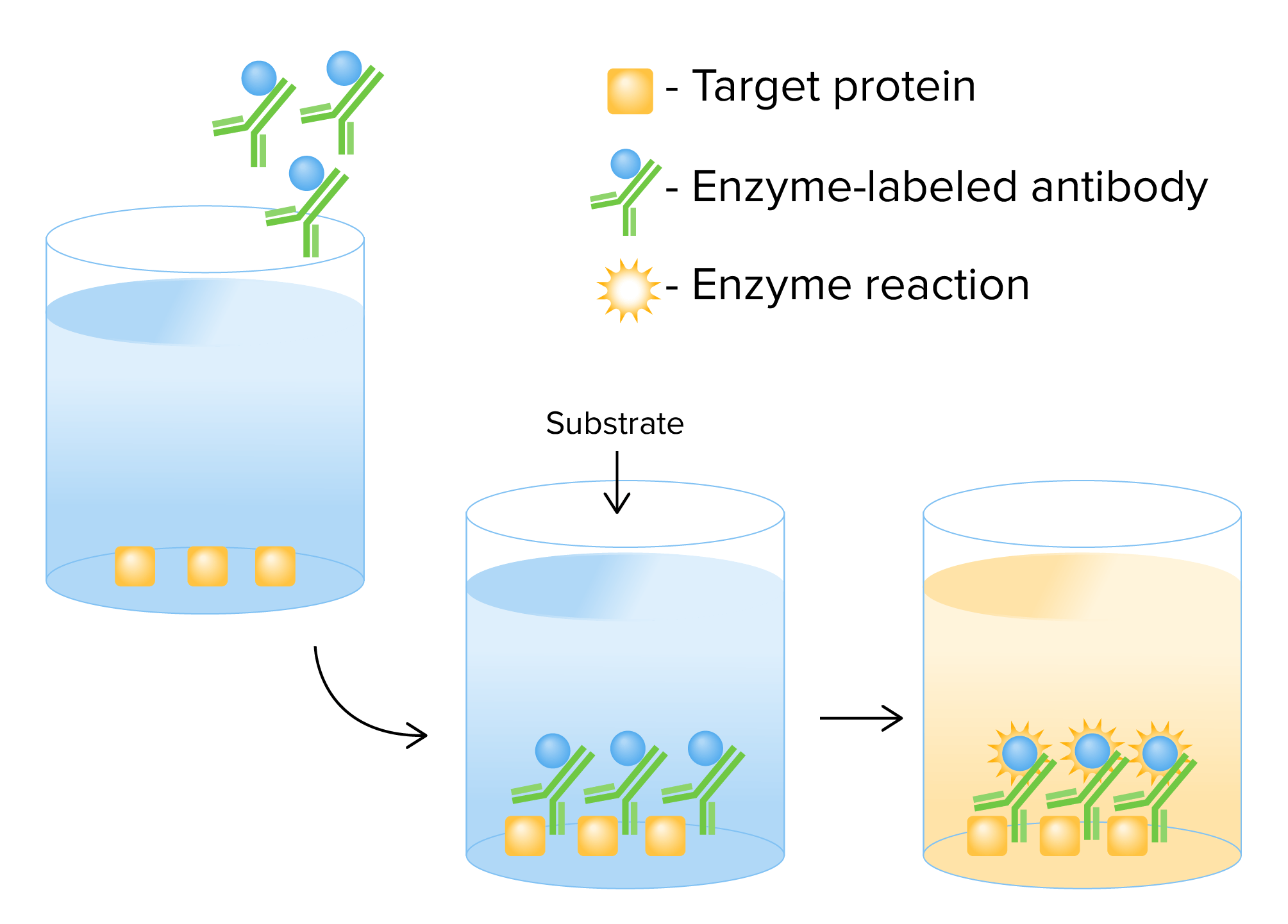
  • ELISA ELISA An immunoassay utilizing an antibody labeled with an enzyme marker such as horseradish peroxidase. While either the enzyme or the antibody is bound to an immunosorbent substrate, they both retain their biologic activity; the change in enzyme activity as a result of the enzyme-antibody-antigen reaction is proportional to the concentration of the antigen and can be measured spectrophotometrically or with the naked eye. Many variations of the method have been developed. St. Louis Encephalitis Virus directo:
    • La placa está recubierta con un antígeno.
    • Incubación con un anticuerpo específico marcado
  • ELISA ELISA An immunoassay utilizing an antibody labeled with an enzyme marker such as horseradish peroxidase. While either the enzyme or the antibody is bound to an immunosorbent substrate, they both retain their biologic activity; the change in enzyme activity as a result of the enzyme-antibody-antigen reaction is proportional to the concentration of the antigen and can be measured spectrophotometrically or with the naked eye. Many variations of the method have been developed. St. Louis Encephalitis Virus indirecto:
    • La placa está recubierta con un antígeno.
    • Incubación con un anticuerpo primario no marcado (específico del antígeno)
    • Incubación de nuevo con un anticuerpo secundario marcado (específico del anticuerpo primario)
  • ELISA ELISA An immunoassay utilizing an antibody labeled with an enzyme marker such as horseradish peroxidase. While either the enzyme or the antibody is bound to an immunosorbent substrate, they both retain their biologic activity; the change in enzyme activity as a result of the enzyme-antibody-antigen reaction is proportional to the concentration of the antigen and can be measured spectrophotometrically or with the naked eye. Many variations of the method have been developed. St. Louis Encephalitis Virus sándwich (el analito se “intercala” entre 2 capas de anticuerpos):
    • Se utiliza una placa recubierta de anticuerpos.
    • El antígeno analito se añade a la placa y se incuba.
    • Incubado de nuevo con un anticuerpo marcado
  • ELISA ELISA An immunoassay utilizing an antibody labeled with an enzyme marker such as horseradish peroxidase. While either the enzyme or the antibody is bound to an immunosorbent substrate, they both retain their biologic activity; the change in enzyme activity as a result of the enzyme-antibody-antigen reaction is proportional to the concentration of the antigen and can be measured spectrophotometrically or with the naked eye. Many variations of the method have been developed. St. Louis Encephalitis Virus competitivo:
    • Se utiliza una placa recubierta de anticuerpos (se utiliza una placa recubierta de antígeno si se analiza un anticuerpo específico).
    • Se añade el antígeno (o anticuerpo) objetivo de la muestra.
    • Se añade el antígeno (o anticuerpo) diana marcado y luego se lava.
    • Nota: A diferencia de otros métodos ELISA ELISA An immunoassay utilizing an antibody labeled with an enzyme marker such as horseradish peroxidase. While either the enzyme or the antibody is bound to an immunosorbent substrate, they both retain their biologic activity; the change in enzyme activity as a result of the enzyme-antibody-antigen reaction is proportional to the concentration of the antigen and can be measured spectrophotometrically or with the naked eye. Many variations of the method have been developed. St. Louis Encephalitis Virus, menos color/ausencia de color indica un resultado positivo.
Mecanismo de ELISA directo

Mecanismo de ELISA directo: Se agrega un antígeno objetivo a una placa junto con anticuerpos marcados con enzimas específicos para ese antígeno. Después de la incubación, el exceso de anticuerpos no unidos se elimina mediante lavado y se agrega un sustrato. En presencia del marcador enzimático, se produce una reacción que da como resultado un cambio de color.

Imagen por Lecturio.
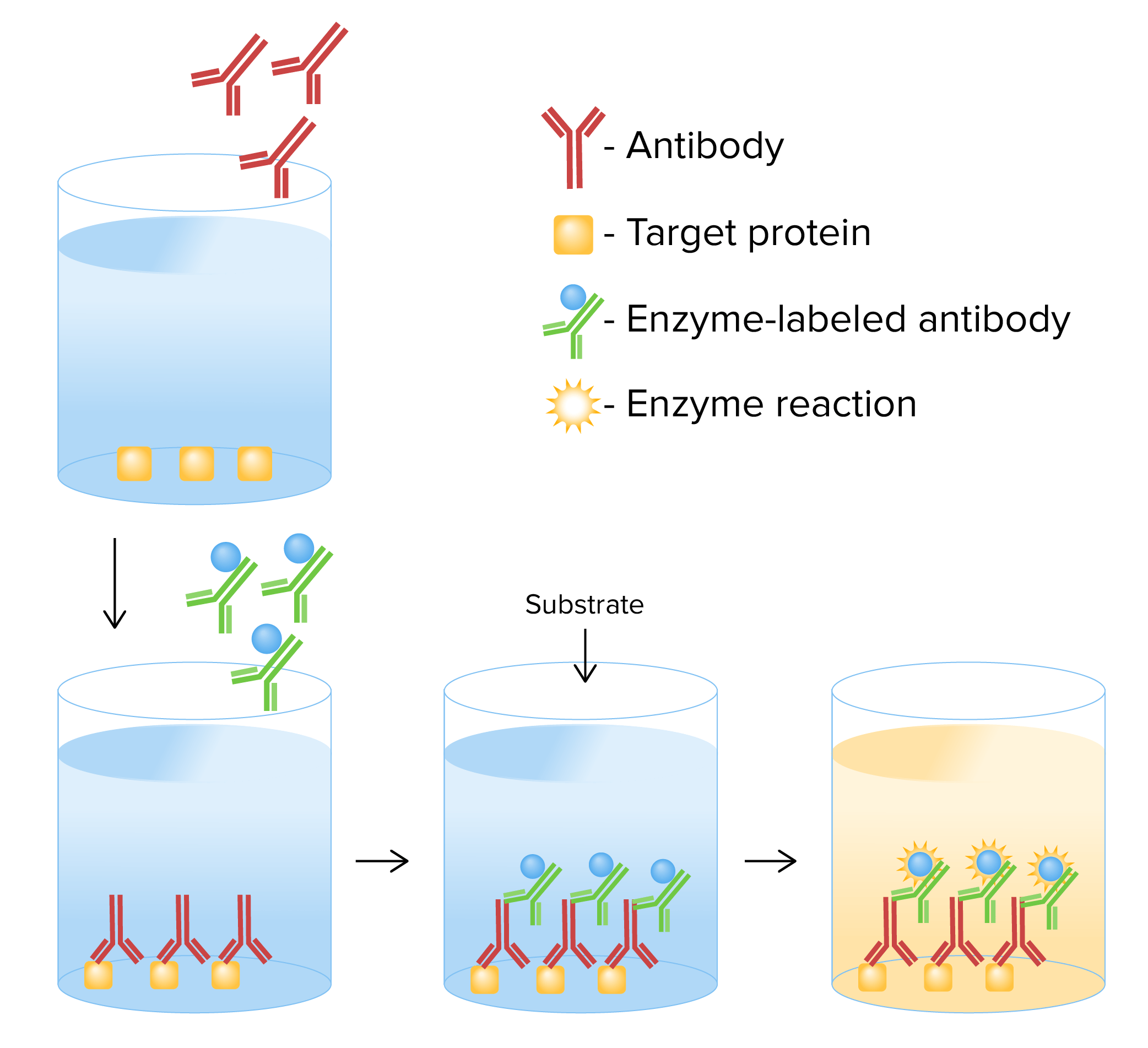
Mecanismo de ELISA indirecto

Mecanismo de ELISA indirecto: Se agrega un antígeno diana a una placa recubierta con anticuerpos primarios. Después de la incubación se forma un complejo antígeno-anticuerpo. El exceso de anticuerpo se elimina mediante lavado y se agregan anticuerpos secundarios marcados con enzimas, que se unen al complejo anticuerpo-antígeno. El exceso de anticuerpos se elimina por lavado y se añade el sustrato. La presencia del marcador enzimático da como resultado un cambio de color.

Imagen por Lecturio.
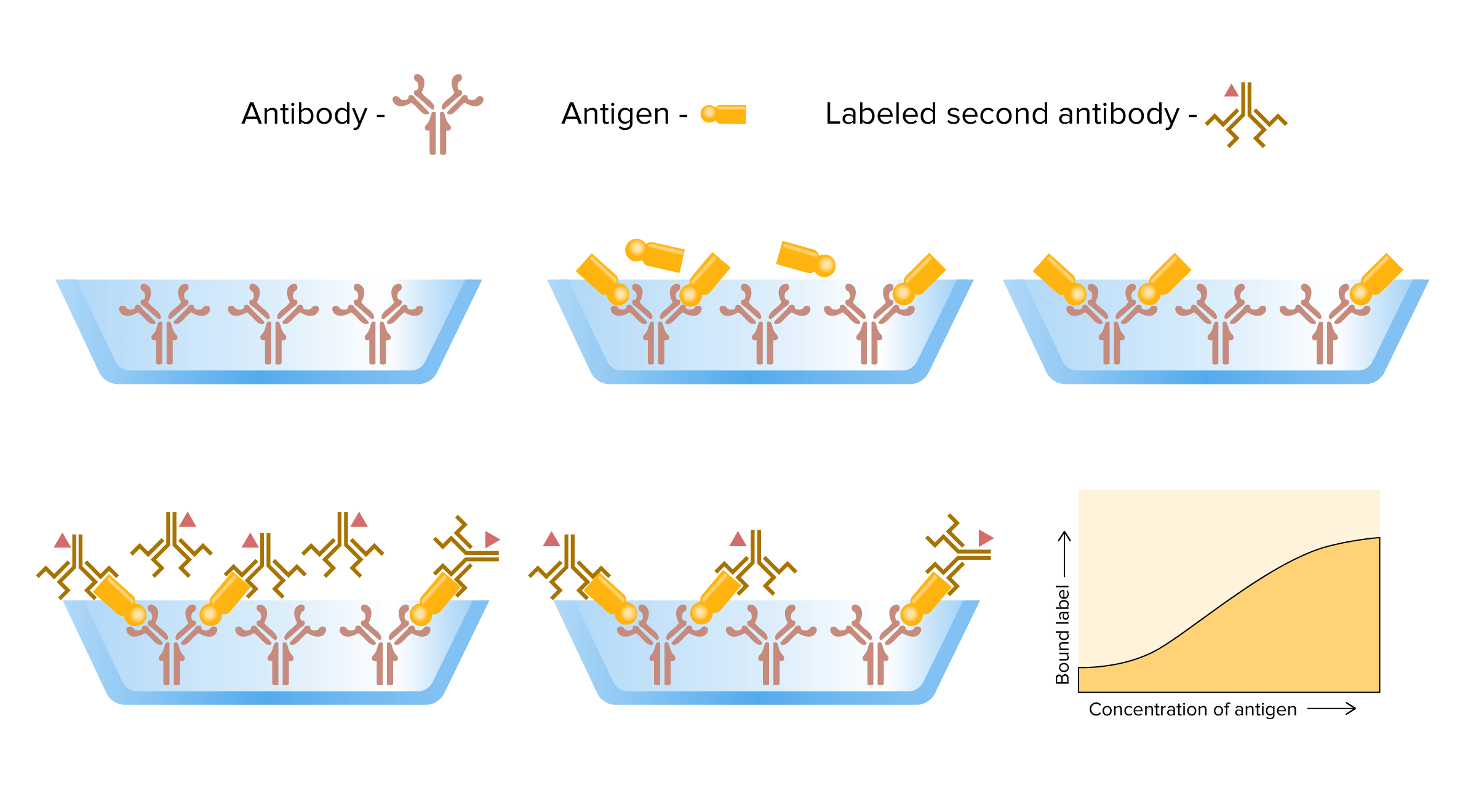
mecanismo de inmunoensayo sandwich

Mecanismo de inmunoensayo sándwich:
De izquierda a derecha: el antígeno del analito se agrega a una placa recubierta de anticuerpos. Los antígenos no unidos se eliminan mediante lavado y se agregan anticuerpos secundarios marcados con enzimas, que se unen a los antígenos. El exceso de anticuerpos marcados no unidos se elimina mediante lavado. Se añade el sustrato y se detecta/mide el cambio de color resultante.
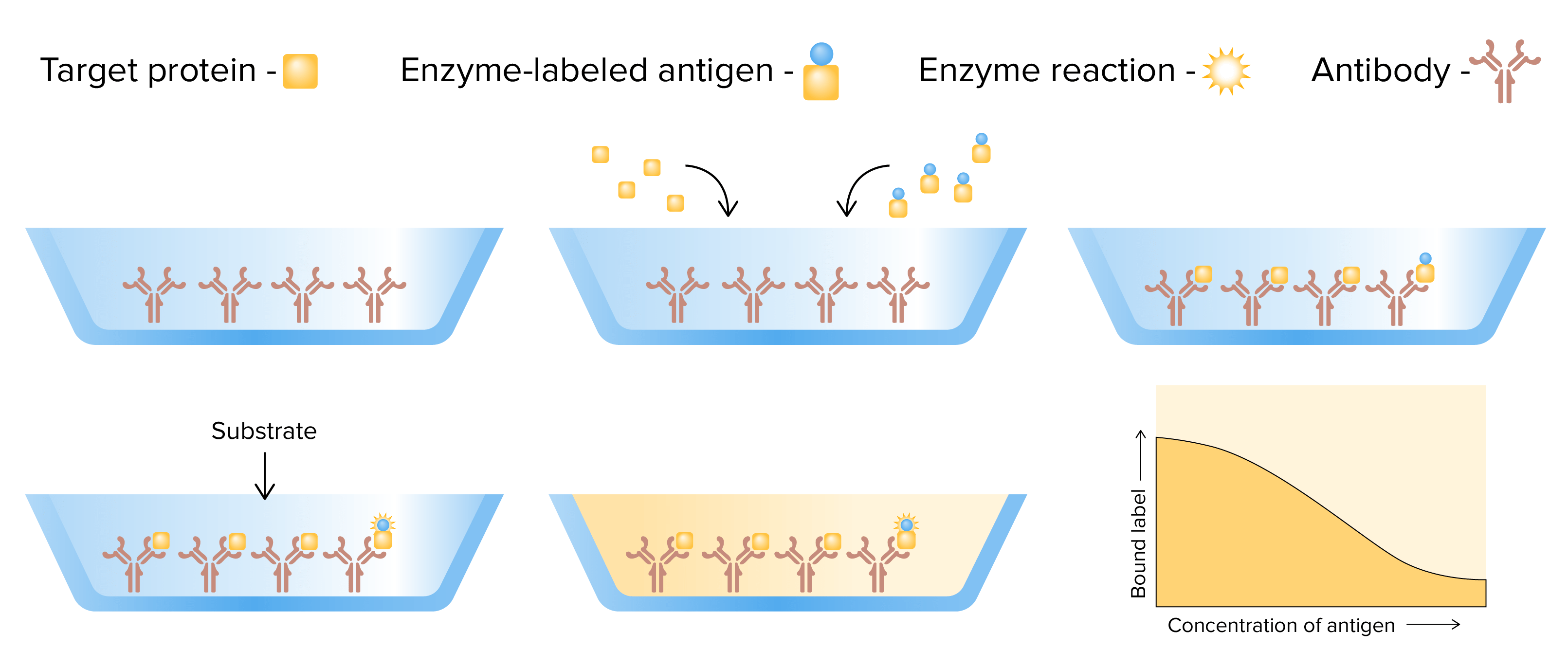
Imagen por Lecturio.
Mecanismo de ELISA competitivo

Mecanismo de ELISA competitivo:
De izquierda a derecha: se agregan un antígeno objetivo y un antígeno marcado con enzima a una placa recubierta de anticuerpos. Los antígenos compiten por unirse a los anticuerpos. A continuación, se añade un sustrato y se detecta/mide el cambio de color subsiguiente. A diferencia de otras formas de inmunoensayos, menos cambio de color indica una mayor concentración del antígeno objetivo (ya que no contiene el marcador enzimático).

Imagen por Lecturio.

Usos

Los LOS Neisseria inmunoensayos tienen una amplia gama de aplicaciones clínicas. Los LOS Neisseria ejemplos enumerados a continuación no son todos ellos.

Enfermedades infecciosas

Los LOS Neisseria inmunoensayos se pueden utilizar para identificar directamente microorganismos (basados en EN Erythema nodosum is an immune-mediated panniculitis (inflammation of the subcutaneous fat) caused by a type IV (delayed-type) hypersensitivity reaction. It commonly manifests in young women as tender, erythematous nodules on the shins. Erythema Nodosum antígenos o toxinas) o evaluar indirectamente los LOS Neisseria anticuerpos contra el agente infeccioso. Algunos ejemplos son:

  • Detección de microorganismos:
    • Legionella pneumophila Legionella pneumophila A species of gram-negative, aerobic bacteria that is the causative agent of legionnaires’ disease. It has been isolated from numerous environmental sites as well as from human lung tissue, respiratory secretions, and blood. Legionella/Legionellosis
    • Escherichia coli Escherichia coli The gram-negative bacterium Escherichia coli is a key component of the human gut microbiota. Most strains of E. coli are avirulent, but occasionally they escape the GI tract, infecting the urinary tract and other sites. Less common strains of E. coli are able to cause disease within the GI tract, most commonly presenting as abdominal pain and diarrhea. Escherichia coli (toxina)
    • Clostridioides difficile (toxina)
    • Hepatitis B Hepatitis B Hepatitis B virus (HBV) is a partially double-stranded DNA virus, which belongs to the Orthohepadnavirus genus and the Hepadnaviridae family. Most individuals with acute HBV infection are asymptomatic or have mild, self-limiting symptoms. Chronic infection can be asymptomatic or create hepatic inflammation, leading to liver cirrhosis and hepatocellular carcinoma (HCC). Hepatitis B Virus
  • Detección de anticuerpos:
    • VIH
    • Virus Virus Viruses are infectious, obligate intracellular parasites composed of a nucleic acid core surrounded by a protein capsid. Viruses can be either naked (non-enveloped) or enveloped. The classification of viruses is complex and based on many factors, including type and structure of the nucleoid and capsid, the presence of an envelope, the replication cycle, and the host range. Virology del Nilo Occidental
    • Hepatitis C Hepatitis C Hepatitis C is an infection of the liver caused by the hepatitis C virus (HCV). The infection can be transmitted through infectious blood or body fluids and may be transmitted during childbirth or through IV drug use or sexual intercourse. Hepatitis C virus can cause both acute and chronic hepatitis, ranging from a mild to a serious, lifelong illness including liver cirrhosis and hepatocellular carcinoma (HCC). Hepatitis C Virus
    • Borrelia burgdorferi Borrelia burgdorferi A specific species of bacteria, part of the borrelia burgdorferi group, whose common name is lyme disease spirochete. Borrelia
    • Treponema pallidum Treponema pallidum The causative agent of venereal and non-venereal syphilis as well as yaws. Treponema

Detección y seguimiento del cáncer

Pueden utilizarse inmunoensayos para detectar marcadores tumorales. Ejemplos incluyen:

  • Antígeno prostático específico ( PSA PSA A glycoprotein that is a kallikrein-like serine proteinase and an esterase, produced by epithelial cells of both normal and malignant prostate tissue. It is an important marker for the diagnosis of prostate cancer. Prostate Cancer, por sus siglas en EN Erythema nodosum is an immune-mediated panniculitis (inflammation of the subcutaneous fat) caused by a type IV (delayed-type) hypersensitivity reaction. It commonly manifests in young women as tender, erythematous nodules on the shins. Erythema Nodosum inglés)
  • Antígeno del cáncer-125
  • Alfafetoproteína
  • Antígeno carcinoembrionario

Pruebas de alergia

Los LOS Neisseria inmunoensayos se pueden utilizar para detectar anticuerpos IgE IgE An immunoglobulin associated with mast cells. Overexpression has been associated with allergic hypersensitivity. Immunoglobulins: Types and Functions contra alérgenos específicos:

  • Resultado positivo:
    • Indica sensibilización a ese alérgeno
    • No indica necesariamente si ese individuo tendrá una respuesta clínica tras la exposición a ese antígeno
  • Resultado negativo:
    • No sugiere alergia al AL Amyloidosis antígeno
    • No excluye completamente la alergia al AL Amyloidosis antígeno ( en EN Erythema nodosum is an immune-mediated panniculitis (inflammation of the subcutaneous fat) caused by a type IV (delayed-type) hypersensitivity reaction. It commonly manifests in young women as tender, erythematous nodules on the shins. Erythema Nodosum particular, si hay un antecedente clínico sugestivo)

Medicamentos

La monitorización de medicamentos terapéuticos es una aplicación importante de los LOS Neisseria inmunoensayos. Los LOS Neisseria ejemplos incluyen el control de los LOS Neisseria niveles de medicamentos de:

  • Digoxina
  • Teofilina
  • Inmunosupresores (e.g., ácido micofenólico, ciclosporina)
  • Antibióticos (e.g., amikacina, vancomicina, gentamicina)

Otros usos diagnósticos

Las pruebas de laboratorio adicionales donde se pueden utilizar inmunoensayos incluyen:

  • Troponina I de alta sensibilidad
  • Función de la tiroides:
    • Hormona estimulante de la tiroides (TSH, por sus siglas en EN Erythema nodosum is an immune-mediated panniculitis (inflammation of the subcutaneous fat) caused by a type IV (delayed-type) hypersensitivity reaction. It commonly manifests in young women as tender, erythematous nodules on the shins. Erythema Nodosum inglés)
    • Tiroxina libre ( T4 T4 The major hormone derived from the thyroid gland. Thyroxine is synthesized via the iodination of tyrosines (monoiodotyrosine) and the coupling of iodotyrosines (diiodotyrosine) in the thyroglobulin. Thyroxine is released from thyroglobulin by proteolysis and secreted into the blood. Thyroxine is peripherally deiodinated to form triiodothyronine which exerts a broad spectrum of stimulatory effects on cell metabolism. Thyroid Hormones) y triyodotironina ( T3 T3 A T3 thyroid hormone normally synthesized and secreted by the thyroid gland in much smaller quantities than thyroxine (T4). Most T3 is derived from peripheral monodeiodination of T4 at the 5′ position of the outer ring of the iodothyronine nucleus. The hormone finally delivered and used by the tissues is mainly t3. Thyroid Hormones)
  • Nutricional:
    • Folato
    • Vitamina B12
    • Ferritina
    • Vitamina D

Ventajas y Errores

Ventajas

Las ventajas dependen del tipo de inmunoensayo utilizado; sin embargo, en EN Erythema nodosum is an immune-mediated panniculitis (inflammation of the subcutaneous fat) caused by a type IV (delayed-type) hypersensitivity reaction. It commonly manifests in young women as tender, erythematous nodules on the shins. Erythema Nodosum general, son:

  • Baratos
  • Sensibles
  • Específicos
  • Relativamente rápidos y convenientes

Fuentes de error Error Refers to any act of commission (doing something wrong) or omission (failing to do something right) that exposes patients to potentially hazardous situations. Disclosure of Information

  • Reactividad cruzada ( los LOS Neisseria anticuerpos reactivos se unen a moléculas que son similares al AL Amyloidosis analito → resultados falsos positivos/falsamente elevados)
  • Los LOS Neisseria autoanticuerpos (anticuerpos endógenos, en EN Erythema nodosum is an immune-mediated panniculitis (inflammation of the subcutaneous fat) caused by a type IV (delayed-type) hypersensitivity reaction. It commonly manifests in young women as tender, erythematous nodules on the shins. Erythema Nodosum lugar de anticuerpos reactivos) se unen al AL Amyloidosis analito → resultados falsos negativos/falsamente bajos)
  • Anticuerpos antirreactivos ( los LOS Neisseria anticuerpos endógenos se unen a los LOS Neisseria anticuerpos reactivos → resultados falsos positivos/falsamente elevados)

Referencias

  1. Aydin, S. (2015). A short history, principles, and types of ELISA, and our laboratory experience with peptide/protein analyses using ELISA. Peptides, 72, 4–15. https://doi.org/10.1016/j.peptides.2015.04.012
  2. Engvall, E. (2010). The ELISA, enzyme-linked immunosorbent assay. Clinical Chemistry, 56(2), 319–320. https://doi.org/10.1373/clinchem.2009.127803
  3. Shah, K., & Maghsoudlou, P. (2016). Enzyme-linked immunosorbent assay (ELISA): The basics. British Journal of Hospital Medicine, 77(7), C98–C101. https://doi.org/10.12968/hmed.2016.77.7.C98
  4. Konstantinou, G. N. (2017). Enzyme-linked immunosorbent assay (ELISA). In G. K. Makowski (Ed.), Methods in molecular biology (Vol. 1592, pp. 79–94). Humana Press. https://doi.org/10.1007/978-1-4939-6925-8_7
  5. Kohl, T. O., & Ascoli, C. A. (2017). Direct competitive enzyme-linked immunosorbent assay (ELISA). Cold Spring Harbor Protocols, 2017(7), pdb.prot093740. https://doi.org/10.1101/pdb.prot093740
  6. Kohl, T. O., & Ascoli, C. A. (2017). Indirect immunometric ELISA. Cold Spring Harbor Protocols, 2017(5), pdb.prot093708. https://doi.org/10.1101/pdb.prot093708
  7. Kohl, T. O., & Ascoli, C. A. (2017). Immunometric double-antibody sandwich enzyme-linked immunosorbent assay. Cold Spring Harbor Protocols, 2017(6), pdb.prot093724. https://doi.org/10.1101/pdb.prot093724
  8. Kowal, K., DuBuske, L. (2025). Overview of in vitro allergy tests. In Feldweg, A.M. (Ed.), UpToDate. Retrieved April 28, 2025, from https://www.uptodate.com/contents/overview-of-in-vitro-allergy-tests
  9. Alhajj, M., Farhana, A. (2023). Enzyme linked immunosorbent assay. [online] StatPearls. Retrieved April 28, 2025, from https://www.ncbi.nlm.nih.gov/books/NBK555922/
  10. Gleichmann, N. (2023). Immunoassays: A guide. Technology Networks. Retrieved April 28, 2025, from https://www.technologynetworks.com/diagnostics/articles/immunoassays-a-guide-338790
  11. Yin, Y., Cao, Y., Xu, Y., & Li, G. (2010). Colorimetric immunoassay for detection of tumor markers. International Journal of Molecular Sciences, 11(12), 5077–5094. https://doi.org/10.3390/ijms11125077
  12. Hoofnagle, A. N., & Wener, M. H. (2009). The fundamental flaws of immunoassays and potential solutions using tandem mass spectrometry. Journal of Immunological Methods, 347(1–2), 3–11. https://doi.org/10.1016/j.jim.2009.06.003
  13. Darwish, I. A. (2006). Immunoassay methods and their applications in pharmaceutical analysis: Basic methodology and recent advances. International Journal of Biomedical Science, 2(3), 217–235. PMID: 23674985.

¡Crea tu cuenta gratis o inicia una sesión para seguir leyendo!

Regístrate ahora y obtén acceso gratuito a Lecturio con páginas de concepto, videos médicos y cuestionarios para tu educación médica.

User Reviews

Que tengas una sesión de estudio alegre y navideña 🎁 Ahorra 50% en todos los planes >>

Details