
Domina Conceptos Médicos

Estudia para la escuela de medicina y tus examenes con Lecturio.

Hiperpotasemia

La hiperpotasemia se define como una concentración sérica de potasio (K+) > 5,2 mEq/L. Los LOS Neisseria mecanismos homeostáticos mantienen la concentración sérica de K+ entre 3,5 y 5,2 mEq/L, a pesar de la marcada variación en EN Erythema nodosum is an immune-mediated panniculitis (inflammation of the subcutaneous fat) caused by a type IV (delayed-type) hypersensitivity reaction. It commonly manifests in young women as tender, erythematous nodules on the shins. Erythema Nodosum la ingesta dietética. La hiperpotasemia puede deberse a una variedad de causas, que incluyen cambios transcelulares, destrucción de tejidos, excreción renal inadecuada y medicamentos. La hiperpotasemia leve suele ser asintomática; sin embargo, las elevaciones agudas o la hiperpotasemia grave pueden provocar arritmias cardíacas potencialmente mortales. El tratamiento se guía por la gravedad e incluye medidas para estabilizar el potencial de la membrana miocárdica, desplazar el K+  al AL Amyloidosis espacio intracelular transitoriamente, eliminar el K+ del cuerpo y tratar las condiciones predisponentes subyacentes.

Last updated: Dec 15, 2025

Editorial responsibility: Stanley Oiseth, Lindsay Jones, Evelin Maza

Descripción General

Consideraciones generales

El K+ es el principal catión intracelular en EN Erythema nodosum is an immune-mediated panniculitis (inflammation of the subcutaneous fat) caused by a type IV (delayed-type) hypersensitivity reaction. It commonly manifests in young women as tender, erythematous nodules on the shins. Erythema Nodosum todas las células y se distribuye de manera desigual entre el líquido intracelular (98%) y el líquido extracelular (2%).

  • La disparidad es necesaria para mantener el potencial de membrana en EN Erythema nodosum is an immune-mediated panniculitis (inflammation of the subcutaneous fat) caused by a type IV (delayed-type) hypersensitivity reaction. It commonly manifests in young women as tender, erythematous nodules on the shins. Erythema Nodosum reposo de las células → el equilibrio de K+ está estrictamente regulado
  • La hiperpotasemia causa despolarización (i.e., disminución) del potencial de membrana en EN Erythema nodosum is an immune-mediated panniculitis (inflammation of the subcutaneous fat) caused by a type IV (delayed-type) hypersensitivity reaction. It commonly manifests in young women as tender, erythematous nodules on the shins. Erythema Nodosum reposo, lo que lleva a la inactivación de los LOS Neisseria canales de Na+ → disminución de la excitabilidad de las células cardíacas → predisposición a las arritmias
  • Los LOS Neisseria riñones son responsables del 90%–95% de la regulación general de K+.
  • El tracto gastrointestinal secreta 5%–10% de K+ absorbido diariamente.

Sitios de acción en EN Erythema nodosum is an immune-mediated panniculitis (inflammation of the subcutaneous fat) caused by a type IV (delayed-type) hypersensitivity reaction. It commonly manifests in young women as tender, erythematous nodules on the shins. Erythema Nodosum el riñón

  • Glomérulo: K+ se filtra libremente.
  • Túbulo proximal: se reabsorbe del 65%–70% del K+ filtrado.
  • Porción ascendente gruesa del asa ASA Anterior Cord Syndrome de Henle: se reabsorbe 10%–25% del K+ filtrado.
  • Célula principal (conducto colector cortical): se secreta K+.
  • Célula 𝛼-intercalada (conducto colector): K+ se reabsorbe (mecanismo fino de ajuste final).

Respuesta normal al AL Amyloidosis K+ ingerido

Una dieta occidental normal contiene aproximadamente 70–150 mmol de K+ por día. Es poco probable que esta dieta conduzca al AL Amyloidosis desarrollo de hiperpotasemia solo por el aumento de la ingesta, debido a los LOS Neisseria siguientes mecanismos:

  1. El intestino absorbe el K+ de la dieta hacia el torrente sanguíneo.
  2. El cambio transcelular evita el aumento excesivo de la concentración de K+ en el líquido extracelular (LEC).
    1. Mediado por insulina y β2
    2. El K+ se desplaza principalmente hacia las células musculares y hepáticas.
  3. El aumento de la concentración de K+ en EN Erythema nodosum is an immune-mediated panniculitis (inflammation of the subcutaneous fat) caused by a type IV (delayed-type) hypersensitivity reaction. It commonly manifests in young women as tender, erythematous nodules on the shins. Erythema Nodosum LEC desencadena mecanismos para la excreción renal de K+.
  4. El cambio transcelular hacia las células musculares/hepáticas se revierte gradualmente.
  5. El resto de la carga de K+ ingerido se excreta por vía renal.

Etiología

Las etiologías de la hiperpotasemia se pueden agrupar en EN Erythema nodosum is an immune-mediated panniculitis (inflammation of the subcutaneous fat) caused by a type IV (delayed-type) hypersensitivity reaction. It commonly manifests in young women as tender, erythematous nodules on the shins. Erythema Nodosum 5 categorías: cambios transcelulares, destrucción de tejidos, excreción renal inadecuada, inducida por medicamentos y pseudohiperpotasemia.

Intercambios transcelulares

  • Ciertos factores hacen que el K+ entre o salga transitoriamente de las células.
  • El efecto de este cambio puede ser lo suficientemente significativo como para disminuir o aumentar el K+ sérico medido.
  • El K+ total corporal no cambia.
  • Factores que provocan el desplazamiento fuera de la célula (→ aumento del K+ plasmático):
    • Acidosis Acidosis A pathologic condition of acid accumulation or depletion of base in the body. The two main types are respiratory acidosis and metabolic acidosis, due to metabolic acid build up. Respiratory Acidosis: el intercambio de H+/K+ mantiene la electroneutralidad → mueve H+ hacia el interior de la célula para ayudar a equilibrar el pH pH The quantitative measurement of the acidity or basicity of a solution. Acid-Base Balance extracelular a cambio de que el K+ salga de la célula
    • Hiperosmolalidad (hiperglucemia, contraste intravenoso, manitol):
      • Alta osmolalidad del LEC → cambio de agua al AL Amyloidosis LEC → disminución de la concentración de K+ en EN Erythema nodosum is an immune-mediated panniculitis (inflammation of the subcutaneous fat) caused by a type IV (delayed-type) hypersensitivity reaction. It commonly manifests in young women as tender, erythematous nodules on the shins. Erythema Nodosum el LEC → gradiente más favorable para la difusión de K+ fuera de las células
      • El arrastre del solvente sobre el K+ a medida que el agua sale de la célula también puede contribuir.
      • Mecanismo común en EN Erythema nodosum is an immune-mediated panniculitis (inflammation of the subcutaneous fat) caused by a type IV (delayed-type) hypersensitivity reaction. It commonly manifests in young women as tender, erythematous nodules on the shins. Erythema Nodosum la hiperglucemia (i.e., cetoacidosis diabética)
    • Ejercicio: K+ es liberado intencionalmente por las células musculares para actuar como un vasodilatador local.
  • Factores que provocan el desplazamiento hacia la célula (→ disminuye el K+ sérico):
    • Insulina: estimula la Na+/K+ ATPasa → 3 Na+ salen de la célula, 2 K+ entran en EN Erythema nodosum is an immune-mediated panniculitis (inflammation of the subcutaneous fat) caused by a type IV (delayed-type) hypersensitivity reaction. It commonly manifests in young women as tender, erythematous nodules on the shins. Erythema Nodosum la célula
    • Agonista β2-adrenérgico (i.e., albuterol Albuterol A short-acting beta-2 adrenergic agonist that is primarily used as a bronchodilator agent to treat asthma. Sympathomimetic Drugs; estimula la Na+/K+ ATPasa)
    • Alcalosis: el intercambiador H+/K+ mueve H+ fuera de la célula para ayudar a equilibrar el pH pH The quantitative measurement of the acidity or basicity of a solution. Acid-Base Balance extracelular a cambio de que el K+ entre en EN Erythema nodosum is an immune-mediated panniculitis (inflammation of the subcutaneous fat) caused by a type IV (delayed-type) hypersensitivity reaction. It commonly manifests in young women as tender, erythematous nodules on the shins. Erythema Nodosum la célula
Transcellular shift of K Potassium

Desplazamiento transcelular de K+:
Desplazamiento extracelular de K+:
1. La acidosis (aumento de H+) provoca el bloqueo del intercambiador Na+/H+, lo que provoca una disminución del Na+ intracelular, bloqueando a su vez la Na+/K+ ATPasa. Por otro lado, la acidosis activa el intercambiador H+/K+. Ambos provocan un aumento del K+ extracelular.
2. El aumento de la osmolaridad en el espacio extracelular (hiperglucemia, contraste intravenoso, manitol) desplaza el agua fuera de la célula, disminuyendo la concentración de K+. El aumento del gradiente provoca la difusión del K+ al exterior.
Desplazamiento intracelular de K+:
1. La alcalosis (disminución del H+) provoca la activación del intercambiador Na+/H+, lo que provoca un aumento del Na+ intracelular, activando a su vez la Na+/K+ ATPasa. Por otro lado, la alcalosis bloquea el intercambiador H+/K+. Ambos provocan una disminución del K+ extracelular.
2. La insulina y los agonistas β2 adrenérgicos activan la Na+/K+ ATPasa, disminuyendo la concentración plasmática de K+.

Imagen por Lecturio.

Destrucción de tejidos

  • Similar al AL Amyloidosis cambio transcelular, pero el cambio no es reversible.
  • El daño a la célula da como resultado la liberación de K+ intracelular altamente concentrado:
    • Síndrome de lisis tumoral (muerte de células malignas de alto volumen después de la quimioterapia)
    • Rabdomiólisis (células musculares; trauma, lesiones por aplastamiento, inmovilización prolongada)
    • Transfusión de eritrocitos (si varias unidades o eritrocitos viejos se lisan con el tiempo en EN Erythema nodosum is an immune-mediated panniculitis (inflammation of the subcutaneous fat) caused by a type IV (delayed-type) hypersensitivity reaction. It commonly manifests in young women as tender, erythematous nodules on the shins. Erythema Nodosum almacenamiento)
    • Hemorragia digestiva (eritrocitos metabolizados por el tracto gastrointestinal → K+ intracelular liberado)
    • Gran hematoma Hematoma A collection of blood outside the blood vessels. Hematoma can be localized in an organ, space, or tissue. Intussusception (eritrocitos reabsorbidos y metabolizados → K+ intracelular liberado)
    • Quemaduras (células de la piel)

Excreción renal inadecuada

Insuficiencia renal:

  • Oliguria Oliguria Decreased urine output that is below the normal range. Oliguria can be defined as urine output of less than or equal to 0. 5 or 1 ml/kg/hr depending on the age. Renal Potassium Regulation → ↓ tasa de flujo distal → ↓ K+ secreción
  • La oliguria Oliguria Decreased urine output that is below the normal range. Oliguria can be defined as urine output of less than or equal to 0. 5 or 1 ml/kg/hr depending on the age. Renal Potassium Regulation más el exceso de carga de K+ o el bloqueador de aldosterona (IECA/ARA) darán como resultado hiperpotasemia.
  • La oliguria Oliguria Decreased urine output that is below the normal range. Oliguria can be defined as urine output of less than or equal to 0. 5 or 1 ml/kg/hr depending on the age. Renal Potassium Regulation por sí sola puede no causar hiperpotasemia.

Depleción de volumen:

  • Hipovolemia → ↓ aporte distal de Na+ → ↓ secreción de K+
  • También ocurre en EN Erythema nodosum is an immune-mediated panniculitis (inflammation of the subcutaneous fat) caused by a type IV (delayed-type) hypersensitivity reaction. It commonly manifests in young women as tender, erythematous nodules on the shins. Erythema Nodosum estados de sobrecarga de líquidos corporales totales, pero con depleción efectiva del volumen sanguíneo arterial (insuficiencia cardíaca, cirrosis)
  • La depleción de volumen también puede causar IRA → hiperpotasemia por oliguria Oliguria Decreased urine output that is below the normal range. Oliguria can be defined as urine output of less than or equal to 0. 5 or 1 ml/kg/hr depending on the age. Renal Potassium Regulation

Hipoaldosteronismo funcional:

  • Deficiencia de mineralocorticoides:
    • Insuficiencia suprarrenal primaria
    • Hipoaldosteronismo hiporreninémico
  • Enfermedad tubulointersticial: enfermedad de células falciformes, obstrucción del tracto urinario
  • Medicamentos (véase tabla a continuación)

Hiperpotasemia inducida por medicamentos

Los LOS Neisseria medicamentos son una causa muy común de hiperpotasemia y la provocan una variedad de los LOS Neisseria mecanismos mencionados anteriormente. Una parte clave del diagnóstico de hiperpotasemia es revisar todos los LOS Neisseria fármacos y medicamentos recientes que ha HA Hemolytic anemia (HA) is the term given to a large group of anemias that are caused by the premature destruction/hemolysis of circulating red blood cells (RBCs). Hemolysis can occur within (intravascular hemolysis) or outside the blood vessels (extravascular hemolysis). Hemolytic Anemia recibido un paciente.

Tabla: Hiperpotasemia inducida por medicamentos
Clases de medicamentos (ejemplos) Mecanismo
IECA (e.g., lisinopril Lisinopril One of the angiotensin-converting enzyme inhibitors (ACE inhibitors), orally active, that has been used in the treatment of hypertension and congestive heart failure. Renin-Angiotensin-Aldosterone System Inhibitors, captopril Captopril A potent and specific inhibitor of peptidyl-dipeptidase a. It blocks the conversion of angiotensin I to angiotensin II, a vasoconstrictor and important regulator of arterial blood pressure. Captopril acts to suppress the renin-angiotensin system and inhibits pressure responses to exogenous angiotensin. Hypertension Drugs) Inhiben la formación de angiotensina II → disminuyen la secreción de aldosterona → disminuyen la secreción renal de K+
ARA (e.g., losartán, valsartán) Bloquean el receptor Receptor Receptors are proteins located either on the surface of or within a cell that can bind to signaling molecules known as ligands (e.g., hormones) and cause some type of response within the cell. Receptors de angiotensina → ↓ secreción de aldosterona → ↓ secreción renal de K+
Inhibidores directos de la renina (e.g., aliskiren Aliskiren Renin-Angiotensin-Aldosterone System Inhibitors) Impiden que la renina convierta el angiotensinógeno en EN Erythema nodosum is an immune-mediated panniculitis (inflammation of the subcutaneous fat) caused by a type IV (delayed-type) hypersensitivity reaction. It commonly manifests in young women as tender, erythematous nodules on the shins. Erythema Nodosum angiotensina l → disminuyen la secreción de aldosterona → ↓ excreción renal de K+
Diuréticos ahorradores de K+ (e.g., amilorida, triamtereno, espironolactona) Bloquean el canal de sodio epitelial ( ENaC ENaC Sodium channels found on salt-reabsorbing epithelial cells that line the distal nephron; the distal colon; salivary ducts; sweat glands; and the lung. They are amiloride-sensitive and play a critical role in the control of sodium balance, blood volume, and blood pressure. Liddle Syndrome, por sus siglas en EN Erythema nodosum is an immune-mediated panniculitis (inflammation of the subcutaneous fat) caused by a type IV (delayed-type) hypersensitivity reaction. It commonly manifests in young women as tender, erythematous nodules on the shins. Erythema Nodosum inglés) (amilorida, triamtereno) o el receptor Receptor Receptors are proteins located either on the surface of or within a cell that can bind to signaling molecules known as ligands (e.g., hormones) and cause some type of response within the cell. Receptors de aldosterona (espironolactona, eplerenona) → ↓ excreción renal de K+
Glucósidos cardíacos (digoxina) Inhiben la bomba Na+/K+ ATPasa → se mueve menos K+ a las células
AINE (e.g., ibuprofeno) Disminuyen renina y aldosterona → ↓ secreción renal de K+
Inhibidores de la calcineurina (e.g., ciclosporina, tacrolimus Tacrolimus A macrolide isolated from the culture broth of a strain of streptomyces tsukubaensis that has strong immunosuppressive activity in vivo and prevents the activation of T-lymphocytes in response to antigenic or mitogenic stimulation in vitro. Immunosuppressants) Multifactorial/comprendido de forma incompleta: ↓ liberación de aldosterona, ↓ sensibilidad a la aldosterona, inhibición de la bomba Na+/K+ ATPasa, bloqueo del canal ENaC ENaC Sodium channels found on salt-reabsorbing epithelial cells that line the distal nephron; the distal colon; salivary ducts; sweat glands; and the lung. They are amiloride-sensitive and play a critical role in the control of sodium balance, blood volume, and blood pressure. Liddle Syndrome
Succinilcolina Provoca fuga extracelular de K+ a través de canales activados por receptores de acetilcolina
Antimicrobianos (e.g., trimetoprima, pentamidina) Bloquean el canal ENaC ENaC Sodium channels found on salt-reabsorbing epithelial cells that line the distal nephron; the distal colon; salivary ducts; sweat glands; and the lung. They are amiloride-sensitive and play a critical role in the control of sodium balance, blood volume, and blood pressure. Liddle Syndrome

Pseudohiperpotasemia

  • Hiperpotasemia falsa, debido al AL Amyloidosis proceso de extracción y/o procesamiento de una muestra de sangre
  • Relacionado con la extracción de sangre:
    • Los LOS Neisseria eritrocitos dañados se lisan y liberan su K+ intracelular.
    • Torniquete prolongado
    • Apretar los LOS Neisseria puños en EN Erythema nodosum is an immune-mediated panniculitis (inflammation of the subcutaneous fat) caused by a type IV (delayed-type) hypersensitivity reaction. It commonly manifests in young women as tender, erythematous nodules on the shins. Erythema Nodosum exceso
    • Trauma por venopunción
  • Relacionado con el procesamiento de muestras de sangre:
    • Trombocitosis severa o leucocitosis
    • Más probable si el análisis de la muestra de sangre se retrasa
    • El K+ intracelular se libera de las plaquetas después de la coagulación en EN Erythema nodosum is an immune-mediated panniculitis (inflammation of the subcutaneous fat) caused by a type IV (delayed-type) hypersensitivity reaction. It commonly manifests in young women as tender, erythematous nodules on the shins. Erythema Nodosum el tubo de ensayo.
    • Los LOS Neisseria leucocitos se lisan y liberan K+ intracelular

Presentación Clínica

Los LOS Neisseria síntomas más graves de la hiperpotasemia son la alteración de la conducción eléctrica en EN Erythema nodosum is an immune-mediated panniculitis (inflammation of the subcutaneous fat) caused by a type IV (delayed-type) hypersensitivity reaction. It commonly manifests in young women as tender, erythematous nodules on the shins. Erythema Nodosum el corazón. Es más probable que los LOS Neisseria síntomas cardíacos ocurran con el aumento de la gravedad y la agudeza de la hiperpotasemia; sin embargo, incluso la hiperpotasemia relativamente grave puede ser asintomática. Se pueden observar síntomas musculares, y estos incluyen debilidad y parálisis.

Síntomas cardíacos

Los LOS Neisseria síntomas cardíacos son los LOS Neisseria síntomas más importantes de la hiperpotasemia, ya que pueden ser rápidamente fatales.

  • Los LOS Neisseria cambios en EN Erythema nodosum is an immune-mediated panniculitis (inflammation of the subcutaneous fat) caused by a type IV (delayed-type) hypersensitivity reaction. It commonly manifests in young women as tender, erythematous nodules on the shins. Erythema Nodosum el ECG ECG An electrocardiogram (ECG) is a graphic representation of the electrical activity of the heart plotted against time. Adhesive electrodes are affixed to the skin surface allowing measurement of cardiac impulses from many angles. The ECG provides 3-dimensional information about the conduction system of the heart, the myocardium, and other cardiac structures. Electrocardiogram (ECG) siguen una progresión característica con el aumento de K+:
    • Ondas T puntiagudas e intervalo QT corto → prolongación del intervalo PR y ensanchamiento del QRS → pérdida de ondas P → QRS se ensancha a onda sinusoidal → asistolia
    • Esta progresión clásica a menudo no se observa clínicamente.
    • Los LOS Neisseria hallazgos del ECG ECG An electrocardiogram (ECG) is a graphic representation of the electrical activity of the heart plotted against time. Adhesive electrodes are affixed to the skin surface allowing measurement of cardiac impulses from many angles. The ECG provides 3-dimensional information about the conduction system of the heart, the myocardium, and other cardiac structures. Electrocardiogram (ECG) son útiles si están presentes, pero no son sensibles para la hiperpotasemia en EN Erythema nodosum is an immune-mediated panniculitis (inflammation of the subcutaneous fat) caused by a type IV (delayed-type) hypersensitivity reaction. It commonly manifests in young women as tender, erythematous nodules on the shins. Erythema Nodosum general.
  • Arritmias:
    • Bloqueo auriculoventricular avanzado
    • Bradicardia sinusal
    • Paro sinusal
    • Ritmo idioventricular lento
    • Taquicardia ventricular, fibrilación ventricular y/o asistolia si es grave
  • Monitorización
    • Importante en EN Erythema nodosum is an immune-mediated panniculitis (inflammation of the subcutaneous fat) caused by a type IV (delayed-type) hypersensitivity reaction. It commonly manifests in young women as tender, erythematous nodules on the shins. Erythema Nodosum todos los LOS Neisseria niveles de hiperpotasemia
    • Se puede hacer con ECG ECG An electrocardiogram (ECG) is a graphic representation of the electrical activity of the heart plotted against time. Adhesive electrodes are affixed to the skin surface allowing measurement of cardiac impulses from many angles. The ECG provides 3-dimensional information about the conduction system of the heart, the myocardium, and other cardiac structures. Electrocardiogram (ECG) seriados y/o monitoreo cardíaco continuo

Algunos pacientes no tendrán cambios en EN Erythema nodosum is an immune-mediated panniculitis (inflammation of the subcutaneous fat) caused by a type IV (delayed-type) hypersensitivity reaction. It commonly manifests in young women as tender, erythematous nodules on the shins. Erythema Nodosum el ECG ECG An electrocardiogram (ECG) is a graphic representation of the electrical activity of the heart plotted against time. Adhesive electrodes are affixed to the skin surface allowing measurement of cardiac impulses from many angles. The ECG provides 3-dimensional information about the conduction system of the heart, the myocardium, and other cardiac structures. Electrocardiogram (ECG) ni arritmias, incluso con hiperpotasemia grave.
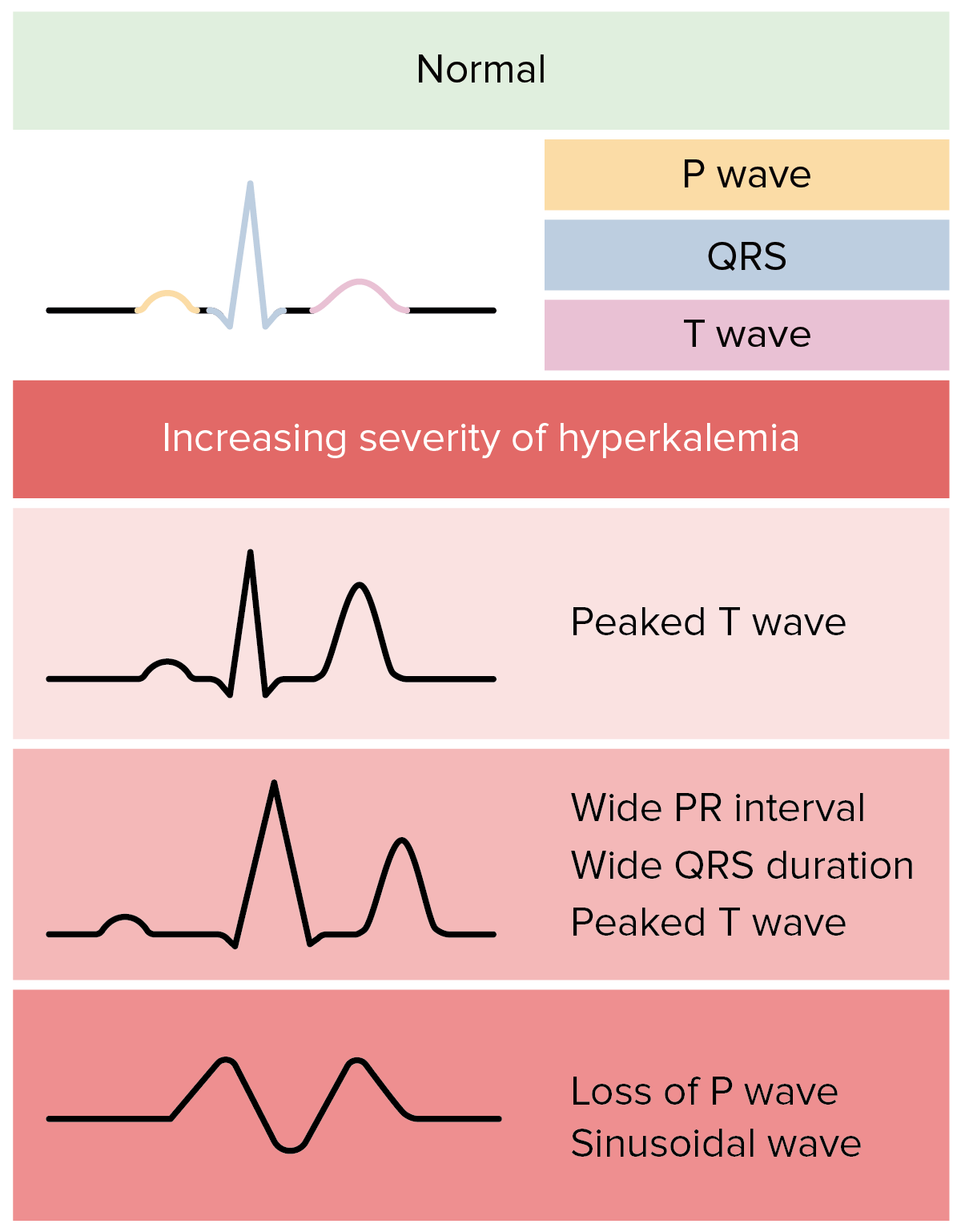
hiperpotasemia electrocardiograma

Cambios en el ECG en la hiperpotasemia:
En realidad, los cambios del ECG en la hiperpotasemia son más variables y menos predecibles.

Imagen por Lecturio.

Síntomas musculares

  • Debilidad muscular
  • Parálisis flácida ascendente (puede parecerse al AL Amyloidosis síndrome de Guillain–Barré)
  • Es poco probable que tenga insuficiencia respiratoria debido a la debilidad de los LOS Neisseria músculos respiratorios

Tratamiento y Diagnóstico

El tratamiento de la hiperpotasemia a menudo tiene prioridad sobre el diagnóstico debido a la posibilidad de arritmias potencialmente mortales y se guía por la determinación del nivel de urgencia necesario para el tratamiento. Por lo general, la etiología de la hiperpotasemia no es difícil de determinar y no se ve VE Ventilation: Mechanics of Breathing impedida por tratarla primero.

Tratamiento

  1. ¿Emergencia hiperpotasémica?
    • Cambios en EN Erythema nodosum is an immune-mediated panniculitis (inflammation of the subcutaneous fat) caused by a type IV (delayed-type) hypersensitivity reaction. It commonly manifests in young women as tender, erythematous nodules on the shins. Erythema Nodosum el ECG ECG An electrocardiogram (ECG) is a graphic representation of the electrical activity of the heart plotted against time. Adhesive electrodes are affixed to the skin surface allowing measurement of cardiac impulses from many angles. The ECG provides 3-dimensional information about the conduction system of the heart, the myocardium, and other cardiac structures. Electrocardiogram (ECG), arritmia o debilidad/parálisis muscular grave
    • K+ sérico por lo general > 6,5 mEq/L
    • Opciones para el tratamiento de emergencia:
      • Calcio intravenoso para estabilizar el miocardio
      • Insulina/glucosa +/– bicarbonato de sodio +/– agonista β2, para desplazar K+ hacia las células
      • Resina de intercambio catiónico +/– diurético de asa ASA Anterior Cord Syndrome para eliminar K+
      • Hemodiálisis
    • Monitorizar el K+ sérico con frecuencia
    • Monitoreo cardíaco continuo y/o repetición del ECG ECG An electrocardiogram (ECG) is a graphic representation of the electrical activity of the heart plotted against time. Adhesive electrodes are affixed to the skin surface allowing measurement of cardiac impulses from many angles. The ECG provides 3-dimensional information about the conduction system of the heart, the myocardium, and other cardiac structures. Electrocardiogram (ECG) durante el tratamiento
    • Consultar a nefrología rápidamente
  2. ¿Resultado de laboratorio exacto?
    • ¿Muestra hemolizada?
      • Tipo común de pseudohiperpotasemia
      • La mayoría de los LOS Neisseria laboratorios indicarán de forma rutinaria si la muestra está hemolizada.
      • Vuelva a tomar la muestra antes de tomar decisiones de tratamiento.
    • ¿Causas menos frecuentes de pseudohiperpotasemia?
      • Trombocitosis grave (i.e., > 1 000 × 109/L)
      • Leucocitosis grave (i.e., > 50 000 × 109/L)
      • Mida el K+ plasmático ( en EN Erythema nodosum is an immune-mediated panniculitis (inflammation of the subcutaneous fat) caused by a type IV (delayed-type) hypersensitivity reaction. It commonly manifests in young women as tender, erythematous nodules on the shins. Erythema Nodosum lugar del K+ sérico de rutina) para obtener un nivel exacto.
  3. ¿Hiperpotasemia moderada con alto riesgo?
    • Generalmente asintomático y sin cambios en EN Erythema nodosum is an immune-mediated panniculitis (inflammation of the subcutaneous fat) caused by a type IV (delayed-type) hypersensitivity reaction. It commonly manifests in young women as tender, erythematous nodules on the shins. Erythema Nodosum el ECG ECG An electrocardiogram (ECG) is a graphic representation of the electrical activity of the heart plotted against time. Adhesive electrodes are affixed to the skin surface allowing measurement of cardiac impulses from many angles. The ECG provides 3-dimensional information about the conduction system of the heart, the myocardium, and other cardiac structures. Electrocardiogram (ECG)
    • K+ sérico 5,5–6,5 mEq/L con factor de alto riesgo:
      • Aumento repentino (e.g., 3,7–6 mEq/L durante la noche)
      • Liberación continua de K+ (e.g., lisis tumoral, rabdomiólisis)
      • Absorción continua de K+ (e.g., hemorragia digestiva)
      • Disfunción renal
      • Acidosis Acidosis A pathologic condition of acid accumulation or depletion of base in the body. The two main types are respiratory acidosis and metabolic acidosis, due to metabolic acid build up. Respiratory Acidosis metabólica
    • Tratar de manera similar a la emergencia hiperpotasémica, pero sin necesidad de calcio intravenoso.
  4. ¿Hiperpotasemia moderada sin alto riesgo?
    • Generalmente asintomático y sin cambios en EN Erythema nodosum is an immune-mediated panniculitis (inflammation of the subcutaneous fat) caused by a type IV (delayed-type) hypersensitivity reaction. It commonly manifests in young women as tender, erythematous nodules on the shins. Erythema Nodosum el ECG ECG An electrocardiogram (ECG) is a graphic representation of the electrical activity of the heart plotted against time. Adhesive electrodes are affixed to the skin surface allowing measurement of cardiac impulses from many angles. The ECG provides 3-dimensional information about the conduction system of the heart, the myocardium, and other cardiac structures. Electrocardiogram (ECG)
    • K+ sérico 5,5–6,5 mEq/L sin ninguno de los LOS Neisseria factores de riesgo anteriores
    • Tratar urgentemente:
      • Resina de intercambio catiónico +/– diurético de asa ASA Anterior Cord Syndrome +/– hemodiálisis para eliminar K+
      • Diferencias con el tratamiento de emergencia:
        • No necesita calcio intravenoso
        • No necesariamente necesita medidas intercambiantes de iones
    • Monitorice el K+ sérico con frecuencia
    • Monitoreo cardíaco continuo y/o repetición del ECG ECG An electrocardiogram (ECG) is a graphic representation of the electrical activity of the heart plotted against time. Adhesive electrodes are affixed to the skin surface allowing measurement of cardiac impulses from many angles. The ECG provides 3-dimensional information about the conduction system of the heart, the myocardium, and other cardiac structures. Electrocardiogram (ECG) durante el tratamiento
  5. ¿Hiperpotasemia leve?
    • Generalmente asintomático y sin cambios en EN Erythema nodosum is an immune-mediated panniculitis (inflammation of the subcutaneous fat) caused by a type IV (delayed-type) hypersensitivity reaction. It commonly manifests in young women as tender, erythematous nodules on the shins. Erythema Nodosum el ECG ECG An electrocardiogram (ECG) is a graphic representation of the electrical activity of the heart plotted against time. Adhesive electrodes are affixed to the skin surface allowing measurement of cardiac impulses from many angles. The ECG provides 3-dimensional information about the conduction system of the heart, the myocardium, and other cardiac structures. Electrocardiogram (ECG)
    • K+ sérico < 5,5 mEq/L
    • No requiere tratamiento urgente
    • El tratamiento consiste principalmente en EN Erythema nodosum is an immune-mediated panniculitis (inflammation of the subcutaneous fat) caused by a type IV (delayed-type) hypersensitivity reaction. It commonly manifests in young women as tender, erythematous nodules on the shins. Erythema Nodosum la modificación de los LOS Neisseria factores de riesgo:
      • Restricción dietética de K+ si hay disfunción renal
      • Suspender o ajustar los LOS Neisseria medicamentos causantes (e.g., IECA/ARA, AINE, etc ETC The electron transport chain (ETC) sends electrons through a series of proteins, which generate an electrochemical proton gradient that produces energy in the form of adenosine triphosphate (ATP). Electron Transport Chain (ETC).).
      • Iniciar/ajustar diuréticos de asa ASA Anterior Cord Syndrome o tiazídicos.
      • Iniciar/ajustar bicarbonato de sodio oral.
      • Iniciar/ajustar la resina de intercambio catiónico.
  6. Identificar y tratar cualquier enfermedad subyacente contribuyente.
Tabla: Opciones terapéuticas agudas para la hiperpotasemia
Meta Intervención Propiedades/indicación
Estabilizar el miocardio Calcio intravenoso
  • Antagoniza el efecto sobre el potencial de membrana
  • Indicado en EN Erythema nodosum is an immune-mediated panniculitis (inflammation of the subcutaneous fat) caused by a type IV (delayed-type) hypersensitivity reaction. It commonly manifests in young women as tender, erythematous nodules on the shins. Erythema Nodosum urgencias hiperpotasémicas
  • Inicio en EN Erythema nodosum is an immune-mediated panniculitis (inflammation of the subcutaneous fat) caused by a type IV (delayed-type) hypersensitivity reaction. It commonly manifests in young women as tender, erythematous nodules on the shins. Erythema Nodosum minutos, dura de 30–60 minutos
  • Puede requerir dosis repetidas si persisten los LOS Neisseria síntomas de emergencia
  • Empeora la toxicidad de la digoxina (usar con precaución)
Ingresar el K+ a la célula Insulina
  • ↓ K+ en EN Erythema nodosum is an immune-mediated panniculitis (inflammation of the subcutaneous fat) caused by a type IV (delayed-type) hypersensitivity reaction. It commonly manifests in young women as tender, erythematous nodules on the shins. Erythema Nodosum el LEC a través del intercambio transcelular
  • La opción de intercambio transcelular más efectiva
  • Inicio 10–20 min, dura 4–6 horas
  • Repita cada 2–4 horas, si es necesario.
  • Por lo general, se administra con dextrosa (D/A 50%), para evitar la hipoglucemia
  • Controle de cerca la glucosa en EN Erythema nodosum is an immune-mediated panniculitis (inflammation of the subcutaneous fat) caused by a type IV (delayed-type) hypersensitivity reaction. It commonly manifests in young women as tender, erythematous nodules on the shins. Erythema Nodosum la sangre por punción en EN Erythema nodosum is an immune-mediated panniculitis (inflammation of the subcutaneous fat) caused by a type IV (delayed-type) hypersensitivity reaction. It commonly manifests in young women as tender, erythematous nodules on the shins. Erythema Nodosum el dedo.
Bicarbonato de sodio (NaHCO3)
  • ↓ K+ en EN Erythema nodosum is an immune-mediated panniculitis (inflammation of the subcutaneous fat) caused by a type IV (delayed-type) hypersensitivity reaction. It commonly manifests in young women as tender, erythematous nodules on the shins. Erythema Nodosum el LEC a través del intercambio transcelular
  • Comienzo 15–30 minutos
  • Dura mientras el bicarbonato sérico se mantenga aumentado.
  • Más eficaz si la acidosis Acidosis A pathologic condition of acid accumulation or depletion of base in the body. The two main types are respiratory acidosis and metabolic acidosis, due to metabolic acid build up. Respiratory Acidosis metabólica está presente inicialmente
Agonista β2
  • ↓ K+ en EN Erythema nodosum is an immune-mediated panniculitis (inflammation of the subcutaneous fat) caused by a type IV (delayed-type) hypersensitivity reaction. It commonly manifests in young women as tender, erythematous nodules on the shins. Erythema Nodosum el LEC a través del intercambio transcelular
  • Inicio 30 minutos, dura 2 horas
  • Puede causar taquicardia (precaución en EN Erythema nodosum is an immune-mediated panniculitis (inflammation of the subcutaneous fat) caused by a type IV (delayed-type) hypersensitivity reaction. It commonly manifests in young women as tender, erythematous nodules on the shins. Erythema Nodosum enfermedades del corazón)
Aumentar la excreción de K+ del cuerpo A través de la orina
  • Furosemida +/– solución salina normal
  • La solución salina evita la hipovolemia causada por el diurético → mantiene el flujo tubular distal necesario para la secreción de K+
A través del tracto gastrointestinal Resinas de intercambio catiónico: unen K+ a cambio de Na+ o Ca CA Condylomata acuminata are a clinical manifestation of genital HPV infection. Condylomata acuminata are described as raised, pearly, flesh-colored, papular, cauliflower-like lesions seen in the anogenital region that may cause itching, pain, or bleeding. Condylomata Acuminata (Genital Warts)2+
Diálisis
  • Primera opción si el paciente ya está en EN Erythema nodosum is an immune-mediated panniculitis (inflammation of the subcutaneous fat) caused by a type IV (delayed-type) hypersensitivity reaction. It commonly manifests in young women as tender, erythematous nodules on the shins. Erythema Nodosum diálisis a largo plazo
  • Indicada para cualquier paciente con hiperpotasemia potencialmente mortal que no responde a otras medidas
  • Se prefiere la hemodiálisis (elimina K+ más rápido que la diálisis peritoneal)

Diagnóstico

  1. ¿IRA o ERC presente?
  2. ¿Proceso reciente que podría causar un cambio transcelular?
    • Acidosis Acidosis A pathologic condition of acid accumulation or depletion of base in the body. The two main types are respiratory acidosis and metabolic acidosis, due to metabolic acid build up. Respiratory Acidosis metabólica nueva o que empeora (incluida la cetoacidosis diabética)
    • Ejercicio intenso reciente
    • Cirugía reciente
  3. ¿Otro proceso patológico predisponente presente?
    • Hipovolemia u otros estados de disminución del volumen sanguíneo arterial efectivo (insuficiencia cardíaca, cirrosis)
    • Alto recambio celular (síndrome de lisis tumoral, rabdomiólisis, quemaduras)
    • Absorción de eritrocitos (transfusión de eritrocitos, hemorragia digestiva, reabsorción de hematomas grandes)
  4. Revise cuidadosamente la lista de medicamentos.
  5. Compruebe la actividad de la renina plasmática y la aldosterona si aún no se identifica la etiología.

Diagnóstico Diferencial

  • Rabdomiólisis: muerte de células musculares a gran escala, que puede resultar de muchas etiologías posibles (traumatismos, medicamentos, toxinas, infecciones): el K+ sérico puede aumentar repentinamente si la rabdomiólisis no se reconoce o se trata de manera inadecuada o si se desarrolla IRA (complicación común). La rabdomiólisis se diagnostica por un nivel sérico de CK > 5 veces el límite superior de lo normal y es tratada con líquidos intravenosos.
  • Síndrome de lisis tumoral: muerte de células malignas a gran escala, a menudo repentina y provocada por el inicio de la quimioterapia: se liberan grandes cantidades de K+ intracelular, fosfato y ácido úrico cuando mueren las células malignas. Se trata con rasburicasa (para la hiperuricemia), suplementos de calcio y diálisis, si es necesario.
  • Toxicidad por digoxina: la digoxina es el único glucósido cardíaco comúnmente utilizado. La toxicidad es común, ya que la ventana terapéutica es estrecha y la excreción es renal. La presentación clínica incluye arritmias, hiperpotasemia y cambios característicos de la visión, incluido un aumento de los LOS Neisseria colores amarillos en EN Erythema nodosum is an immune-mediated panniculitis (inflammation of the subcutaneous fat) caused by a type IV (delayed-type) hypersensitivity reaction. It commonly manifests in young women as tender, erythematous nodules on the shins. Erythema Nodosum la visión (xantopsia). Tratado con fragmentos de anticuerpos específicos de digoxina ( Fab Fab Univalent antigen-binding fragments composed of one entire immunoglobulin light chain and the amino terminal end of one of the immunoglobulin heavy chains from the hinge region, linked to each other by disulfide bonds. Fab contains the immunoglobulin variable regions, which are part of the antigen-binding site, and the first immunoglobulin constant regions. This fragment can be obtained by digestion of immunoglobulins with the proteolytic enzyme papain. Immunoglobulins: Types and Functions), que se unen y, por lo tanto, inactivan el medicamento circulante.
  • Hipertermia maligna: síndrome potencialmente mortal caracterizado por hipertermia, rigidez muscular e hiperpotasemia (vía rabdomiólisis): la hipertermia maligna se desencadena por el uso perioperatorio de anestésicos volátiles en EN Erythema nodosum is an immune-mediated panniculitis (inflammation of the subcutaneous fat) caused by a type IV (delayed-type) hypersensitivity reaction. It commonly manifests in young women as tender, erythematous nodules on the shins. Erythema Nodosum pacientes genéticamente predispuestos. El tratamiento incluye dantroleno (relajante de músculo esquelético) y cuidados de soporte.
  • Insuficiencia suprarrenal primaria (enfermedad de Addison): un tipo raro de destrucción autoinmune de las glándulas suprarrenales: la enfermedad de Addison se diagnostica midiendo la aldosterona (baja), la renina (alta), el cortisol Cortisol Glucocorticoids sérico (bajo) y la hormona liberadora de corticotropina (ACTH, por sus siglas en EN Erythema nodosum is an immune-mediated panniculitis (inflammation of the subcutaneous fat) caused by a type IV (delayed-type) hypersensitivity reaction. It commonly manifests in young women as tender, erythematous nodules on the shins. Erythema Nodosum inglés) (baja) y la prueba de estimulación con ACTH. La enfermedad de Addison provoca hiperpotasemia principalmente a través del hipoaldosteronismo. La enfermedad se manifiesta de forma aguda como una crisis suprarrenal, que es una emergencia debido al AL Amyloidosis shock Shock Shock is a life-threatening condition associated with impaired circulation that results in tissue hypoxia. The different types of shock are based on the underlying cause: distributive (↑ cardiac output (CO), ↓ systemic vascular resistance (SVR)), cardiogenic (↓ CO, ↑ SVR), hypovolemic (↓ CO, ↑ SVR), obstructive (↓ CO), and mixed. Types of Shock circulatorio. El tratamiento agudo consiste en EN Erythema nodosum is an immune-mediated panniculitis (inflammation of the subcutaneous fat) caused by a type IV (delayed-type) hypersensitivity reaction. It commonly manifests in young women as tender, erythematous nodules on the shins. Erythema Nodosum glucocorticoides en EN Erythema nodosum is an immune-mediated panniculitis (inflammation of the subcutaneous fat) caused by a type IV (delayed-type) hypersensitivity reaction. It commonly manifests in young women as tender, erythematous nodules on the shins. Erythema Nodosum dosis altas y cuidados de soporte. El tratamiento a largo plazo se lleva a cabo mediante la sustitución de glucocorticoides (hidrocortisona) y mineralocorticoides (fludrocortisona).
  • Cetoacidosis diabética: acidosis Acidosis A pathologic condition of acid accumulation or depletion of base in the body. The two main types are respiratory acidosis and metabolic acidosis, due to metabolic acid build up. Respiratory Acidosis grave causada por deficiencia de insulina, por lo general en EN Erythema nodosum is an immune-mediated panniculitis (inflammation of the subcutaneous fat) caused by a type IV (delayed-type) hypersensitivity reaction. It commonly manifests in young women as tender, erythematous nodules on the shins. Erythema Nodosum el contexto de diabetes Diabetes Diabetes mellitus (DM) is a metabolic disease characterized by hyperglycemia and dysfunction of the regulation of glucose metabolism by insulin. Type 1 DM is diagnosed mostly in children and young adults as the result of autoimmune destruction of β cells in the pancreas and the resulting lack of insulin. Type 2 DM has a significant association with obesity and is characterized by insulin resistance. Diabetes Mellitus tipo 1: se presenta con déficit de K+ corporal total (pérdidas urinarias por diuresis osmótica/poliuria); sin embargo, el K+ sérico será normal o alto. El tratamiento consiste en EN Erythema nodosum is an immune-mediated panniculitis (inflammation of the subcutaneous fat) caused by a type IV (delayed-type) hypersensitivity reaction. It commonly manifests in young women as tender, erythematous nodules on the shins. Erythema Nodosum reemplazo de insulina seguido de suplementos de K+ una vez que desciende el nivel plasmático. Si hay una hipopotasemia (por muy leve que sea) en EN Erythema nodosum is an immune-mediated panniculitis (inflammation of the subcutaneous fat) caused by a type IV (delayed-type) hypersensitivity reaction. It commonly manifests in young women as tender, erythematous nodules on the shins. Erythema Nodosum la presentación, esto representa un déficit grave de K+ corporal total, y el K+ plasmático disminuirá aún más una vez que se inicie un goteo de insulina. En EN Erythema nodosum is an immune-mediated panniculitis (inflammation of the subcutaneous fat) caused by a type IV (delayed-type) hypersensitivity reaction. It commonly manifests in young women as tender, erythematous nodules on the shins. Erythema Nodosum esta situación, se debe reponer K+ hasta que el nivel plasmático sea de al AL Amyloidosis menos 3,3 mEq/L antes de comenzar con la insulina.
  • Parálisis periódica hiperpotasémica: una enfermedad genética rara con herencia autosómica dominante: la parálisis periódica hiperpotasémica se caracteriza por ataques agudos de debilidad muscular y/o parálisis debido a la hiperpotasemia por el intercambio transcelular severo de K+. Los LOS Neisseria ataques son precipitados por las bajas temperaturas, el descanso después del ejercicio y/o la ingestión de K+. Si la recuperación no es espontánea, el tratamiento es con agonistas β2 inhalados y terapias de eliminación de K+ (e.g., furosemida, resinas de intercambio catiónico, diálisis).
  • Acidosis Acidosis A pathologic condition of acid accumulation or depletion of base in the body. The two main types are respiratory acidosis and metabolic acidosis, due to metabolic acid build up. Respiratory Acidosis tubular renal tipo IV: un síndrome de disminución de la secreción urinaria de K+ y H+ en EN Erythema nodosum is an immune-mediated panniculitis (inflammation of the subcutaneous fat) caused by a type IV (delayed-type) hypersensitivity reaction. It commonly manifests in young women as tender, erythematous nodules on the shins. Erythema Nodosum la célula principal, lo que resulta en EN Erythema nodosum is an immune-mediated panniculitis (inflammation of the subcutaneous fat) caused by a type IV (delayed-type) hypersensitivity reaction. It commonly manifests in young women as tender, erythematous nodules on the shins. Erythema Nodosum una acidosis Acidosis A pathologic condition of acid accumulation or depletion of base in the body. The two main types are respiratory acidosis and metabolic acidosis, due to metabolic acid build up. Respiratory Acidosis metabólica sin brecha aniónica e hiperpotasemia: las causas comunes incluyen diabetes Diabetes Diabetes mellitus (DM) is a metabolic disease characterized by hyperglycemia and dysfunction of the regulation of glucose metabolism by insulin. Type 1 DM is diagnosed mostly in children and young adults as the result of autoimmune destruction of β cells in the pancreas and the resulting lack of insulin. Type 2 DM has a significant association with obesity and is characterized by insulin resistance. Diabetes Mellitus, AINE, inhibidores de la calcineurina, heparina, y la enfermedad de Addison. Diagnosticado por medio de la historia clínica y la medición del cortisol Cortisol Glucocorticoids sérico, la renina y la aldosterona. El tratamiento consiste en EN Erythema nodosum is an immune-mediated panniculitis (inflammation of the subcutaneous fat) caused by a type IV (delayed-type) hypersensitivity reaction. It commonly manifests in young women as tender, erythematous nodules on the shins. Erythema Nodosum reemplazo de mineralocorticoides (e.g., fludrocortisona). La hiperpotasemia no suele ser grave a menos que estén presentes factores predisponentes concurrentes.

Referencias

  1. Gutmann, L., Conwit, R. (2025). Hyperkalemic periodic paralysis. UpToDate. Retrieved June 19, 2025, from https://www.uptodate.com/contents/hyperkalemic-periodic-paralysis
  2. Kasper, D. L., Fauci, A. S., Hauser, S. L., Longo, D. L., Jameson, J. L., Loscalzo, J. (2015). Harrison’s principles of internal medicine (19th ed..). New York: McGraw Hill Education.
  3. Levine, M.D., O’Connar A. (2025). Digitalis (cardiac glycoside) poisoning. UpToDate. Retrieved June 19, 2025, from https://www.uptodate.com/contents/digitalis-cardiac-glycoside-poisoning
  4. Mount, D.B. (2025). Causes and evaluation of hyperkalemia in adults. UpToDate. Retrieved June 19, 2025, from https://www.uptodate.com/contents/causes-and-evaluation-of-hyperkalemia-in-adults
  5. Mount, D.B. (2025). Clinical manifestations of hyperkalemia in adults. UpToDate. Retrieved June 19, 2025, from https://www.uptodate.com/contents/clinical-manifestations-of-hyperkalemia-in-adults
  6. Mount, D.B. (2025). Treatment and prevention of hyperkalemia in adults. UpToDate. Retrieved June 19, 2025, from https://www.uptodate.com/contents/treatment-and-prevention-of-hyperkalemia-in-adults
  7. Nieman, L. K. (2025). Causes of primary adrenal insufficiency (Addison’s disease). UpToDate.  Retrieved June 19, 2025, from  https://www.uptodate.com/contents/causes-of-primary-adrenal-insufficiency-addisons-disease
  8. Nieman, LK. (2025). Treatment of adrenal insufficiency in adults. UpToDate. Retrieved June 19, 2025, from https://www.uptodate.com/contents/treatment-of-adrenal-insufficiency-in-adults
  9. Young, W. F., Jr. (2025). Etiology, diagnosis, and treatment of hypoaldosteronism (type 4 RTA). UpToDate. Retrieved June 19, 2025, from https://www.uptodate.com/contents/etiology-diagnosis-and-treatment-of-hypoaldosteronism-type-4-rta

¡Crea tu cuenta gratis o inicia una sesión para seguir leyendo!

Regístrate ahora y obtén acceso gratuito a Lecturio con páginas de concepto, videos médicos y cuestionarios para tu educación médica.

User Reviews

Que tengas una sesión de estudio alegre y navideña 🎁 Ahorra 50% en todos los planes >>

Details