
Domina Conceptos Médicos

Estudia para la escuela de medicina y tus examenes con Lecturio.

Hipernatremia

La hipernatremia es una concentración sérica elevada de sodio > 145 mmol/L. El sodio sérico es el mayor contribuyente a la osmolalidad del plasma Plasma The residual portion of blood that is left after removal of blood cells by centrifugation without prior blood coagulation. Transfusion Products, que está muy estrictamente controlada por el hipotálamo a través del mecanismo de la sed y la liberación de la hormona antidiurética (ADH, por sus siglas en EN Erythema nodosum is an immune-mediated panniculitis (inflammation of the subcutaneous fat) caused by a type IV (delayed-type) hypersensitivity reaction. It commonly manifests in young women as tender, erythematous nodules on the shins. Erythema Nodosum inglés). La hipernatremia se produce por la falta de acceso al AL Amyloidosis agua o por una ingesta excesiva de sodio. El volumen total de agua perdido (por lo general a través de las vías gastrointestinal o renal) se recupera a través de la ingesta oral normal. Por lo tanto, si un paciente tiene acceso al AL Amyloidosis agua y un mecanismo de sed intacto, muchas etiologías de la hipernatremia pueden permanecer ocultas. La etiología de la hipernatremia a menudo se determina fácilmente mediante los LOS Neisseria antecedentes clínicos. El tratamiento es principalmente un reemplazo del déficit de agua libre por vía intravenosa u oral.

Last updated: Dec 15, 2025

Editorial responsibility: Stanley Oiseth, Lindsay Jones, Evelin Maza

Regulación del Agua

La regulación del agua está controlada por la interacción entre los LOS Neisseria osmorreceptores en EN Erythema nodosum is an immune-mediated panniculitis (inflammation of the subcutaneous fat) caused by a type IV (delayed-type) hypersensitivity reaction. It commonly manifests in young women as tender, erythematous nodules on the shins. Erythema Nodosum el hipotálamo y la respuesta a la ADH en EN Erythema nodosum is an immune-mediated panniculitis (inflammation of the subcutaneous fat) caused by a type IV (delayed-type) hypersensitivity reaction. It commonly manifests in young women as tender, erythematous nodules on the shins. Erythema Nodosum los LOS Neisseria riñones, lo que da como resultado un control muy estricto del sodio sérico y la osmolalidad plasmática.
Osmorreceptores hipotalámicos

  • Detectan cambios en EN Erythema nodosum is an immune-mediated panniculitis (inflammation of the subcutaneous fat) caused by a type IV (delayed-type) hypersensitivity reaction. It commonly manifests in young women as tender, erythematous nodules on the shins. Erythema Nodosum el balance hídrico como resultado de cambios en EN Erythema nodosum is an immune-mediated panniculitis (inflammation of the subcutaneous fat) caused by a type IV (delayed-type) hypersensitivity reaction. It commonly manifests in young women as tender, erythematous nodules on the shins. Erythema Nodosum la osmolalidad del plasma Plasma The residual portion of blood that is left after removal of blood cells by centrifugation without prior blood coagulation. Transfusion Products:
    • ↑ La ingesta de agua provoca ↓ osmolalidad plasmática (↓ sodio sérico) → ↓ liberación de ADH y ↓ sed
    • ↓ La ingesta de agua provoca ↑ osmolalidad plasmática (↑ sodio sérico) → ↑ liberación de ADH y ↑ sed
  • Mantienen la osmolalidad del plasma Plasma The residual portion of blood that is left after removal of blood cells by centrifugation without prior blood coagulation. Transfusion Products estrechamente:
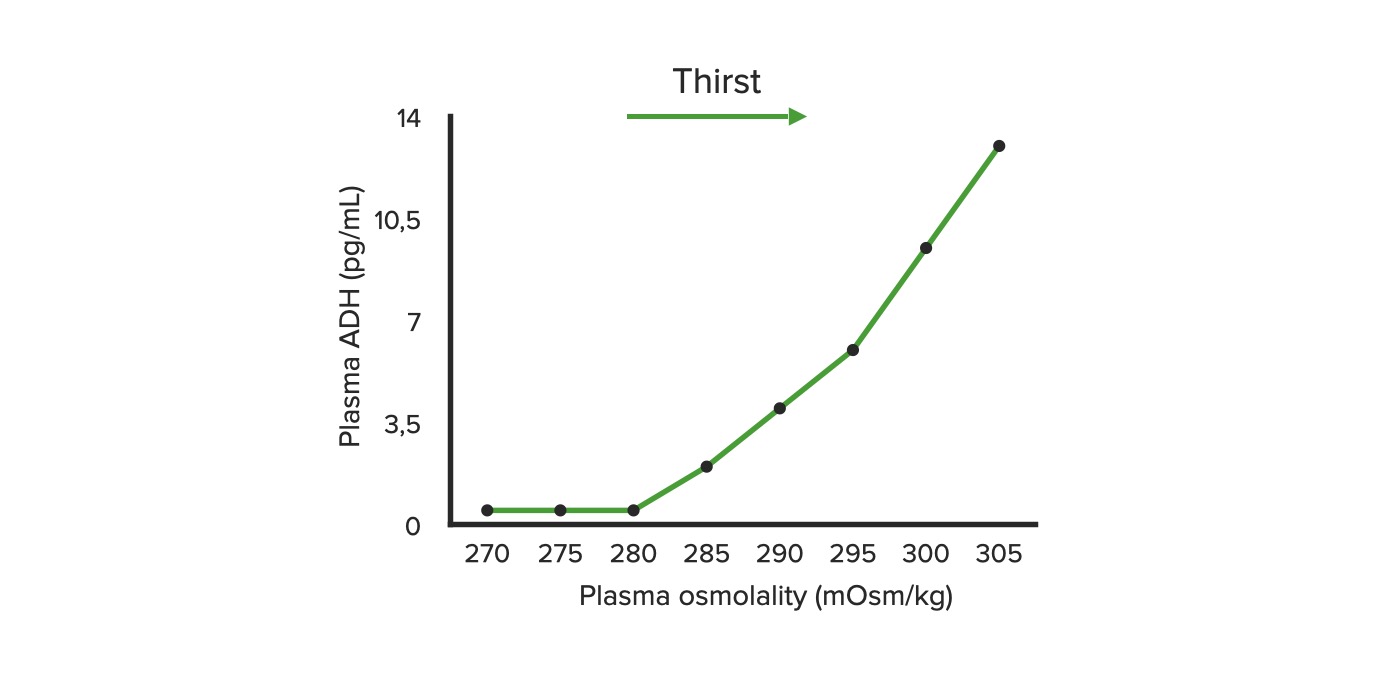
    • Las concentraciones de ADH son mínimas cuando la osmolalidad plasmática es normal (280–290 mOsm/kg).
    • La ADH aumenta linealmente en EN Erythema nodosum is an immune-mediated panniculitis (inflammation of the subcutaneous fat) caused by a type IV (delayed-type) hypersensitivity reaction. It commonly manifests in young women as tender, erythematous nodules on the shins. Erythema Nodosum respuesta a cambios muy pequeños en EN Erythema nodosum is an immune-mediated panniculitis (inflammation of the subcutaneous fat) caused by a type IV (delayed-type) hypersensitivity reaction. It commonly manifests in young women as tender, erythematous nodules on the shins. Erythema Nodosum la osmolalidad del plasma Plasma The residual portion of blood that is left after removal of blood cells by centrifugation without prior blood coagulation. Transfusion Products.

Respuesta a la ADH en EN Erythema nodosum is an immune-mediated panniculitis (inflammation of the subcutaneous fat) caused by a type IV (delayed-type) hypersensitivity reaction. It commonly manifests in young women as tender, erythematous nodules on the shins. Erythema Nodosum el riñón

  • Los LOS Neisseria canales de acuaporina son la diana de la ADH:
    • Permiten que el agua pase del líquido tubular a la médula renal a través de la difusión
    • La médula renal es hipertónica (debido a la rama ascendente gruesa y al AL Amyloidosis túbulo contorneado distal).
  • La ADH estimula la producción e inserción de canales de acuaporina en EN Erythema nodosum is an immune-mediated panniculitis (inflammation of the subcutaneous fat) caused by a type IV (delayed-type) hypersensitivity reaction. It commonly manifests in young women as tender, erythematous nodules on the shins. Erythema Nodosum el conducto colector:
    • Niveles altos de ADH → niveles máximos de reabsorción de agua → orina concentrada
    • Niveles bajos de ADH → niveles mínimos de reabsorción de agua → orina diluida
Osmolalidad plasmática

Osmolalidad plasmática y hormona antidiurética (ADH): gráfico que ilustra la relación entre la osmolalidad plasmática y la liberación de ADH

Imagen por Lecturio.

Etiología

Las etiologías de la hipernatremia se clasifican según el estado del volumen.

Hipernatremia hipervolémica

  • Ganancia de más sodio que agua
  • Ingesta excesiva de sodio:
    • Infusión de solución salina isotónica, solución salina hipertónica o soluciones de bicarbonato de sodio
    • Ingestión oral de tabletas de sal (i.e., para el tratamiento de la hiponatremia)
    • Envenenamiento por sal (i.e., ingestión oral excesiva de sal de mesa)
  • Mediada por aldosterona:
    • Hiperaldosteronismo primario
    • Síndrome de Cushing

Hipernatremia euvolémica

  • Pérdida de agua solamente
  • Diabetes Diabetes Diabetes mellitus (DM) is a metabolic disease characterized by hyperglycemia and dysfunction of the regulation of glucose metabolism by insulin. Type 1 DM is diagnosed mostly in children and young adults as the result of autoimmune destruction of β cells in the pancreas and the resulting lack of insulin. Type 2 DM has a significant association with obesity and is characterized by insulin resistance. Diabetes Mellitus insípida (tanto central como nefrogénica)
  • Falta de acceso al AL Amyloidosis agua:
    • Lactantes
    • Ancianos
    • Estado mental alterado
    • Demencia
    • Pacientes en EN Erythema nodosum is an immune-mediated panniculitis (inflammation of the subcutaneous fat) caused by a type IV (delayed-type) hypersensitivity reaction. It commonly manifests in young women as tender, erythematous nodules on the shins. Erythema Nodosum ventilación mecánica
    • Pacientes restringidos
  • Deterioro del mecanismo de la sed (ancianos)

Hipernatremia hipovolémica

  • Pérdida de más agua que sodio
  • Pérdidas gastrointestinales:
    • Diarrea
    • Vómitos
    • Drenaje por sonda nasogástrica
  • Diuréticos
  • Diuresis osmótica:
    • Hiperglucemia
    • Manitol
    • Urea Urea A compound formed in the liver from ammonia produced by the deamination of amino acids. It is the principal end product of protein catabolism and constitutes about one half of the total urinary solids. Urea Cycle elevada por alimentación excesiva por sonda
    • Recuperación de lesión renal aguda
  • Aumento de la pérdida insensible de agua (i.e., sudor o quemaduras)

Related videos

Presentación Clínica

El principal hallazgo clínico en EN Erythema nodosum is an immune-mediated panniculitis (inflammation of the subcutaneous fat) caused by a type IV (delayed-type) hypersensitivity reaction. It commonly manifests in young women as tender, erythematous nodules on the shins. Erythema Nodosum la hipernatremia es la sed. Si el paciente no puede ingerir suficiente agua para evitar que su sodio sérico aumente significativamente, también pueden ocurrir deshidratación y hallazgos neurológicos. La gravedad de los LOS Neisseria hallazgos neurológicos depende del tiempo de instauración y la magnitud de la hipernatremia.

Hipernatremia aguda

  • Inicio < 48 horas
  • Más probabilidades de ser sintomático (debido a menos tiempo para la adaptación del cerebro)
  • Se necesitan aumentos menos severos en EN Erythema nodosum is an immune-mediated panniculitis (inflammation of the subcutaneous fat) caused by a type IV (delayed-type) hypersensitivity reaction. It commonly manifests in young women as tender, erythematous nodules on the shins. Erythema Nodosum el sodio sérico para inducir los LOS Neisseria síntomas.

Hipernatremia crónica

  • Inicio > 48 horas
  • Menos probable que sea sintomático (debido al AL Amyloidosis tiempo adecuado para la adaptación del cerebro)
  • Se necesitan aumentos más severos en EN Erythema nodosum is an immune-mediated panniculitis (inflammation of the subcutaneous fat) caused by a type IV (delayed-type) hypersensitivity reaction. It commonly manifests in young women as tender, erythematous nodules on the shins. Erythema Nodosum el sodio sérico antes de que aparezcan los LOS Neisseria síntomas.

Síntomas leves

  • Cefalea
  • Anorexia Anorexia The lack or loss of appetite accompanied by an aversion to food and the inability to eat. It is the defining characteristic of the disorder anorexia nervosa. Anorexia Nervosa
  • Náuseas
  • Vómitos

Síntomas severos

  • Letargo
  • Confusión
  • Irritabilidad neuromuscular
  • Convulsiones
  • Coma Coma Coma is defined as a deep state of unarousable unresponsiveness, characterized by a score of 3 points on the GCS. A comatose state can be caused by a multitude of conditions, making the precise epidemiology and prognosis of coma difficult to determine. Coma

Diagnóstico

En EN Erythema nodosum is an immune-mediated panniculitis (inflammation of the subcutaneous fat) caused by a type IV (delayed-type) hypersensitivity reaction. It commonly manifests in young women as tender, erythematous nodules on the shins. Erythema Nodosum la mayoría de los LOS Neisseria casos, la etiología de la hipernatremia será clara y el tratamiento puede iniciarse sin más pruebas. Si el diagnóstico no está claro, los LOS Neisseria siguientes pasos pueden ser útiles:

  1. Identificar rápidamente las causas agudas y los LOS Neisseria casos muy graves.
    • Ejemplos de causas agudas: intoxicación por sal, pacientes con diabetes Diabetes Diabetes mellitus (DM) is a metabolic disease characterized by hyperglycemia and dysfunction of the regulation of glucose metabolism by insulin. Type 1 DM is diagnosed mostly in children and young adults as the result of autoimmune destruction of β cells in the pancreas and the resulting lack of insulin. Type 2 DM has a significant association with obesity and is characterized by insulin resistance. Diabetes Mellitus insípida sin libre acceso al AL Amyloidosis agua
    • Ejemplo de un caso muy severo: Na > 160 mmol/L
    • Si es aguda se justifica un tratamiento urgente y agresivo.
    • Si es grave, pero no necesariamente aguda, priorizar el tratamiento urgente sobre el diagnóstico definitivo.
  2. Identificar los LOS Neisseria factores reversibles.
    • Acceso al AL Amyloidosis agua/estado mental alterado (lo más probable es que reduzca la tasa de reemplazo intravenoso una vez que se restablezca)
    • Pérdidas continuas: abordar cualquier otro factor para limitar las necesidades adicionales de reemplazo de agua libre.
  3. ¿Etiología desconocida y solo hipernatremia leve?
    • Considerar las causas mediadas por aldosterona.
    • Diagnóstico del síndrome de Cushing: verificar el cortisol Cortisol Glucocorticoids salival nocturno, el cortisol Cortisol Glucocorticoids libre en EN Erythema nodosum is an immune-mediated panniculitis (inflammation of the subcutaneous fat) caused by a type IV (delayed-type) hypersensitivity reaction. It commonly manifests in young women as tender, erythematous nodules on the shins. Erythema Nodosum orina de 24 horas y/o una prueba de supresión con dexametasona durante la noche.
    • Diagnóstico de hiperaldosteronismo primario: verificar renina y aldosterona en EN Erythema nodosum is an immune-mediated panniculitis (inflammation of the subcutaneous fat) caused by a type IV (delayed-type) hypersensitivity reaction. It commonly manifests in young women as tender, erythematous nodules on the shins. Erythema Nodosum plasma Plasma The residual portion of blood that is left after removal of blood cells by centrifugation without prior blood coagulation. Transfusion Products.
  4. ¿Etiología desconocida y no mediada por aldosterona?
    • Medir la osmolalidad de la orina.
    • Osmolalidad urinaria < 300 mOsm/kg (< osmolalidad plasmática): diabetes Diabetes Diabetes mellitus (DM) is a metabolic disease characterized by hyperglycemia and dysfunction of the regulation of glucose metabolism by insulin. Type 1 DM is diagnosed mostly in children and young adults as the result of autoimmune destruction of β cells in the pancreas and the resulting lack of insulin. Type 2 DM has a significant association with obesity and is characterized by insulin resistance. Diabetes Mellitus insípida
      • Administrar desmopresina (igual que ADH).
      • Aumenta la osmolalidad de la orina: diabetes Diabetes Diabetes mellitus (DM) is a metabolic disease characterized by hyperglycemia and dysfunction of the regulation of glucose metabolism by insulin. Type 1 DM is diagnosed mostly in children and young adults as the result of autoimmune destruction of β cells in the pancreas and the resulting lack of insulin. Type 2 DM has a significant association with obesity and is characterized by insulin resistance. Diabetes Mellitus insípida central
      • Sin cambios en EN Erythema nodosum is an immune-mediated panniculitis (inflammation of the subcutaneous fat) caused by a type IV (delayed-type) hypersensitivity reaction. It commonly manifests in young women as tender, erythematous nodules on the shins. Erythema Nodosum la osmolalidad de la orina: diabetes Diabetes Diabetes mellitus (DM) is a metabolic disease characterized by hyperglycemia and dysfunction of the regulation of glucose metabolism by insulin. Type 1 DM is diagnosed mostly in children and young adults as the result of autoimmune destruction of β cells in the pancreas and the resulting lack of insulin. Type 2 DM has a significant association with obesity and is characterized by insulin resistance. Diabetes Mellitus insípida nefrogénica
    • Osmolalidad urinaria indeterminada (300–600 mOsm/kg): diabetes Diabetes Diabetes mellitus (DM) is a metabolic disease characterized by hyperglycemia and dysfunction of the regulation of glucose metabolism by insulin. Type 1 DM is diagnosed mostly in children and young adults as the result of autoimmune destruction of β cells in the pancreas and the resulting lack of insulin. Type 2 DM has a significant association with obesity and is characterized by insulin resistance. Diabetes Mellitus insípida frente a diuresis osmótica
      • Comprobar la respuesta a la desmopresina para diagnosticar una posible diabetes Diabetes Diabetes mellitus (DM) is a metabolic disease characterized by hyperglycemia and dysfunction of the regulation of glucose metabolism by insulin. Type 1 DM is diagnosed mostly in children and young adults as the result of autoimmune destruction of β cells in the pancreas and the resulting lack of insulin. Type 2 DM has a significant association with obesity and is characterized by insulin resistance. Diabetes Mellitus insípida.
      • Comprobar la carga total de solutos para evaluar la diuresis osmótica.
    • Osmolalidad urinaria > 600 mOsm/kg (generalmente pérdida de agua no renal (i.e., diarrea)):
      • Nota: la osmolalidad urinaria alta representa la respuesta adecuada de los LOS Neisseria riñones a la osmolalidad plasmática alta en EN Erythema nodosum is an immune-mediated panniculitis (inflammation of the subcutaneous fat) caused by a type IV (delayed-type) hypersensitivity reaction. It commonly manifests in young women as tender, erythematous nodules on the shins. Erythema Nodosum la hipernatremia

Tratamiento

Consideraciones generales

La hipernatremia se trata reemplazando el déficit de agua libre administrando una solución hipotónica (i.e., dextrosa en EN Erythema nodosum is an immune-mediated panniculitis (inflammation of the subcutaneous fat) caused by a type IV (delayed-type) hypersensitivity reaction. It commonly manifests in young women as tender, erythematous nodules on the shins. Erythema Nodosum agua al AL Amyloidosis 5% intravenosa). El tratamiento es generalmente empírico con monitoreo frecuente del sodio sérico y ajuste de la tasa de administración de líquidos.

Consideraciones sobre el estado del volumen:

  • Si está hipotenso (hipovolémico):
    • Administrar líquidos isotónicos para mejorar la presión arterial.
    • Después de que aumente la presión arterial, cambiar a líquidos hipotónicos para abordar la hipernatremia.
  • Si diabetes Diabetes Diabetes mellitus (DM) is a metabolic disease characterized by hyperglycemia and dysfunction of the regulation of glucose metabolism by insulin. Type 1 DM is diagnosed mostly in children and young adults as the result of autoimmune destruction of β cells in the pancreas and the resulting lack of insulin. Type 2 DM has a significant association with obesity and is characterized by insulin resistance. Diabetes Mellitus insípida (euvolémico):
    • Administrar líquidos hipotónicos para corregir la hipernatremia.
    • Reanudar o comenzar la desmopresina para mantener el sodio sérico normal.
  • Si es mediado por aldosterona (hipervolémico):
    • Es posible que solo necesite acceso libre a líquidos hipotónicos orales (la hipernatremia debe ser leve)
    • Tratar la afección subyacente.

Tratamiento según tiempo de instauración

Hipernatremia aguda:

  • Poco común (solo ocurre en EN Erythema nodosum is an immune-mediated panniculitis (inflammation of the subcutaneous fat) caused by a type IV (delayed-type) hypersensitivity reaction. It commonly manifests in young women as tender, erythematous nodules on the shins. Erythema Nodosum situaciones específicas):
    • Envenenamiento por sal
    • Diabetes Diabetes Diabetes mellitus (DM) is a metabolic disease characterized by hyperglycemia and dysfunction of the regulation of glucose metabolism by insulin. Type 1 DM is diagnosed mostly in children and young adults as the result of autoimmune destruction of β cells in the pancreas and the resulting lack of insulin. Type 2 DM has a significant association with obesity and is characterized by insulin resistance. Diabetes Mellitus insípida sin toma de agua compensatoria adecuada
    • Hiperglucemia severa sin ingesta compensatoria adecuada de agua
  • Identificar rápidamente debido a la necesidad de un tratamiento rápido y agresivo.
  • Meta: reponer el 100% del déficit de agua libre en EN Erythema nodosum is an immune-mediated panniculitis (inflammation of the subcutaneous fat) caused by a type IV (delayed-type) hypersensitivity reaction. It commonly manifests in young women as tender, erythematous nodules on the shins. Erythema Nodosum las 1ras 24 horas.
  • Dextrosa en EN Erythema nodosum is an immune-mediated panniculitis (inflammation of the subcutaneous fat) caused by a type IV (delayed-type) hypersensitivity reaction. It commonly manifests in young women as tender, erythematous nodules on the shins. Erythema Nodosum agua al AL Amyloidosis 5% intravenosa para empezar
  • Controlar de cerca el sodio sérico y ajustar la tasa de administración de líquidos según sea necesario:
    • Monitorizar inicialmente el sodio sérico y disminuir la tasa de administración de líquidos una vez que el sodio sérico < 145 mmol/L.
    • El objetivo es una disminución del sodio sérico de 1–2 mEq/L/hora y una corrección completa dentro de las 24 horas.

Hipernatremia crónica:

  • La gran mayoría de las hipernatremias
  • Objetivo: disminuir el sodio sérico en EN Erythema nodosum is an immune-mediated panniculitis (inflammation of the subcutaneous fat) caused by a type IV (delayed-type) hypersensitivity reaction. It commonly manifests in young women as tender, erythematous nodules on the shins. Erythema Nodosum 10 mEq/L/día (aproximadamente 0,5 mEq/L/hora) hasta la normalidad.
  • Dextrosa en EN Erythema nodosum is an immune-mediated panniculitis (inflammation of the subcutaneous fat) caused by a type IV (delayed-type) hypersensitivity reaction. It commonly manifests in young women as tender, erythematous nodules on the shins. Erythema Nodosum agua al AL Amyloidosis 5% intravenosa para empezar
  • El agua libre por vía oral es una opción si la hipernatremia no es grave.
  • Controlar el sodio sérico y ajustar la tasa según sea necesario.
  • La sobrecorrección rápida puede causar complicaciones neurológicas graves (p. ej., edema Edema Edema is a condition in which excess serous fluid accumulates in the body cavity or interstitial space of connective tissues. Edema is a symptom observed in several medical conditions. It can be categorized into 2 types, namely, peripheral (in the extremities) and internal (in an organ or body cavity). Edema cerebral, convulsiones) en EN Erythema nodosum is an immune-mediated panniculitis (inflammation of the subcutaneous fat) caused by a type IV (delayed-type) hypersensitivity reaction. It commonly manifests in young women as tender, erythematous nodules on the shins. Erythema Nodosum todos los LOS Neisseria pacientes, pero el riesgo es especialmente alto en EN Erythema nodosum is an immune-mediated panniculitis (inflammation of the subcutaneous fat) caused by a type IV (delayed-type) hypersensitivity reaction. It commonly manifests in young women as tender, erythematous nodules on the shins. Erythema Nodosum lactantes y niños.

Complicaciones

Un aumento agudo en EN Erythema nodosum is an immune-mediated panniculitis (inflammation of the subcutaneous fat) caused by a type IV (delayed-type) hypersensitivity reaction. It commonly manifests in young women as tender, erythematous nodules on the shins. Erythema Nodosum la tonicidad da como resultado un movimiento abrupto de líquido fuera del cerebro. Un aumento lento de la tonicidad permite que el cerebro se adapte y minimice el efecto de los LOS Neisseria cambios de líquidos. Una corrección demasiado rápida de la hipernatremia podría resultar en EN Erythema nodosum is an immune-mediated panniculitis (inflammation of the subcutaneous fat) caused by a type IV (delayed-type) hypersensitivity reaction. It commonly manifests in young women as tender, erythematous nodules on the shins. Erythema Nodosum un movimiento abrupto de líquido hacia el cerebro y causar edema Edema Edema is a condition in which excess serous fluid accumulates in the body cavity or interstitial space of connective tissues. Edema is a symptom observed in several medical conditions. It can be categorized into 2 types, namely, peripheral (in the extremities) and internal (in an organ or body cavity). Edema cerebral.

Hipernatremia aguda

  • Aumento repentino de la tonicidad del plasma Plasma The residual portion of blood that is left after removal of blood cells by centrifugation without prior blood coagulation. Transfusion Products → cambio rápido de agua fuera del cerebro
  • El cerebro esencialmente se encoge en EN Erythema nodosum is an immune-mediated panniculitis (inflammation of the subcutaneous fat) caused by a type IV (delayed-type) hypersensitivity reaction. It commonly manifests in young women as tender, erythematous nodules on the shins. Erythema Nodosum volumen.
  • Si es lo suficientemente grave, la contracción puede desgarrar los LOS Neisseria vasos sanguíneos del cerebro → hemorragia intracraneal y muerte

Hipernatremia crónica

  • Aumento más lento de la tonicidad del plasma Plasma The residual portion of blood that is left after removal of blood cells by centrifugation without prior blood coagulation. Transfusion Products → desplazamiento más lento del agua fuera del cerebro
  • El cerebro responde con mecanismos adaptativos para contrarrestar el cambio de agua:
    • Tarda unas 48 horas: distinción entre hipernatremia aguda (< 48 horas) y crónica (> 48 horas)
    • El efecto neto es una pérdida mucho menor de volumen cerebral → sin desgarro de los LOS Neisseria vasos
    • Sin embargo, no detiene la aparición de otros síntomas (i.e., letargo, confusión)

Sobrecorrección de la hipernatremia aguda

  • No suele causar problemas clínicos en EN Erythema nodosum is an immune-mediated panniculitis (inflammation of the subcutaneous fat) caused by a type IV (delayed-type) hypersensitivity reaction. It commonly manifests in young women as tender, erythematous nodules on the shins. Erythema Nodosum adultos
  • Suele causar problemas clínicos en EN Erythema nodosum is an immune-mediated panniculitis (inflammation of the subcutaneous fat) caused by a type IV (delayed-type) hypersensitivity reaction. It commonly manifests in young women as tender, erythematous nodules on the shins. Erythema Nodosum niños y adultos jóvenes (i.e., < 40 años) con hiperglucemia grave (i.e., cetoacidosis diabética)
  • La hiperglucemia severa da como resultado que la glucosa contribuya en EN Erythema nodosum is an immune-mediated panniculitis (inflammation of the subcutaneous fat) caused by a type IV (delayed-type) hypersensitivity reaction. It commonly manifests in young women as tender, erythematous nodules on the shins. Erythema Nodosum una cantidad significativa a la hipertonicidad.
  • La osmolalidad plasmática y la glucosa sérica deben monitorizarse muy de cerca durante el tratamiento para prevenir el edema Edema Edema is a condition in which excess serous fluid accumulates in the body cavity or interstitial space of connective tissues. Edema is a symptom observed in several medical conditions. It can be categorized into 2 types, namely, peripheral (in the extremities) and internal (in an organ or body cavity). Edema cerebral:
    • Meta: disminución de la osmolalidad plasmática en EN Erythema nodosum is an immune-mediated panniculitis (inflammation of the subcutaneous fat) caused by a type IV (delayed-type) hypersensitivity reaction. It commonly manifests in young women as tender, erythematous nodules on the shins. Erythema Nodosum < 3 mmol/kg/hora
    • Meta: disminución de la glucosa en EN Erythema nodosum is an immune-mediated panniculitis (inflammation of the subcutaneous fat) caused by a type IV (delayed-type) hypersensitivity reaction. It commonly manifests in young women as tender, erythematous nodules on the shins. Erythema Nodosum sangre de 50–75 mg/dL/hora

Sobrecorrección de la hipernatremia crónica

  • El agua siempre regresará al AL Amyloidosis cerebro a medida que mejora la hipernatremia.
  • Si el cambio de agua ocurre demasiado abruptamente, puede ocurrir edema Edema Edema is a condition in which excess serous fluid accumulates in the body cavity or interstitial space of connective tissues. Edema is a symptom observed in several medical conditions. It can be categorized into 2 types, namely, peripheral (in the extremities) and internal (in an organ or body cavity). Edema cerebral y/o síndrome de desmielinización osmótica.
  • En EN Erythema nodosum is an immune-mediated panniculitis (inflammation of the subcutaneous fat) caused by a type IV (delayed-type) hypersensitivity reaction. It commonly manifests in young women as tender, erythematous nodules on the shins. Erythema Nodosum la práctica, las complicaciones de la sobrecorrección de la hipernatremia en EN Erythema nodosum is an immune-mediated panniculitis (inflammation of the subcutaneous fat) caused by a type IV (delayed-type) hypersensitivity reaction. It commonly manifests in young women as tender, erythematous nodules on the shins. Erythema Nodosum adultos son extremadamente raras:
    • Meta para adultos: disminuir el sodio sérico en EN Erythema nodosum is an immune-mediated panniculitis (inflammation of the subcutaneous fat) caused by a type IV (delayed-type) hypersensitivity reaction. It commonly manifests in young women as tender, erythematous nodules on the shins. Erythema Nodosum aproximadamente 10 mEq/L/día.
    • Debido a que la sobrecorrección no es perjudicial, no se recomienda el aumento terapéutico del sodio sérico si se excede el objetivo.
  • La sobrecorrección es un problema clínico común en EN Erythema nodosum is an immune-mediated panniculitis (inflammation of the subcutaneous fat) caused by a type IV (delayed-type) hypersensitivity reaction. It commonly manifests in young women as tender, erythematous nodules on the shins. Erythema Nodosum niños y adultos jóvenes:
    • Volumen del cráneo más pequeño → menos margen de error Error Refers to any act of commission (doing something wrong) or omission (failing to do something right) that exposes patients to potentially hazardous situations. Disclosure of Information si el cerebro se encoge o se inflama
    • Se necesita un monitoreo mucho más estrecho del tratamiento.
    • Meta para niños y adultos jóvenes: disminuir el sodio sérico en EN Erythema nodosum is an immune-mediated panniculitis (inflammation of the subcutaneous fat) caused by a type IV (delayed-type) hypersensitivity reaction. It commonly manifests in young women as tender, erythematous nodules on the shins. Erythema Nodosum < 0,5 mEq/L/hora y < 10–12 mEq/L/día.

Referencias

  1. Blocher, N. C. (2025). Serum osmolality. In Medscape. Retrieved June 21, 2025, from https://emedicine.medscape.com/article/2099042-overview
  2. Alshayeb, H. M., Showkat, A., Babar, F., Mangold, T., & Wall, B. M. (2011). Severe hypernatremia correction rate and mortality in hospitalized patients. The American Journal of the Medical Sciences, 341(5), 356–360. https://doi.org/10.1097/MAJ.0b013e31820a3a90
  3. Chauhan, K., Pattharanitima, P., Patel, N., Duffy, A., Saha, A., Chaudhary, K., Debnath, N., Vleck, T. V., Chan, L., Nadkarni, G. N., & Coca, S. G. (2019). Rate of correction of hypernatremia and health outcomes in critically ill patients. Clinical Journal of the American Society of Nephrology, 14(5), 656–663. https://doi.org/10.2215/CJN.10640918
  4. Rondon-Berrios, H., Argyropoulos, C., Ing, T. S., Raj, D. S., Malhotra, D., Agaba, E. I., Rohrscheib, M., Khitan, Z. J., Murata, G. H., Shapiro, J. I., & Tzamaloukas, A. H. (2017). Hypertonicity: Clinical entities, manifestations and treatment. World Journal of Nephrology, 6(1), 1–13. https://doi.org/10.5527/wjn.v6.i1.1
  5. Sterns, R. (2025). General principles of disorders of water balance (hyponatremia and hypernatremia) and sodium balance (hypovolemia and edema). JP Forman (Ed.), UpToDate. Retrieved June 21, 2025, from https://www.uptodate.com/contents/general-principles-of-disorders-of-water-balance-hyponatremia-and-hypernatremia-and-sodium-balance-hypovolemia-and-edema
  6. Sterns, R., & Hoorn, EJ. (2025). Treatment of hypernatremia in adults. JP Forman (Ed.), UpToDate. Retrieved June 21, 2025, from https://www.uptodate.com/contents/treatment-of-hypernatremia-in-adults
  7. Sterns, R. (2025). Etiology and evaluation of hypernatremia in adults. JP Forman (Ed.), UpToDate. Retrieved June 21, 2025, from https://www.uptodate.com/contents/etiology-and-evaluation-of-hypernatremia-in-adults

¡Crea tu cuenta gratis o inicia una sesión para seguir leyendo!

Regístrate ahora y obtén acceso gratuito a Lecturio con páginas de concepto, videos médicos y cuestionarios para tu educación médica.

User Reviews

Que tengas una sesión de estudio alegre y navideña 🎁 Ahorra 50% en todos los planes >>

Details