Domina Conceptos Médicos

Estudia para la escuela de medicina y tus examenes con Lecturio.

Glomerulonefritis Membranoproliferativa

La glomerulonefritis membranoproliferativa también se conoce como glomerulonefritis mesangiocapilar. La glomerulonefritis membranoproliferativa es un patrón de lesión glomerular caracterizado por hipercelularidad mesangial, proliferación endocapilar y engrosamiento de la membrana basal glomerular (formación de doble contorno). Los LOS Neisseria cambios se deben al AL Amyloidosis depósito de inmunoglobulinas, factores del complemento, o ambos, en EN Erythema nodosum is an immune-mediated panniculitis (inflammation of the subcutaneous fat) caused by a type IV (delayed-type) hypersensitivity reaction. It commonly manifests in young women as tender, erythematous nodules on the shins. Erythema Nodosum el mesangio glomerular y a lo largo de las paredes de los LOS Neisseria capilares glomerulares. Las variantes patogénicas incluyen glomerulonefritis membranoproliferativa mediada por inmunocomplejos/inmunoglobulinas monoclonales (e.g., de infecciones, enfermedades autoinmunes) y mediada por complemento. En EN Erythema nodosum is an immune-mediated panniculitis (inflammation of the subcutaneous fat) caused by a type IV (delayed-type) hypersensitivity reaction. It commonly manifests in young women as tender, erythematous nodules on the shins. Erythema Nodosum casos raros, glomerulonefritis membranoproliferativa no se asocia con inmunoglobulinas o el sistema del complemento, como en EN Erythema nodosum is an immune-mediated panniculitis (inflammation of the subcutaneous fat) caused by a type IV (delayed-type) hypersensitivity reaction. It commonly manifests in young women as tender, erythematous nodules on the shins. Erythema Nodosum el caso de lesión endotelial. Con múltiples etiologías, la presentación y el curso clínico varían. Las características de presentación pueden ser proteinuria Proteinuria The presence of proteins in the urine, an indicator of kidney diseases. Nephrotic Syndrome in Children y hematuria Hematuria Presence of blood in the urine. Renal Cell Carcinoma asintomática, síndrome nefrótico, síndrome nefrítico o insuficiencia renal crónica. El diagnóstico definitivo requiere una biopsia renal, aunque las pruebas de laboratorio y de imagenología adicionales pueden indicar la enfermedad asociada. El tratamiento se basa en EN Erythema nodosum is an immune-mediated panniculitis (inflammation of the subcutaneous fat) caused by a type IV (delayed-type) hypersensitivity reaction. It commonly manifests in young women as tender, erythematous nodules on the shins. Erythema Nodosum la causa subyacente. Los LOS Neisseria esteroides, los LOS Neisseria inmunosupresores y el trasplante de riñón se encuentran entre las modalidades de tratamiento más utilizadas.

Last updated: Dec 15, 2025

Editorial responsibility: Stanley Oiseth, Lindsay Jones, Evelin Maza

Descripción General

Definición

La glomerulonefritis membranoproliferativa es una lesión glomerular caracterizada por un engrosamiento de la membrana basal glomerular (“membrano-”) y un aumento de la celularidad endocapilar y mesangial (“proliferativa”).

  • La membrana basal glomerular se engrosa a partir de depósitos de complejos inmunes, factores del complemento y/o células interpuestas (entre ella y las células endoteliales).
  • La proliferación de células mesangiales y monocitos contribuye a una mayor celularidad, creando un penacho glomerular lobulado.
  • La glomerulonefritis membranoproliferativa es un hallazgo histológico y no una enfermedad específica; por tanto, se asocia a múltiples etiologías.
  • También se llama glomerulonefritis mesangiocapilar.

Epidemiología

  • Representa del 7%–10% de los LOS Neisseria casos de glomerulonefritis confirmada por biopsia
  • La forma idiopática o primaria afecta a la población más joven (8–30 años de edad).
  • La forma secundaria se observa predominantemente en EN Erythema nodosum is an immune-mediated panniculitis (inflammation of the subcutaneous fat) caused by a type IV (delayed-type) hypersensitivity reaction. It commonly manifests in young women as tender, erythematous nodules on the shins. Erythema Nodosum individuos > 30 años.

Fisiopatología y Etiología

Lesión glomerular

  • Mecanismos patogenéticos:
    • Mecanismo mediado por inmunoglobulinas monoclonales/inmunocomplejos:
      • Depósito de inmunocomplejos o inmunoglobulinas monoclonales
      • Conduce a la activación del complemento
    • Mecanismo mediado por complemento:
      • La vía alternativa del complemento (donde C3 se encuentra en EN Erythema nodosum is an immune-mediated panniculitis (inflammation of the subcutaneous fat) caused by a type IV (delayed-type) hypersensitivity reaction. It commonly manifests in young women as tender, erythematous nodules on the shins. Erythema Nodosum un nivel bajo constante en EN Erythema nodosum is an immune-mediated panniculitis (inflammation of the subcutaneous fat) caused by a type IV (delayed-type) hypersensitivity reaction. It commonly manifests in young women as tender, erythematous nodules on the shins. Erythema Nodosum la circulación) se desregula, provocando una activación persistente.
      • Deposición de productos del complemento en EN Erythema nodosum is an immune-mediated panniculitis (inflammation of the subcutaneous fat) caused by a type IV (delayed-type) hypersensitivity reaction. It commonly manifests in young women as tender, erythematous nodules on the shins. Erythema Nodosum los LOS Neisseria glomérulos (paredes capilares y mesangio)
    • No relacionado con el depósito del complemento o de inmunoglobulinas (visto en EN Erythema nodosum is an immune-mediated panniculitis (inflammation of the subcutaneous fat) caused by a type IV (delayed-type) hypersensitivity reaction. It commonly manifests in young women as tender, erythematous nodules on the shins. Erythema Nodosum el caso de lesión endotelial)
  • Las lesiones a los LOS Neisseria glomérulos y al AL Amyloidosis mesangio provocan:
    • Lesión mesangial y capilar aguda por depósito de inmunocomplejos, inmunoglobulinas monoclonales o factores del complemento
    • Invasión de células inflamatorias
    • Cambios histológicos:
      • Se produce una nueva matriz mesangial → el mesangio se expande → el penacho glomerular se vuelve lobulillar
      • Se forma una nueva membrana basal glomerular que parece una membrana basal con doble contorno → “rieles de tranvía”

Clasificación (microscopía electrónica)

Tradicionalmente, la glomerulonefritis membranoproliferativa se clasificaba según los LOS Neisseria hallazgos de la microscopía electrónica (clasificación vieja):

  • Basado en EN Erythema nodosum is an immune-mediated panniculitis (inflammation of the subcutaneous fat) caused by a type IV (delayed-type) hypersensitivity reaction. It commonly manifests in young women as tender, erythematous nodules on the shins. Erythema Nodosum microscopía electrónica:
    • Glomerulonefritis membranoproliferativa tipo I:
      • Caracterizada por depósitos inmunes en EN Erythema nodosum is an immune-mediated panniculitis (inflammation of the subcutaneous fat) caused by a type IV (delayed-type) hypersensitivity reaction. It commonly manifests in young women as tender, erythematous nodules on the shins. Erythema Nodosum el espacio subendotelial (depósitos subendoteliales) y mesangio (depósitos mesangiales)
      • Visto en EN Erythema nodosum is an immune-mediated panniculitis (inflammation of the subcutaneous fat) caused by a type IV (delayed-type) hypersensitivity reaction. It commonly manifests in young women as tender, erythematous nodules on the shins. Erythema Nodosum nefritis lúpica, infecciones
    • Glomerulonefritis membranoproliferativa tipo II:
      • Enfermedad de depósitos densos
      • Depósitos intramembranosos adicionales
      • A lo largo de las membranas basales glomerulares, los LOS Neisseria túbulos y la cápsula de Bowman, se ven depósitos densos y continuos en EN Erythema nodosum is an immune-mediated panniculitis (inflammation of the subcutaneous fat) caused by a type IV (delayed-type) hypersensitivity reaction. It commonly manifests in young women as tender, erythematous nodules on the shins. Erythema Nodosum forma de cinta.
      • Asociado con factor nefrítico C3
    • Glomerulonefritis membranoproliferativa tipo III: similar a la de tipo I, pero con depósitos subendoteliales, mesangiales y subepiteliales
  • Hay superposición de las características de los LOS Neisseria diferentes tipos (e.g., se puede encontrar que el tipo I tiene características de glomerulonefritis membranoproliferativa mediada por complemento o mediada por inmunocomplejos).

Clasificación (microscopía de inmunofluorescencia) y etiología

Una clasificación diferente basada en EN Erythema nodosum is an immune-mediated panniculitis (inflammation of the subcutaneous fat) caused by a type IV (delayed-type) hypersensitivity reaction. It commonly manifests in young women as tender, erythematous nodules on the shins. Erythema Nodosum el proceso patogénico ayuda a señalar la etiología o enfermedad subyacente, dirigiendo así el tratamiento.

  • La patogenia es identificada con base en EN Erythema nodosum is an immune-mediated panniculitis (inflammation of the subcutaneous fat) caused by a type IV (delayed-type) hypersensitivity reaction. It commonly manifests in young women as tender, erythematous nodules on the shins. Erythema Nodosum los LOS Neisseria hallazgos de inmunofluorescencia.
  • Clasificación basada en EN Erythema nodosum is an immune-mediated panniculitis (inflammation of the subcutaneous fat) caused by a type IV (delayed-type) hypersensitivity reaction. It commonly manifests in young women as tender, erythematous nodules on the shins. Erythema Nodosum la patogénesis (inmunocomplejo/inmunoglobulina monoclonal versus complemento):
    • Glomerulonefritis membranoproliferativa mediada por inmunoglobulina monoclonal/inmunocomplejos:
      • Infecciones virales crónicas (e.g., hepatitis B Hepatitis B Hepatitis B virus (HBV) is a partially double-stranded DNA virus, which belongs to the Orthohepadnavirus genus and the Hepadnaviridae family. Most individuals with acute HBV infection are asymptomatic or have mild, self-limiting symptoms. Chronic infection can be asymptomatic or create hepatic inflammation, leading to liver cirrhosis and hepatocellular carcinoma (HCC). Hepatitis B Virus o C)
      • Infecciones bacterianas crónicas (e.g., endocarditis Endocarditis Endocarditis is an inflammatory disease involving the inner lining (endometrium) of the heart, most commonly affecting the cardiac valves. Both infectious and noninfectious etiologies lead to vegetations on the valve leaflets. Patients may present with nonspecific symptoms such as fever and fatigue. Endocarditis, nefritis de la derivación y abscesos)
      • Infecciones por hongos y parásitos
      • Enfermedades autoinmunes (e.g., lupus eritematoso sistémico, síndrome de Sjögren, artritis reumatoide)
      • Paraproteinemias (e.g., gammapatía monoclonal de significado incierto, macroglobulinemia de Waldenstrom)
      • Neoplasias (e.g., linfoma no Hodgkin)
      • Derivación esplenorrenal para la hipertensión portal
      • Idiopática/primaria
    • Glomerulonefritis membranoproliferativa mediada por complemento (menos común):
      • Glomerulonefritis C3
      • Enfermedad por depósitos densos de C3: la mayoría de los LOS Neisseria casos tienen factor nefrítico C3 → se une a la vía alternativa C3 convertasa → activación sostenida de C3
      • Glomerulopatías C4 (glomerulonefritis C4, enfermedad de depósitos densos de C4)
      • Causas genéticas
    • Glomerulonefritis membranoproliferativa sin depósito de inmunoglobulinas o complemento (comúnmente por lesión endotelial, seguida de reparación):
      • Microangiopatías trombóticas
      • Síndrome de anticuerpos antifosfolípidos
      • Después del trasplante de médula ósea
      • Nefropatía crónica por aloinjerto de riñón
      • Nefritis por radiación
      • Hipertensión maligna

Presentación Clínica y Diagnóstico

Manifestaciones clínicas

  • Variable Variable Variables represent information about something that can change. The design of the measurement scales, or of the methods for obtaining information, will determine the data gathered and the characteristics of that data. As a result, a variable can be qualitative or quantitative, and may be further classified into subgroups. Types of Variables (puede presentarse como glomerulonefritis aguda/rápidamente progresiva o como ERC)
  • Hallazgos típicos:
    • Hematuria Hematuria Presence of blood in the urine. Renal Cell Carcinoma: típicamente con eritrocitos dismórficos o cilindros de eritrocitos
    • La creatinina sérica puede estar elevada o normal.
    • Proteinuria Proteinuria The presence of proteins in the urine, an indicator of kidney diseases. Nephrotic Syndrome in Children: a veces similar a los LOS Neisseria niveles observados en EN Erythema nodosum is an immune-mediated panniculitis (inflammation of the subcutaneous fat) caused by a type IV (delayed-type) hypersensitivity reaction. It commonly manifests in young women as tender, erythematous nodules on the shins. Erythema Nodosum el síndrome nefrótico.
    • Edema Edema Edema is a condition in which excess serous fluid accumulates in the body cavity or interstitial space of connective tissues. Edema is a symptom observed in several medical conditions. It can be categorized into 2 types, namely, peripheral (in the extremities) and internal (in an organ or body cavity). Edema
    • Hipertensión
  • Los LOS Neisseria niveles bajos de complemento o hipocomplementemia (↓ C3 y ↓ CH50 CH50 Terminal Complement Pathway Deficiency) son comunes (aunque los LOS Neisseria niveles de complemento pueden ser normales):
    • Glomerulonefritis membranoproliferativa mediada por inmunocomplejos:
      • Se activa la vía clásica del complemento.
      • ↓ C3 y C4
    • Glomerulonefritis membranoproliferativa mediada por complemento:
      • Se activa la vía alternativa.
      • ↓ C3, pero C4 normal
  • Manifestaciones extrarrenales: depósitos retinianos maculares (drusas) y lipodistrofia de la parte superior del cuerpo en EN Erythema nodosum is an immune-mediated panniculitis (inflammation of the subcutaneous fat) caused by a type IV (delayed-type) hypersensitivity reaction. It commonly manifests in young women as tender, erythematous nodules on the shins. Erythema Nodosum enfermedad por depósitos densos

Diagnóstico

  • Aunque la presentación clínica puede ser sugerente, se requiere una biopsia para el diagnóstico:
    • La biopsia establece una lesión histológica pero no un diagnóstico clínico.
    • Se necesitan más estudios para determinar la entidad subyacente que causa la glomerulonefritis membranoproliferativa.
  • Hallazgos de la biopsia: basados en EN Erythema nodosum is an immune-mediated panniculitis (inflammation of the subcutaneous fat) caused by a type IV (delayed-type) hypersensitivity reaction. It commonly manifests in young women as tender, erythematous nodules on the shins. Erythema Nodosum cambios histológicos determinados mediante microscopía óptica, inmunofluorescencia y microscopía electrónica
Tabla: Hallazgos microscópicos en EN Erythema nodosum is an immune-mediated panniculitis (inflammation of the subcutaneous fat) caused by a type IV (delayed-type) hypersensitivity reaction. It commonly manifests in young women as tender, erythematous nodules on the shins. Erythema Nodosum glomerulonefritis membranoproliferativa (según el proceso patogénico)
Glomerulonefritis membranoproliferativa mediada por inmunoglobulina monoclonal/inmunocomplejos Glomerulonefritis membranoproliferativa mediada por complemento Glomerulonefritis membranoproliferativa sin inmunoglobulina ni complemento
Microscopía óptica “Rieles de tranvía” (doble contorno) de la membrana basal
Microscopía de inmunofluorescencia
  • Tinción positiva para inmunoglobulina policlonal y complemento (C3)
  • Inmunoglobulina monoclonal: probable trastorno clonal de células B o células plasmáticas
Complemento positivo y sin tinción (o mínima) para inmunoglobulinas Sin tinción de inmunoglobulinas o complemento
Microscopía electrónica Depósitos subendoteliales y mesangiales ( en EN Erythema nodosum is an immune-mediated panniculitis (inflammation of the subcutaneous fat) caused by a type IV (delayed-type) hypersensitivity reaction. It commonly manifests in young women as tender, erythematous nodules on the shins. Erythema Nodosum algunas enfermedades autoinmunes, + depósitos subepiteliales)
  • Depósitos mesangiales, subendoteliales (a veces, + depósitos subepiteliales e intramembranosos)
  • Depósitos intramembranosos densos (solo en EN Erythema nodosum is an immune-mediated panniculitis (inflammation of the subcutaneous fat) caused by a type IV (delayed-type) hypersensitivity reaction. It commonly manifests in young women as tender, erythematous nodules on the shins. Erythema Nodosum enfermedad por depósitos densos)
Sin depósitos electro-densos a lo largo de las paredes capilares
Diagnóstico diferencial
  • Enfermedades autoinmunes
  • Infecciones
  • Gammapatías monoclonales
  • Idiopática
  • Glomerulopatías C3 (C3GN, C3 enfermedad por depósitos densos)
  • Glomerulopatías C4 (C4GN, C3 enfermedad por depósitos densos)
Lesión endotelial, que puede deberse a:
  • Púrpura trombocitopénica trombótica, Síndrome urémico hemolítico, síndrome antifosfolípido
  • Trasplante de médula ósea
  • Nefropatía por aloinjerto renal
  • Hipertensión maligna
  • Nefritis por radiación
Tabla: Microscopía de inmunofluorescencia de enfermedades específicas que causan glomerulonefritis membranoproliferativa
Etiología Hallazgos microscópicos
Glomerulonefritis membranoproliferativa mediada por inmunoglobulina monoclonal/inmunocomplejos Hepatitis B Hepatitis B Hepatitis B virus (HBV) is a partially double-stranded DNA virus, which belongs to the Orthohepadnavirus genus and the Hepadnaviridae family. Most individuals with acute HBV infection are asymptomatic or have mild, self-limiting symptoms. Chronic infection can be asymptomatic or create hepatic inflammation, leading to liver cirrhosis and hepatocellular carcinoma (HCC). Hepatitis B Virus o C (u otras infecciones virales)
  • Deposición granular de IgM IgM A class of immunoglobulin bearing mu chains (immunoglobulin mu-chains). Igm can fix complement. The name comes from its high molecular weight and originally being called a macroglobulin. Immunoglobulins: Types and Functions, C3
  • Cadenas ligeras kappa y lambda
Gammapatía monoclonal Cadenas ligeras kappa o lambda
Enfermedades autoinmunes “Patrón de casa llena”:
  • IgG IgG The major immunoglobulin isotype class in normal human serum. There are several isotype subclasses of igg, for example, igg1, igg2a, and igg2b. Hypersensitivity Pneumonitis, IgM IgM A class of immunoglobulin bearing mu chains (immunoglobulin mu-chains). Igm can fix complement. The name comes from its high molecular weight and originally being called a macroglobulin. Immunoglobulins: Types and Functions, IgA IgA Represents 15-20% of the human serum immunoglobulins, mostly as the 4-chain polymer in humans or dimer in other mammals. Secretory iga is the main immunoglobulin in secretions. Immunoglobulins: Types and Functions
  • C1q, C3, C4
  • Cadenas ligeras kappa y lambda
Glomerulonefritis membranoproliferativa mediada por complemento Glomerulopatía C3
  • C3 teñido de manera brillante a lo largo de las paredes capilares y el mesangio
  • Sin tinción (o mínima) de inmunoglobulinas
Glomerulopatía C4
  • C4d brillantemente teñido (producto de degradación de C4)
  • Sin tinción (o mínima) de inmunoglobulinas
Glomerulonefritis membranoproliferativa no asociada con el complemento o la deposición de inmunoglobulinas Microangiopatías (comúnmente asociadas con lesión endotelial) No se observa depósito significativo de inmunoglobulinas o complemento
Glomerulonefritis membranoproliferativa versus glomérulos normales

Glomerulonefritis membranoproliferativa versus glomérulos normales:
A: glomérulo normal (con asas capilares abiertas, ≤ 3 núcleos en cada área mesangial, procesos podocitarios intactos y sin depósitos ni proliferación)
B: Glomerulonefritis membranoproliferativa: Los glomérulos se lobulan con proliferación endocapilar y la membrana basal glomerular tiene una apariencia dividida (por depósitos subendoteliales e interposición mesangial).
C: Glomerulonefritis membranoproliferativa con depósitos mesangiales y depósitos intramembranosos (como se observa en la enfermedad por depósitos densos)
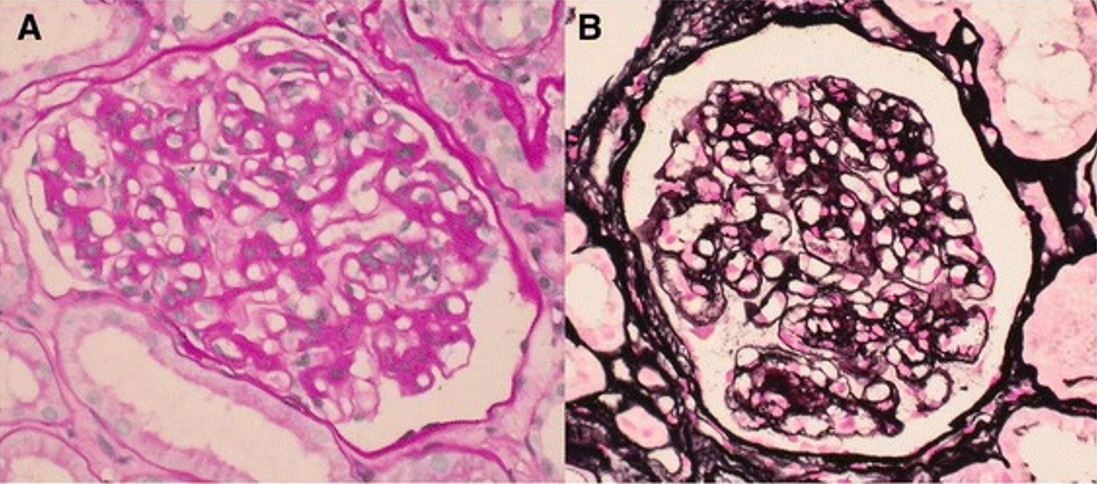
Imagen por Lecturio.

Estudios adicionales

Se indica un estudio adicional cuando la biopsia muestra cambios consistentes con:

  • Glomerulonefritis membranoproliferativa mediada por inmunoglobulina monoclonal/inmunocomplejo; otras pruebas pueden incluir:
    • Examen de infecciones:
      • Hemocultivos
      • Serología para determinar las infecciones por hepatitis B Hepatitis B Hepatitis B virus (HBV) is a partially double-stranded DNA virus, which belongs to the Orthohepadnavirus genus and the Hepadnaviridae family. Most individuals with acute HBV infection are asymptomatic or have mild, self-limiting symptoms. Chronic infection can be asymptomatic or create hepatic inflammation, leading to liver cirrhosis and hepatocellular carcinoma (HCC). Hepatitis B Virus y hepatitis C Hepatitis C Hepatitis C is an infection of the liver caused by the hepatitis C virus (HCV). The infection can be transmitted through infectious blood or body fluids and may be transmitted during childbirth or through IV drug use or sexual intercourse. Hepatitis C virus can cause both acute and chronic hepatitis, ranging from a mild to a serious, lifelong illness including liver cirrhosis and hepatocellular carcinoma (HCC). Hepatitis C Virus
      • Reacción en EN Erythema nodosum is an immune-mediated panniculitis (inflammation of the subcutaneous fat) caused by a type IV (delayed-type) hypersensitivity reaction. It commonly manifests in young women as tender, erythematous nodules on the shins. Erythema Nodosum cadena de la polimerasa ( PCR PCR Polymerase chain reaction (PCR) is a technique that amplifies DNA fragments exponentially for analysis. The process is highly specific, allowing for the targeting of specific genomic sequences, even with minuscule sample amounts. The PCR cycles multiple times through 3 phases: denaturation of the template DNA, annealing of a specific primer to the individual DNA strands, and synthesis/elongation of new DNA molecules. Polymerase Chain Reaction (PCR), por sus siglas en EN Erythema nodosum is an immune-mediated panniculitis (inflammation of the subcutaneous fat) caused by a type IV (delayed-type) hypersensitivity reaction. It commonly manifests in young women as tender, erythematous nodules on the shins. Erythema Nodosum inglés) y pruebas serológicas para determinar infecciones virales, bacterianas y fúngicas en EN Erythema nodosum is an immune-mediated panniculitis (inflammation of the subcutaneous fat) caused by a type IV (delayed-type) hypersensitivity reaction. It commonly manifests in young women as tender, erythematous nodules on the shins. Erythema Nodosum el contexto clínico relevante
    • Evaluación de enfermedades autoinmunes: detección de enfermedades autoinmunes, seguida de pruebas específicas según se indique
    • Evaluación de gammapatías monoclonales:
      • Electroforesis e inmunofijación de proteínas séricas
      • Cadenas ligeras libres de suero
      • Electroforesis e inmunofijación de proteínas en EN Erythema nodosum is an immune-mediated panniculitis (inflammation of the subcutaneous fat) caused by a type IV (delayed-type) hypersensitivity reaction. It commonly manifests in young women as tender, erythematous nodules on the shins. Erythema Nodosum orina
      • También pueden estar indicados los LOS Neisseria estudios de médula ósea.
  • Glomerulonefritis membranoproliferativa mediada por complemento; comprobar:
    • Activación de las vías clásicas del complemento: C3, C4, CH50 CH50 Terminal Complement Pathway Deficiency
    • Activación de la vía alternativa del complemento: AH50
    • Análisis genético de mutaciones y variantes alélicas de factores del complemento.
    • Autoanticuerpos para complementar proteínas reguladoras (e.g., factores H e I)
    • Prueba de factor nefrítico C3
    • Niveles séricos del complejo de ataque de membranas.

Tratamiento

Tratamiento

  • Trate la enfermedad subyacente (e.g., terapia antiviral Antiviral Antivirals for Hepatitis B para la hepatitis B Hepatitis B Hepatitis B virus (HBV) is a partially double-stranded DNA virus, which belongs to the Orthohepadnavirus genus and the Hepadnaviridae family. Most individuals with acute HBV infection are asymptomatic or have mild, self-limiting symptoms. Chronic infection can be asymptomatic or create hepatic inflammation, leading to liver cirrhosis and hepatocellular carcinoma (HCC). Hepatitis B Virus o C, inmunosupresión para los LOS Neisseria trastornos autoinmunitarios).
  • Si bien la mayoría de los LOS Neisseria casos pueden clasificarse, la enfermedad subyacente no se encuentra (idiopática) en EN Erythema nodosum is an immune-mediated panniculitis (inflammation of the subcutaneous fat) caused by a type IV (delayed-type) hypersensitivity reaction. It commonly manifests in young women as tender, erythematous nodules on the shins. Erythema Nodosum una pequeña cantidad de casos.
    • El tratamiento depende de:
    • En EN Erythema nodosum is an immune-mediated panniculitis (inflammation of the subcutaneous fat) caused by a type IV (delayed-type) hypersensitivity reaction. It commonly manifests in young women as tender, erythematous nodules on the shins. Erythema Nodosum la enfermedad leve (función renal normal, proteinuria Proteinuria The presence of proteins in the urine, an indicator of kidney diseases. Nephrotic Syndrome in Children en EN Erythema nodosum is an immune-mediated panniculitis (inflammation of the subcutaneous fat) caused by a type IV (delayed-type) hypersensitivity reaction. It commonly manifests in young women as tender, erythematous nodules on the shins. Erythema Nodosum rango no nefrótico (< 3,5 g/día) y sin hematuria Hematuria Presence of blood in the urine. Renal Cell Carcinoma significativa):
      • Inhibidores de la enzima convertidora de angiotensina (IECA) o inhibidores de los LOS Neisseria receptores de angiotensina II
      • Seguimiento regular Regular Insulin de la función renal (creatinina, análisis de orina, proteína en EN Erythema nodosum is an immune-mediated panniculitis (inflammation of the subcutaneous fat) caused by a type IV (delayed-type) hypersensitivity reaction. It commonly manifests in young women as tender, erythematous nodules on the shins. Erythema Nodosum orina)
    • Ante el deterioro (e.g., proteinuria Proteinuria The presence of proteins in the urine, an indicator of kidney diseases. Nephrotic Syndrome in Children >1,5 g/día o creatinina anormal), las opciones terapéuticas a considerar son:
      • Inmunosupresión (corticosteroides, micofenolato, ciclofosfamida, ciclosporina, tacrolimus Tacrolimus A macrolide isolated from the culture broth of a strain of streptomyces tsukubaensis that has strong immunosuppressive activity in vivo and prevents the activation of T-lymphocytes in response to antigenic or mitogenic stimulation in vitro. Immunosuppressants)
      • Intercambio de plasma Plasma The residual portion of blood that is left after removal of blood cells by centrifugation without prior blood coagulation. Transfusion Products si el factor nefrítico C3 está presente
      • Eculizumab (anticuerpo monoclonal contra C5)
    • Trasplante renal (posible recurrencia en EN Erythema nodosum is an immune-mediated panniculitis (inflammation of the subcutaneous fat) caused by a type IV (delayed-type) hypersensitivity reaction. It commonly manifests in young women as tender, erythematous nodules on the shins. Erythema Nodosum el injerto)

Pronóstico

  • Factores de mal pronóstico:
    • Síndrome nefrótico
    • Hipertensión
    • Creatinina elevada
    • Semilunas en EN Erythema nodosum is an immune-mediated panniculitis (inflammation of the subcutaneous fat) caused by a type IV (delayed-type) hypersensitivity reaction. It commonly manifests in young women as tender, erythematous nodules on the shins. Erythema Nodosum biopsia
    • Enfermedad tubulointersticial
  • Factores de buen pronóstico:
    • Proteinuria Proteinuria The presence of proteins in the urine, an indicator of kidney diseases. Nephrotic Syndrome in Children en EN Erythema nodosum is an immune-mediated panniculitis (inflammation of the subcutaneous fat) caused by a type IV (delayed-type) hypersensitivity reaction. It commonly manifests in young women as tender, erythematous nodules on the shins. Erythema Nodosum rango no nefrótico
    • Presión arterial normal
    • Creatinina normal

Diagnóstico Diferencial

  • Nefropatía por IgA IgA Represents 15-20% of the human serum immunoglobulins, mostly as the 4-chain polymer in humans or dimer in other mammals. Secretory iga is the main immunoglobulin in secretions. Immunoglobulins: Types and Functions: enfermedad renal caracterizada por el depósito de IgA IgA Represents 15-20% of the human serum immunoglobulins, mostly as the 4-chain polymer in humans or dimer in other mammals. Secretory iga is the main immunoglobulin in secretions. Immunoglobulins: Types and Functions en EN Erythema nodosum is an immune-mediated panniculitis (inflammation of the subcutaneous fat) caused by a type IV (delayed-type) hypersensitivity reaction. It commonly manifests in young women as tender, erythematous nodules on the shins. Erythema Nodosum el mesangio. La nefropatía por inmunoglobulina A se presenta con frecuencia en EN Erythema nodosum is an immune-mediated panniculitis (inflammation of the subcutaneous fat) caused by a type IV (delayed-type) hypersensitivity reaction. It commonly manifests in young women as tender, erythematous nodules on the shins. Erythema Nodosum la 2da y 3ra década de la vida e, históricamente, con una infección anterior de las vías respiratorias superiores o gastrointestinal. Las características de presentación son hematuria Hematuria Presence of blood in the urine. Renal Cell Carcinoma macroscópica o hematuria Hematuria Presence of blood in the urine. Renal Cell Carcinoma microscópica asintomática. El curso suele ser benigno y la biopsia renal se realiza solo en EN Erythema nodosum is an immune-mediated panniculitis (inflammation of the subcutaneous fat) caused by a type IV (delayed-type) hypersensitivity reaction. It commonly manifests in young women as tender, erythematous nodules on the shins. Erythema Nodosum casos de nefropatía progresiva grave. El tratamiento depende de la gravedad de la proteinuria Proteinuria The presence of proteins in the urine, an indicator of kidney diseases. Nephrotic Syndrome in Children, la función renal y los LOS Neisseria cambios patológicos. Para reducir la progresión de la enfermedad, a menudo se utilizan IECA o inhibidores de los LOS Neisseria receptores de angiotensina II. Los LOS Neisseria inmunosupresores se administran para tratar la proteinuria Proteinuria The presence of proteins in the urine, an indicator of kidney diseases. Nephrotic Syndrome in Children persistente y los LOS Neisseria niveles crecientes de creatinina.
  • Nefritis lúpica (glomerulonefritis causada por lupus eritematoso sistémico): las presentaciones clínicas incluyen hematuria Hematuria Presence of blood in the urine. Renal Cell Carcinoma, proteinuria Proteinuria The presence of proteins in the urine, an indicator of kidney diseases. Nephrotic Syndrome in Children en EN Erythema nodosum is an immune-mediated panniculitis (inflammation of the subcutaneous fat) caused by a type IV (delayed-type) hypersensitivity reaction. It commonly manifests in young women as tender, erythematous nodules on the shins. Erythema Nodosum rango nefrótico y, en EN Erythema nodosum is an immune-mediated panniculitis (inflammation of the subcutaneous fat) caused by a type IV (delayed-type) hypersensitivity reaction. It commonly manifests in young women as tender, erythematous nodules on the shins. Erythema Nodosum la enfermedad avanzada, azotemia Azotemia A biochemical abnormality referring to an elevation of blood urea nitrogen and creatinine. Azotemia can be produced by kidney diseases or other extrarenal disorders. When azotemia becomes associated with a constellation of clinical signs, it is termed uremia. Acute Kidney Injury. El diagnóstico se basa en EN Erythema nodosum is an immune-mediated panniculitis (inflammation of the subcutaneous fat) caused by a type IV (delayed-type) hypersensitivity reaction. It commonly manifests in young women as tender, erythematous nodules on the shins. Erythema Nodosum una biopsia renal. El tratamiento suele incluir corticosteroides y agentes citotóxicos u otros medicamentos inmunosupresores.
  • Glomerulonefritis postestreptocócica: un tipo de nefritis causada por una infección previa por estreptococo beta-hemolítico del grupo A. La presentación clínica puede variar desde hematuria Hematuria Presence of blood in the urine. Renal Cell Carcinoma microscópica asintomática hasta síndrome nefrítico agudo en EN Erythema nodosum is an immune-mediated panniculitis (inflammation of the subcutaneous fat) caused by a type IV (delayed-type) hypersensitivity reaction. It commonly manifests in young women as tender, erythematous nodules on the shins. Erythema Nodosum toda regla, que se caracteriza por orina de color rojo a marrón, proteinuria Proteinuria The presence of proteins in the urine, an indicator of kidney diseases. Nephrotic Syndrome in Children, edema Edema Edema is a condition in which excess serous fluid accumulates in the body cavity or interstitial space of connective tissues. Edema is a symptom observed in several medical conditions. It can be categorized into 2 types, namely, peripheral (in the extremities) and internal (in an organ or body cavity). Edema y lesión renal aguda. El diagnóstico se basa en EN Erythema nodosum is an immune-mediated panniculitis (inflammation of the subcutaneous fat) caused by a type IV (delayed-type) hypersensitivity reaction. It commonly manifests in young women as tender, erythematous nodules on the shins. Erythema Nodosum los LOS Neisseria hallazgos clínicos en EN Erythema nodosum is an immune-mediated panniculitis (inflammation of the subcutaneous fat) caused by a type IV (delayed-type) hypersensitivity reaction. It commonly manifests in young women as tender, erythematous nodules on the shins. Erythema Nodosum el contexto de una infección reciente por estreptococo del grupo A. El tratamiento es de apoyo e implica el tratamiento de las manifestaciones clínicas. El pronóstico es generalmente favorable, especialmente en EN Erythema nodosum is an immune-mediated panniculitis (inflammation of the subcutaneous fat) caused by a type IV (delayed-type) hypersensitivity reaction. It commonly manifests in young women as tender, erythematous nodules on the shins. Erythema Nodosum niños.
  • Glomerulonefritis rápidamente progresiva: síndrome de enfermedad glomerular grave con pérdida progresiva de la función renal en EN Erythema nodosum is an immune-mediated panniculitis (inflammation of the subcutaneous fat) caused by a type IV (delayed-type) hypersensitivity reaction. It commonly manifests in young women as tender, erythematous nodules on the shins. Erythema Nodosum semanas o meses. La glomerulonefritis rápidamente progresiva es una manifestación de diferentes enfermedades. Histológicamente, las semilunas se encuentran en EN Erythema nodosum is an immune-mediated panniculitis (inflammation of the subcutaneous fat) caused by a type IV (delayed-type) hypersensitivity reaction. It commonly manifests in young women as tender, erythematous nodules on the shins. Erythema Nodosum los LOS Neisseria glomérulos. Las semilunas surgen de una lesión inmunológica, cuyos principales mecanismos se clasifican en EN Erythema nodosum is an immune-mediated panniculitis (inflammation of the subcutaneous fat) caused by a type IV (delayed-type) hypersensitivity reaction. It commonly manifests in young women as tender, erythematous nodules on the shins. Erythema Nodosum enfermedad anti-membrana basal glomerular, enfermedad pauciinmune con semilunas y lesión mediada por complejos inmunitarios. La hematuria Hematuria Presence of blood in the urine. Renal Cell Carcinoma, la proteinuria Proteinuria The presence of proteins in the urine, an indicator of kidney diseases. Nephrotic Syndrome in Children, el edema Edema Edema is a condition in which excess serous fluid accumulates in the body cavity or interstitial space of connective tissues. Edema is a symptom observed in several medical conditions. It can be categorized into 2 types, namely, peripheral (in the extremities) and internal (in an organ or body cavity). Edema y la hipertensión son las manifestaciones de la glomerulonefritis rápidamente progresiva. El diagnóstico se basa en EN Erythema nodosum is an immune-mediated panniculitis (inflammation of the subcutaneous fat) caused by a type IV (delayed-type) hypersensitivity reaction. It commonly manifests in young women as tender, erythematous nodules on the shins. Erythema Nodosum la presentación, las pruebas de laboratorio, la imagenología y la biopsia renal. El tratamiento oportuno es esencial e incluye corticosteroides, inmunosupresores y plasmaféresis, según la enfermedad subyacente.

Referencias

  1. Alchi, B., Jayne, D. (2010). Membranoproliferative glomerulonephritis. Pediatric nephrology (Berlin, Germany). 25, 1409–1418. https://doi.org/10.1007/s00467-009-1322-7
  2. Fervenza, F.C., et al. (2021). Membranoproliferative glomerulonephritis: Classification, clinical features, and diagnosis. In Glassock, R.J., et al. (Ed.), UpToDate. Retrieved Sept 30, 2021, from https://www.uptodate.com/contents/membranoproliferative-glomerulonephritis-classification-clinical-features-and-diagnosis
  3. Fervenza, F.C., et al. (2020). Membranoproliferative glomerulonephritis: Treatment and prognosis. In Glassock, R.J., et al. (Ed.), UpToDate. Retrieved Sept 30, 2021, from https://www.uptodate.com/contents/membranoproliferative-glomerulonephritis-treatment-and-prognosis
  4. Kathuria, P., Patel, A. (2019). Membranoproliferative glomerulonephritis. Medscape. Retrieved August 11, 2021, from https://emedicine.medscape.com/article/240056
  5. O’Brien, F. (2021). Membranoproliferative glomerulonephritis. MSD Manual Professional Version. Retrieved August 10, 2021, from https://www.msdmanuals.com/professional/genitourinary-disorders/glomerular-disorders/membranoproliferative-glomerulonephritis
  6. Sethi, S., Fervenza, F.C. (2012). Membranoproliferative Glomerulonephritis — A New Look at an Old Entity. N Engl J Med. 366, 1119–1931. https://pubmed.ncbi.nlm.nih.gov/22435371/
  7. Salvadori, M., Rosso, G. (2016). Reclassification of membranoproliferative glomerulonephritis: Identification of a new GN: C3GN. World Journal of Nephrology. 5, 308–320. https://doi.org/10.5527/wjn.v5.i4.308
  8. Trachtman, H. (2017). Membranoproliferative glomerulonephritis. In Lerma, E.V., et al. (Eds.), CURRENT Diagnosis & Treatment: Nephrology & Hypertension, 2e. McGraw Hill. https://accessmedicine.mhmedical.com/content.aspx?bookid=2287&sectionid=177428874

¡Crea tu cuenta gratis o inicia una sesión para seguir leyendo!

Regístrate ahora y obtén acceso gratuito a Lecturio con páginas de concepto, videos médicos y cuestionarios para tu educación médica.

User Reviews

Que tengas una sesión de estudio alegre y navideña 🎁 Ahorra 50% en todos los planes >>

Details