Domina Conceptos Médicos

Estudia para la escuela de medicina y tus examenes con Lecturio.

Evaluación Enfocada con Ultrasonido para Traumatismos (FAST)

La evaluación enfocada con ultrasonido para traumatismos es un protocolo de examen de ultrasonido en EN Erythema nodosum is an immune-mediated panniculitis (inflammation of the subcutaneous fat) caused by a type IV (delayed-type) hypersensitivity reaction. It commonly manifests in young women as tender, erythematous nodules on the shins. Erythema Nodosum el punto de atención para las cavidades abdominal y torácica que se realiza en EN Erythema nodosum is an immune-mediated panniculitis (inflammation of the subcutaneous fat) caused by a type IV (delayed-type) hypersensitivity reaction. It commonly manifests in young women as tender, erythematous nodules on the shins. Erythema Nodosum la sala de emergencias como parte de la evaluación secundaria en EN Erythema nodosum is an immune-mediated panniculitis (inflammation of the subcutaneous fat) caused by a type IV (delayed-type) hypersensitivity reaction. It commonly manifests in young women as tender, erythematous nodules on the shins. Erythema Nodosum el soporte vital avanzado para traumatismos. El objetivo principal del examen FAST es identificar líquido intraperitoneal Intraperitoneal Peritoneum: Anatomy libre (sangre) y derrame pericárdico por traumatismo. Como el FAST requiere solo una máquina de ultrasonido a la cabecera del paciente y un ultrasonografista experimentado, está ampliamente disponible, es más rápida y menos invasiva que otras modalidades de imagenología. La evaluación enfocada con ultrasonido para traumatismos ha HA Hemolytic anemia (HA) is the term given to a large group of anemias that are caused by the premature destruction/hemolysis of circulating red blood cells (RBCs). Hemolysis can occur within (intravascular hemolysis) or outside the blood vessels (extravascular hemolysis). Hemolytic Anemia reemplazado en EN Erythema nodosum is an immune-mediated panniculitis (inflammation of the subcutaneous fat) caused by a type IV (delayed-type) hypersensitivity reaction. It commonly manifests in young women as tender, erythematous nodules on the shins. Erythema Nodosum gran medida al AL Amyloidosis lavado peritoneal diagnóstico.

Last updated: Dec 15, 2025

Editorial responsibility: Stanley Oiseth, Lindsay Jones, Evelin Maza

Introducción

Definición

La evaluación enfocada con ultrasonido para traumatismos (FAST, por sus siglas en EN Erythema nodosum is an immune-mediated panniculitis (inflammation of the subcutaneous fat) caused by a type IV (delayed-type) hypersensitivity reaction. It commonly manifests in young women as tender, erythematous nodules on the shins. Erythema Nodosum inglés) es un protocolo de examen de ultrasonido en EN Erythema nodosum is an immune-mediated panniculitis (inflammation of the subcutaneous fat) caused by a type IV (delayed-type) hypersensitivity reaction. It commonly manifests in young women as tender, erythematous nodules on the shins. Erythema Nodosum el punto de atención de las cavidades abdominal y torácica realizado con el objetivo de identificar líquido intraperitoneal Intraperitoneal Peritoneum: Anatomy libre y/o derrame pericárdico.

Antecedentes

  • Los LOS Neisseria antecedentes y el examen físico a menudo carecen de la sensibilidad y especificidad necesarias para diagnosticar con precisión la patología traumática aguda del abdomen.
  • El líquido libre dentro de la cavidad peritoneal se asienta en EN Erythema nodosum is an immune-mediated panniculitis (inflammation of the subcutaneous fat) caused by a type IV (delayed-type) hypersensitivity reaction. It commonly manifests in young women as tender, erythematous nodules on the shins. Erythema Nodosum áreas dependientes dentro del peritoneo cuando el paciente está en EN Erythema nodosum is an immune-mediated panniculitis (inflammation of the subcutaneous fat) caused by a type IV (delayed-type) hypersensitivity reaction. It commonly manifests in young women as tender, erythematous nodules on the shins. Erythema Nodosum decúbito supino y puede detectarse mediante ultrasonido.
  • Sensibilidad del 42% y especificidad ≥ 98% para líquido peritoneal libre
  • Se pueden observar 100 mL de líquido libre, aunque se necesitan > 500 mL para el usuario común.
  • El ultrasonido pulmonar ( en EN Erythema nodosum is an immune-mediated panniculitis (inflammation of the subcutaneous fat) caused by a type IV (delayed-type) hypersensitivity reaction. It commonly manifests in young women as tender, erythematous nodules on the shins. Erythema Nodosum el FAST extendido ( E-FAST E-FAST Focused Assessment with Sonography for Trauma (FAST))) tiene una sensibilidad del 95%, una especificidad del 91% y un valor predictivo negativo del 100%.
  • El lavado peritoneal diagnóstico se utilizó anteriormente como la prueba estándar para ayudar a los LOS Neisseria médicos a decidir qué pacientes traumatizados necesitaban una laparotomía exploratoria de emergencia.
  • El FAST ha HA Hemolytic anemia (HA) is the term given to a large group of anemias that are caused by the premature destruction/hemolysis of circulating red blood cells (RBCs). Hemolysis can occur within (intravascular hemolysis) or outside the blood vessels (extravascular hemolysis). Hemolytic Anemia reemplazado a lavado peritoneal diagnóstico y, a menudo, es más beneficioso que la TC por muchas razones.
Tabla: Ventajas y desventajas del examen FAST
Ventajas Desventajas
  • Se puede realizar en EN Erythema nodosum is an immune-mediated panniculitis (inflammation of the subcutaneous fat) caused by a type IV (delayed-type) hypersensitivity reaction. It commonly manifests in young women as tender, erythematous nodules on the shins. Erythema Nodosum cualquier paciente
  • Determina de manera temprana si se requiere cirugía
  • ↓ Tiempo hasta el diagnóstico de lesión abdominal aguda
  • Diagnostica con precisión el hemoperitoneo
  • No invasivo
  • Integrado en EN Erythema nodosum is an immune-mediated panniculitis (inflammation of the subcutaneous fat) caused by a type IV (delayed-type) hypersensitivity reaction. It commonly manifests in young women as tender, erythematous nodules on the shins. Erythema Nodosum la evaluación primaria o secundaria
  • Se puede realizar rápidamente
  • Disponible a la cabecera del paciente
  • Facilidad de uso para exámenes seriados
  • Seguro para su uso en EN Erythema nodosum is an immune-mediated panniculitis (inflammation of the subcutaneous fat) caused by a type IV (delayed-type) hypersensitivity reaction. It commonly manifests in young women as tender, erythematous nodules on the shins. Erythema Nodosum mujeres embarazadas y niños
  • ↓ Radiación que la TC
  • Conduce a ↓ LPD
  • Puede conducir a la ↓ de TC
  • Método dependiente del operador
  • Solo evalúa la presencia de sangre dentro de la cavidad peritoneal y no su fuente
  • Distorsión de imágenes debido a obesidad, gases intestinales y aire subcutáneo
  • Puede pasar por alto lesiones diafragmáticas, intestinales y pancreáticas
  • No evalúa las estructuras retroperitoneales
  • No visualiza aire extraluminal
LPD: lavado peritoneal diagnóstico

Indicaciones

  • Traumatismo abdominal cerrado
  • Traumatismo abdominal penetrante sin otras indicaciones de laparotomía inmediata

Contraindicaciones

  • Sin contraindicaciones absolutas
  • No debe retrasar los LOS Neisseria esfuerzos de reanimación

Recomendaciones

  • FAST + tendrá 1 de los LOS Neisseria siguientes:
    • Área anecoica (sangre) dentro del espacio pericárdico
    • Área anecoica (sangre) entre el hígado y el riñón
    • Área anecoica (sangre) entre el diafragma y el bazo
    • Área anecoica (sangre) entre el bazo y el riñón
    • Área anecoica (sangre) entre el espacio superior y posterior a la pared posterior de la vejiga
  • E-FAST E-FAST Focused Assessment with Sonography for Trauma (FAST) + puede tener 1 de los LOS Neisseria hallazgos agregados:
    • Área anecoica (sangre) por encima del diafragma entre el diafragma y el pulmón
    • Ausencia de deslizamiento pulmonar
  • Se debe repetir el FAST – si existe un cambio en EN Erythema nodosum is an immune-mediated panniculitis (inflammation of the subcutaneous fat) caused by a type IV (delayed-type) hypersensitivity reaction. It commonly manifests in young women as tender, erythematous nodules on the shins. Erythema Nodosum la condición del paciente.
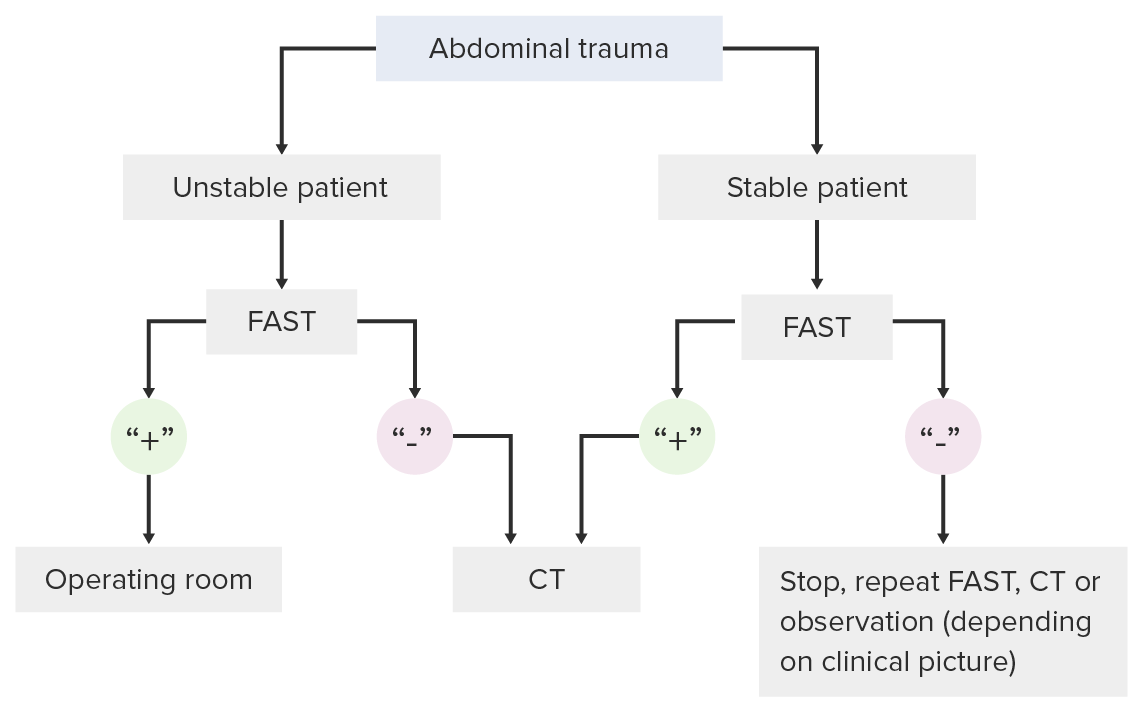
Vía de toma de decisiones para el uso de FAST

Algoritmo de toma de decisiones para el uso del examen FAST en el entorno de un traumatismo

Imagen por Lecturio. Licencia: CC BY-NC-SA 4.0
Conceptos Básicos del Ultrasonido

Imagenología

  • La ultrasonografía es una técnica de imagenología basada en EN Erythema nodosum is an immune-mediated panniculitis (inflammation of the subcutaneous fat) caused by a type IV (delayed-type) hypersensitivity reaction. It commonly manifests in young women as tender, erythematous nodules on the shins. Erythema Nodosum ultrasonidos (ondas de sonido inaudibles de alta frecuencia).
  • Las ondas de sonido que tienen una frecuencia de 2–18 MHz se utilizan para la imagenología médica.
  • El equipo utiliza un transductor que actúa como emisor y receptor Receptor Receptors are proteins located either on the surface of or within a cell that can bind to signaling molecules known as ligands (e.g., hormones) and cause some type of response within the cell. Receptors de ondas de sonido y una computadora central que procesa las señales eléctricas para generar la imagen.

Terminología

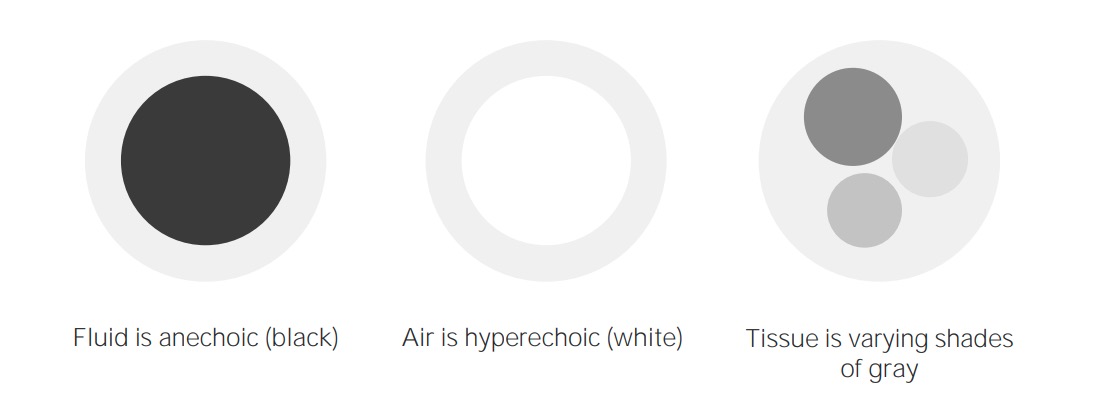
  • Hiperecoico (e.g., superficie del hueso, cálculos en EN Erythema nodosum is an immune-mediated panniculitis (inflammation of the subcutaneous fat) caused by a type IV (delayed-type) hypersensitivity reaction. It commonly manifests in young women as tender, erythematous nodules on the shins. Erythema Nodosum las vías urinarias, lesiones que contienen grasa): una estructura que produce un eco de gran amplitud (grises más claros y blanco)
  • Hipoecoico (e.g., abscesos sin gas, tumores sólidos sin calcificaciones ni grasa): una estructura que produce eco de baja amplitud (grises más oscuros)
  • Anecoico (e.g., quistes simples): una estructura que no produce ningún eco (se observa completamente negra)
  • Isoecoico: una estructura que produce un eco con una amplitud muy similar a la de su entorno, que es muy difícil de distinguir
Conceptos de imagen de ultrasonido

Conceptos básicos de imagenología del ultrasonido

Imagen por Lecturio. Licencia: CC BY-NC-SA 4.0

Sondas

  • Sonda curvilínea o convexa:
    • “Sonda abdominal”
    • 2–5 MHz (baja frecuencia)
    • Alta penetración
    • Gran huella
    • Poco adecuada para el movimiento
    • Se utiliza para la mayoría de los LOS Neisseria órganos internos, la aorta Aorta The main trunk of the systemic arteries. Mediastinum and Great Vessels: Anatomy, el abdomen, los LOS Neisseria pulmones, la pleura Pleura The pleura is a serous membrane that lines the walls of the thoracic cavity and the surface of the lungs. This structure of mesodermal origin covers both lungs, the mediastinum, the thoracic surface of the diaphragm, and the inner part of the thoracic cage. The pleura is divided into a visceral pleura and parietal pleura. Pleura: Anatomy, ginecología, FAST, E-FAST E-FAST Focused Assessment with Sonography for Trauma (FAST)
  • Sonda de matriz en EN Erythema nodosum is an immune-mediated panniculitis (inflammation of the subcutaneous fat) caused by a type IV (delayed-type) hypersensitivity reaction. It commonly manifests in young women as tender, erythematous nodules on the shins. Erythema Nodosum fase:
    • “Sonda cardíaca”
    • 1–5 MHz (baja frecuencia)
    • Alta penetración
    • Pequeña huella
    • Ideal para el movimiento
    • Usos: cardíaco, pleura Pleura The pleura is a serous membrane that lines the walls of the thoracic cavity and the surface of the lungs. This structure of mesodermal origin covers both lungs, the mediastinum, the thoracic surface of the diaphragm, and the inner part of the thoracic cage. The pleura is divided into a visceral pleura and parietal pleura. Pleura: Anatomy, FAST, E-FAST E-FAST Focused Assessment with Sonography for Trauma (FAST)
  • Sonda lineal:
    • “Sonda vascular”
    • Sonda de 6–13 MHz (alta frecuencia)
    • Baja penetración
    • Gran huella
    • Usos: vascular, pleural ( en EN Erythema nodosum is an immune-mediated panniculitis (inflammation of the subcutaneous fat) caused by a type IV (delayed-type) hypersensitivity reaction. It commonly manifests in young women as tender, erythematous nodules on the shins. Erythema Nodosum E-FAST E-FAST Focused Assessment with Sonography for Trauma (FAST)), nervio óptico, acceso venoso

Evaluación

Seleccionar la sonda:

  • La sonda curvilínea es ideal para todas las partes del FAST.
  • La sonda cardíaca se puede utilizar para la ventana cardíaca.
  • Si se realiza E-FAST E-FAST Focused Assessment with Sonography for Trauma (FAST), se utiliza sonda lineal para la pleura Pleura The pleura is a serous membrane that lines the walls of the thoracic cavity and the surface of the lungs. This structure of mesodermal origin covers both lungs, the mediastinum, the thoracic surface of the diaphragm, and the inner part of the thoracic cage. The pleura is divided into a visceral pleura and parietal pleura. Pleura: Anatomy.

Localización:

  • La secuencia tradicionalmente varía según el mecanismo.
  • El traumatismo cerrado comienza con la ventana del cuadrante superior derecho.
  • Ventana más sensible para líquido peritoneal libre
  • El traumatismo penetrante comienza con la ventana cardíaca.
  • Descartar derrame pericárdico y taponamiento (inminente).
  • Incluir las ventanas cardíaca, cuadrante superior derecho, pélvica, cuadrante superior izquierdo y pulmonar.

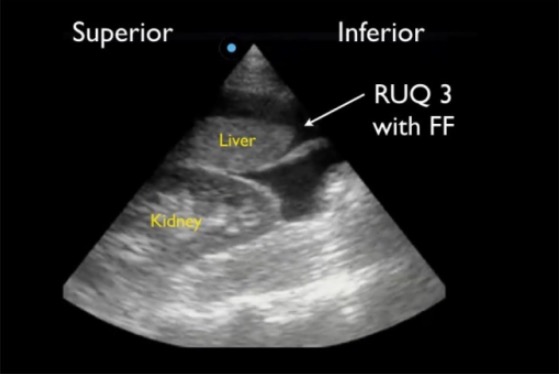
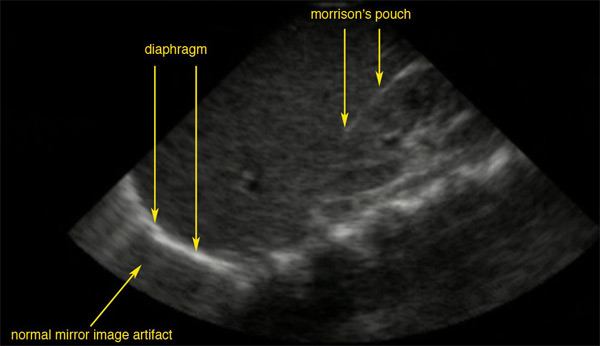
Ventana del cuadrante superior derecho (espacio de Morison o fosa hepatorrenal)

  • Colocación de la sonda:
    • Vista coronal Coronal Computed Tomography (CT) sobre el flanco derecho
    • 8 a 11 costillas derechas en EN Erythema nodosum is an immune-mediated panniculitis (inflammation of the subcutaneous fat) caused by a type IV (delayed-type) hypersensitivity reaction. It commonly manifests in young women as tender, erythematous nodules on the shins. Erythema Nodosum la línea axilar media o anterior
    • La sonda debe mantenerse paralela para evitar sombras de las costillas.
  • Puntos de referencia:
    • Visualizar la interfaz hepatorrenal.
    • Espacio entre el lóbulo derecho del hígado y el riñón derecho = espacio de Morison
  • Explorar de anterior a posterior y los LOS Neisseria polos superior e inferior del riñón.
  • La punta del hígado es un sitio común donde se olvida la presencia de líquido libre.
  • Líquido intraperitoneal Intraperitoneal Peritoneum: Anatomy + inestabilidad hemodinámica → laparotomía exploratoria
  • Imagen anecoica por encima del diafragma = derrame pleural

Ventana cardíaca (ventana subxifoidea)

  • Colocación de la sonda:
    • Apófisis subxifoideo: los LOS Neisseria ventrículos derecho e izquierdo deben visualizarse en EN Erythema nodosum is an immune-mediated panniculitis (inflammation of the subcutaneous fat) caused by a type IV (delayed-type) hypersensitivity reaction. It commonly manifests in young women as tender, erythematous nodules on the shins. Erythema Nodosum un eje longitudinal.
    • Paraesternal largo, si el abdomen está distendido o es difícil obtener una ventana subxifoidea
  • Puntos de referencia:
    • Visualizar el corazón y el pericardio.
    • Escanear de anterior a posterior a través del corazón.
    • Nota: una almohadilla de grasa anterior puede dar la impresión de un derrame pericárdico, pero no debe observarse en EN Erythema nodosum is an immune-mediated panniculitis (inflammation of the subcutaneous fat) caused by a type IV (delayed-type) hypersensitivity reaction. It commonly manifests in young women as tender, erythematous nodules on the shins. Erythema Nodosum las proyecciones posteriores.
    • Una franja anecoica (negra) alrededor de los LOS Neisseria ventrículos indica derrame pericárdico.
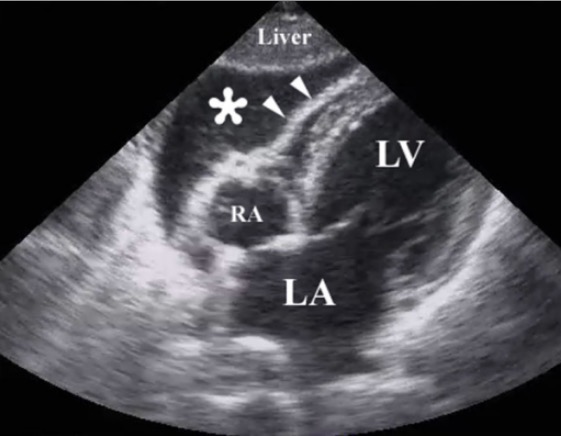
Ultrasonido después de una lesión torácica que muestra taponamiento pericárdico

Imagen de ultrasonido de reanimación tras un traumatismo torácico penetrante que ilustra la presencia de un taponamiento pericárdico por hemopericardio (*):
Las puntas de flecha ilustran la pared del ventrículo derecho.
RA: aurícula derecha (por sus siglas en inglés)
LA: aurícula izquierda (por sus siglas en inglés)
LV: ventrículo izquierdo (por sus siglas en inglés)
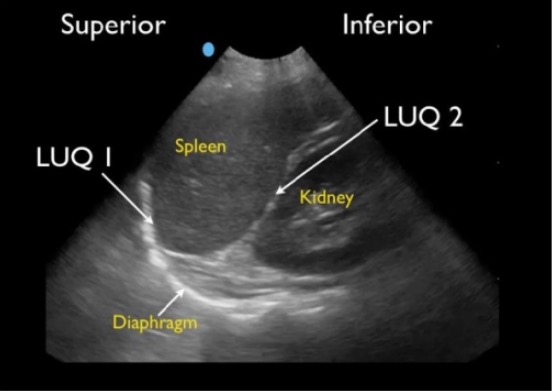
Imagen: “Ultrasound after chest injury showing pericardial tamponade” por Regional Trauma Services, Calgary Heath Region and Foothills Medical Centre, Calgary, Alberta, Canada. Licencia: CC BY 2.0

Ventana del cuadrante superior izquierdo (ventana esplenorrenal o fosa esplenorrenal)

  • Colocación de la sonda:
    • Similar al AL Amyloidosis del espacio de Morison en EN Erythema nodosum is an immune-mediated panniculitis (inflammation of the subcutaneous fat) caused by a type IV (delayed-type) hypersensitivity reaction. It commonly manifests in young women as tender, erythematous nodules on the shins. Erythema Nodosum el lado contralateral (izquierdo)
    • Vista coronal Coronal Computed Tomography (CT) sobre el flanco izquierdo
  • Puntos de referencia:
    • Luce similar a la ventana del espacio de Morison
    • Identificar el espacio entre el bazo y el diafragma y la interfaz esplenorrenal.
  • El líquido se acumula cefálicamente al AL Amyloidosis bazo, debajo del diafragma.
  • Imagen anecoica por encima del diafragma = derrame pleural

Ventana vesical (pélvica)

  • Colocación de la sonda:
    • En EN Erythema nodosum is an immune-mediated panniculitis (inflammation of the subcutaneous fat) caused by a type IV (delayed-type) hypersensitivity reaction. It commonly manifests in young women as tender, erythematous nodules on the shins. Erythema Nodosum la línea media, inmediatamente superior al AL Amyloidosis hueso púbico
    • Vista sagital, justo por encima de la sínfisis púbica
  • Puntos de referencia:
    • Identificar la vejiga.
    • Explorar de medial a lateral para identificar el líquido posterior y superior a la vejiga.
    • Esta ventana estará limitada si la vejiga está vacía.
    • El líquido libre se observa como anecoico, posterior a la vejiga.
    • En EN Erythema nodosum is an immune-mediated panniculitis (inflammation of the subcutaneous fat) caused by a type IV (delayed-type) hypersensitivity reaction. It commonly manifests in young women as tender, erythematous nodules on the shins. Erythema Nodosum las mujeres, el líquido se acumula en EN Erythema nodosum is an immune-mediated panniculitis (inflammation of the subcutaneous fat) caused by a type IV (delayed-type) hypersensitivity reaction. It commonly manifests in young women as tender, erythematous nodules on the shins. Erythema Nodosum el espacio llamado fondo de saco de Douglas (bolsa rectouterina).
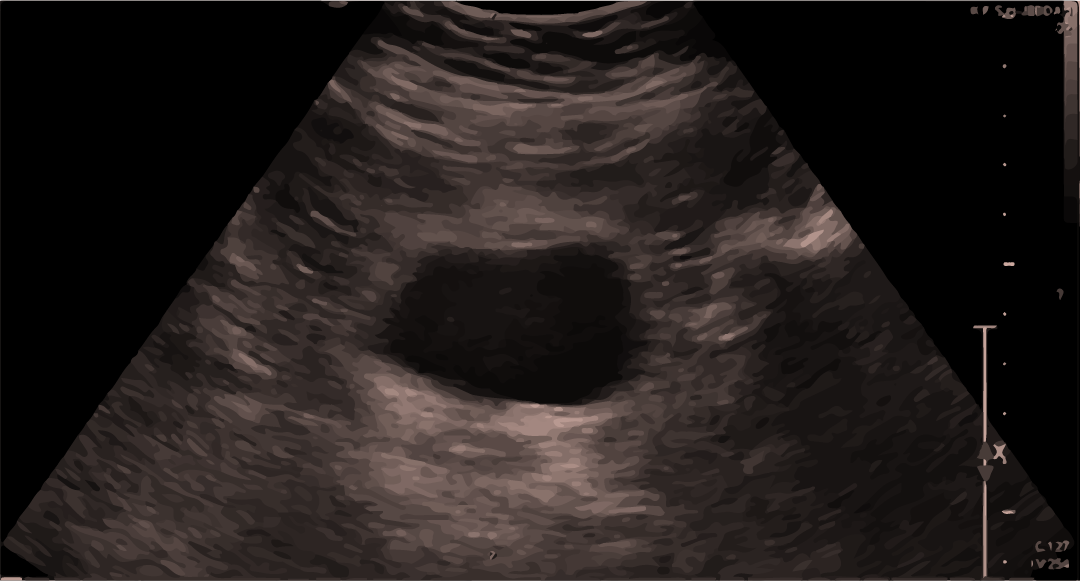
Ultrasonido de la vejiga

Ultrasonido normal de la vejiga:
Se puede observar sangre/líquido por encima o por debajo de la vejiga.
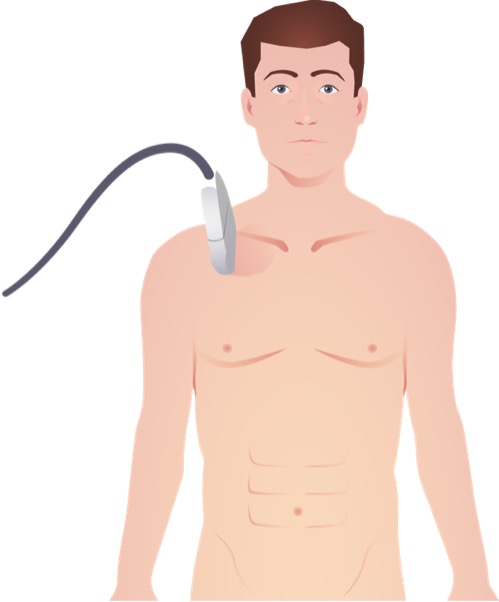
Imagen por Lecturio.

Ventana pulmonar en EN Erythema nodosum is an immune-mediated panniculitis (inflammation of the subcutaneous fat) caused by a type IV (delayed-type) hypersensitivity reaction. It commonly manifests in young women as tender, erythematous nodules on the shins. Erythema Nodosum el FAST extendido

  • Colocación de la sonda:
    • Vista coronal Coronal Computed Tomography (CT) sobre el diafragma derecho e izquierdo (sonda curvilínea)
    • Vista sagital sobre la línea medioclavicular entre el 2do y el 3er espacio intercostal (sonda lineal)
  • Puntos de referencia:
    • Identificar la interfaz entre el diafragma y el pulmón a la derecha y a la izquierda (sonda curvilínea).
    • Identificar el deslizamiento del pulmón entre las 2 costillas sobre el tórax anterior (sonda lineal).
  • Se incluye en EN Erythema nodosum is an immune-mediated panniculitis (inflammation of the subcutaneous fat) caused by a type IV (delayed-type) hypersensitivity reaction. It commonly manifests in young women as tender, erythematous nodules on the shins. Erythema Nodosum el protocolo la visualización de ambos hemitórax para evaluar la presencia de:
    • Hemotórax
    • Neumotórax
Colocación de ultrasonido lineal

Colocación de la sonda lineal de ultrasonido para la visualización de la pleura pulmonar y el deslizamiento pulmonar en la evaluación del neumotórax

Imagen por Lecturio.

Relevancia Clínica

  • Ultrasonografía: una técnica de imagenología basada en EN Erythema nodosum is an immune-mediated panniculitis (inflammation of the subcutaneous fat) caused by a type IV (delayed-type) hypersensitivity reaction. It commonly manifests in young women as tender, erythematous nodules on the shins. Erythema Nodosum ultrasonidos (ondas de sonido inaudibles de alta frecuencia). Las ondas de sonido que tienen una frecuencia de 2–18 MHz se utilizan para la imagenología médica. El equipo utiliza un transductor que actúa como emisor y receptor Receptor Receptors are proteins located either on the surface of or within a cell that can bind to signaling molecules known as ligands (e.g., hormones) and cause some type of response within the cell. Receptors de ondas de sonido y una computadora central que procesa las señales eléctricas para generar la imagen. Las ventajas generales de este tipo de imagenología son su bajo costo, disponibilidad y seguridad.
  • Hemopericardio (taponamiento): acumulación de exceso de líquido en EN Erythema nodosum is an immune-mediated panniculitis (inflammation of the subcutaneous fat) caused by a type IV (delayed-type) hypersensitivity reaction. It commonly manifests in young women as tender, erythematous nodules on the shins. Erythema Nodosum el espacio pericárdico alrededor del corazón, lo que aumenta la presión, restringe el llenado cardíaco y da como resultado una disminución del gasto cardíaco. Los LOS Neisseria síntomas incluyen disnea, hipotensión, ruidos cardíacos amortiguados, ingurgitación yugular y pulso paradójico. El diagnóstico se confirma mediante ultrasonido. El tratamiento es pericardiocentesis Pericardiocentesis Puncture and aspiration of fluid from the pericardium. Cardiac Surgery o pericardiotomía emergente.
  • Hemotórax: acumulación de sangre en EN Erythema nodosum is an immune-mediated panniculitis (inflammation of the subcutaneous fat) caused by a type IV (delayed-type) hypersensitivity reaction. It commonly manifests in young women as tender, erythematous nodules on the shins. Erythema Nodosum la cavidad pleural que ocurre con mayor frecuencia debido al AL Amyloidosis daño de las arterias intercostales. Los LOS Neisseria pacientes afectados presentan dificultad para respirar, dolor Dolor Inflammation torácico, hipotensión, taquicardia, disminución de los LOS Neisseria sonidos pulmonares y matidez a la percusión del tórax. El diagnóstico es mediante radiografía de tórax. El tratamiento es con drenaje pleural, cirugía toracoscópica asistida por video o toracotomía.
  • Neumotórax: una afección potencialmente mortal en EN Erythema nodosum is an immune-mediated panniculitis (inflammation of the subcutaneous fat) caused by a type IV (delayed-type) hypersensitivity reaction. It commonly manifests in young women as tender, erythematous nodules on the shins. Erythema Nodosum la que se acumula aire en EN Erythema nodosum is an immune-mediated panniculitis (inflammation of the subcutaneous fat) caused by a type IV (delayed-type) hypersensitivity reaction. It commonly manifests in young women as tender, erythematous nodules on the shins. Erythema Nodosum el espacio pleural, lo que lleva al AL Amyloidosis colapso pulmonar. Los LOS Neisseria pacientes se presentan con dolor Dolor Inflammation torácico, disnea y disminución de los LOS Neisseria ruidos respiratorios. El diagnóstico se realiza mediante imagenología, aunque el neumotórax a tensión es un diagnóstico clínico. El tratamiento se basa en EN Erythema nodosum is an immune-mediated panniculitis (inflammation of the subcutaneous fat) caused by a type IV (delayed-type) hypersensitivity reaction. It commonly manifests in young women as tender, erythematous nodules on the shins. Erythema Nodosum el tamaño y la estabilidad del paciente afectado y puede incluir la descompresión con aguja y la colocación de drenaje pleural.
  • Derrame pleural: acumulación de líquido entre las capas de la pleura Pleura The pleura is a serous membrane that lines the walls of the thoracic cavity and the surface of the lungs. This structure of mesodermal origin covers both lungs, the mediastinum, the thoracic surface of the diaphragm, and the inner part of the thoracic cage. The pleura is divided into a visceral pleura and parietal pleura. Pleura: Anatomy parietal Parietal One of a pair of irregularly shaped quadrilateral bones situated between the frontal bone and occipital bone, which together form the sides of the cranium. Skull: Anatomy y visceral. Las causas comunes de derrame pleural incluyen infección, malignidad, trastornos autoinmunes o sobrecarga de volumen. Las manifestaciones clínicas incluyen dolor Dolor Inflammation torácico, tos TOS Thoracic outlet syndrome (TOS) is a broad term used for a spectrum of syndromes related to the general region of the thoracic outlet, which involves the compression or irritation of elements of the brachial plexus, subclavian artery, or subclavian vein. Thoracic Outlet Syndrome y disnea. El tratamiento depende de la afección subyacente y de si el derrame está causando dificultad respiratoria.

Referencias

  1. Roberts, J., Custalow, C., Thomsen, T. (2019). Roberts and Hedges’ Clinical Procedures in Emergency Medicine and Acute Care. Philadelphia, PA: Elsevier.
  2. Bloom, B.A., Gibbons, R.C. (2021). Focused assessment with sonography for trauma. StatPearls. Treasure Island (FL): StatPearls Publishing. Retrieved from http://www.ncbi.nlm.nih.gov/books/NBK470479/
  3. American College of Surgeons. (2018). Advanced trauma life support: Student course manual. Chicago, IL: American College of Surgeons.
  4. Natarajan, B., Gupta, P.K., Cemaj S, et al. (2010). FAST scan: Is it worth doing in hemodynamically stable blunt trauma patients? Surgery. 148, 695-700.
  5. Miller, M.T., Pasquale, M.D., Bromberg, W.J., et al. (2003). Not so FAST. J Trauma. 54, 52–59.
  6. Von Kuenssberg, J.D., Stiller, G., Wagner, D. (2003). Sensitivity in detecting free intraperitoneal fluid with the pelvic views of the FAST exam. Am J Emerg Med. 21, 476-478.
  7. McKenney, K.L., McKenney, M.G., Cohn, S.M., et al. (2001). Hemoperitoneum score helps determine need for therapeutic laparotomy. J Trauma. 50, 650–654.
  8. Lichtenstein, D.A., Menu, Y. (1995). A bedside ultrasound sign ruling out pneumothorax in the critically ill. Lung sliding. Chest. 108, 1345–1348.
  9. Chen, M.M., Whitlow, C.T. (2011). Chapter 1. scope of diagnostic imaging. Chen, M.M., & Pope, T.L., & Ott D.J.(Eds.). Basic Radiology, 2e. McGraw-Hill. https://accessmedicine-mhmedical-com.ezproxy.unbosque.edu.co/content.aspx?bookid=360&sectionid=39669007
  10. Zaer, N.F., Amini B, Elsayes, K.M. (2014). Overview of diagnostic modalities and contrast agents. Elsayes, K.M., Oldham, S.A.(Eds.). Introduction to Diagnostic Radiology. McGraw-Hill. https://accessmedicine-mhmedical-com.ezproxy.unbosque.edu.co/content.aspx?bookid=1562&sectionid=95875179

¡Crea tu cuenta gratis o inicia una sesión para seguir leyendo!

Regístrate ahora y obtén acceso gratuito a Lecturio con páginas de concepto, videos médicos y cuestionarios para tu educación médica.

User Reviews

Que tengas una sesión de estudio alegre y navideña 🎁 Ahorra 50% en todos los planes >>

Details