Domina Conceptos Médicos

Estudia para la escuela de medicina y tus examenes con Lecturio.

Enfermedades Mamarias Benignas

Las lesiones epiteliales benignas de la mama se agrupan histológicamente en EN Erythema nodosum is an immune-mediated panniculitis (inflammation of the subcutaneous fat) caused by a type IV (delayed-type) hypersensitivity reaction. It commonly manifests in young women as tender, erythematous nodules on the shins. Erythema Nodosum no proliferativas, proliferativas sin atipia e hiperplasia atípica. Las clasificaciones se basan en EN Erythema nodosum is an immune-mediated panniculitis (inflammation of the subcutaneous fat) caused by a type IV (delayed-type) hypersensitivity reaction. It commonly manifests in young women as tender, erythematous nodules on the shins. Erythema Nodosum el riesgo de cáncer posterior en EN Erythema nodosum is an immune-mediated panniculitis (inflammation of the subcutaneous fat) caused by a type IV (delayed-type) hypersensitivity reaction. It commonly manifests in young women as tender, erythematous nodules on the shins. Erythema Nodosum cualquiera de las mamas. El tipo no proliferativo no conlleva ningún riesgo, mientras que el fibroadenoma Fibroadenoma Fibroadenomas are the most common benign tumor of the female breast and the most common breast tumor in adolescent and young women. The tumors are well-circumscribed, mobile, and unencapsulated, with a rubbery or firm consistency. Fibroadenoma, el tumor Tumor Inflammation benigno más común, es una lesión mamaria proliferativa (i.e., puede presentar un ligero aumento del riesgo de malignidad si es complejo). Dado que la hiperplasia atípica comparte algunas características con el carcinoma de mama in situ, el potencial de cáncer futuro es mayor. El tratamiento va VA Ventilation: Mechanics of Breathing desde la monitorización frecuente hasta la escisión quirúrgica, dependiendo de ciertos factores, incluido el riesgo inherente al AL Amyloidosis diagnóstico patológico. Otros trastornos mamarios sin posibilidad de malignidad se asocian a una infección subyacente o a una enfermedad sistémica, por lo que el tratamiento es diferente. Las enfermedades mamarias benignas son frecuentes, pero se presentan de forma diversa. Es importante distinguirlas para determinar la probabilidad de cáncer y el mejor tratamiento.

Last updated: Dec 15, 2025

Editorial responsibility: Stanley Oiseth, Lindsay Jones, Evelin Maza

Lesiones Epiteliales No Proliferativas de la Mama

Definición

Las lesiones no proliferativas de la mama son afecciones que generalmente no se asocian con un mayor riesgo de cáncer de mama.
Quiste mamario simple

  • Masas redondas u ovaladas llenas de líquido de la unidad lobulillar ductal terminal
  • Epidemiología:
    • Común; la prevalencia poblacional precisa varía según la edad y el método de imagen
    • Hasta ⅓ de las mujeres de 30–50 años tienen quistes mamarios
  • Presentación clínica:
    • Se siente como una masa palpable
    • Dolor Dolor Inflammation observado con el agrandamiento agudo del quiste
  • Diagnóstico:
    • Ultrasonido:
      • Diferencia las masas (sólidas, llenas de líquido o con elementos mixtos)
      • Quiste simple: bien circunscrito, anecoico, sin componentes sólidos
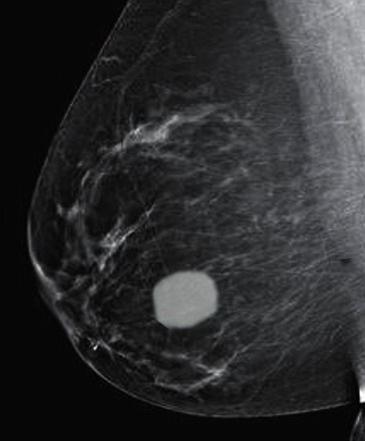
    • Mamografía: forma ovalada o redonda con márgenes circunscritos
  • Tratamiento:
    • La mayoría de las veces no se interviene
    • Aspiración con aguja fina
      • Para signos de infección o inflamación
      • Dolor Dolor Inflammation por aumento de tamaño

Hiperplasia leve de tipo usual

  • Patología:
    • Las células tienen un aspecto muy cercano a la normalidad.
    • Aumento del número de células epiteliales dentro de un ducto
    • La profundidad celular es más de 2 pero no más de 4 células.
  • Presentación clínica: se encuentra en EN Erythema nodosum is an immune-mediated panniculitis (inflammation of the subcutaneous fat) caused by a type IV (delayed-type) hypersensitivity reaction. It commonly manifests in young women as tender, erythematous nodules on the shins. Erythema Nodosum la biopsia o escisión quirúrgica
  • Tratamiento: no es necesario ningún tratamiento

Cambios papilares apocrinos

  • Patología:
    • Proliferación de células epiteliales ductales con características apocrinas
    • Pueden ser lesiones simples, complejas o muy complejas
  • Presentación clínica: se encuentra en EN Erythema nodosum is an immune-mediated panniculitis (inflammation of the subcutaneous fat) caused by a type IV (delayed-type) hypersensitivity reaction. It commonly manifests in young women as tender, erythematous nodules on the shins. Erythema Nodosum el examen histológico (biopsia o escisión quirúrgica)
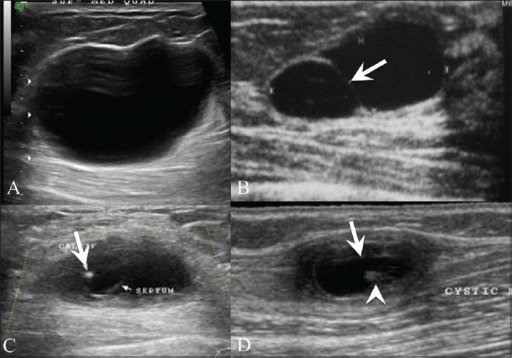
Ultrasonido de mama

Ultrasonido de mama que muestra un quiste simple (A) que se presenta como una lesión anecoica con realce posterior y un quiste (B) con un tabique (flecha). Ultrasonido de mama (C) en una mujer de 26 años con un bulto palpable indoloro en la mama izquierda muestra un quiste complejo con un foco ecogénico localizado excéntricamente (flecha) que representa el escólex de un granuloma de cisticerco. La paciente también tenía una inflamación similar en la parte superior del brazo derecho, se tomó un ultrasonido (D) que reveló un quiste (flecha) con un escólex ecogénico (cabeza de flecha) en su interior.

Imagen: “Breast USG” por Advanced Radiology Centre, Mumbai, India. Licencia: CC BY 2.0

Lesiones Proliferativas Epiteliales sin Atipia

Definición

En EN Erythema nodosum is an immune-mediated panniculitis (inflammation of the subcutaneous fat) caused by a type IV (delayed-type) hypersensitivity reaction. It commonly manifests in young women as tender, erythematous nodules on the shins. Erythema Nodosum las lesiones proliferativas sin atipia de la mama, el desarrollo de cáncer de mama es 1,5–2 veces el riesgo de la población general.
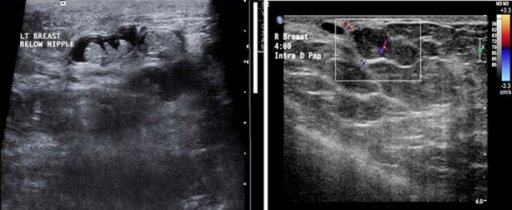
Papiloma intraductal

  • Masa benigna con configuración papilar de estroma mamario y epitelio dentro de un ducto mamario
  • Epidemiología:
    • Pico de incidencia: 30–50 años de edad
    • < 10% de lesiones mamarias benignas
  • Presentación clínica: depende del tamaño y la localización
    • Tipo central:
      • Frecuentemente una masa solitaria, cerca o detrás del pezón dentro de los LOS Neisseria conductos galactóforos principales
      • Generalmente, es lo suficientemente grande como para ser palpado
      • Secreción serosa o sanguinolenta unilateral del pezón: una presentación común
      • Normalmente benigno
    • Tipo periférico: (10% de los LOS Neisseria casos)
      • Suele aparecer en EN Erythema nodosum is an immune-mediated panniculitis (inflammation of the subcutaneous fat) caused by a type IV (delayed-type) hypersensitivity reaction. It commonly manifests in young women as tender, erythematous nodules on the shins. Erythema Nodosum forma de papilomas múltiples y afecta a mujeres premenopáusicas jóvenes
      • Se encuentra en EN Erythema nodosum is an immune-mediated panniculitis (inflammation of the subcutaneous fat) caused by a type IV (delayed-type) hypersensitivity reaction. It commonly manifests in young women as tender, erythematous nodules on the shins. Erythema Nodosum las zonas externas de la mama (crecimiento en EN Erythema nodosum is an immune-mediated panniculitis (inflammation of the subcutaneous fat) caused by a type IV (delayed-type) hypersensitivity reaction. It commonly manifests in young women as tender, erythematous nodules on the shins. Erythema Nodosum los LOS Neisseria ductos terminales)
      • Generalmente, no es palpable y es menos probable que haya secreciones
      • Aparece como calcificaciones mamográficas
      • Mayor riesgo de cáncer de mama
  • Diagnóstico:
    • Mamografía:
      • Puede estar oculta
      • Cuando se observa, es una masa ovalada/redonda; los LOS Neisseria márgenes pueden estar mal definidos
      • Puede tener calcificaciones
    • Biopsia por punción con aguja gruesa (guiada por ductograma o ultrasonido):
      • Preferible a la biopsia con aguja fina (riesgo de una muestra de tejido inadecuada)
      • Muestra células papilares con un núcleo fibrovascular central ramificado
  • Tratamiento:
    • Escisión quirúrgica/tumorectomía con extirpación completa: debido al AL Amyloidosis riesgo de hiperplasia ductal atípica o carcinoma ductal in situ
    • Examen anual de mama y mamografía

Fibroadenoma Fibroadenoma Fibroadenomas are the most common benign tumor of the female breast and the most common breast tumor in adolescent and young women. The tumors are well-circumscribed, mobile, and unencapsulated, with a rubbery or firm consistency. Fibroadenoma simple

  • Una masa mamaria sólida benigna compuesta por tejido fibroso y glandular
  • Epidemiología:
    • Tumor Tumor Inflammation benigno más común de la mama
    • Pico de incidencia: 15–35 años de edad
    • La mayoría no tiene potencial cancerígeno
    • Factores de riesgo de cáncer subsecuente:
      • Histología proliferativa
      • Masa compleja
      • Antecedentes familiares de cáncer de mama
  • Presentación clínica:
    • Masa pequeña, bien definida, esférica y móvil
    • Consistencia gomosa o firme, no sensible
    • Tamaño: generalmente ≤ 3 cm de diámetro, solitario
    • Localización: a menudo en EN Erythema nodosum is an immune-mediated panniculitis (inflammation of the subcutaneous fat) caused by a type IV (delayed-type) hypersensitivity reaction. It commonly manifests in young women as tender, erythematous nodules on the shins. Erythema Nodosum el cuadrante superior externo
    • El tamaño de la masa y la sensibilidad están influenciados por los LOS Neisseria niveles estrogénicos:
      • Aumento de tamaño: embarazo, lactancia, premenstruación y anticonceptivos orales
      • Experimenta regresión después de la menopausia
  • Diagnóstico:
    • Ultrasonido: masa sólida bien definida, límites regulares y una señal ecogénica débil
    • Mamografía:
      • Masa ovalada bien circunscrita, puede tener lóbulos
      • Calcificaciones en EN Erythema nodosum is an immune-mediated panniculitis (inflammation of the subcutaneous fat) caused by a type IV (delayed-type) hypersensitivity reaction. It commonly manifests in young women as tender, erythematous nodules on the shins. Erythema Nodosum “palomita de maíz” en EN Erythema nodosum is an immune-mediated panniculitis (inflammation of the subcutaneous fat) caused by a type IV (delayed-type) hypersensitivity reaction. It commonly manifests in young women as tender, erythematous nodules on the shins. Erythema Nodosum los LOS Neisseria fibroadenomas en EN Erythema nodosum is an immune-mediated panniculitis (inflammation of the subcutaneous fat) caused by a type IV (delayed-type) hypersensitivity reaction. It commonly manifests in young women as tender, erythematous nodules on the shins. Erythema Nodosum involución
    • Biopsia:
      • Indicaciones:
        • > 5 cm o aumento de tamaño
        • Bordes irregulares
        • Dolor Dolor Inflammation considerable
      • Citología: células epiteliales distribuidas uniformemente (patrón en EN Erythema nodosum is an immune-mediated panniculitis (inflammation of the subcutaneous fat) caused by a type IV (delayed-type) hypersensitivity reaction. It commonly manifests in young women as tender, erythematous nodules on the shins. Erythema Nodosum panal de abeja o cuerno de alce)
      • Microscopía: estroma y células epiteliales en EN Erythema nodosum is an immune-mediated panniculitis (inflammation of the subcutaneous fat) caused by a type IV (delayed-type) hypersensitivity reaction. It commonly manifests in young women as tender, erythematous nodules on the shins. Erythema Nodosum patrón pericanalicular o intracanalicular
    • RM: puede tener tabicación interna oscura
      • T1: iso o hipointenso con relación al AL Amyloidosis parénquima normal
      • T2: varía con la cantidad de elementos mixoides o fibrosos
  • Tratamiento:
    • Fibroadenoma Fibroadenoma Fibroadenomas are the most common benign tumor of the female breast and the most common breast tumor in adolescent and young women. The tumors are well-circumscribed, mobile, and unencapsulated, with a rubbery or firm consistency. Fibroadenoma con características benignas: vigilancia, examen de mama y mamografía anual
    • Crioablación: una opción para los LOS Neisseria fibroadenomas pequeños pero sintomáticos
      • La biopsia por punción con aguja gruesa se realiza primero para confirmar el diagnóstico
      • Criterios:
        • Para fibroadenomas < 4 cm de tamaño, < 3 en EN Erythema nodosum is an immune-mediated panniculitis (inflammation of the subcutaneous fat) caused by a type IV (delayed-type) hypersensitivity reaction. It commonly manifests in young women as tender, erythematous nodules on the shins. Erythema Nodosum número
        • Sin tendencia a hemorragia ni a infección local de la piel
    • Escisión quirúrgica para:
      • Fibroadenoma Fibroadenoma Fibroadenomas are the most common benign tumor of the female breast and the most common breast tumor in adolescent and young women. The tumors are well-circumscribed, mobile, and unencapsulated, with a rubbery or firm consistency. Fibroadenoma de inicio en EN Erythema nodosum is an immune-mediated panniculitis (inflammation of the subcutaneous fat) caused by a type IV (delayed-type) hypersensitivity reaction. It commonly manifests in young women as tender, erythematous nodules on the shins. Erythema Nodosum la adolescencia que persiste en EN Erythema nodosum is an immune-mediated panniculitis (inflammation of the subcutaneous fat) caused by a type IV (delayed-type) hypersensitivity reaction. It commonly manifests in young women as tender, erythematous nodules on the shins. Erythema Nodosum la adultez (aumenta el riesgo de cáncer de mama)
      • Aumento de tamaño o con características o síntomas atípicos

Related videos

Cicatrices radiales

  • Lesiones esclerosantes complejas
  • Presentación clínica:
    • Hallazgo incidental en EN Erythema nodosum is an immune-mediated panniculitis (inflammation of the subcutaneous fat) caused by a type IV (delayed-type) hypersensitivity reaction. It commonly manifests in young women as tender, erythematous nodules on the shins. Erythema Nodosum una biopsia realizada por otra razón
    • Si es grande, se ve VE Ventilation: Mechanics of Breathing en EN Erythema nodosum is an immune-mediated panniculitis (inflammation of the subcutaneous fat) caused by a type IV (delayed-type) hypersensitivity reaction. It commonly manifests in young women as tender, erythematous nodules on the shins. Erythema Nodosum la mamografía como una distorsión arquitectural
  • Patología: núcleo fibroelástico con ductos y lobulillos irradiantes
  • Tratamiento: escisión quirúrgica, ya que las lesiones pueden ser premalignas (hasta el 17% tienen malignidad)

Adenosis Adenosis Fibrocystic Change esclerosante

  • Lobulillos (sacos productores de leche) agrandados y distorsionados con fibrosis Fibrosis Any pathological condition where fibrous connective tissue invades any organ, usually as a consequence of inflammation or other injury. Bronchiolitis Obliterans estromal y células glandulares intercaladas
  • Presentación clínica: se siente como una masa palpable
  • Diagnóstico:
    • Mamografía: calcificaciones, desde una masa bien circunscrita a una espiculada
    • Biopsia por punción con aguja gruesa
  • Tratamiento:
    • Pequeño riesgo de subsecuente malignidad
    • Vigilancia con examen anual de mamas y mamografía

Hiperplasia ductal usual

  • Patología: células incrementadas en EN Erythema nodosum is an immune-mediated panniculitis (inflammation of the subcutaneous fat) caused by a type IV (delayed-type) hypersensitivity reaction. It commonly manifests in young women as tender, erythematous nodules on the shins. Erythema Nodosum el espacio ductal o en EN Erythema nodosum is an immune-mediated panniculitis (inflammation of the subcutaneous fat) caused by a type IV (delayed-type) hypersensitivity reaction. It commonly manifests in young women as tender, erythematous nodules on the shins. Erythema Nodosum el lobulillo (sin atipia)
  • Presentación clínica: se observa incidentalmente en EN Erythema nodosum is an immune-mediated panniculitis (inflammation of the subcutaneous fat) caused by a type IV (delayed-type) hypersensitivity reaction. It commonly manifests in young women as tender, erythematous nodules on the shins. Erythema Nodosum la biopsia o como calcificaciones en EN Erythema nodosum is an immune-mediated panniculitis (inflammation of the subcutaneous fat) caused by a type IV (delayed-type) hypersensitivity reaction. It commonly manifests in young women as tender, erythematous nodules on the shins. Erythema Nodosum la mamografía
  • Tratamiento:
    • Pequeño riesgo de subsecuente malignidad
    • Vigilancia con examen anual de mamas y mamografía
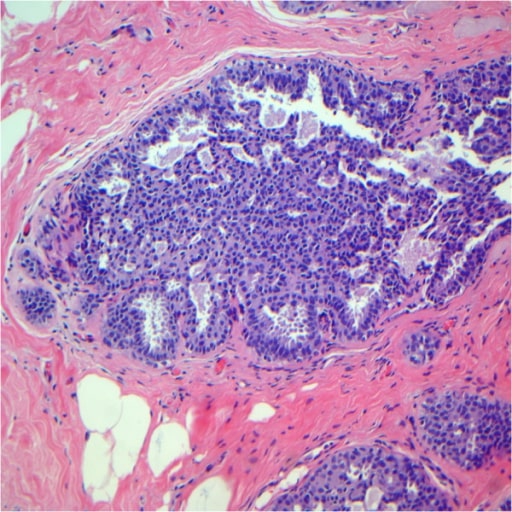
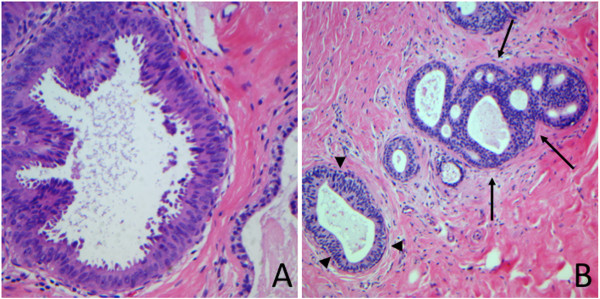
Hiperplasia ductal

Hiperplasia ductal usual tras la revisión. Obsérvese que las células epiteliales muestran una orientación desordenada y la presencia de lúmenes secundarios en forma de hendidura localizados periféricamente.

Imagen: “Usual ductal hyperplasia” por Breast Pathology Laboratory, School of Medicine, Federal University of Minas Gerais (UFMG), Av, Professor Alfredo Balena, 190, Belo Horizonte, Minas Gerais 30130-100, Brazil. Licencia: CC BY 2.0
Lesiones Epiteliales Benignas Mamarias con Hiperplasia Atípica

Hiperplasia ductal atípica

  • Se encuentra en EN Erythema nodosum is an immune-mediated panniculitis (inflammation of the subcutaneous fat) caused by a type IV (delayed-type) hypersensitivity reaction. It commonly manifests in young women as tender, erythematous nodules on the shins. Erythema Nodosum el 5%–20% de las biopsias de mama
  • Aumento moderado del riesgo de cáncer de mama
  • Presentación clínica: demasiado pequeña para la palpación, descubierta incidentalmente en EN Erythema nodosum is an immune-mediated panniculitis (inflammation of the subcutaneous fat) caused by a type IV (delayed-type) hypersensitivity reaction. It commonly manifests in young women as tender, erythematous nodules on the shins. Erythema Nodosum la biopsia (ante hallazgos mamográficos como calcificaciones)
  • Diagnóstico:
    • Biopsia por punción con aguja gruesa
    • Patología: proliferación de células epiteliales monomorfas en EN Erythema nodosum is an immune-mediated panniculitis (inflammation of the subcutaneous fat) caused by a type IV (delayed-type) hypersensitivity reaction. It commonly manifests in young women as tender, erythematous nodules on the shins. Erythema Nodosum el ducto mamario
    • Comparte características con el carcinoma ductal in situ de bajo grado sin cumplir todos los LOS Neisseria criterios
  • Tratamiento:
    • Escisión quirúrgica: estándar de atención (la hiperplasia ductal atípica es premaligna)
    • Examen de mama cada 6–12 meses y mamografía anual
    • Evitar la terapia de reemplazo hormonal, los LOS Neisseria anticonceptivos orales
    • Cambios en EN Erythema nodosum is an immune-mediated panniculitis (inflammation of the subcutaneous fat) caused by a type IV (delayed-type) hypersensitivity reaction. It commonly manifests in young women as tender, erythematous nodules on the shins. Erythema Nodosum el estilo de vida y la dieta
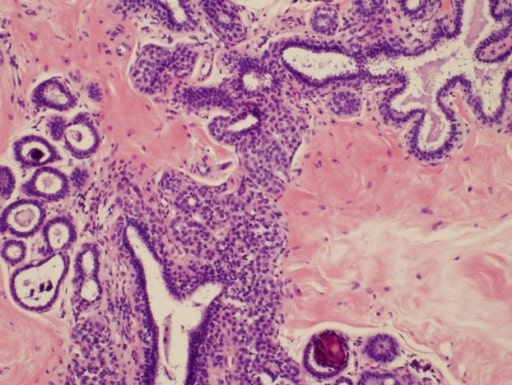
Hiperplasia ductal atípica

Hiperplasia ductal atípica (flechas)

Imagen: “Atypical ductal hyperplasia” por Breast Pathology Laboratory, School of Medicine, Federal University of Minas Gerais (UFMG), Av, Professor Alfredo Balena, 190, Belo Horizonte, Minas Gerais 30130-100, Brazil. Licencia: CC BY 2.0
Hiperplasia lobulillar atípica

  • Mayor riesgo de desarrollar cáncer de mama en EN Erythema nodosum is an immune-mediated panniculitis (inflammation of the subcutaneous fat) caused by a type IV (delayed-type) hypersensitivity reaction. It commonly manifests in young women as tender, erythematous nodules on the shins. Erythema Nodosum la mama ipsilateral o contralateral
  • Presentación clínica: descubierta incidentalmente en EN Erythema nodosum is an immune-mediated panniculitis (inflammation of the subcutaneous fat) caused by a type IV (delayed-type) hypersensitivity reaction. It commonly manifests in young women as tender, erythematous nodules on the shins. Erythema Nodosum la biopsia (ante hallazgos mamográficos como calcificaciones)
  • Diagnóstico:
    • Patología: dentro de los LOS Neisseria acinos de la unidad lobulillar ductal terminal, hay una sobreproliferación de células epiteliales con cohesión alterada.
    • Comparte características con el carcinoma lobulillar in situ o carcinoma lobulillar invasivo sin cumplir todos los LOS Neisseria criterios
  • Tratamiento:
    • La escisión quirúrgica es generalmente apropiada, pero no es rutinaria.
    • Escisión para pacientes de alto riesgo (antecedentes familiares/personales de cáncer de mama, mutación de BRCA1 o BRCA2)
    • En EN Erythema nodosum is an immune-mediated panniculitis (inflammation of the subcutaneous fat) caused by a type IV (delayed-type) hypersensitivity reaction. It commonly manifests in young women as tender, erythematous nodules on the shins. Erythema Nodosum pacientes de bajo riesgo cuidadosamente seleccionadas:
      • Moduladores de los LOS Neisseria receptores estrogénicos
      • Aumento de la frecuencia de mamografías y seguimiento
    • Medidas de reducción de riesgos:
      • Evitar la terapia de reemplazo hormonal, anticonceptivos orales
      • Cambios en EN Erythema nodosum is an immune-mediated panniculitis (inflammation of the subcutaneous fat) caused by a type IV (delayed-type) hypersensitivity reaction. It commonly manifests in young women as tender, erythematous nodules on the shins. Erythema Nodosum el estilo de vida y la dieta
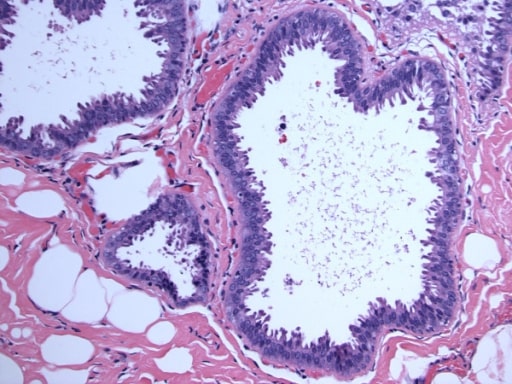
Hiperplasia lobulillar atípica

Microfotografía de hiperplasia lobulillar atípica asociada a cambios de células columnares y a microcalcificaciones incidentales y focalizadas

Imagen: “Atypical lobular hyperplasia” por Department of Pathology, The University of Texas MD Anderson Cancer Center, Houston, Texas. Licencia: CC BY 3.0
Atipia Epitelial Plana

  • Una lesión distinta de la hiperplasia ductal atípica y la hiperplasia lobulillar atípica
  • Patrón de crecimiento plano (no cumple los LOS Neisseria criterios arquitecturales de la hiperplasia ductal atípica)
  • Lesión mamaria de alto riesgo o atípica, pero el riesgo sigue sin ser definido
  • Presentación clínica: se descubre en EN Erythema nodosum is an immune-mediated panniculitis (inflammation of the subcutaneous fat) caused by a type IV (delayed-type) hypersensitivity reaction. It commonly manifests in young women as tender, erythematous nodules on the shins. Erythema Nodosum las biopsias realizadas por calcificaciones mamográficas
  • Diagnóstico: patología caracterizada por cambios columnares con atipia
  • Tratamiento:
    • Consulta quirúrgica con valoración de riesgo
    • La vigilancia es una opción junto con el examen frecuente y la mamografía.
Atipia epitelial plana

Lesiones de células columnares con atipia (atipia epitelial plana)

Imagen: “Flat epithelial atypia” por Department of Pathology, Wilford Hall Medical Center, Lackland AFB, TX, USA. Licencia: CC BY 2.0
Absceso Mamario

  • Epidemiología: generalmente asociado a mastitis Mastitis Mastitis is inflammation of the breast tissue with or without infection. The most common form of mastitis is associated with lactation in the first few weeks after birth. Non-lactational mastitis includes periductal mastitis and idiopathic granulomatous mastitis (IGM). Mastitis
    • Factores de riesgo conocidos ( en EN Erythema nodosum is an immune-mediated panniculitis (inflammation of the subcutaneous fat) caused by a type IV (delayed-type) hypersensitivity reaction. It commonly manifests in young women as tender, erythematous nodules on the shins. Erythema Nodosum mujeres lactantes):
      • Edad > 30 años
      • Primíparas
      • Parto tardío
      • Tabaquismo
    • Factores de riesgo conocidos ( en EN Erythema nodosum is an immune-mediated panniculitis (inflammation of the subcutaneous fat) caused by a type IV (delayed-type) hypersensitivity reaction. It commonly manifests in young women as tender, erythematous nodules on the shins. Erythema Nodosum mujeres no lactantes):
      • Afroamericana
      • Obesidad
      • Diabetes Diabetes Diabetes mellitus (DM) is a metabolic disease characterized by hyperglycemia and dysfunction of the regulation of glucose metabolism by insulin. Type 1 DM is diagnosed mostly in children and young adults as the result of autoimmune destruction of β cells in the pancreas and the resulting lack of insulin. Type 2 DM has a significant association with obesity and is characterized by insulin resistance. Diabetes Mellitus
      • Tabaquismo
  • Presentación clínica:
    • Masa unilateral y fluctuante
    • Mama dolorosa, eritematosa y edematosa
    • Posible secreción purulenta del pezón
    • Fiebre
  • Diagnóstico:
    • Clínica: antecedentes y hallazgos de una masa fluctuante, sensible y palpable
    • Secreción del pezón: el cultivo puede ayudar a orientar la elección del antibiótico.
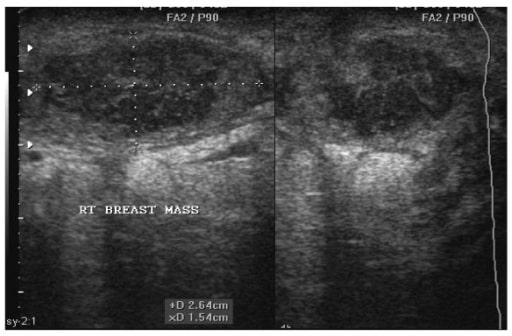
    • Ultrasonido: colección hipoecoica mal definida con tabiques internos
    • La aspiración con aguja revela un contenido purulento.
  • Tratamiento:
    • Incisión y drenaje, especialmente si:
      • Hay isquemia cutánea o necrosis Necrosis The death of cells in an organ or tissue due to disease, injury or failure of the blood supply. Ischemic Cell Damage por presión
      • La aspiración con aguja y/o los LOS Neisseria antibióticos no tienen efecto
    • Aspiración con aguja:
      • Puede ser un tratamiento inicial si la piel suprayacente no está isquémica o si los LOS Neisseria abscesos son < 3 cm
      • Se repite cada 2–3 días hasta que no haya colecciones
    • Antibióticos dirigidos al AL Amyloidosis agente causal más común, Staphylococcus aureus Staphylococcus aureus Potentially pathogenic bacteria found in nasal membranes, skin, hair follicles, and perineum of warm-blooded animals. They may cause a wide range of infections and intoxications. Brain Abscess: cefalexina, dicloxacilina o amoxicilina-clavulanato
Absceso mamario

Ultrasonido de una mujer de 22 años que muestra un absceso en la mama derecha. Obsérvese la forma ovalada del absceso, que mide 2,64 cm por 1,54 cm antes de la aspiración bajo guía por ultrasonido.

Imagen: “Breast abscess” por Department of Surgery, Weil Bugando University College of Health Sciences, Mwanza, Tanzania. Licencia: CC BY 2.0
Lesiones de Mama Misceláneas

Mastopatía diabética

  • Mastopatía linfocítica o mastitis Mastitis Mastitis is inflammation of the breast tissue with or without infection. The most common form of mastitis is associated with lactation in the first few weeks after birth. Non-lactational mastitis includes periductal mastitis and idiopathic granulomatous mastitis (IGM). Mastitis linfocítica
  • Puede deberse a una reacción autoinmune secundaria a los LOS Neisseria efectos de la hiperglicemia en EN Erythema nodosum is an immune-mediated panniculitis (inflammation of the subcutaneous fat) caused by a type IV (delayed-type) hypersensitivity reaction. It commonly manifests in young women as tender, erythematous nodules on the shins. Erythema Nodosum el tejido conectivo
  • Se observa hasta en EN Erythema nodosum is an immune-mediated panniculitis (inflammation of the subcutaneous fat) caused by a type IV (delayed-type) hypersensitivity reaction. It commonly manifests in young women as tender, erythematous nodules on the shins. Erythema Nodosum el 13% de las pacientes con diabetes Diabetes Diabetes mellitus (DM) is a metabolic disease characterized by hyperglycemia and dysfunction of the regulation of glucose metabolism by insulin. Type 1 DM is diagnosed mostly in children and young adults as the result of autoimmune destruction of β cells in the pancreas and the resulting lack of insulin. Type 2 DM has a significant association with obesity and is characterized by insulin resistance. Diabetes Mellitus mellitus tipo 1
  • Presentación clínica: masa indolora, observada en EN Erythema nodosum is an immune-mediated panniculitis (inflammation of the subcutaneous fat) caused by a type IV (delayed-type) hypersensitivity reaction. It commonly manifests in young women as tender, erythematous nodules on the shins. Erythema Nodosum diabetes Diabetes Diabetes mellitus (DM) is a metabolic disease characterized by hyperglycemia and dysfunction of the regulation of glucose metabolism by insulin. Type 1 DM is diagnosed mostly in children and young adults as the result of autoimmune destruction of β cells in the pancreas and the resulting lack of insulin. Type 2 DM has a significant association with obesity and is characterized by insulin resistance. Diabetes Mellitus mellitus tipo 1 de larga duración
  • Diagnóstico:
    • Mamografía: masa sólida con densidad asimétrica
    • Ultrasonido: masa hipoecoica irregular
    • Biopsia por punción con aguja gruesa
  • Tratamiento:
    • La escisión no es necesaria, ya que no hay un mayor riesgo de cáncer de mama
    • Se sabe que hay recidiva después de una extirpación quirúrgica
    • Mamografía anual

Sarcoidosis Sarcoidosis Sarcoidosis is a multisystem inflammatory disease that causes noncaseating granulomas. The exact etiology is unknown. Sarcoidosis usually affects the lungs and thoracic lymph nodes, but it can also affect almost every system in the body, including the skin, heart, and eyes, most commonly. Sarcoidosis

  • Se observa en EN Erythema nodosum is an immune-mediated panniculitis (inflammation of the subcutaneous fat) caused by a type IV (delayed-type) hypersensitivity reaction. It commonly manifests in young women as tender, erythematous nodules on the shins. Erythema Nodosum pacientes con sarcoidosis Sarcoidosis Sarcoidosis is a multisystem inflammatory disease that causes noncaseating granulomas. The exact etiology is unknown. Sarcoidosis usually affects the lungs and thoracic lymph nodes, but it can also affect almost every system in the body, including the skin, heart, and eyes, most commonly. Sarcoidosis sistémica, pero la afectación mamaria podría ser la única manifestación
  • Presentación clínica: masas mamarias firmes
  • Diagnóstico:
    • Mamografía: masas irregulares y mal definidas
    • Biopsia por punción con aguja gruesa: granulomas Granulomas A relatively small nodular inflammatory lesion containing grouped mononuclear phagocytes, caused by infectious and noninfectious agents. Sarcoidosis no caseificantes
  • Tratamiento:
    • Glucocorticoides
    • La escisión quirúrgica es una opción

Galactocele Galactocele Benign Breast Conditions

  • Un quiste de retención láctea dentro de la glándula mamaria
  • Una obstrucción de un conducto galactóforo → acumulación de células epiteliales y leche → distensión ductal → formación de quistes
  • Epidemiología: afección mamaria benigna más frecuente en EN Erythema nodosum is an immune-mediated panniculitis (inflammation of the subcutaneous fat) caused by a type IV (delayed-type) hypersensitivity reaction. It commonly manifests in young women as tender, erythematous nodules on the shins. Erythema Nodosum mujeres lactantes
  • Presentación clínica:
    • Masa firme y palpable en EN Erythema nodosum is an immune-mediated panniculitis (inflammation of the subcutaneous fat) caused by a type IV (delayed-type) hypersensitivity reaction. It commonly manifests in young women as tender, erythematous nodules on the shins. Erythema Nodosum la región subareolar
    • Se presenta sin fiebre ni dolor Dolor Inflammation (el dolor Dolor Inflammation sugiere una infección bacteriana secundaria)
    • Unilateral
  • Diagnóstico:
    • Principalmente clínico
    • La aspiración con aguja fina revela un contenido lechoso
    • Mamografía:
      • Masas quísticas complejas
      • Con niveles de grasa/líquido (por la superposición de porciones de leche retenida)
    • Ultrasonido:
      • Depende del contenido quístico de grasa y agua
      • Típicamente, una lesión hipoecoica homogénea con atenuación acústica, márgenes bien definidos y paredes delgadas
  • Tratamiento:
    • La mayoría de los LOS Neisseria casos resuelven espontáneamente.
    • Aumento de la lactancia materna, compresas calientes y masajes
    • Aspiración con aguja repetida o escisión quirúrgica: para quistes sintomáticos
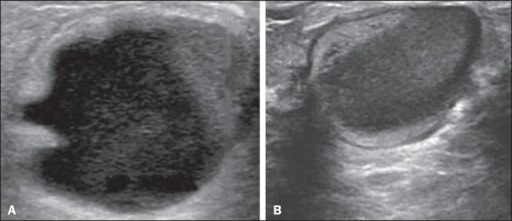
Galactocele

Galactocele:
A: Lesión paralela a la piel con bordes bien definidos que muestra componentes anecoicos (quísticos) y ecogénicos (sólidos), con discreto realce acústico posterior y bordes bien definidos.
B: Lesión predominantemente hipoecoica paralela a la piel con bordes bien definidos, áreas periféricas de hiperecogenicidad y realce acústico posterior.
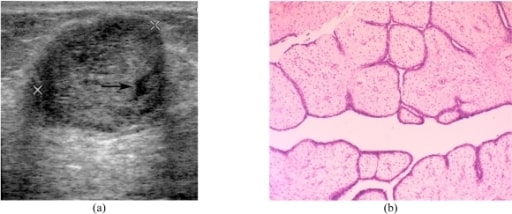
Imagen: “Galactocele” por US National Library of Medicine. Licencia: CC BY 4.0

Tumor Tumor Inflammation filoides

  • Cistosarcoma filoides
  • Tumor Tumor Inflammation fibroepitelial similar a los LOS Neisseria fibroadenomas, caracterizado por un rápido crecimiento
  • Epidemiología:
    • Más común en EN Erythema nodosum is an immune-mediated panniculitis (inflammation of the subcutaneous fat) caused by a type IV (delayed-type) hypersensitivity reaction. It commonly manifests in young women as tender, erythematous nodules on the shins. Erythema Nodosum mujeres entre 40 y 50 años de edad
    • Representan < 1% de todas las neoplasias de mama
    • Aunque generalmente son benignos, algunos pueden volverse malignos (25% de los LOS Neisseria casos)
  • Presentación clínica:
    • Masa indolora, multinodular, firme y de rápido crecimiento
    • Generalmente de 4–7 cm de diámetro
    • Alrededor del 20% son no palpables, identificados en EN Erythema nodosum is an immune-mediated panniculitis (inflammation of the subcutaneous fat) caused by a type IV (delayed-type) hypersensitivity reaction. It commonly manifests in young women as tender, erythematous nodules on the shins. Erythema Nodosum la mamografía
  • Diagnóstico:
    • Mamografía: masa lobulada, se asemeja a un fibroadenoma Fibroadenoma Fibroadenomas are the most common benign tumor of the female breast and the most common breast tumor in adolescent and young women. The tumors are well-circumscribed, mobile, and unencapsulated, with a rubbery or firm consistency. Fibroadenoma
    • Ultrasonido: masa bien definida, hipoecoica (como los LOS Neisseria fibroadenomas, sin microcalcificaciones)
    • RM: bien circunscrita con paredes irregulares, señal de alta intensidad en EN Erythema nodosum is an immune-mediated panniculitis (inflammation of the subcutaneous fat) caused by a type IV (delayed-type) hypersensitivity reaction. It commonly manifests in young women as tender, erythematous nodules on the shins. Erythema Nodosum T1 y de baja intensidad en EN Erythema nodosum is an immune-mediated panniculitis (inflammation of the subcutaneous fat) caused by a type IV (delayed-type) hypersensitivity reaction. It commonly manifests in young women as tender, erythematous nodules on the shins. Erythema Nodosum T2
    • Biopsia por punción con aguja gruesa:
      • Proyección papilar (filoides/”en forma de hoja”) del estroma revestido de epitelio proliferante
      • Diversos grados de atipia e hiperplasia (depende de la naturaleza benigna o maligna)
  • Tratamiento:
    • Resección quirúrgica con márgenes amplios (debido a la alta tasa de recurrencia)
    • Examen de mama y mamografía cada 6 meses durante 2 años, luego anualmente
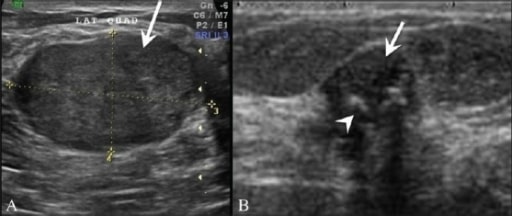
Tumor filoides

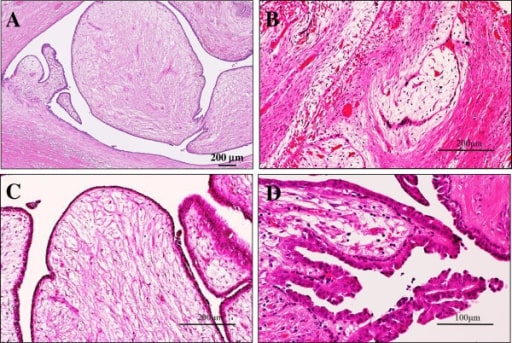
Tumor filoides de la mama

(a) Imagen de ultrasonido transversal que muestra un eco heterogéneo circunscrito con un pequeño espacio quístico (flecha) y un ligero realce acústico posterior.
(b) Microfotografía que muestra procesos en forma de hoja que contienen estroma celular revestido de células epiteliales ductales benignas que se proyectan en el espacio quístico (tinción de hematoxilina y eosina; x100).

Imagen: “Benign phyllodes tumour in a 35-year-old woman” por Department of Radiology, Chiang Mai University, Chiang Mai, Thailand. Licencia: CC BY 2.5

Fibroadenoma Fibroadenoma Fibroadenomas are the most common benign tumor of the female breast and the most common breast tumor in adolescent and young women. The tumors are well-circumscribed, mobile, and unencapsulated, with a rubbery or firm consistency. Fibroadenoma gigante juvenil

  • Aproximadamente el 0,5%–2% de todos los LOS Neisseria fibroadenomas
  • Generalmente ocurre en EN Erythema nodosum is an immune-mediated panniculitis (inflammation of the subcutaneous fat) caused by a type IV (delayed-type) hypersensitivity reaction. It commonly manifests in young women as tender, erythematous nodules on the shins. Erythema Nodosum adolescentes afroamericanas
  • Presentación clínica:
    • Rápido aumento de tamaño; tumores unilaterales > 5 cm de diámetro
    • Puede causar ulceración cutánea y congestión venosa
  • Tratamiento: escisión quirúrgica (ya que no se distinguen fácilmente de los LOS Neisseria tumores filoides en EN Erythema nodosum is an immune-mediated panniculitis (inflammation of the subcutaneous fat) caused by a type IV (delayed-type) hypersensitivity reaction. It commonly manifests in young women as tender, erythematous nodules on the shins. Erythema Nodosum el examen físico o en EN Erythema nodosum is an immune-mediated panniculitis (inflammation of the subcutaneous fat) caused by a type IV (delayed-type) hypersensitivity reaction. It commonly manifests in young women as tender, erythematous nodules on the shins. Erythema Nodosum la imagenología)

Fibroadenoma Fibroadenoma Fibroadenomas are the most common benign tumor of the female breast and the most common breast tumor in adolescent and young women. The tumors are well-circumscribed, mobile, and unencapsulated, with a rubbery or firm consistency. Fibroadenoma complejo

  • Fibroadenoma Fibroadenoma Fibroadenomas are the most common benign tumor of the female breast and the most common breast tumor in adolescent and young women. The tumors are well-circumscribed, mobile, and unencapsulated, with a rubbery or firm consistency. Fibroadenoma con características patológicas:
  • Ligero aumento del riesgo de cáncer
  • Presentación clínica: se presenta como un bulto o masa palpable en EN Erythema nodosum is an immune-mediated panniculitis (inflammation of the subcutaneous fat) caused by a type IV (delayed-type) hypersensitivity reaction. It commonly manifests in young women as tender, erythematous nodules on the shins. Erythema Nodosum la imagenología mamaria
  • Diagnóstico: la biopsia lo distingue del fibroadenoma Fibroadenoma Fibroadenomas are the most common benign tumor of the female breast and the most common breast tumor in adolescent and young women. The tumors are well-circumscribed, mobile, and unencapsulated, with a rubbery or firm consistency. Fibroadenoma simple
  • Tratamiento: vigilancia, evaluación del riesgo con examen anual y mamografía

Diagnóstico Diferencial

  • Cambios fibroquísticos de la mama: se refiere a los LOS Neisseria cambios que se producen en EN Erythema nodosum is an immune-mediated panniculitis (inflammation of the subcutaneous fat) caused by a type IV (delayed-type) hypersensitivity reaction. It commonly manifests in young women as tender, erythematous nodules on the shins. Erythema Nodosum el tejido mamario a medida que la mujer envejece. El aspecto histológico normal de los LOS Neisseria ductos, lobulillos, estroma intralobulillar y estroma interlobulillar predominantes es sustituido por tejido fibroso y formación quística.
  • Necrosis Necrosis The death of cells in an organ or tissue due to disease, injury or failure of the blood supply. Ischemic Cell Damage grasa de la mama: generalmente, se debe a una lesión mamaria. A medida que se repara el tejido mamario dañado, se sustituye por tejido cicatricial. Sin embargo, algunas células grasas pueden tener una respuesta diferente y formar lo que se conoce como quistes oleosos (que se ven en EN Erythema nodosum is an immune-mediated panniculitis (inflammation of the subcutaneous fat) caused by a type IV (delayed-type) hypersensitivity reaction. It commonly manifests in young women as tender, erythematous nodules on the shins. Erythema Nodosum la mamografía y el ultrasonido).
  • Ginecomastia: aumento unilateral o bilateral de las mamas en EN Erythema nodosum is an immune-mediated panniculitis (inflammation of the subcutaneous fat) caused by a type IV (delayed-type) hypersensitivity reaction. It commonly manifests in young women as tender, erythematous nodules on the shins. Erythema Nodosum los LOS Neisseria varones debido a una mayor proliferación glandular. Una afección muy común y principalmente fisiológica que se observa en EN Erythema nodosum is an immune-mediated panniculitis (inflammation of the subcutaneous fat) caused by a type IV (delayed-type) hypersensitivity reaction. It commonly manifests in young women as tender, erythematous nodules on the shins. Erythema Nodosum neonatos, varones púberes y pacientes de edad avanzada. Algunos casos son patológicos y son secundarios a medicamentos, hipertiroidismo, neoplasias y enfermedades hepáticas y renales crónicas.
  • Mastitis Mastitis Mastitis is inflammation of the breast tissue with or without infection. The most common form of mastitis is associated with lactation in the first few weeks after birth. Non-lactational mastitis includes periductal mastitis and idiopathic granulomatous mastitis (IGM). Mastitis: inflamación del tejido de la glándula mamaria, que puede ocurrir por lactancia o no. La mastitis Mastitis Mastitis is inflammation of the breast tissue with or without infection. The most common form of mastitis is associated with lactation in the first few weeks after birth. Non-lactational mastitis includes periductal mastitis and idiopathic granulomatous mastitis (IGM). Mastitis es más frecuente en EN Erythema nodosum is an immune-mediated panniculitis (inflammation of the subcutaneous fat) caused by a type IV (delayed-type) hypersensitivity reaction. It commonly manifests in young women as tender, erythematous nodules on the shins. Erythema Nodosum mujeres en EN Erythema nodosum is an immune-mediated panniculitis (inflammation of the subcutaneous fat) caused by a type IV (delayed-type) hypersensitivity reaction. It commonly manifests in young women as tender, erythematous nodules on the shins. Erythema Nodosum edad fértil.

Referencias

  1. Ajmal, M., Van Fossen, K. (2022). Breast Fibroadenoma. Retrieved October 22, 2025, from https://www.ncbi.nlm.nih.gov/books/NBK535345/
  2. Dilaveri, C., MacBride, M., Sandhu, N., Lonzetta, N., Ghosh, K., Wahner-Roedler, D. (2012) Breast manifestations of systemic diseases. Int J Womens Health. 4: 35–43. https://www.ncbi.nlm.nih.gov/pmc/articles/PMC3282604/
  3. Guray, M, Sahin, A. (2006). Benign breast diseases: classification, diagnosis and management. Oncologist 11(5):435-49. https://pubmed.ncbi.nlm.nih.gov/16720843/
  4. Lee, M., Soltanian, H. (2015). Breast fibroadenomas in adolescents: current perspectives. Adolesc Health Med Ther. 6: 159–163. https://www.ncbi.nlm.nih.gov/pmc/articles/PMC4562655/
  5. Li, A., Kirk, L. (2022). Intraductal papilloma. Retrieved October 22, 2025, from https://www.ncbi.nlm.nih.gov/books/NBK519539/
  6. Neal, L., Sandhu, N., Hieken, T., Glazebrook K., Mac Bride, M.B., Dilaveri, C., Wahner-Riedler, D.; Ghosh, K; Visscher, D. (2014). Diagnosis and Management of Benign, Atypical and Indeterminate Breast lesions detected on core needle biopsy. Mayo Clinic Proceedings. ;89(4):536-547. https://www.mayoclinicproceedings.org/article/S0025-6196(14)00146-3/pdf
  7. Sabel, M. S. (2025). Overview of benign breast diseases. UpToDate. Retrieved October 22, 2025, from https://www.uptodate.com/contents/overview-of-benign-breast-diseases
  8. Santen, R. (2018). Benign breast disease in women. Endotext. https://www.ncbi.nlm.nih.gov/books/NBK278994/
  9. Visscher, D. et al. (2014). Sclerosing adenosis and risk of breast cancer. Breast Cancer Res Treat. 144(1): 205–212. https://www.ncbi.nlm.nih.gov/pmc/articles/PMC3924024/

¡Crea tu cuenta gratis o inicia una sesión para seguir leyendo!

Regístrate ahora y obtén acceso gratuito a Lecturio con páginas de concepto, videos médicos y cuestionarios para tu educación médica.

User Reviews

Details