Domina Conceptos Médicos

Estudia para la escuela de medicina y tus examenes con Lecturio.

Degeneración Macular

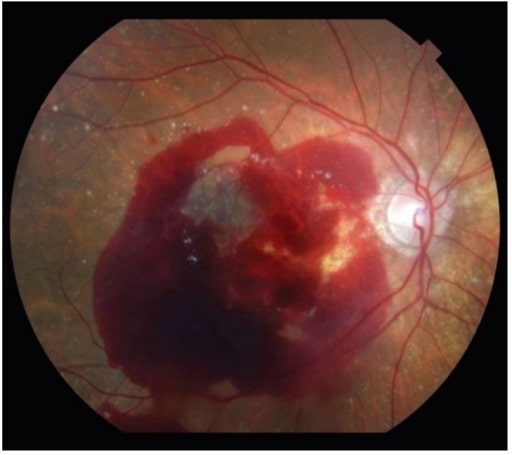
La degeneración macular asociada a la edad es una alteración visual debida a cambios en EN Erythema nodosum is an immune-mediated panniculitis (inflammation of the subcutaneous fat) caused by a type IV (delayed-type) hypersensitivity reaction. It commonly manifests in young women as tender, erythematous nodules on the shins. Erythema Nodosum la mácula, la zona responsable de mayor agudeza visual. Se caracteriza por la pérdida de la visión central, mientras que la visión periférica está relativamente respetada. Los LOS Neisseria factores de riesgo incluyen la edad avanzada, el tabaquismo, los LOS Neisseria antecedentes familiares y enfermedad cardiovascular. Los LOS Neisseria dos tipos de degeneración macular asociada a la edad son exudativa (húmeda) o no exudativa (seca). La diferencia entre estos 2 tipos es la presencia de neovascularización coroidea en EN Erythema nodosum is an immune-mediated panniculitis (inflammation of the subcutaneous fat) caused by a type IV (delayed-type) hypersensitivity reaction. It commonly manifests in young women as tender, erythematous nodules on the shins. Erythema Nodosum la degeneración macular asociada a la edad húmeda, que se manifiesta como distorsión o pérdida visual. La degeneración macular asociada a la edad seca, que es la más frecuente, suele ser asintomática, pero en EN Erythema nodosum is an immune-mediated panniculitis (inflammation of the subcutaneous fat) caused by a type IV (delayed-type) hypersensitivity reaction. It commonly manifests in young women as tender, erythematous nodules on the shins. Erythema Nodosum una minoría de casos provoca la pérdida de visión. No hay tratamiento para la degeneración macular asociada a la edad seca temprana, pero se recomiendan los LOS Neisseria suplementos del Age-Related Eye Disease Study 2 (AREDS 2, por sus siglas en EN Erythema nodosum is an immune-mediated panniculitis (inflammation of the subcutaneous fat) caused by a type IV (delayed-type) hypersensitivity reaction. It commonly manifests in young women as tender, erythematous nodules on the shins. Erythema Nodosum inglés) para la enfermedad avanzada. Los LOS Neisseria inhibidores del factor de crecimiento endotelial vascular se utilizan para la degeneración macular asociada a la edad húmeda.

Last updated: Dec 15, 2025

Editorial responsibility: Stanley Oiseth, Lindsay Jones, Evelin Maza

Descripción General

Definición

Degeneración macular asociada a la edad:
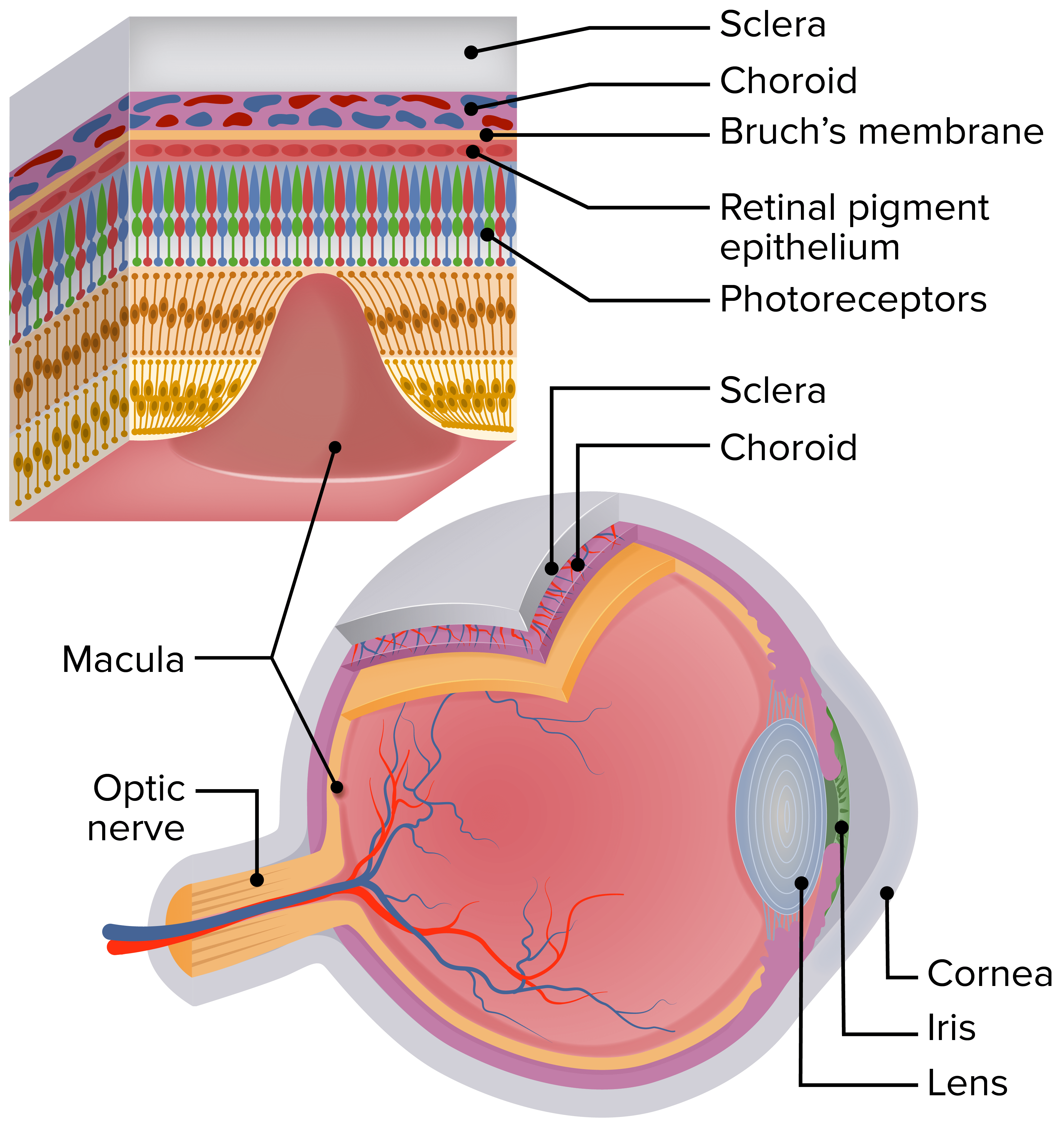
  • Cambios degenerativos que afectan a la mácula, la parte central de la retina Retina The ten-layered nervous tissue membrane of the eye. It is continuous with the optic nerve and receives images of external objects and transmits visual impulses to the brain. Its outer surface is in contact with the choroid and the inner surface with the vitreous body. The outermost layer is pigmented, whereas the inner nine layers are transparent. Eye: Anatomy, y que provocan un deterioro de la visión central
  • Suele afectar a la visión bilateral, pero puede ser asimétrica
  • La visión periférica rara vez se pierde.

Anatomía

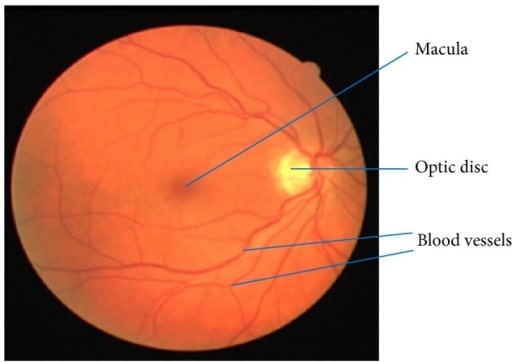
  • Mácula:
    • Es una zona ovalada en EN Erythema nodosum is an immune-mediated panniculitis (inflammation of the subcutaneous fat) caused by a type IV (delayed-type) hypersensitivity reaction. It commonly manifests in young women as tender, erythematous nodules on the shins. Erythema Nodosum el centro de la retina Retina The ten-layered nervous tissue membrane of the eye. It is continuous with the optic nerve and receives images of external objects and transmits visual impulses to the brain. Its outer surface is in contact with the choroid and the inner surface with the vitreous body. The outermost layer is pigmented, whereas the inner nine layers are transparent. Eye: Anatomy, donde la luz es enfocada por el cristalino y la córnea
    • Contiene la fóvea, que alberga la mayor densidad de células cono (fotorreceptores sensibles a los LOS Neisseria colores en EN Erythema nodosum is an immune-mediated panniculitis (inflammation of the subcutaneous fat) caused by a type IV (delayed-type) hypersensitivity reaction. It commonly manifests in young women as tender, erythematous nodules on the shins. Erythema Nodosum condiciones de luz brillante)
    • Función:
      • Visión central, gran agudeza visual y visión a color
      • Proporciona la capacidad de leer, conducir y ver con gran detalle
  • Otras estructuras:
    • Células fotorreceptoras de la retina Retina The ten-layered nervous tissue membrane of the eye. It is continuous with the optic nerve and receives images of external objects and transmits visual impulses to the brain. Its outer surface is in contact with the choroid and the inner surface with the vitreous body. The outermost layer is pigmented, whereas the inner nine layers are transparent. Eye: Anatomy externa: bastones y conos sensibles a la luz
    • Epitelio pigmentario de la retina Retina The ten-layered nervous tissue membrane of the eye. It is continuous with the optic nerve and receives images of external objects and transmits visual impulses to the brain. Its outer surface is in contact with the choroid and the inner surface with the vitreous body. The outermost layer is pigmented, whereas the inner nine layers are transparent. Eye: Anatomy
      • Protege de los LOS Neisseria efectos nocivos de la luz solar
      • Elimina los LOS Neisseria productos de desecho y las células dañadas
      • Regula el transporte de nutrientes
    • La membrana de Bruch:
      • Barrera y filtro que separa la retina Retina The ten-layered nervous tissue membrane of the eye. It is continuous with the optic nerve and receives images of external objects and transmits visual impulses to the brain. Its outer surface is in contact with the choroid and the inner surface with the vitreous body. The outermost layer is pigmented, whereas the inner nine layers are transparent. Eye: Anatomy de los LOS Neisseria vasos sanguíneos
      • Un defecto en EN Erythema nodosum is an immune-mediated panniculitis (inflammation of the subcutaneous fat) caused by a type IV (delayed-type) hypersensitivity reaction. It commonly manifests in young women as tender, erythematous nodules on the shins. Erythema Nodosum ella puede dar a lugar a un crecimiento de los LOS Neisseria vasos sanguíneos.
    • Lecho capilar en EN Erythema nodosum is an immune-mediated panniculitis (inflammation of the subcutaneous fat) caused by a type IV (delayed-type) hypersensitivity reaction. It commonly manifests in young women as tender, erythematous nodules on the shins. Erythema Nodosum la coroides interna (coriocapilar):
      • Nutrición y oxígeno para el epitelio pigmentario de la retina Retina The ten-layered nervous tissue membrane of the eye. It is continuous with the optic nerve and receives images of external objects and transmits visual impulses to the brain. Its outer surface is in contact with the choroid and the inner surface with the vitreous body. The outermost layer is pigmented, whereas the inner nine layers are transparent. Eye: Anatomy y las capas externas de la retina Retina The ten-layered nervous tissue membrane of the eye. It is continuous with the optic nerve and receives images of external objects and transmits visual impulses to the brain. Its outer surface is in contact with the choroid and the inner surface with the vitreous body. The outermost layer is pigmented, whereas the inner nine layers are transparent. Eye: Anatomy
      • Suministro principal de sangre para la fóvea

Clasificación

  • Degeneración macular asociada a la edad seca (no exudativa o atrófica)
    • 90% de los LOS Neisseria casos
    • A menudo es asintomática con una aparición gradual de cambios visuales
    • En EN Erythema nodosum is an immune-mediated panniculitis (inflammation of the subcutaneous fat) caused by a type IV (delayed-type) hypersensitivity reaction. It commonly manifests in young women as tender, erythematous nodules on the shins. Erythema Nodosum una minoría de pacientes: avanza hacia la pérdida del campo visual central o la degeneración macular asociada a la edad húmeda
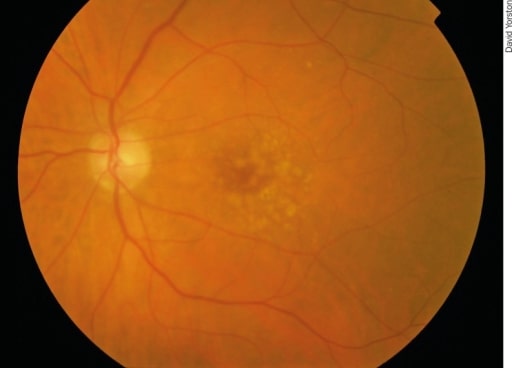
    • Asociado a las drusas:
      • Depósitos de material extracelular o desechos debajo el epitelio pigmentario de la retina Retina The ten-layered nervous tissue membrane of the eye. It is continuous with the optic nerve and receives images of external objects and transmits visual impulses to the brain. Its outer surface is in contact with the choroid and the inner surface with the vitreous body. The outermost layer is pigmented, whereas the inner nine layers are transparent. Eye: Anatomy
      • Unas pocas se encuentran en EN Erythema nodosum is an immune-mediated panniculitis (inflammation of the subcutaneous fat) caused by a type IV (delayed-type) hypersensitivity reaction. It commonly manifests in young women as tender, erythematous nodules on the shins. Erythema Nodosum personas > 50 años como parte del envejecimiento.
    • Aumento del tamaño y/o del número de drusas → degeneración macular asociada a la edad
  • Degeneración macular asociada a la edad húmeda (exudativa o neovascular)
    • 10% de los LOS Neisseria casos, pero representa la mayoría de los LOS Neisseria pacientes con degeneración macular asociada a la edad avanzada
    • Se presenta como una pérdida de visión central insidiosa o de rápida progresión
  • Causada por el crecimiento de vasos sanguíneos anormales en EN Erythema nodosum is an immune-mediated panniculitis (inflammation of the subcutaneous fat) caused by a type IV (delayed-type) hypersensitivity reaction. It commonly manifests in young women as tender, erythematous nodules on the shins. Erythema Nodosum el espacio subretiniano, frecuentemente desde la circulación coroidea (neovascularización coroidea)

Epidemiología

  • Es la principal causa de ceguera irreversible en EN Erythema nodosum is an immune-mediated panniculitis (inflammation of the subcutaneous fat) caused by a type IV (delayed-type) hypersensitivity reaction. It commonly manifests in young women as tender, erythematous nodules on the shins. Erythema Nodosum los LOS Neisseria países desarrollados
  • Prevalencia mundial del 8,7%.
  • Las mujeres se ven más afectadas que los LOS Neisseria hombres.
  • Factores de riesgo:
    • Edad avanzada: ↑ incidencia en EN Erythema nodosum is an immune-mediated panniculitis (inflammation of the subcutaneous fat) caused by a type IV (delayed-type) hypersensitivity reaction. It commonly manifests in young women as tender, erythematous nodules on the shins. Erythema Nodosum > 60 años de edad.
    • Caucásicos > afroamericanos o hispanos
    • Tabaquismo
    • Consumo excesivo de alcohol (> 3 bebidas al AL Amyloidosis día)
    • Antecedentes familiares
    • Predisposición genética (gen del complemento H)
    • Obesidad
    • Hipercolesterolemia
    • Enfermedades cardiovasculares
    • VIH/SIDA
    • Enfermedad mieloproliferativa crónica
    • Cirugía de cataratas
  • Disminuir el riesgo de degeneración macular asociada a la edad: ↑ el consumo de pescado, ↑ los LOS Neisseria ácidos grasos poliinsaturados omega-3 y omega-6

Fisiopatología

Degeneración macular asociada a la edad seca

  • El mecanismo exacto aún no está claro.
  • Los LOS Neisseria factores de riesgo conocidos (como el envejecimiento y la genética), el estrés oxidativo y la inflamación conducen a cambios patológicos:
    • Envejecimiento de la membrana de Bruch: la membrana se engrosa y acumula apolipoproteínas → ↑ inflamación y restos → los LOS Neisseria depósitos basales nodulares se convierten en EN Erythema nodosum is an immune-mediated panniculitis (inflammation of the subcutaneous fat) caused by a type IV (delayed-type) hypersensitivity reaction. It commonly manifests in young women as tender, erythematous nodules on the shins. Erythema Nodosum drusas blandas
    • Degeneración del epitelio pigmentario de la retina Retina The ten-layered nervous tissue membrane of the eye. It is continuous with the optic nerve and receives images of external objects and transmits visual impulses to the brain. Its outer surface is in contact with the choroid and the inner surface with the vitreous body. The outermost layer is pigmented, whereas the inner nine layers are transparent. Eye: Anatomy → se disocia de la membrana de Bruch → disfunción del epitelio pigmentario de la retina Retina The ten-layered nervous tissue membrane of the eye. It is continuous with the optic nerve and receives images of external objects and transmits visual impulses to the brain. Its outer surface is in contact with the choroid and the inner surface with the vitreous body. The outermost layer is pigmented, whereas the inner nine layers are transparent. Eye: Anatomy → pérdida de fotorreceptores.
    • Pérdida de la coriocapilaridad:
      • Se correlaciona con ↑ del tamaño y número de drusas blandas
      • Precede al AL Amyloidosis daño del epitelio pigmentario de la retina Retina The ten-layered nervous tissue membrane of the eye. It is continuous with the optic nerve and receives images of external objects and transmits visual impulses to the brain. Its outer surface is in contact with the choroid and the inner surface with the vitreous body. The outermost layer is pigmented, whereas the inner nine layers are transparent. Eye: Anatomy (atrofia geográfica)

Degeneración macular asociada a la edad húmeda

  • Factores de riesgo + estrés oxidativo + complemento activado → cambios inflamatorios
  • Inflamación → el epitelio pigmentario de la retina Retina The ten-layered nervous tissue membrane of the eye. It is continuous with the optic nerve and receives images of external objects and transmits visual impulses to the brain. Its outer surface is in contact with the choroid and the inner surface with the vitreous body. The outermost layer is pigmented, whereas the inner nine layers are transparent. Eye: Anatomy y otras células de la retina Retina The ten-layered nervous tissue membrane of the eye. It is continuous with the optic nerve and receives images of external objects and transmits visual impulses to the brain. Its outer surface is in contact with the choroid and the inner surface with the vitreous body. The outermost layer is pigmented, whereas the inner nine layers are transparent. Eye: Anatomy secretan el factor de crecimiento endotelial vascular y moléculas vasculogénicas → neovascularización coroidea y disfunción del epitelio pigmentario de la retina Retina The ten-layered nervous tissue membrane of the eye. It is continuous with the optic nerve and receives images of external objects and transmits visual impulses to the brain. Its outer surface is in contact with the choroid and the inner surface with the vitreous body. The outermost layer is pigmented, whereas the inner nine layers are transparent. Eye: Anatomy.
  • Nuevos vasos sanguíneos inmaduros crecen desde la coroides → perforan la membrana de Bruch y se extienden hacia la retina Retina The ten-layered nervous tissue membrane of the eye. It is continuous with the optic nerve and receives images of external objects and transmits visual impulses to the brain. Its outer surface is in contact with the choroid and the inner surface with the vitreous body. The outermost layer is pigmented, whereas the inner nine layers are transparent. Eye: Anatomy
  • Estos vasos sanguíneos dejan escapar líquido y sangre por debajo o dentro de la retina Retina The ten-layered nervous tissue membrane of the eye. It is continuous with the optic nerve and receives images of external objects and transmits visual impulses to the brain. Its outer surface is in contact with the choroid and the inner surface with the vitreous body. The outermost layer is pigmented, whereas the inner nine layers are transparent. Eye: Anatomy → desprendimiento del epitelio pigmentario de la retina Retina The ten-layered nervous tissue membrane of the eye. It is continuous with the optic nerve and receives images of external objects and transmits visual impulses to the brain. Its outer surface is in contact with the choroid and the inner surface with the vitreous body. The outermost layer is pigmented, whereas the inner nine layers are transparent. Eye: Anatomy y hemorragia

Related videos

Presentación Clínica

Degeneración macular asociada a la edad seca

  • Síntomas
    • Asintomático en EN Erythema nodosum is an immune-mediated panniculitis (inflammation of the subcutaneous fat) caused by a type IV (delayed-type) hypersensitivity reaction. It commonly manifests in young women as tender, erythematous nodules on the shins. Erythema Nodosum la mayoría de los LOS Neisseria casos
    • A medida que la enfermedad avanza:
      • Dificultad de visión nocturna
      • Fluctuación visual
      • Dificultad para la lectura
      • No se pueden distinguir los LOS Neisseria rostros
      • Tiempo prolongado de adaptación a niveles bajos de luz
      • Metamorfopsia (líneas rectas distorsionadas) en EN Erythema nodosum is an immune-mediated panniculitis (inflammation of the subcutaneous fat) caused by a type IV (delayed-type) hypersensitivity reaction. It commonly manifests in young women as tender, erythematous nodules on the shins. Erythema Nodosum la enfermedad avanzada
  • Signos (examen fundoscópico y biomicroscopía con lámpara de hendidura)
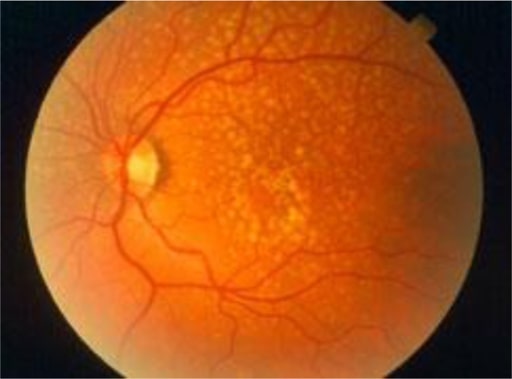
    • Depósitos blanco-amarillentos (drusas) entre la membrana de Bruch y el epitelio pigmentario de la retina Retina The ten-layered nervous tissue membrane of the eye. It is continuous with the optic nerve and receives images of external objects and transmits visual impulses to the brain. Its outer surface is in contact with the choroid and the inner surface with the vitreous body. The outermost layer is pigmented, whereas the inner nine layers are transparent. Eye: Anatomy
    • Moteado pigmentario del epitelio pigmentario de la retina Retina The ten-layered nervous tissue membrane of the eye. It is continuous with the optic nerve and receives images of external objects and transmits visual impulses to the brain. Its outer surface is in contact with the choroid and the inner surface with the vitreous body. The outermost layer is pigmented, whereas the inner nine layers are transparent. Eye: Anatomy: aumento de la pigmentación
    • Atrofia geográfica:
      • Se observa en EN Erythema nodosum is an immune-mediated panniculitis (inflammation of the subcutaneous fat) caused by a type IV (delayed-type) hypersensitivity reaction. It commonly manifests in young women as tender, erythematous nodules on the shins. Erythema Nodosum la degeneración macular asociada a la edad seca avanzada
      • Hipopigmentación o despigmentación del epitelio pigmentario de la retina Retina The ten-layered nervous tissue membrane of the eye. It is continuous with the optic nerve and receives images of external objects and transmits visual impulses to the brain. Its outer surface is in contact with the choroid and the inner surface with the vitreous body. The outermost layer is pigmented, whereas the inner nine layers are transparent. Eye: Anatomy
      • Representa la muerte celular en EN Erythema nodosum is an immune-mediated panniculitis (inflammation of the subcutaneous fat) caused by a type IV (delayed-type) hypersensitivity reaction. It commonly manifests in young women as tender, erythematous nodules on the shins. Erythema Nodosum las zonas adyacentes del epitelio pigmentario de la retina Retina The ten-layered nervous tissue membrane of the eye. It is continuous with the optic nerve and receives images of external objects and transmits visual impulses to the brain. Its outer surface is in contact with the choroid and the inner surface with the vitreous body. The outermost layer is pigmented, whereas the inner nine layers are transparent. Eye: Anatomy y los LOS Neisseria fotorreceptores
  • Etapas
    • En EN Erythema nodosum is an immune-mediated panniculitis (inflammation of the subcutaneous fat) caused by a type IV (delayed-type) hypersensitivity reaction. It commonly manifests in young women as tender, erythematous nodules on the shins. Erythema Nodosum la fase inicial:
      • > 15 drusas pequeñas o < 20 drusas medianas
      • No hay pérdida de visión
    • Etapa intermedia:
      • Al AL Amyloidosis menos 1 drusa grande, ≥ 20 drusas o atrofia geográfica no central (fóvea no implicada)
      • Puede tener pérdida de visión
    • Etapa avanzada:
      • Atrofia geográfica central (fóvea afectada)
      • Pérdida de visión notable

Degeneración macular asociada a la edad húmeda

  • Síntomas
    • Distorsión o pérdida visual central, a menudo bilateral e indolora
    • Agudeza por debajo del nivel de lectura y conducción
    • Puede ser gradual dependiendo de la patología
    • La hemorragia subretiniana provoca un cambio de visión agudo.
    • Metamorfopsia: uno de los LOS Neisseria primeros cambios en EN Erythema nodosum is an immune-mediated panniculitis (inflammation of the subcutaneous fat) caused by a type IV (delayed-type) hypersensitivity reaction. It commonly manifests in young women as tender, erythematous nodules on the shins. Erythema Nodosum la visión
    • Escotoma: alteración parcial de la visión en EN Erythema nodosum is an immune-mediated panniculitis (inflammation of the subcutaneous fat) caused by a type IV (delayed-type) hypersensitivity reaction. It commonly manifests in young women as tender, erythematous nodules on the shins. Erythema Nodosum un punto, pero con un campo visual normal alrededor
  • Signos (examen fundoscópico y biomicroscopía con lámpara de hendidura)
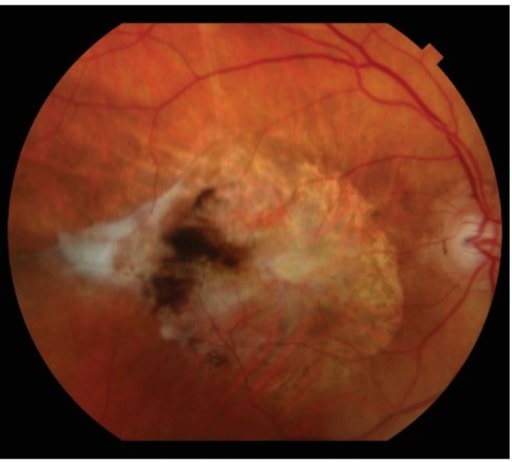
    • Neovascularización en EN Erythema nodosum is an immune-mediated panniculitis (inflammation of the subcutaneous fat) caused by a type IV (delayed-type) hypersensitivity reaction. It commonly manifests in young women as tender, erythematous nodules on the shins. Erythema Nodosum la mácula: decoloración gris-verde
    • Hemorragia subretiniana
    • Desprendimientos del epitelio pigmentario de la retina Retina The ten-layered nervous tissue membrane of the eye. It is continuous with the optic nerve and receives images of external objects and transmits visual impulses to the brain. Its outer surface is in contact with the choroid and the inner surface with the vitreous body. The outermost layer is pigmented, whereas the inner nine layers are transparent. Eye: Anatomy: separación del epitelio pigmentario de la retina Retina The ten-layered nervous tissue membrane of the eye. It is continuous with the optic nerve and receives images of external objects and transmits visual impulses to the brain. Its outer surface is in contact with the choroid and the inner surface with the vitreous body. The outermost layer is pigmented, whereas the inner nine layers are transparent. Eye: Anatomy de la membrana de Bruch
    • Depósitos lipídicos subretinianos en EN Erythema nodosum is an immune-mediated panniculitis (inflammation of the subcutaneous fat) caused by a type IV (delayed-type) hypersensitivity reaction. It commonly manifests in young women as tender, erythematous nodules on the shins. Erythema Nodosum ocasiones
    • Cicatrices disciformes

Diagnóstico

  • Hallazgos clínicos, examen fundoscópico dilatado con biomicroscopía de lámpara de hendidura
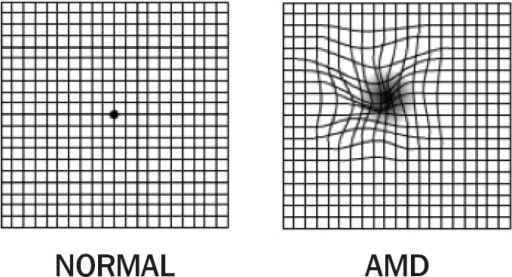
  • Prueba de la rejilla de Amsler: detecta metamorfopsias y escotomas
  • Angiografía
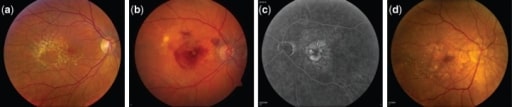
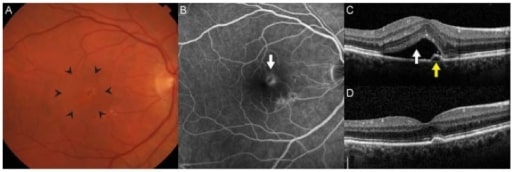
    • Angiografía de fondo de ojo con fluoresceína:
      • Inyección intravenosa de colorante de fluoresceína, que sigue el trayecto de los LOS Neisseria vasos de la coroides y la retina Retina The ten-layered nervous tissue membrane of the eye. It is continuous with the optic nerve and receives images of external objects and transmits visual impulses to the brain. Its outer surface is in contact with the choroid and the inner surface with the vitreous body. The outermost layer is pigmented, whereas the inner nine layers are transparent. Eye: Anatomy
      • Hipofluorescencia: hemorragia
      • Hiperfluorescencia: drusas, atrofia del epitelio pigmentario de la retina Retina The ten-layered nervous tissue membrane of the eye. It is continuous with the optic nerve and receives images of external objects and transmits visual impulses to the brain. Its outer surface is in contact with the choroid and the inner surface with the vitreous body. The outermost layer is pigmented, whereas the inner nine layers are transparent. Eye: Anatomy, membranas neurovasculares coroideas, desprendimientos serosos del epitelio pigmentario de la retina Retina The ten-layered nervous tissue membrane of the eye. It is continuous with the optic nerve and receives images of external objects and transmits visual impulses to the brain. Its outer surface is in contact with the choroid and the inner surface with the vitreous body. The outermost layer is pigmented, whereas the inner nine layers are transparent. Eye: Anatomy
    • Angiografía con verde de indocianina
      • Utiliza un colorante de tricarbocianina soluble en EN Erythema nodosum is an immune-mediated panniculitis (inflammation of the subcutaneous fat) caused by a type IV (delayed-type) hypersensitivity reaction. It commonly manifests in young women as tender, erythematous nodules on the shins. Erythema Nodosum agua
      • Detecta la neovascularización coroidea y los LOS Neisseria desprendimientos del epitelio pigmentario de la retina Retina The ten-layered nervous tissue membrane of the eye. It is continuous with the optic nerve and receives images of external objects and transmits visual impulses to the brain. Its outer surface is in contact with the choroid and the inner surface with the vitreous body. The outermost layer is pigmented, whereas the inner nine layers are transparent. Eye: Anatomy
  • Tomografía de coherenciaóptica
    • Prueba de imagen no invasiva que utiliza ondas de luz
    • Produce imágenes transversales de alta resolución de la retina Retina The ten-layered nervous tissue membrane of the eye. It is continuous with the optic nerve and receives images of external objects and transmits visual impulses to the brain. Its outer surface is in contact with the choroid and the inner surface with the vitreous body. The outermost layer is pigmented, whereas the inner nine layers are transparent. Eye: Anatomy
    • Detección de:
      • Drusas como elevación nodular del epitelio pigmentario de la retina Retina The ten-layered nervous tissue membrane of the eye. It is continuous with the optic nerve and receives images of external objects and transmits visual impulses to the brain. Its outer surface is in contact with the choroid and the inner surface with the vitreous body. The outermost layer is pigmented, whereas the inner nine layers are transparent. Eye: Anatomy
      • Edema Edema Edema is a condition in which excess serous fluid accumulates in the body cavity or interstitial space of connective tissues. Edema is a symptom observed in several medical conditions. It can be categorized into 2 types, namely, peripheral (in the extremities) and internal (in an organ or body cavity). Edema de retina Retina The ten-layered nervous tissue membrane of the eye. It is continuous with the optic nerve and receives images of external objects and transmits visual impulses to the brain. Its outer surface is in contact with the choroid and the inner surface with the vitreous body. The outermost layer is pigmented, whereas the inner nine layers are transparent. Eye: Anatomy y líquido subretiniano
    • Monitorea la respuesta al AL Amyloidosis tratamiento en EN Erythema nodosum is an immune-mediated panniculitis (inflammation of the subcutaneous fat) caused by a type IV (delayed-type) hypersensitivity reaction. It commonly manifests in young women as tender, erythematous nodules on the shins. Erythema Nodosum la degeneración macular asociada a la edad húmeda
  • Fotografía de fondo de ojo a color: se utiliza para dar seguimiento a la degeneración macular asociada a la edad
  • Autofluorescencia del fondo de ojo
    • No hay contraste
    • Identifica la acumulación de lipofuscina (↑ en EN Erythema nodosum is an immune-mediated panniculitis (inflammation of the subcutaneous fat) caused by a type IV (delayed-type) hypersensitivity reaction. It commonly manifests in young women as tender, erythematous nodules on the shins. Erythema Nodosum el envejecimiento celular)
    • Define las áreas de atrofia geográfica
Rejilla Amsler

1. Rejilla de Amsler: visión normal (izquierda); 2. Rejilla de Amsler: degeneración macular asociada a la edad con metamorfopsia (derecha). Observe las líneas distorsionadas.

Imagen: “Amsler Grid” por Africa Regional Medical Advisor: Fred Hollows Foundation, Kigali, Rwanda. Licencia: CC BY 2.0
Tratamiento

Degeneración macular asociada a la edad seca

  • Para todos los LOS Neisseria pacientes: dejar de fumar
  • Monitorea de la progresión con un seguimiento periódico
  • Para la degeneración macular asociada a la edad intermedia y la degeneración macular asociada a la edad avanzada: suplemento diario de AREDS 2 (Age-Related Eye Disease Study 2, en EN Erythema nodosum is an immune-mediated panniculitis (inflammation of the subcutaneous fat) caused by a type IV (delayed-type) hypersensitivity reaction. It commonly manifests in young women as tender, erythematous nodules on the shins. Erythema Nodosum inglés)
    • Vitamina C 500 mg
    • Vitamina E 400 unidades internacionales (UI)
    • Óxido de zinc Zinc A metallic element of atomic number 30 and atomic weight 65. 38. It is a necessary trace element in the diet, forming an essential part of many enzymes, and playing an important role in protein synthesis and in cell division. Zinc deficiency is associated with anemia, short stature, hypogonadism, impaired wound healing, and geophagia. It is known by the symbol zn. Trace Elements 80 mg
    • Óxido cúprico 2 mg
    • Luteína 10 mg
    • Zeaxantina 2 mg

Degeneración macular asociada a la edad húmeda

  • AREDS 2
  • Anti factor de crecimiento endotelial vascular intravítreo
    • Terapia de primera línea; antiangiogénica
    • Ranibizumab:
      • Fragmento de anticuerpo humanizado recombinante que se une al AL Amyloidosis factor de crecimiento endotelial vascular
      • 0,5 mg mensuales durante 3 meses
    • Bevacizumab Bevacizumab An anti-vegf humanized murine monoclonal antibody. It inhibits vegf receptors and helps to prevent pathologic angiogenesis. Targeted and Other Nontraditional Antineoplastic Therapy:
      • Anticuerpo monoclonal contra el factor de crecimiento endotelial vascular
      • 1,25 mg mensuales durante 3 meses
      • Menor costo que el ranibizumab
    • Aflibercept:
      • Proteína de fusión recombinante que actúa como receptor Receptor Receptors are proteins located either on the surface of or within a cell that can bind to signaling molecules known as ligands (e.g., hormones) and cause some type of response within the cell. Receptors competitivo para el factor de crecimiento endotelial vascular
      • 2 mg cada mes durante 3 meses y luego cada 2 meses
    • Faricimab:
      • Anticuerpo biespecífico dirigido contra VEGF-A y Ang-2
      • 6 mg mensuales durante 4 dosis, posteriormente cada 8-16
    • Brolucizumab:
      • Fragmento de anticuerpo monocatenario contra VEGF-A
      • 6 mg mensuales durante 3 dosis, posteriormente cada 8-12 semanas; vigilar la aparición de vasculitis Vasculitis Inflammation of any one of the blood vessels, including the arteries; veins; and rest of the vasculature system in the body. Systemic Lupus Erythematosus/oclusión retiniana poco frecuente
    • Efectos adversos:
      • Endoftalmitis
      • Aumento de la presión intraocular
      • Desprendimiento de retina Retina The ten-layered nervous tissue membrane of the eye. It is continuous with the optic nerve and receives images of external objects and transmits visual impulses to the brain. Its outer surface is in contact with the choroid and the inner surface with the vitreous body. The outermost layer is pigmented, whereas the inner nine layers are transparent. Eye: Anatomy
      • Eventos trombóticos reportados
    • Fotocoagulación láser térmica
      • Rara vez se utiliza debido a la recurrencia de la enfermedad y a los LOS Neisseria malos resultados visuales
    • Terapia fotodinámica
      • Aplicación de luz de longitud de onda específica y administración intravenosa de verteporfina
      • Resultados en EN Erythema nodosum is an immune-mediated panniculitis (inflammation of the subcutaneous fat) caused by a type IV (delayed-type) hypersensitivity reaction. It commonly manifests in young women as tender, erythematous nodules on the shins. Erythema Nodosum la ralentización de la progresión de la neovascularización coroidea
      • Rara vez se utiliza, pero es una opción en EN Erythema nodosum is an immune-mediated panniculitis (inflammation of the subcutaneous fat) caused by a type IV (delayed-type) hypersensitivity reaction. It commonly manifests in young women as tender, erythematous nodules on the shins. Erythema Nodosum los LOS Neisseria casos de fracaso del tratamiento anti factor de crecimiento endotelial vascular
    • Cirugía
      • Activador tisular del plasminógeno intravítreo con desplazamiento neumático
      • Necesaria en EN Erythema nodosum is an immune-mediated panniculitis (inflammation of the subcutaneous fat) caused by a type IV (delayed-type) hypersensitivity reaction. It commonly manifests in young women as tender, erythematous nodules on the shins. Erythema Nodosum casos raros de hemorragia submacular

Diagnóstico Diferencial

  • Cataratas: es una disminución de la visión debido a la opacidad del cristalino, que se presenta de manera indolora, con visión borrosa y problemas de destellos. Las cataratas son la principal causa de ceguera en EN Erythema nodosum is an immune-mediated panniculitis (inflammation of the subcutaneous fat) caused by a type IV (delayed-type) hypersensitivity reaction. It commonly manifests in young women as tender, erythematous nodules on the shins. Erythema Nodosum todo el mundo. La afección puede aparecer a cualquier edad, pero la mayoría de los LOS Neisseria casos afectan a quienes tienen > 60 años.
  • Retinopatía diabética: es una alteración visual debida al AL Amyloidosis daño microvascular de los LOS Neisseria órganos diana por la diabetes Diabetes Diabetes mellitus (DM) is a metabolic disease characterized by hyperglycemia and dysfunction of the regulation of glucose metabolism by insulin. Type 1 DM is diagnosed mostly in children and young adults as the result of autoimmune destruction of β cells in the pancreas and the resulting lack of insulin. Type 2 DM has a significant association with obesity and is characterized by insulin resistance. Diabetes Mellitus mellitus. La retinopatía diabética se clasifica en EN Erythema nodosum is an immune-mediated panniculitis (inflammation of the subcutaneous fat) caused by a type IV (delayed-type) hypersensitivity reaction. It commonly manifests in young women as tender, erythematous nodules on the shins. Erythema Nodosum retinopatía no proliferativa y proliferativa. La retinopatía no proliferativa se caracteriza por microaneurismas, hemorragias intrarretinianas, exudados y edema Edema Edema is a condition in which excess serous fluid accumulates in the body cavity or interstitial space of connective tissues. Edema is a symptom observed in several medical conditions. It can be categorized into 2 types, namely, peripheral (in the extremities) and internal (in an organ or body cavity). Edema macular. La característica distintiva del tipo proliferativo es la presencia de neovascularización de la retina Retina The ten-layered nervous tissue membrane of the eye. It is continuous with the optic nerve and receives images of external objects and transmits visual impulses to the brain. Its outer surface is in contact with the choroid and the inner surface with the vitreous body. The outermost layer is pigmented, whereas the inner nine layers are transparent. Eye: Anatomy o del disco óptico. Los LOS Neisseria pacientes son inicialmente asintomáticos, pero en EN Erythema nodosum is an immune-mediated panniculitis (inflammation of the subcutaneous fat) caused by a type IV (delayed-type) hypersensitivity reaction. It commonly manifests in young women as tender, erythematous nodules on the shins. Erythema Nodosum las últimas fases presentan una visión disminuida o fluctuante, y a veces partículas flotantes.
  • Desprendimiento de retina Retina The ten-layered nervous tissue membrane of the eye. It is continuous with the optic nerve and receives images of external objects and transmits visual impulses to the brain. Its outer surface is in contact with the choroid and the inner surface with the vitreous body. The outermost layer is pigmented, whereas the inner nine layers are transparent. Eye: Anatomy: es la separación de la retina Retina The ten-layered nervous tissue membrane of the eye. It is continuous with the optic nerve and receives images of external objects and transmits visual impulses to the brain. Its outer surface is in contact with the choroid and the inner surface with the vitreous body. The outermost layer is pigmented, whereas the inner nine layers are transparent. Eye: Anatomy del epitelio pigmentario de la retina Retina The ten-layered nervous tissue membrane of the eye. It is continuous with the optic nerve and receives images of external objects and transmits visual impulses to the brain. Its outer surface is in contact with the choroid and the inner surface with the vitreous body. The outermost layer is pigmented, whereas the inner nine layers are transparent. Eye: Anatomy. Esto provoca un rápido daño en EN Erythema nodosum is an immune-mediated panniculitis (inflammation of the subcutaneous fat) caused by a type IV (delayed-type) hypersensitivity reaction. It commonly manifests in young women as tender, erythematous nodules on the shins. Erythema Nodosum los LOS Neisseria fotorreceptores. Los LOS Neisseria síntomas incluyen cambios indoloros en EN Erythema nodosum is an immune-mediated panniculitis (inflammation of the subcutaneous fat) caused by a type IV (delayed-type) hypersensitivity reaction. It commonly manifests in young women as tender, erythematous nodules on the shins. Erythema Nodosum la visión, como destellos repentinos de luz, partículas flotantes, empeoramiento de la visión periférica o presencia de una sombra en EN Erythema nodosum is an immune-mediated panniculitis (inflammation of the subcutaneous fat) caused by a type IV (delayed-type) hypersensitivity reaction. It commonly manifests in young women as tender, erythematous nodules on the shins. Erythema Nodosum el campo visual. El desprendimiento de retina Retina The ten-layered nervous tissue membrane of the eye. It is continuous with the optic nerve and receives images of external objects and transmits visual impulses to the brain. Its outer surface is in contact with the choroid and the inner surface with the vitreous body. The outermost layer is pigmented, whereas the inner nine layers are transparent. Eye: Anatomy es una emergencia médica que requiere cirugía correctiva.

Referencias

  1. Ambati, J., & Fowler, B. J. (2012). Mechanisms of age-related macular degeneration. Neuron75(1), 26–39. https://doi.org/10.1016/j.neuron.2012.06.018
  2. Vavvas, D. G. (2025). Age-related macular degeneration. In M. F. Gardiner, K. E. Schmader, & H. Li (Eds.), UpToDate. Retrieved July 10, 2025, from https://www.uptodate.com/contents/age-related-macular-degeneration
  3. Vavvas, D. G. (2025). Age-related macular degeneration. UpToDate. Retrieved July 10, 2025, from https://www.uptodate.com/contents/age-related-macular-degeneration
  4. Handa, J., Rickman, C., Dick, A., Gorin, M., Miller, J., Toth, C.,Ueffing, M., Zarbin, M., Farrer, L. (2019). A systems biology approach towards understanding and treating non-neovascular age-related macular degeneration. Nature 10, 3347. https://doi.org/10.1038/s41467-019-11262-1
  5. Jonas, JB, Cheung, C., Panda-Jonas, S. (2017). Updates on the Epidemiology of Age-related Macular Degeneration. Asia Pacific J Ophthalmol 6 (6):493-497. doi: 10.22608/APO.2017251
  6. Maturi, R., Franklin, A. (2024). Nonexudative (Dry) Age-Related Macular Degeneration. Medscape. Retrieved July 10, 2025, from https://emedicine.medscape.com/article/1223154-overview
  7. Prall, F.R., Ciulla, T.,  Dahl, A. (2023). Exudative (Wet) Age-Related Macular Degeneration. Medscape. Retrieved July 10, 2025, from https://emedicine.medscape.com/article/1226030-overview

¡Crea tu cuenta gratis o inicia una sesión para seguir leyendo!

Regístrate ahora y obtén acceso gratuito a Lecturio con páginas de concepto, videos médicos y cuestionarios para tu educación médica.

User Reviews

Que tengas una sesión de estudio alegre y navideña 🎁 Ahorra 50% en todos los planes >>

Details