Domina Conceptos Médicos

Estudia para la escuela de medicina y tus examenes con Lecturio.

Bloqueos de Rama y Fasciculares

Los LOS Neisseria bloqueos de rama y fasciculares se producen cuando se interrumpe la actividad eléctrica normal del sistema de His-Purkinje. Estos bloqueos pueden deberse a muchas etiologías que pueden afectar a la estructura del corazón o al AL Amyloidosis sistema de conducción directamente. Los LOS Neisseria bloqueos se clasifican en EN Erythema nodosum is an immune-mediated panniculitis (inflammation of the subcutaneous fat) caused by a type IV (delayed-type) hypersensitivity reaction. It commonly manifests in young women as tender, erythematous nodules on the shins. Erythema Nodosum bloqueo de rama derecha, bloqueo de rama izquierda, bloqueo del fascículo anterior izquierdo y bloqueo del fascículo posterior izquierdo en EN Erythema nodosum is an immune-mediated panniculitis (inflammation of the subcutaneous fat) caused by a type IV (delayed-type) hypersensitivity reaction. It commonly manifests in young women as tender, erythematous nodules on the shins. Erythema Nodosum función de la localización de la alteración. La mayoría de los LOS Neisseria individuos son asintomáticos. El ECG ECG An electrocardiogram (ECG) is a graphic representation of the electrical activity of the heart plotted against time. Adhesive electrodes are affixed to the skin surface allowing measurement of cardiac impulses from many angles. The ECG provides 3-dimensional information about the conduction system of the heart, the myocardium, and other cardiac structures. Electrocardiogram (ECG) proporcionará el diagnóstico. Algunos hallazgos comunes del ECG ECG An electrocardiogram (ECG) is a graphic representation of the electrical activity of the heart plotted against time. Adhesive electrodes are affixed to the skin surface allowing measurement of cardiac impulses from many angles. The ECG provides 3-dimensional information about the conduction system of the heart, the myocardium, and other cardiac structures. Electrocardiogram (ECG) incluyen un intervalo QRS prolongado, cambios en EN Erythema nodosum is an immune-mediated panniculitis (inflammation of the subcutaneous fat) caused by a type IV (delayed-type) hypersensitivity reaction. It commonly manifests in young women as tender, erythematous nodules on the shins. Erythema Nodosum la onda R, desviación del eje y ( en EN Erythema nodosum is an immune-mediated panniculitis (inflammation of the subcutaneous fat) caused by a type IV (delayed-type) hypersensitivity reaction. It commonly manifests in young women as tender, erythematous nodules on the shins. Erythema Nodosum algunos casos) cambios en EN Erythema nodosum is an immune-mediated panniculitis (inflammation of the subcutaneous fat) caused by a type IV (delayed-type) hypersensitivity reaction. It commonly manifests in young women as tender, erythematous nodules on the shins. Erythema Nodosum la onda S. No está indicado ningún tratamiento específico.

Last updated: Jul 14, 2022

Editorial responsibility: Stanley Oiseth, Lindsay Jones, Evelin Maza

Clasificación y Epidemiología

Clasificación

Los LOS Neisseria bloqueos de rama y fasciculares se clasifican en EN Erythema nodosum is an immune-mediated panniculitis (inflammation of the subcutaneous fat) caused by a type IV (delayed-type) hypersensitivity reaction. It commonly manifests in young women as tender, erythematous nodules on the shins. Erythema Nodosum función del lugar donde se produce la alteración dentro del sistema de His-Purkinje.

  • Bloqueos de rama:
    • Bloqueo de rama derecha
    • Bloqueo de rama izquierda
  • Bloqueos fasciculares:
    • Bloqueo fascicular anterior izquierdo o hemibloqueo
    • Bloqueo fascicular posterior izquierdo o hemibloqueo
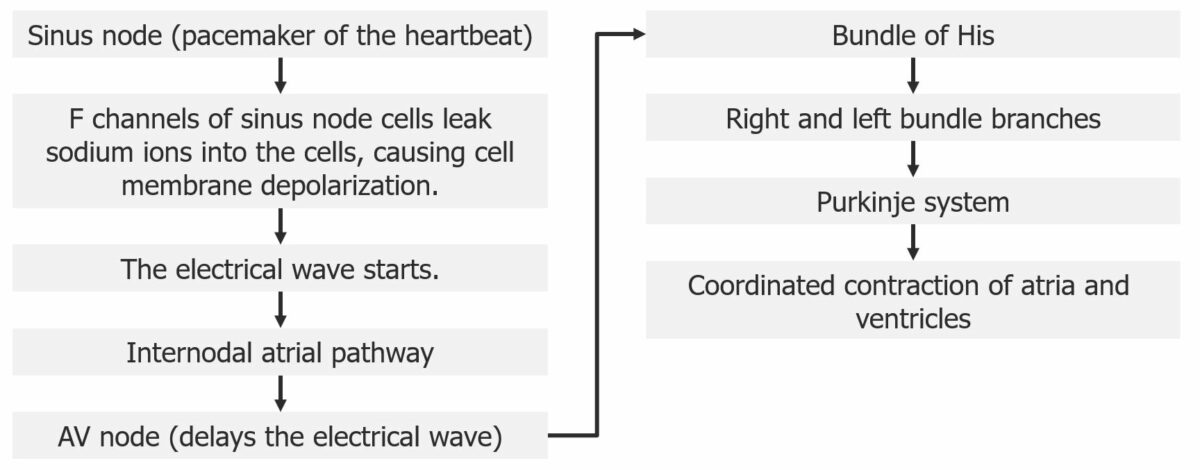
Los bloqueos de rama y fasciculares surgen debido a la obstrucción de la corriente eléctrica

Los bloqueos de rama y fasciculares surgen debido a la obstrucción de la corriente eléctrica a través del sistema de His-Purkinje y se denominan en función de la localización de dicha interrupción.

Imagen por Lecturio.

Epidemiología

  • Bloqueo de rama derecha:
    • Prevalencia:
      • En EN Erythema nodosum is an immune-mediated panniculitis (inflammation of the subcutaneous fat) caused by a type IV (delayed-type) hypersensitivity reaction. It commonly manifests in young women as tender, erythematous nodules on the shins. Erythema Nodosum la población general: < 1%
      • Aumenta con la edad
    • Puede ocurrir en EN Erythema nodosum is an immune-mediated panniculitis (inflammation of the subcutaneous fat) caused by a type IV (delayed-type) hypersensitivity reaction. It commonly manifests in young women as tender, erythematous nodules on the shins. Erythema Nodosum personas jóvenes y sanas
  • Bloqueo de rama izquierda:
    • Prevalencia:
      • En EN Erythema nodosum is an immune-mediated panniculitis (inflammation of the subcutaneous fat) caused by a type IV (delayed-type) hypersensitivity reaction. It commonly manifests in young women as tender, erythematous nodules on the shins. Erythema Nodosum la población general: < 1%
      • Aumenta con la edad
    • Ocurre con poca frecuencia en EN Erythema nodosum is an immune-mediated panniculitis (inflammation of the subcutaneous fat) caused by a type IV (delayed-type) hypersensitivity reaction. It commonly manifests in young women as tender, erythematous nodules on the shins. Erythema Nodosum personas jóvenes y sanas
  • Bloqueo fascicular anterior izquierdo:
    • Prevalencia en EN Erythema nodosum is an immune-mediated panniculitis (inflammation of the subcutaneous fat) caused by a type IV (delayed-type) hypersensitivity reaction. It commonly manifests in young women as tender, erythematous nodules on the shins. Erythema Nodosum la población general: 1%–2,5%
    • La prevalencia aumenta con la edad
  • Bloqueo fascicular posterior izquierdo:
    • Un bloqueo fascicular posterior izquierdo aislado es raro.
    • Prevalencia: 0,1%–0,6%
    • A menudo se produce en EN Erythema nodosum is an immune-mediated panniculitis (inflammation of the subcutaneous fat) caused by a type IV (delayed-type) hypersensitivity reaction. It commonly manifests in young women as tender, erythematous nodules on the shins. Erythema Nodosum asociación con el bloqueo de rama derecha

Etiología

Bloqueo de rama derecha

  • Enfermedad estructural:
    • Incluye condiciones que resultan en EN Erythema nodosum is an immune-mediated panniculitis (inflammation of the subcutaneous fat) caused by a type IV (delayed-type) hypersensitivity reaction. It commonly manifests in young women as tender, erythematous nodules on the shins. Erythema Nodosum patología del ventrículo derecho:
      • Hipertrofia
      • ↑ Presión
      • Dilatación
      • Lesión
      • Inflamación/infiltración
    • Ejemplos:
      • Hipertensión pulmonar y cor pulmonale Cor Pulmonale Cor pulmonale is right ventricular (RV) dysfunction caused by lung disease that results in pulmonary artery hypertension. The most common cause of cor pulmonale is chronic obstructive pulmonary disease. Dyspnea is the usual presenting symptom. Cor Pulmonale
      • Embolia pulmonar
      • Isquemia miocárdica o IM
      • Miocarditis
      • Cardiomiopatía
      • Enfermedad valvular
      • Comunicación interauricular
      • Enfermedad de Chagas
  • Enfermedad idiopática de la conducción cardíaca (enfermedad de Lenegre o de Lev)
  • Traumatismo iatrogénico en EN Erythema nodosum is an immune-mediated panniculitis (inflammation of the subcutaneous fat) caused by a type IV (delayed-type) hypersensitivity reaction. It commonly manifests in young women as tender, erythematous nodules on the shins. Erythema Nodosum el sistema de conducción:
    • Inserción de un catéter en EN Erythema nodosum is an immune-mediated panniculitis (inflammation of the subcutaneous fat) caused by a type IV (delayed-type) hypersensitivity reaction. It commonly manifests in young women as tender, erythematous nodules on the shins. Erythema Nodosum el corazón derecho
    • Terapia de reducción septal con ablación de etanol
    • Cirugía cardíaca
  • También puede ocurrir en EN Erythema nodosum is an immune-mediated panniculitis (inflammation of the subcutaneous fat) caused by a type IV (delayed-type) hypersensitivity reaction. It commonly manifests in young women as tender, erythematous nodules on the shins. Erythema Nodosum quienes no tienen una enfermedad cardíaca

Bloqueo de rama izquierda

  • Enfermedad estructural:
    • Incluye condiciones que resultan en EN Erythema nodosum is an immune-mediated panniculitis (inflammation of the subcutaneous fat) caused by a type IV (delayed-type) hypersensitivity reaction. It commonly manifests in young women as tender, erythematous nodules on the shins. Erythema Nodosum patología del ventrículo izquierdo:
      • Hipertrofia
      • ↑ Presión
      • Dilatación
      • Lesión
      • Inflamación/infiltración
    • Ejemplos:
      • IM/Isquemia miocárdica (más común)
      • Cardiomiopatía
      • Hipertensión
      • Absceso perivalvular por endocarditis Endocarditis Endocarditis is an inflammatory disease involving the inner lining (endometrium) of the heart, most commonly affecting the cardiac valves. Both infectious and noninfectious etiologies lead to vegetations on the valve leaflets. Patients may present with nonspecific symptoms such as fever and fatigue. Endocarditis de la válvula aórtica
      • Miocarditis
      • Enfermedad valvular
      • Defectos congénitos
  • Enfermedad de conducción cardíaca idiopática
  • Iatrogénica:
    • Miectomía septal
    • Implantación de válvula aórtica transcatéter

Bloqueo fascicular anterior izquierdo y bloqueo fascicular posterior izquierdo

Estos bloqueos fasciculares pueden producirse por muchas de las mismas causas del bloqueo de rama izquierda o derecha, sobre todo:
  • Valvulopatía aórtica (bloqueo fascicular anterior izquierdo)
  • Isquemia miocárdica o IM
  • Cardiomiopatía
  • Hipertensión
  • Enfermedad de Chagas
  • Enfermedades infiltrativas e inflamatorias
  • Defectos congénitos
  • Enfermedad de conducción cardíaca idiopática

Fisiopatología

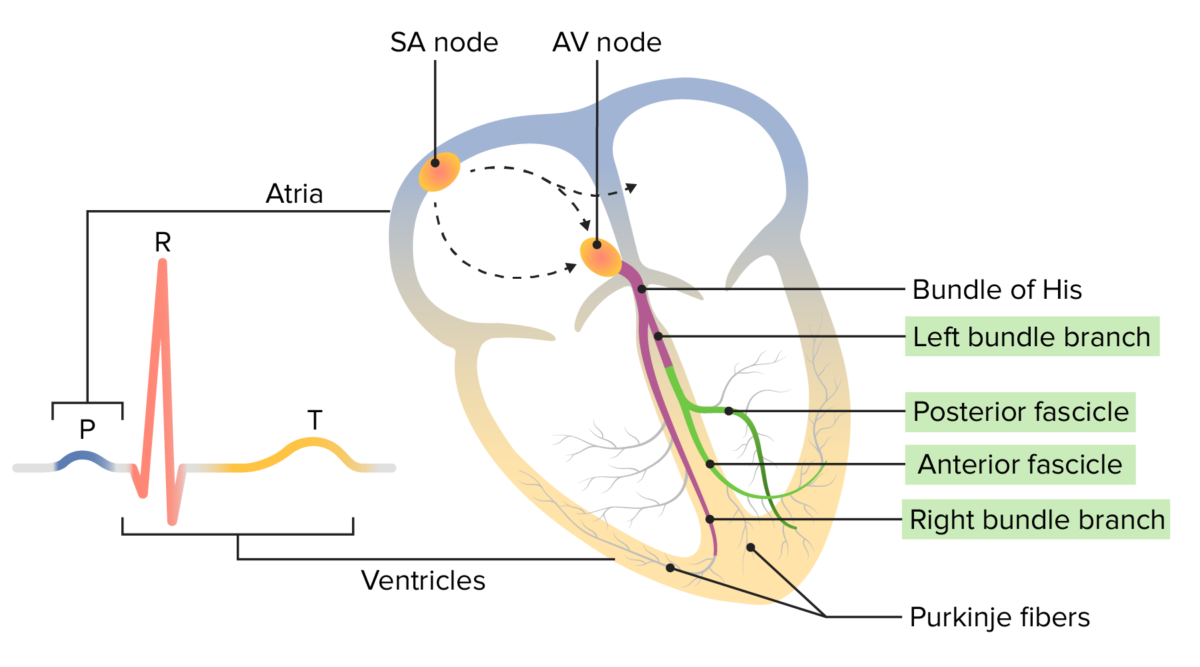
Fisiología normal

  • El impulso cardíaco es generado por las células marcapaso del nodo sinoauricular y se desplaza por las aurículas → despolarización → contracción auricular
  • Se transmite al AL Amyloidosis nodo auriculoventricular → sistema His-Purkinje → despolarización → contracción ventricular
  • Sistema His-Purkinje:
    • Proporciona una conducción eléctrica rápida para los LOS Neisseria ventrículos → despolarización y contracción ventricular sincronizada
    • Contiene:
      • Haz de His
      • El haz se divide en EN Erythema nodosum is an immune-mediated panniculitis (inflammation of the subcutaneous fat) caused by a type IV (delayed-type) hypersensitivity reaction. It commonly manifests in young women as tender, erythematous nodules on the shins. Erythema Nodosum dos → ramas derecha e izquierda
      • La rama izquierda se divide → fascículo anterior izquierdo y fascículo posterior izquierdo
      • Fibras de Purkinje

Bloqueos de rama

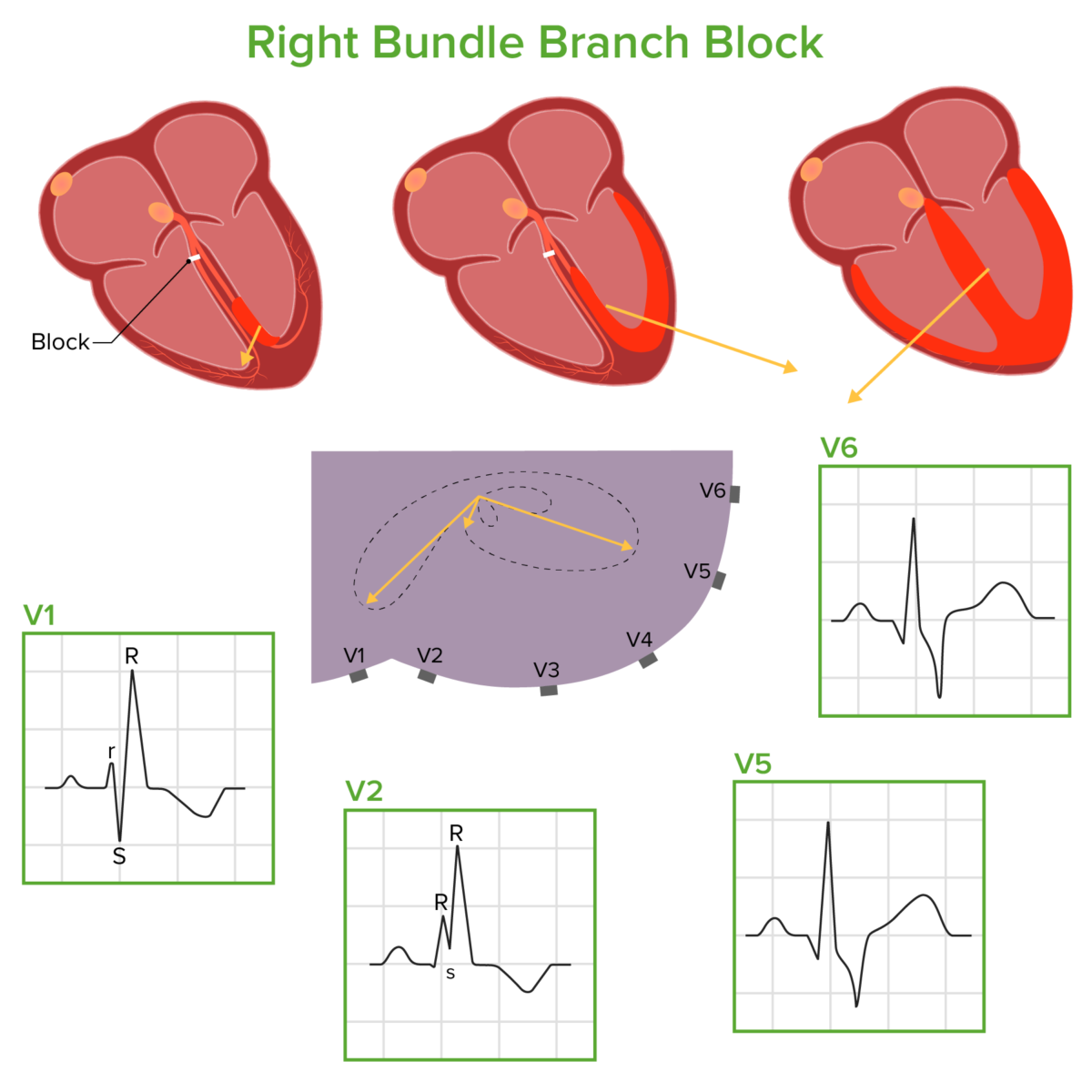
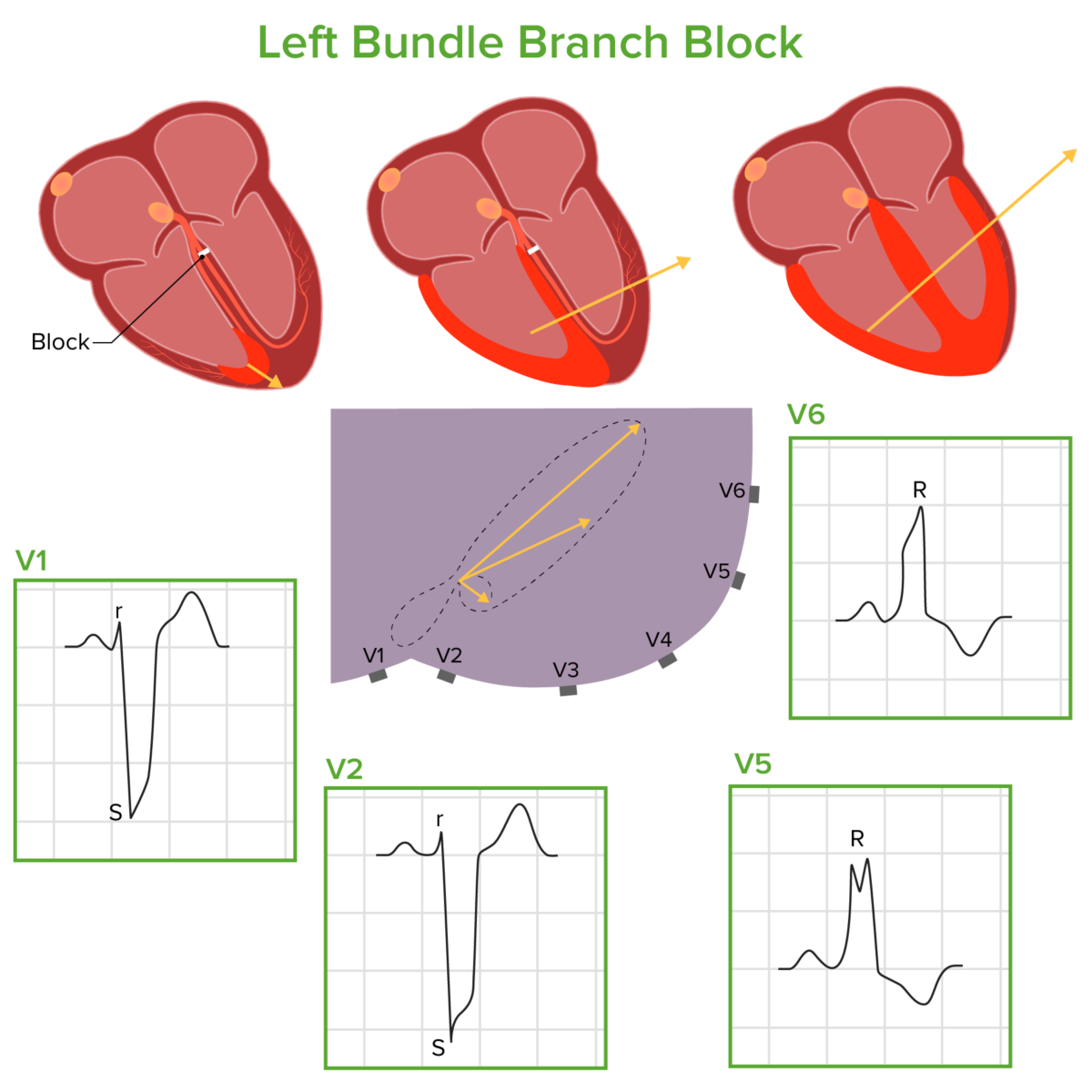
  • La alteración de una rama provoca la interrupción de la transmisión del impulso cardíaco hacia abajo.
  • Esto hace HACE Altitude Sickness que, posteriormente, el impulso sea conducido a través de la rama opuesta.
  • El ventrículo contralateral se despolarizará primero.
  • El ventrículo ipsilateral se despolarizará más tarde (el impulso eléctrico viaja lentamente a través del músculo, alcanzando el sistema de conducción por debajo del bloqueo).
  • Esto aparecerá como una prolongación del intervalo QRS en EN Erythema nodosum is an immune-mediated panniculitis (inflammation of the subcutaneous fat) caused by a type IV (delayed-type) hypersensitivity reaction. It commonly manifests in young women as tender, erythematous nodules on the shins. Erythema Nodosum el ECG ECG An electrocardiogram (ECG) is a graphic representation of the electrical activity of the heart plotted against time. Adhesive electrodes are affixed to the skin surface allowing measurement of cardiac impulses from many angles. The ECG provides 3-dimensional information about the conduction system of the heart, the myocardium, and other cardiac structures. Electrocardiogram (ECG).

Bloqueos fasciculares

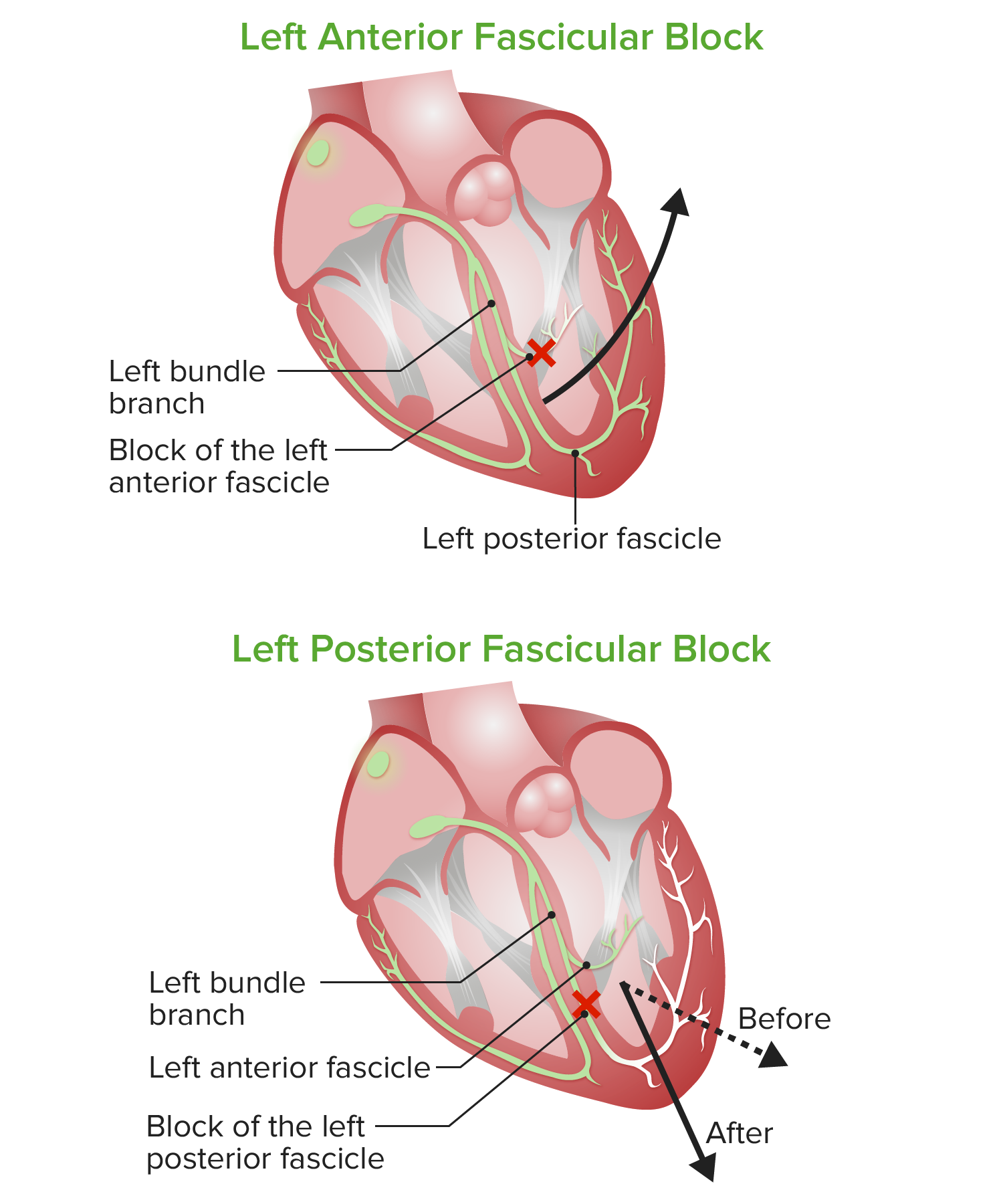
  • La fisiopatología es similar a la de los LOS Neisseria bloqueos de rama, aunque la rama no está completamente afectada → la despolarización del ventrículo izquierdo depende del fascículo opuesto
  • Esto provoca la desviación del eje, pero tiene menos efecto sobre la duración del QRS.
Bloqueos fasciculares anteriores y posteriores izquierdos

Esquema de los bloqueos fasciculares anterior y posterior izquierdos:
En el bloqueo fascicular anterior izquierdo o hemibloqueo, el vector eléctrico resultante provoca una desviación significativa del eje izquierdo. En el bloqueo fascicular posterior izquierdo o hemibloqueo, el vector eléctrico se desvía un poco hacia la derecha pero no se desplaza significativamente del rango normal del eje QRS.
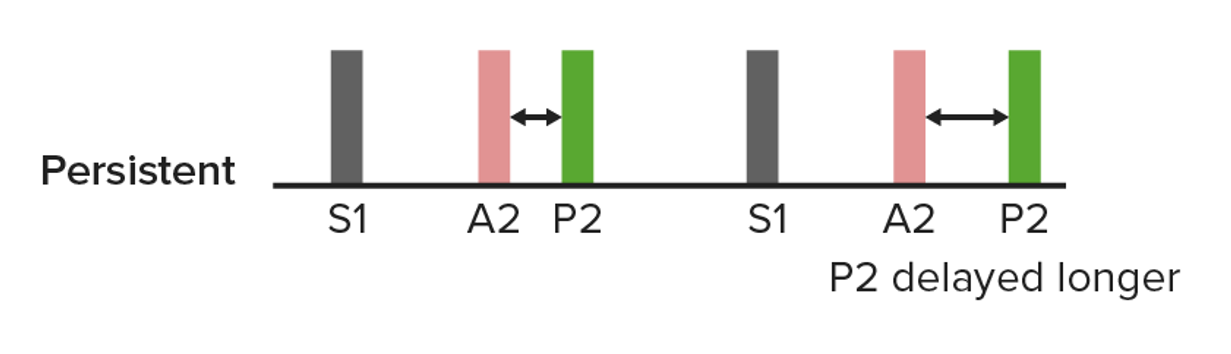
Imagen por Lecturio.

Presentación Clínica y Diagnóstico

Presentación clínica

  • Generalmente asintomática
  • La mayoría de la gente no es consciente.
  • En EN Erythema nodosum is an immune-mediated panniculitis (inflammation of the subcutaneous fat) caused by a type IV (delayed-type) hypersensitivity reaction. It commonly manifests in young women as tender, erythematous nodules on the shins. Erythema Nodosum raras ocasiones, puede provocar un síncope o presíncope (puede haber un bloqueo auriculoventricular asociado)
  • Un S1 S1 Heart Sounds dividido es común en EN Erythema nodosum is an immune-mediated panniculitis (inflammation of the subcutaneous fat) caused by a type IV (delayed-type) hypersensitivity reaction. It commonly manifests in young women as tender, erythematous nodules on the shins. Erythema Nodosum el bloqueo de rama derecha.
  • También se puede observar una división S2 S2 Heart Sounds:
    • Persistente en EN Erythema nodosum is an immune-mediated panniculitis (inflammation of the subcutaneous fat) caused by a type IV (delayed-type) hypersensitivity reaction. It commonly manifests in young women as tender, erythematous nodules on the shins. Erythema Nodosum el bloqueo de rama derecha → retraso en EN Erythema nodosum is an immune-mediated panniculitis (inflammation of the subcutaneous fat) caused by a type IV (delayed-type) hypersensitivity reaction. It commonly manifests in young women as tender, erythematous nodules on the shins. Erythema Nodosum el cierre de la válvula pulmonar (debido al AL Amyloidosis retraso en EN Erythema nodosum is an immune-mediated panniculitis (inflammation of the subcutaneous fat) caused by a type IV (delayed-type) hypersensitivity reaction. It commonly manifests in young women as tender, erythematous nodules on the shins. Erythema Nodosum la activación del ventrículo derecho)
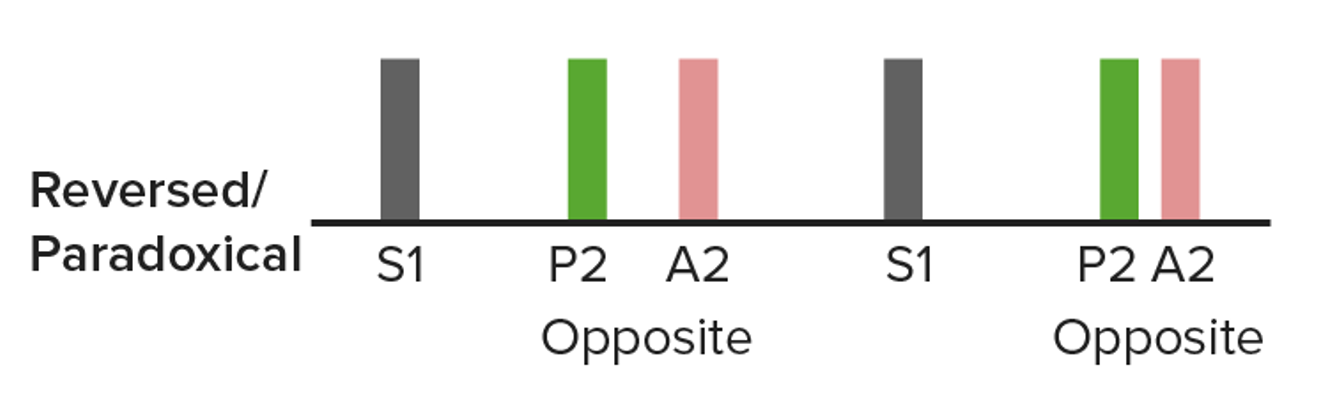
    • Paradójico en EN Erythema nodosum is an immune-mediated panniculitis (inflammation of the subcutaneous fat) caused by a type IV (delayed-type) hypersensitivity reaction. It commonly manifests in young women as tender, erythematous nodules on the shins. Erythema Nodosum el bloqueo de rama izquierda → cierre retardado de la válvula aórtica (debido a la activación retardada del ventrículo izquierdo)
Persistencia del desdoblamiento de S2

Un diagrama de un S2 dividido persistente, en el que el cierre de la válvula pulmonar se retrasa aún más por la inspiración (derecha). Esto puede ocurrir en un bloqueo de rama derecha.

Imagen por Lecturio.

Audio:

Este clip de audio es un ejemplo de un S2 S2 Heart Sounds dividido en EN Erythema nodosum is an immune-mediated panniculitis (inflammation of the subcutaneous fat) caused by a type IV (delayed-type) hypersensitivity reaction. It commonly manifests in young women as tender, erythematous nodules on the shins. Erythema Nodosum el contexto de un bloqueo de rama derecha. Los LOS Neisseria dos ruidos que se producen durante la S2 S2 Heart Sounds son el resultado de un retraso en EN Erythema nodosum is an immune-mediated panniculitis (inflammation of the subcutaneous fat) caused by a type IV (delayed-type) hypersensitivity reaction. It commonly manifests in young women as tender, erythematous nodules on the shins. Erythema Nodosum el cierre de la válvula pulmonar con respecto a la válvula aórtica.
Heart sound por The Regents of the University of Michigan. Licencia: CC BY-SA 3.0
Desdoblamiento paradójico de S2

Un diagrama de una división paradójica en el cierre de la válvula aórtica que se retrasa:
El nombre “paradójico” se debe a que la división se estrecha con la inspiración (derecha). Esto puede oírse en algunos individuos con un bloqueo de rama izquierda.
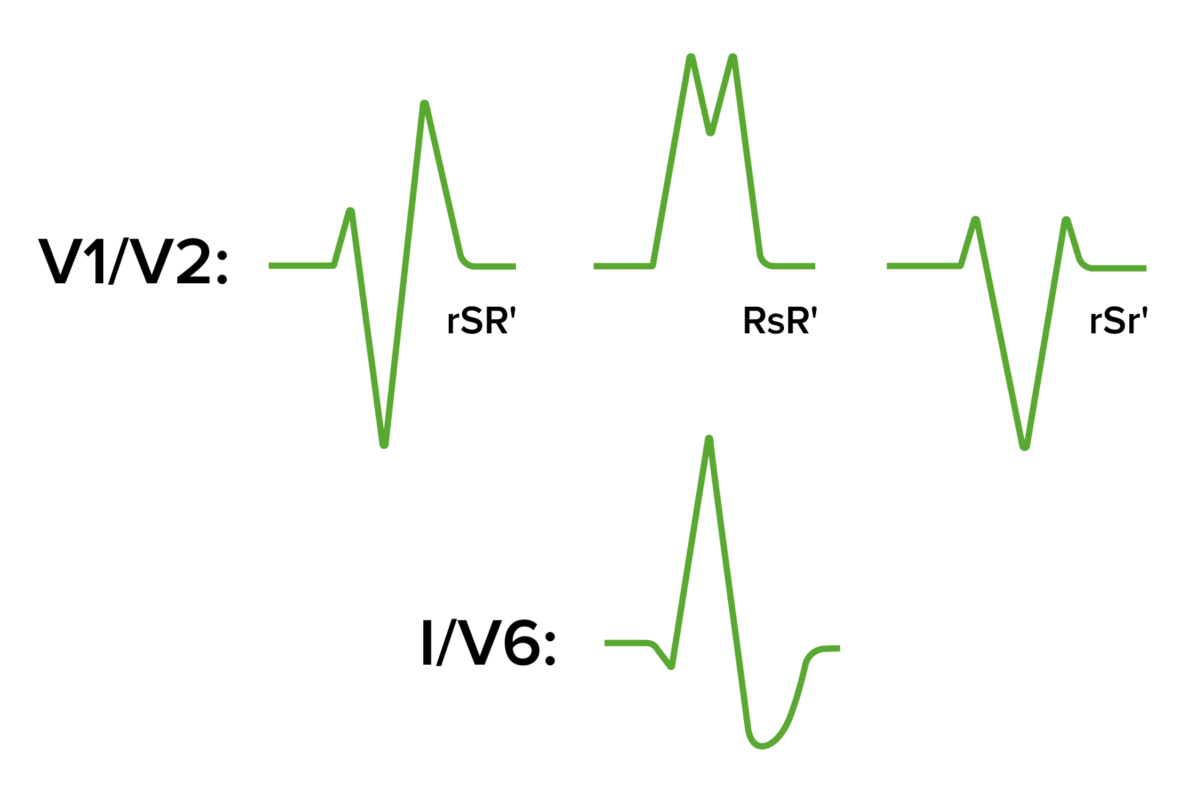
Imagen por Lecturio.

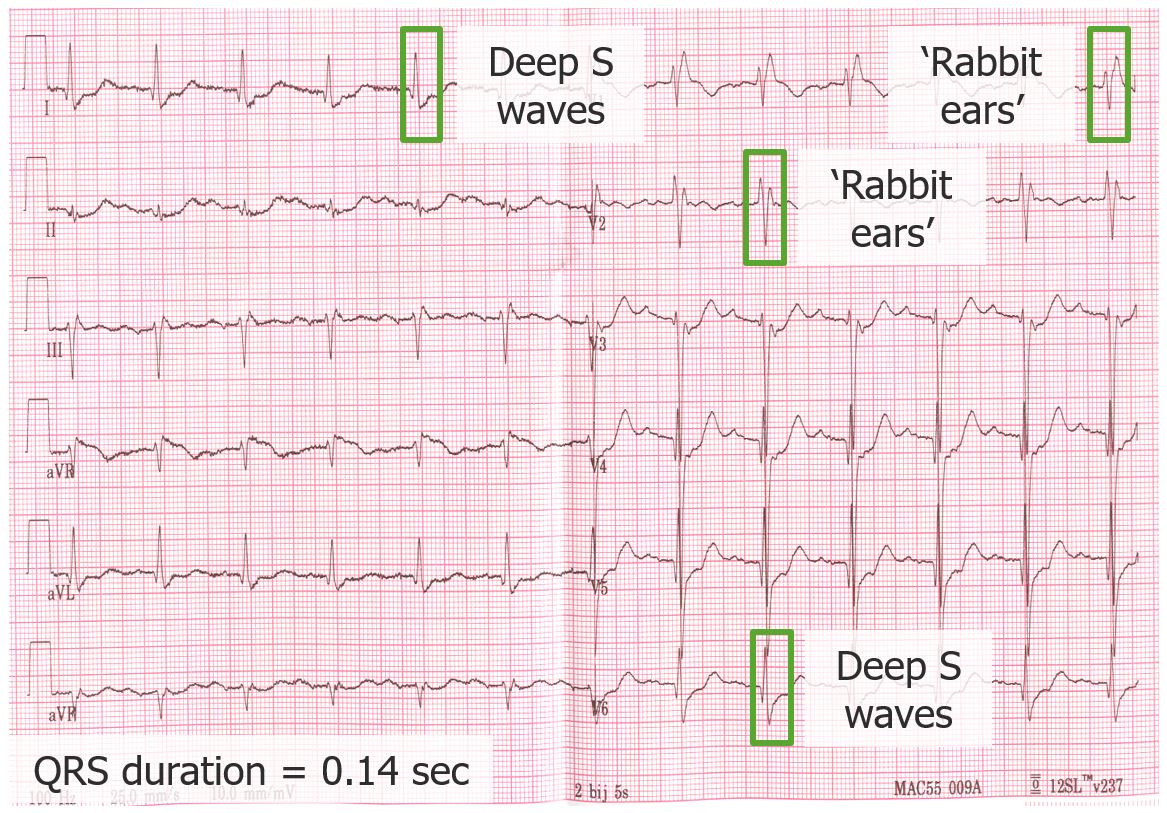
Bloqueo de rama derecha en EN Erythema nodosum is an immune-mediated panniculitis (inflammation of the subcutaneous fat) caused by a type IV (delayed-type) hypersensitivity reaction. It commonly manifests in young women as tender, erythematous nodules on the shins. Erythema Nodosum el ECG ECG An electrocardiogram (ECG) is a graphic representation of the electrical activity of the heart plotted against time. Adhesive electrodes are affixed to the skin surface allowing measurement of cardiac impulses from many angles. The ECG provides 3-dimensional information about the conduction system of the heart, the myocardium, and other cardiac structures. Electrocardiogram (ECG)

  • Duración del QRS ≥ 120 mseg
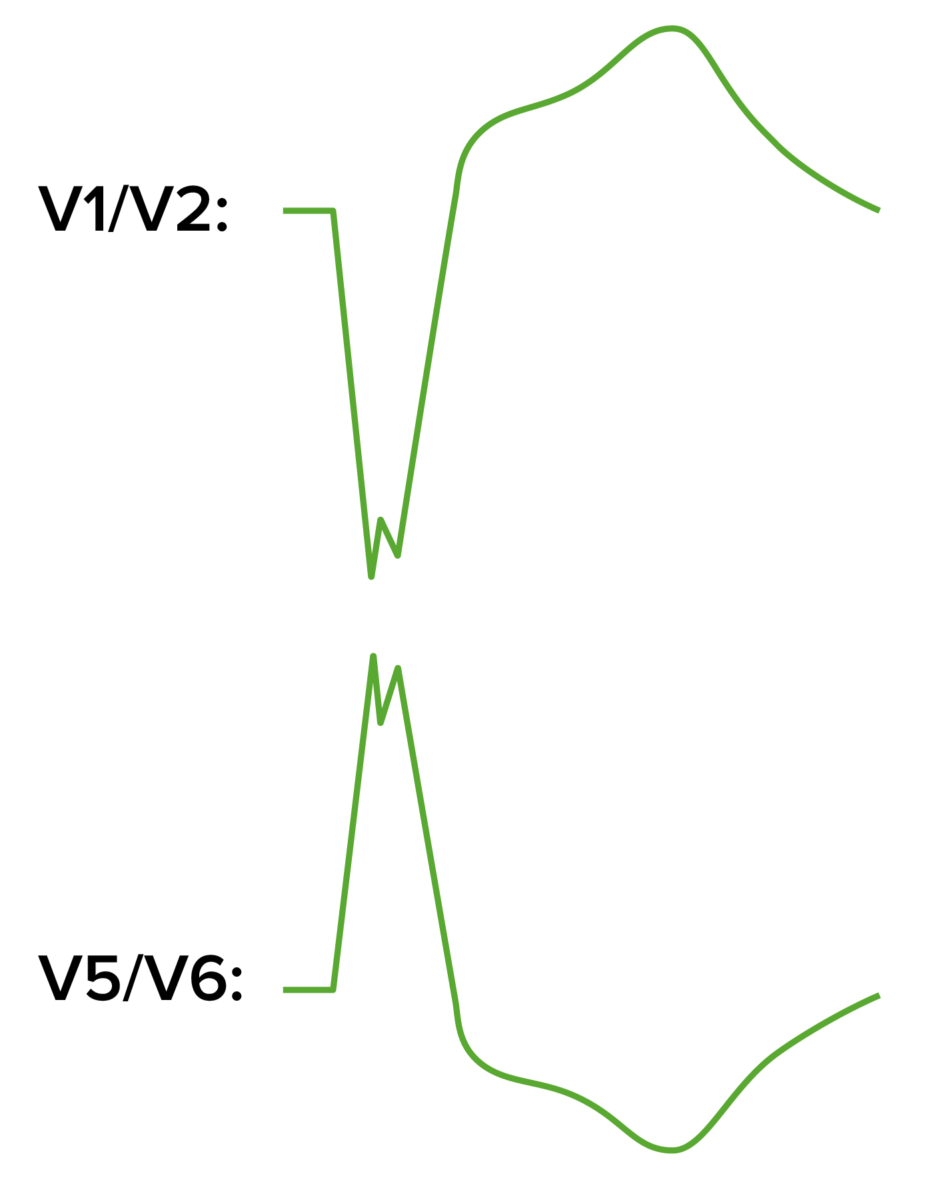
  • Derivadas V1 y V2:
    • Rsr′, rsR’ o rSR’ (muchas variaciones)
    • La desviación R’ o r’ suele ser más amplia que la onda R inicial.
    • Aparece como “orejas de conejo”
  • Las derivaciones I y V6 tendrán una onda S que es:
    • Profunda
    • De mayor duración
    • Deslizada
  • Las ondas T tienden a ser discordantes con el vector QRS terminal.

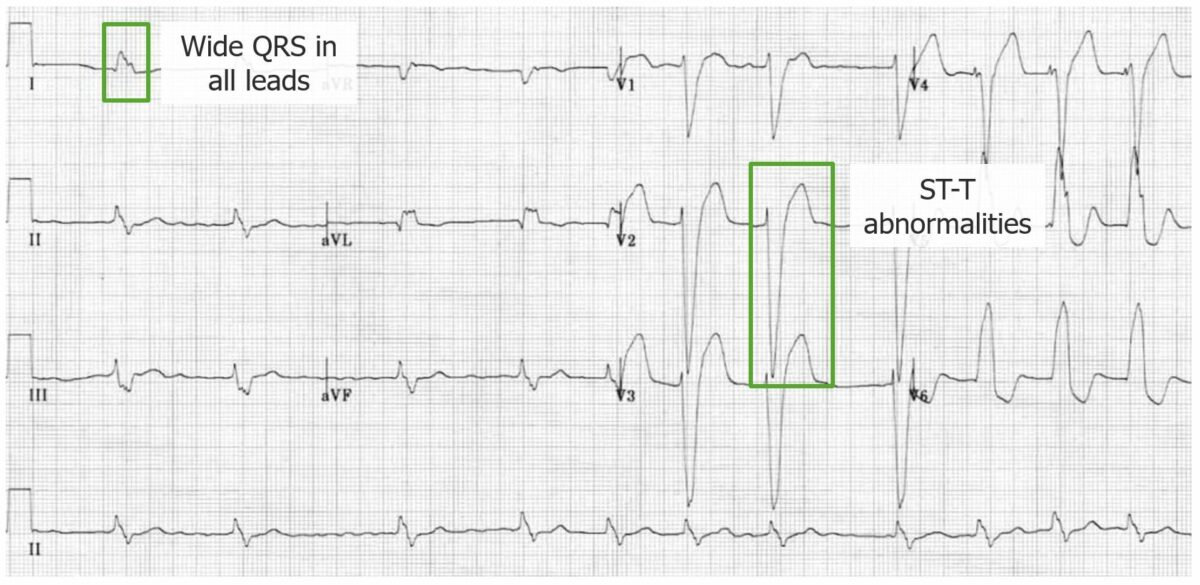
Bloqueo de rama izquierda en EN Erythema nodosum is an immune-mediated panniculitis (inflammation of the subcutaneous fat) caused by a type IV (delayed-type) hypersensitivity reaction. It commonly manifests in young women as tender, erythematous nodules on the shins. Erythema Nodosum el ECG ECG An electrocardiogram (ECG) is a graphic representation of the electrical activity of the heart plotted against time. Adhesive electrodes are affixed to the skin surface allowing measurement of cardiac impulses from many angles. The ECG provides 3-dimensional information about the conduction system of the heart, the myocardium, and other cardiac structures. Electrocardiogram (ECG)

  • Duración del QRS > 120 mseg en EN Erythema nodosum is an immune-mediated panniculitis (inflammation of the subcutaneous fat) caused by a type IV (delayed-type) hypersensitivity reaction. It commonly manifests in young women as tender, erythematous nodules on the shins. Erythema Nodosum adultos
  • Onda R ancha (R,R’) o desplazada en EN Erythema nodosum is an immune-mediated panniculitis (inflammation of the subcutaneous fat) caused by a type IV (delayed-type) hypersensitivity reaction. It commonly manifests in young women as tender, erythematous nodules on the shins. Erythema Nodosum las derivaciones I, aVL, V5 y V6
  • Ausencia de ondas Q en EN Erythema nodosum is an immune-mediated panniculitis (inflammation of the subcutaneous fat) caused by a type IV (delayed-type) hypersensitivity reaction. It commonly manifests in young women as tender, erythematous nodules on the shins. Erythema Nodosum las derivaciones laterales
  • Gran onda S en EN Erythema nodosum is an immune-mediated panniculitis (inflammation of the subcutaneous fat) caused by a type IV (delayed-type) hypersensitivity reaction. It commonly manifests in young women as tender, erythematous nodules on the shins. Erythema Nodosum V1 y V2
  • Los LOS Neisseria segmentos ST y las ondas T suelen ser discordantes con el complejo QRS.

Bloqueo de rama derecha y bloqueo de rama izquierda incompletos

Un bloqueo de rama puede considerarse incompleto si se observa el patrón habitual de bloqueo de rama izquierda o derecha, pero la duración del QRS es de 110–119 mseg.

Bloqueo fascicular anterior izquierdo en EN Erythema nodosum is an immune-mediated panniculitis (inflammation of the subcutaneous fat) caused by a type IV (delayed-type) hypersensitivity reaction. It commonly manifests in young women as tender, erythematous nodules on the shins. Erythema Nodosum el ECG ECG An electrocardiogram (ECG) is a graphic representation of the electrical activity of the heart plotted against time. Adhesive electrodes are affixed to the skin surface allowing measurement of cardiac impulses from many angles. The ECG provides 3-dimensional information about the conduction system of the heart, the myocardium, and other cardiac structures. Electrocardiogram (ECG)

  • Duración del QRS < 120 mseg
  • Desviación del eje izquierdo (aproximadamente −45 a −90 grados)
  • Tiempo al AL Amyloidosis pico de la onda R ≥ 45 mseg en EN Erythema nodosum is an immune-mediated panniculitis (inflammation of the subcutaneous fat) caused by a type IV (delayed-type) hypersensitivity reaction. It commonly manifests in young women as tender, erythematous nodules on the shins. Erythema Nodosum la derivación aVL (medido desde el inicio del QRS hasta el pico de la onda R)
  • Complejos qR en EN Erythema nodosum is an immune-mediated panniculitis (inflammation of the subcutaneous fat) caused by a type IV (delayed-type) hypersensitivity reaction. It commonly manifests in young women as tender, erythematous nodules on the shins. Erythema Nodosum las derivadas I y aVL
  • Complejos rS en EN Erythema nodosum is an immune-mediated panniculitis (inflammation of the subcutaneous fat) caused by a type IV (delayed-type) hypersensitivity reaction. It commonly manifests in young women as tender, erythematous nodules on the shins. Erythema Nodosum las derivadas II, III y aVF
Bloqueo fascicular anterior izquierdo en el electrocardiograma

ECG que demuestra el bloqueo fascicular anterior izquierdo:
Aquí, el eje se desvía a –60 grados y se observa una pequeña onda Q en aVL. El QRS está ligeramente prolongado, pero todavía < 120 mseg.
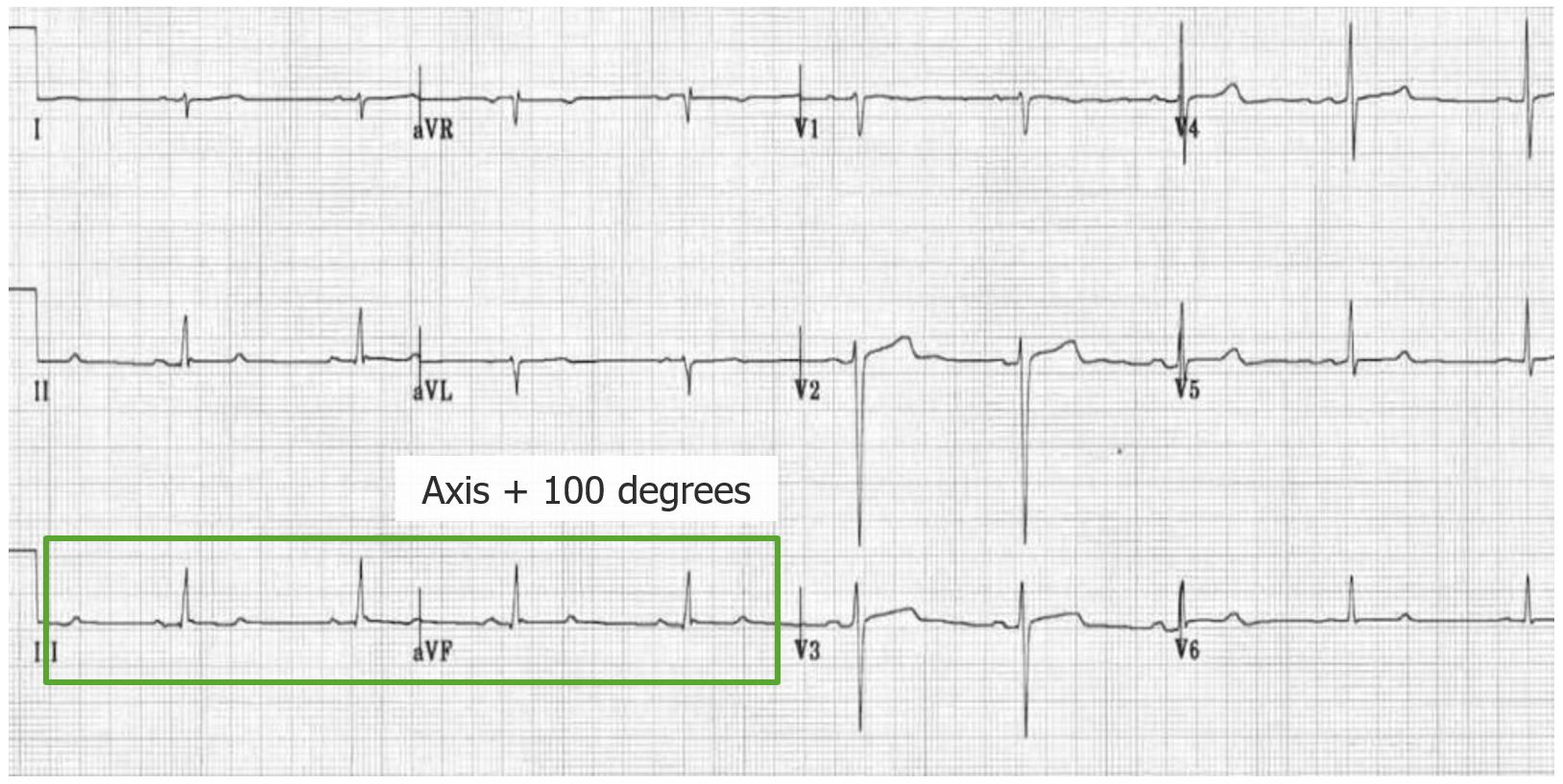
Imagen por Lecturio.

Bloqueo fascicular posterior izquierdo en EN Erythema nodosum is an immune-mediated panniculitis (inflammation of the subcutaneous fat) caused by a type IV (delayed-type) hypersensitivity reaction. It commonly manifests in young women as tender, erythematous nodules on the shins. Erythema Nodosum el ECG ECG An electrocardiogram (ECG) is a graphic representation of the electrical activity of the heart plotted against time. Adhesive electrodes are affixed to the skin surface allowing measurement of cardiac impulses from many angles. The ECG provides 3-dimensional information about the conduction system of the heart, the myocardium, and other cardiac structures. Electrocardiogram (ECG)

  • Duración del QRS < 120 mseg
  • Desviación del eje derecho (90–180 grados)
  • Complejos qR en EN Erythema nodosum is an immune-mediated panniculitis (inflammation of the subcutaneous fat) caused by a type IV (delayed-type) hypersensitivity reaction. It commonly manifests in young women as tender, erythematous nodules on the shins. Erythema Nodosum las derivadas II, III y aVF
  • Complejos rS en EN Erythema nodosum is an immune-mediated panniculitis (inflammation of the subcutaneous fat) caused by a type IV (delayed-type) hypersensitivity reaction. It commonly manifests in young women as tender, erythematous nodules on the shins. Erythema Nodosum las derivadas I y aVL
Bloqueo fascicular posterior izquierdo en el ECG

ECG que demuestra un bloqueo fascicular posterior izquierdo:
Hay desviación del eje derecho (+ 100 grados), pequeñas ondas Q en II, III y aVF, complejos rS en I y aVL. La duración del complejo QRS también es < 120 mseg.

Imagen por Lecturio.

Tratamiento

  • La mayoría de los LOS Neisseria individuos son asintomáticos y no requieren tratamiento.
  • Si existe una causa subyacente (e.g., isquemia miocárdica), el tratamiento se basa en EN Erythema nodosum is an immune-mediated panniculitis (inflammation of the subcutaneous fat) caused by a type IV (delayed-type) hypersensitivity reaction. It commonly manifests in young women as tender, erythematous nodules on the shins. Erythema Nodosum ella.
  • El marcapasos puede ser considerado en EN Erythema nodosum is an immune-mediated panniculitis (inflammation of the subcutaneous fat) caused by a type IV (delayed-type) hypersensitivity reaction. It commonly manifests in young women as tender, erythematous nodules on the shins. Erythema Nodosum individuos con:
    • Otra alteración de la conducción (e.g., un bloqueo auriculoventricular de alto grado)
    • Bloqueo de rama izquierda con síncope
  • Terapia de resincronización cardíaca:
    • Método de estimulación cardíaca utilizado para resincronizar la contracción cardíaca
    • Las indicaciones incluyen el bloqueo de rama izquierda con:
      • Fracción de eyección del ventrículo izquierdo ≤ 35% en EN Erythema nodosum is an immune-mediated panniculitis (inflammation of the subcutaneous fat) caused by a type IV (delayed-type) hypersensitivity reaction. It commonly manifests in young women as tender, erythematous nodules on the shins. Erythema Nodosum ritmo sinusal
      • Intervalo QRS prolongado ≥ 150 mseg

Diagnóstico Diferencial

  • Hiperpotasemia: aumento de la concentración sérica de potasio debido a un movimiento anormal fuera de las células, a la disminución de la excreción renal o al AL Amyloidosis aumento de la ingesta. La hiperpotasemia puede cursar con debilidad muscular y toxicidad cardiaca peligrosa, como fibrilación ventricular o asistolia (si es grave). El diagnóstico se realiza mediante la medición del potasio sérico. La apariencia en EN Erythema nodosum is an immune-mediated panniculitis (inflammation of the subcutaneous fat) caused by a type IV (delayed-type) hypersensitivity reaction. It commonly manifests in young women as tender, erythematous nodules on the shins. Erythema Nodosum el ECG ECG An electrocardiogram (ECG) is a graphic representation of the electrical activity of the heart plotted against time. Adhesive electrodes are affixed to the skin surface allowing measurement of cardiac impulses from many angles. The ECG provides 3-dimensional information about the conduction system of the heart, the myocardium, and other cardiac structures. Electrocardiogram (ECG) puede ser similar al AL Amyloidosis bloqueo de rama derecha o izquierda debido a la conducción deprimida en EN Erythema nodosum is an immune-mediated panniculitis (inflammation of the subcutaneous fat) caused by a type IV (delayed-type) hypersensitivity reaction. It commonly manifests in young women as tender, erythematous nodules on the shins. Erythema Nodosum el sistema His-Purkinje. El tratamiento agudo incluye insulina, bicarbonato de sodio, albuterol Albuterol A short-acting beta-2 adrenergic agonist that is primarily used as a bronchodilator agent to treat asthma. Sympathomimetic Drugs, gluconato de calcio, intercambiadores de cationes y/o diálisis.
  • Síndrome de Wolff-Parkinson-White: condición congénita de preexcitación en EN Erythema nodosum is an immune-mediated panniculitis (inflammation of the subcutaneous fat) caused by a type IV (delayed-type) hypersensitivity reaction. It commonly manifests in young women as tender, erythematous nodules on the shins. Erythema Nodosum la que la conducción anterógrada se produce a través de una vía accesoria. Los LOS Neisseria individuos pueden presentar taquipnea, dolor Dolor Inflammation torácico, palpitaciones y dificultad para respirar debido a la taquiarritmia. La apariencia en EN Erythema nodosum is an immune-mediated panniculitis (inflammation of the subcutaneous fat) caused by a type IV (delayed-type) hypersensitivity reaction. It commonly manifests in young women as tender, erythematous nodules on the shins. Erythema Nodosum el ECG ECG An electrocardiogram (ECG) is a graphic representation of the electrical activity of the heart plotted against time. Adhesive electrodes are affixed to the skin surface allowing measurement of cardiac impulses from many angles. The ECG provides 3-dimensional information about the conduction system of the heart, the myocardium, and other cardiac structures. Electrocardiogram (ECG) puede ser similar al AL Amyloidosis bloqueo de rama izquierda, pero con un intervalo PR acortado. El tratamiento es mediante ablación por radiofrecuencia y medicamentos antiarrítmicos.
  • Taquicardia ventricular: ≥ 3 latidos ventriculares a una frecuencia de ≥ 120 latidos/min. Los LOS Neisseria síntomas de la taquicardia ventricular dependen de la duración y varían desde la ausencia de síntomas hasta las palpitaciones, la inestabilidad hemodinámica y la muerte. El diagnóstico se realiza mediante el ECG ECG An electrocardiogram (ECG) is a graphic representation of the electrical activity of the heart plotted against time. Adhesive electrodes are affixed to the skin surface allowing measurement of cardiac impulses from many angles. The ECG provides 3-dimensional information about the conduction system of the heart, the myocardium, and other cardiac structures. Electrocardiogram (ECG), que puede parecer similar al AL Amyloidosis bloqueo de rama izquierda o derecha debido al AL Amyloidosis ensanchamiento del QRS. Sin embargo, habrá disociación auriculoventricular y desviación extrema del eje. El tratamiento de los LOS Neisseria episodios agudos es con cardioversión o medicamentos antiarrítmicos. El tratamiento a largo plazo es con un desfibrilador cardioversor implantable.
  • Estimulación ventricular: debido a un marcapasos cardíaco implantado. El ECG ECG An electrocardiogram (ECG) is a graphic representation of the electrical activity of the heart plotted against time. Adhesive electrodes are affixed to the skin surface allowing measurement of cardiac impulses from many angles. The ECG provides 3-dimensional information about the conduction system of the heart, the myocardium, and other cardiac structures. Electrocardiogram (ECG) puede tener una apariencia similar al AL Amyloidosis bloqueo de rama izquierda (raramente bloqueo de rama derecha). Sin embargo, los LOS Neisseria picos de marcapasos suelen verse también precediendo al AL Amyloidosis complejo QRS.

Referencias

  1. Goldberger, A.L. (2024). Basic approach to delayed intraventricular conduction. UpToDate. Retrieved September 30, 2025, from https://www.uptodate.com/contents/basic-approach-to-delayed-intraventricular-conduction
  2. Sauer, W.H. (2024). Right bundle branch block. Retrieved September 30, 2025, from https://www.uptodate.com/contents/right-bundle-branch-block
  3. Sauer, W.H. (2024). Left bundle branch block. UpToDate. Retrieved September 30, 2025, from https://www.uptodate.com/contents/left-bundle-branch-block
  4. Sauer, W.H. (2024). Left anterior fascicular block. UpToDate. Retrieved September 30, 2025, from https://www.uptodate.com/contents/left-anterior-fascicular-block
  5. Sauer, W.H. (2024). Left posterior fascicular block. UpToDate. Retrieved September 30, 2025, from https://www.uptodate.com/contents/left-posterior-fascicular-block
  6. Mitchell, L.B. (2024). Bundle branch block and fascicular block. MSD Manual Professional Version. Retrieved September 30, 2025, from https://www.msdmanuals.com/professional/cardiovascular-disorders/arrhythmias-and-conduction-disorders/bundle-branch-block-and-fascicular-block
  7. Lederer, E., et al. (2025). Hyperkalemia. Retrieved September 30, 2025, from https://emedicine.medscape.com/article/240903-overvie

¡Crea tu cuenta gratis o inicia una sesión para seguir leyendo!

Regístrate ahora y obtén acceso gratuito a Lecturio con páginas de concepto, videos médicos y cuestionarios para tu educación médica.

User Reviews

Que tengas una sesión de estudio alegre y navideña 🎁 Ahorra 50% en todos los planes >>

Details