La alopeciaAlopeciaAlopecia is the loss of hair in areas anywhere on the body where hair normally grows. Alopecia may be defined as scarring or non-scarring, localized or diffuse, congenital or acquired, reversible or permanent, or confined to the scalp or universal; however, alopecia is usually classified using the 1st 3 factors.Alopecia es la pérdida de cabello enENErythema nodosum is an immune-mediated panniculitis (inflammation of the subcutaneous fat) caused by a type IV (delayed-type) hypersensitivity reaction. It commonly manifests in young women as tender, erythematous nodules on the shins.Erythema Nodosum zonas del cuerpo donde normalmente crece pelo. La alopeciaAlopeciaAlopecia is the loss of hair in areas anywhere on the body where hair normally grows. Alopecia may be defined as scarring or non-scarring, localized or diffuse, congenital or acquired, reversible or permanent, or confined to the scalp or universal; however, alopecia is usually classified using the 1st 3 factors.Alopecia puede definirse como cicatricial o no cicatricial, localizada o difusa, congénita o adquirida, reversible o permanente, o confinada alALAmyloidosis cuero cabelludo o universal; sin embargo, la alopeciaAlopeciaAlopecia is the loss of hair in areas anywhere on the body where hair normally grows. Alopecia may be defined as scarring or non-scarring, localized or diffuse, congenital or acquired, reversible or permanent, or confined to the scalp or universal; however, alopecia is usually classified using the 1st 3 factors.Alopecia suele clasificarse utilizando losLOSNeisseria 3 1os factores. Las etiologías de la alopeciaAlopeciaAlopecia is the loss of hair in areas anywhere on the body where hair normally grows. Alopecia may be defined as scarring or non-scarring, localized or diffuse, congenital or acquired, reversible or permanent, or confined to the scalp or universal; however, alopecia is usually classified using the 1st 3 factors.Alopecia suelen dividirse enENErythema nodosum is an immune-mediated panniculitis (inflammation of the subcutaneous fat) caused by a type IV (delayed-type) hypersensitivity reaction. It commonly manifests in young women as tender, erythematous nodules on the shins.Erythema Nodosum trastornos enENErythema nodosum is an immune-mediated panniculitis (inflammation of the subcutaneous fat) caused by a type IV (delayed-type) hypersensitivity reaction. It commonly manifests in young women as tender, erythematous nodules on the shins.Erythema NodosumlosLOSNeisseria que el folículo piloso es anormal o está dañado y aquellos enENErythema nodosum is an immune-mediated panniculitis (inflammation of the subcutaneous fat) caused by a type IV (delayed-type) hypersensitivity reaction. It commonly manifests in young women as tender, erythematous nodules on the shins.Erythema NodosumlosLOSNeisseria que el folículo piloso es normal, pero el ciclo de crecimiento del cabello es anormal. Las presentaciones más comunes son la pérdida de cabello androgénica, la alopecia areataAlopecia AreataLoss of scalp and body hair involving microscopically inflammatory patchy areas.Alopecia, la alopeciaAlopeciaAlopecia is the loss of hair in areas anywhere on the body where hair normally grows. Alopecia may be defined as scarring or non-scarring, localized or diffuse, congenital or acquired, reversible or permanent, or confined to the scalp or universal; however, alopecia is usually classified using the 1st 3 factors.Alopecia por tracción, la tinea capitisTinea capitisRingworm of the scalp and associated hair mainly caused by species of Microsporum; Trichophyton; and Epidermophyton, which may occasionally involve the eyebrows and eyelashes.Dermatophytes/Tinea Infections y el efluvio telógeno. El diagnóstico se realiza a través de losLOSNeisseria antecedentes y el examen físico. El tratamiento depende del tipo y del potencial de rebrote.
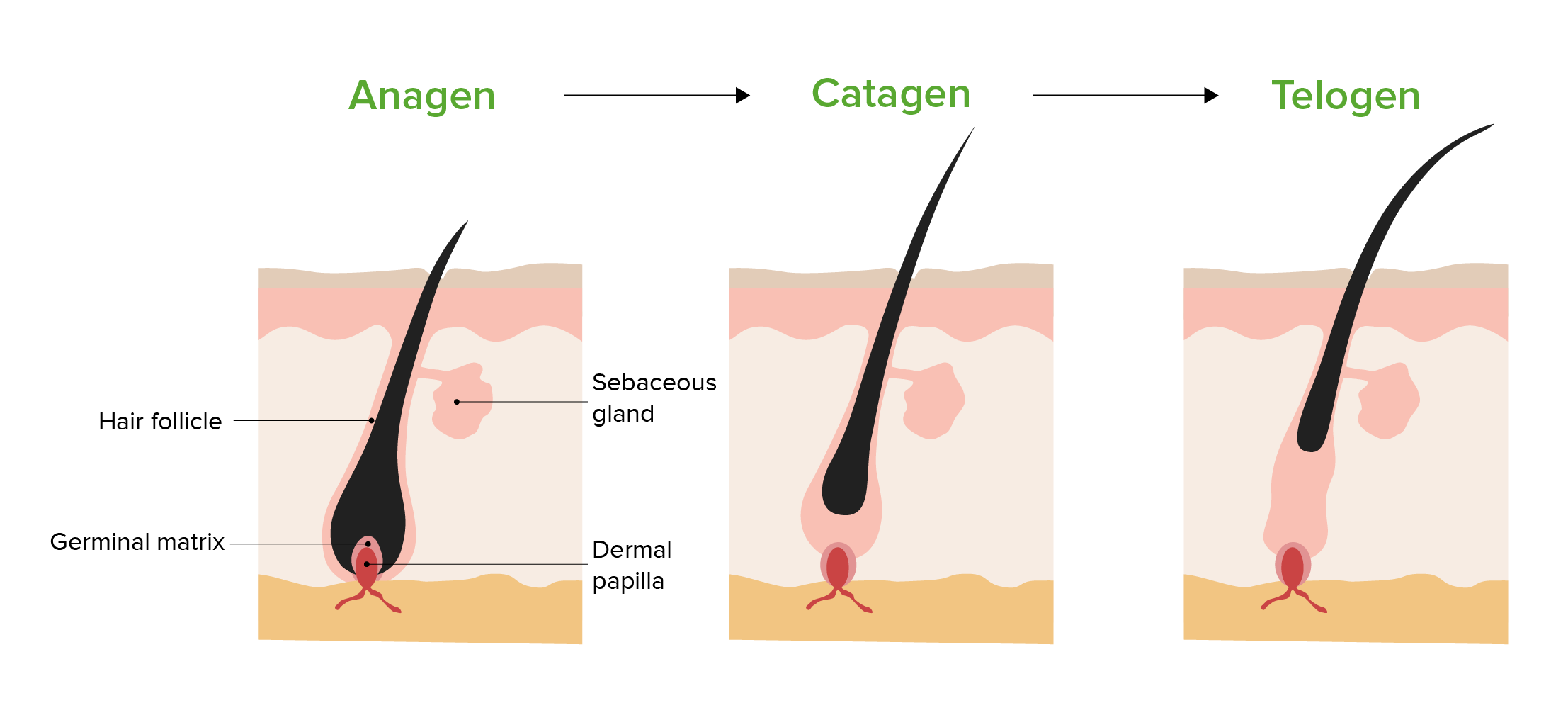
Aproximadamente el 90% de losLOSNeisseria folículos pilosos se encuentran enENErythema nodosum is an immune-mediated panniculitis (inflammation of the subcutaneous fat) caused by a type IV (delayed-type) hypersensitivity reaction. It commonly manifests in young women as tender, erythematous nodules on the shins.Erythema Nodosum la fase anágena.
Dura de 2–6 años
Catágena:
Período transitorio de degeneración o regresión folicular
< 1% de todos losLOSNeisseria folículos pilosos están enENErythema nodosum is an immune-mediated panniculitis (inflammation of the subcutaneous fat) caused by a type IV (delayed-type) hypersensitivity reaction. It commonly manifests in young women as tender, erythematous nodules on the shins.Erythema Nodosum la fase catágena.
Dura 2–3 semanas
Telógena:
Período de descanso
Aproximadamente el 10% de losLOSNeisseria folículos pilosos se encuentran enENErythema nodosum is an immune-mediated panniculitis (inflammation of the subcutaneous fat) caused by a type IV (delayed-type) hypersensitivity reaction. It commonly manifests in young women as tender, erythematous nodules on the shins.Erythema Nodosum la fase telógena.
Dura 2–3 meses
Después de la fase telógena, losLOSNeisseria pelos se caen del cuero cabelludo a un ritmo de 50–100 pelos por día.
Las 3 etapas del crecimiento del cabello: La anágena representa los períodos de crecimiento activo; el 90% de todos los folículos pilosos se encuentran en la fase anágena. La catágena representa los períodos de degeneración y regresión del folículo piloso; < El 1% de todos los folículos pilosos se encuentran en la fase catágena. La telógena representa los períodos de descanso; < El 10% de todos los folículos pilosos se encuentran en la fase telógena. Tras la fase telógena, el cabello se cae de forma natural.
Imagen por Lecturio.
Clasificación o tipos de alopeciaAlopeciaAlopecia is the loss of hair in areas anywhere on the body where hair normally grows. Alopecia may be defined as scarring or non-scarring, localized or diffuse, congenital or acquired, reversible or permanent, or confined to the scalp or universal; however, alopecia is usually classified using the 1st 3 factors.Alopecia
Las clasificaciones más comunes de la pérdida de cabello son laalopeciaAlopeciaAlopecia is the loss of hair in areas anywhere on the body where hair normally grows. Alopecia may be defined as scarring or non-scarring, localized or diffuse, congenital or acquired, reversible or permanent, or confined to the scalp or universal; however, alopecia is usually classified using the 1st 3 factors.Alopecia cicatricial, la alopeciaAlopeciaAlopecia is the loss of hair in areas anywhere on the body where hair normally grows. Alopecia may be defined as scarring or non-scarring, localized or diffuse, congenital or acquired, reversible or permanent, or confined to the scalp or universal; however, alopecia is usually classified using the 1st 3 factors.Alopecia no cicatricial y losLOSNeisseria trastornos capilares estructurales.
Cicatricial:
El folículo piloso sufre un daño irreversible, que se cura a través de la fibrosisFibrosisAny pathological condition where fibrous connective tissue invades any organ, usually as a consequence of inflammation or other injury.Bronchiolitis Obliterans, lo que lleva a un cese del ciclo del cabello y a la pérdida permanente del mismo.
Secundaria: causada por una inflamación debida a un traumatismo físico o a una afección que no es una enfermedad primaria del cuero cabelludo (incluye tinea capitisTinea capitisRingworm of the scalp and associated hair mainly caused by species of Microsporum; Trichophyton; and Epidermophyton, which may occasionally involve the eyebrows and eyelashes.Dermatophytes/Tinea Infections, neoplasias, radioterapia y cicatrices quirúrgicas)
Primaria: causada por trastornos inflamatorios del cuero cabelludo enENErythema nodosum is an immune-mediated panniculitis (inflammation of the subcutaneous fat) caused by a type IV (delayed-type) hypersensitivity reaction. It commonly manifests in young women as tender, erythematous nodules on the shins.Erythema NodosumlosLOSNeisseria que el folículo piloso es el objetivo principal de la destrucción, lo que provoca la pérdida permanente del cabello (dividida enENErythema nodosum is an immune-mediated panniculitis (inflammation of the subcutaneous fat) caused by a type IV (delayed-type) hypersensitivity reaction. It commonly manifests in young women as tender, erythematous nodules on the shins.Erythema Nodosum 3 subtipos: linfocítica, neutrofílica y mixta)
Tabla: Subtipos de alopeciaAlopeciaAlopecia is the loss of hair in areas anywhere on the body where hair normally grows. Alopecia may be defined as scarring or non-scarring, localized or diffuse, congenital or acquired, reversible or permanent, or confined to the scalp or universal; however, alopecia is usually classified using the 1st 3 factors.Alopecia cicatricial primaria
Linfocítica
Neutrofílica
Mixta
Alopecia mucinosaAlopecia MucinosaA disease of the pilosebaceous unit, presenting clinically as grouped follicular papules or plaques with associated hair loss. It is caused by mucinous infiltration of tissues, and usually involving the scalp, face, and neck. It may be primary (idiopathic) or secondary to mycosis fungoides or reticulosis.Alopecia
AlopeciaAlopeciaAlopecia is the loss of hair in areas anywhere on the body where hair normally grows. Alopecia may be defined as scarring or non-scarring, localized or diffuse, congenital or acquired, reversible or permanent, or confined to the scalp or universal; however, alopecia is usually classified using the 1st 3 factors.Alopecia cicatricial centrífuga central
Lupus eritematoso discoide
Queratosis folicular espinosa decalvante
Liquen plano pilar
AlopeciaAlopeciaAlopecia is the loss of hair in areas anywhere on the body where hair normally grows. Alopecia may be defined as scarring or non-scarring, localized or diffuse, congenital or acquired, reversible or permanent, or confined to the scalp or universal; however, alopecia is usually classified using the 1st 3 factors.AlopeciafrontalFrontalThe bone that forms the frontal aspect of the skull. Its flat part forms the forehead, articulating inferiorly with the nasal bone and the cheek bone on each side of the face.Skull: Anatomy fibrosante
Celulitis disecante del cuero cabelludo
Foliculitis decalvante
Acné keloidalis nuchae
Acné necrótico
Dermatosis pustulosa erosiva del cuero cabelludo
No cicatricial:
La inflamación es leve o inexistente, por lo que el folículo piloso no está dañado, lo que da lugar a una pérdida no permanente de cabello (dividida enENErythema nodosum is an immune-mediated panniculitis (inflammation of the subcutaneous fat) caused by a type IV (delayed-type) hypersensitivity reaction. It commonly manifests in young women as tender, erythematous nodules on the shins.Erythema Nodosum 3 subtipos: focal, con patrón y difusa).
Tabla: Subtipos de alopeciaAlopeciaAlopecia is the loss of hair in areas anywhere on the body where hair normally grows. Alopecia may be defined as scarring or non-scarring, localized or diffuse, congenital or acquired, reversible or permanent, or confined to the scalp or universal; however, alopecia is usually classified using the 1st 3 factors.Alopecia no cicatricial
Focal
Con Patrón
Difusa
Alopecia areataAlopecia AreataLoss of scalp and body hair involving microscopically inflammatory patchy areas.Alopecia
AlopeciaAlopeciaAlopecia is the loss of hair in areas anywhere on the body where hair normally grows. Alopecia may be defined as scarring or non-scarring, localized or diffuse, congenital or acquired, reversible or permanent, or confined to the scalp or universal; however, alopecia is usually classified using the 1st 3 factors.Alopecia sifilítica
AlopeciaAlopeciaAlopecia is the loss of hair in areas anywhere on the body where hair normally grows. Alopecia may be defined as scarring or non-scarring, localized or diffuse, congenital or acquired, reversible or permanent, or confined to the scalp or universal; however, alopecia is usually classified using the 1st 3 factors.Alopecia inducida por presión (postoperatoria)
AlopeciaAlopeciaAlopecia is the loss of hair in areas anywhere on the body where hair normally grows. Alopecia may be defined as scarring or non-scarring, localized or diffuse, congenital or acquired, reversible or permanent, or confined to the scalp or universal; however, alopecia is usually classified using the 1st 3 factors.Alopecia temporal triangular
AlopeciaAlopeciaAlopecia is the loss of hair in areas anywhere on the body where hair normally grows. Alopecia may be defined as scarring or non-scarring, localized or diffuse, congenital or acquired, reversible or permanent, or confined to the scalp or universal; however, alopecia is usually classified using the 1st 3 factors.Alopecia por tracción
AlopeciaAlopeciaAlopecia is the loss of hair in areas anywhere on the body where hair normally grows. Alopecia may be defined as scarring or non-scarring, localized or diffuse, congenital or acquired, reversible or permanent, or confined to the scalp or universal; however, alopecia is usually classified using the 1st 3 factors.Alopecia androgénica enENErythema nodosum is an immune-mediated panniculitis (inflammation of the subcutaneous fat) caused by a type IV (delayed-type) hypersensitivity reaction. It commonly manifests in young women as tender, erythematous nodules on the shins.Erythema NodosumlosLOSNeisseria hombres (pérdida de cabello de patrón masculino)
Pérdida de cabello con patrón femenino
Tricotilomanía
Efluvio anágeno
Síndrome del anágeno suelto
Efluvio telógeno
Trastornos estructurales del cabello:
LosLOSNeisseria trastornos capilares estructurales son alteraciones hereditarias o adquiridas de la estructura del cabello que dan lugar a un cabello frágil o quebradizo, lo que provoca la rotura del cabello o la aparición de fallos enENErythema nodosum is an immune-mediated panniculitis (inflammation of the subcutaneous fat) caused by a type IV (delayed-type) hypersensitivity reaction. It commonly manifests in young women as tender, erythematous nodules on the shins.Erythema Nodosum su crecimiento.
Tabla: Trastornos estructurales del cabello
Heredados
Adquiridos
Enfermedad de Menkes
MonilethrixMonilethrixRare autosomal dominant disorder of the hair shaft. The clinical features of the disease include hypotrichosis, dry, and/or brittle hair, with varying degrees of alopecia. Mutations in the hair-specific keratin genes krthb1, krthb3, or krthb6 are associated with monilethrix. Autosomal recessive monilethrix with limited hypotrichosis are also known. Mutations in dsg4, liph, and p2ry5 protein genes are associated with the recessive form of monilethrix.Alopecia
Tricotiodistrofia
Tricorrexis invaginata
Tricorrexis nodosa
Tricoptilosis
Diagnóstico
Antecedentes:
Es importante determinar la duración, tasa de progresión, ubicación, patrón y extensión de la pérdida de cabello junto con losLOSNeisseria síntomas asociados del paciente, trastornos/eventos médicos, antecedentes familiares de pérdida de cabello, medicamentos y dieta/ingesta calórica.
Medicamentos asociados a la caída del cabello:
Amantadina
Amiodarona
Isotretinoína
Anticoagulantes
Ketoconazol
Anticonvulsivos
Litio
CaptoprilCaptoprilA potent and specific inhibitor of peptidyl-dipeptidase a. It blocks the conversion of angiotensin I to angiotensin II, a vasoconstrictor and important regulator of arterial blood pressure. Captopril acts to suppress the renin-angiotensin system and inhibits pressure responses to exogenous angiotensin.Hypertension Drugs
Penicilamina
Estatinas
PropranololPropranololA widely used non-cardioselective beta-adrenergic antagonist. Propranolol has been used for myocardial infarction; arrhythmia; angina pectoris; hypertension; hyperthyroidism; migraine; pheochromocytoma; and anxiety but adverse effects instigate replacement by newer drugs.Antiadrenergic Drugs
Cimetidina
Colchicina
Afecciones médicas asociadas a la caída del cabello:
Enfermedad grave, cirugía y/o estrés psicológico
Pérdida de peso significativa
Deficiencia crónica de hierro
Trastornos de la tiroides
Parto
Intoxicación por arsénico, mercurio o talio
Examen físico:
Inspección visual:
Presencia o ausencia de ostia folicular (ausencia = alopeciaAlopeciaAlopecia is the loss of hair in areas anywhere on the body where hair normally grows. Alopecia may be defined as scarring or non-scarring, localized or diffuse, congenital or acquired, reversible or permanent, or confined to the scalp or universal; however, alopecia is usually classified using the 1st 3 factors.Alopecia cicatricial)
Distribución y densidad del cabello
Patrón de pérdida de cabello
Uso de papel de color contrastado para visualizar completamente el cabello
Examinar otros lugares del cabello, además de las uñas, la piel y losLOSNeisseria dientes
Tricroscopia: dermatoscopia del cabello y del cuero cabelludo, que permite visualizar mejor la epidermisEpidermisThe external, nonvascular layer of the skin. It is made up, from within outward, of five layers of epithelium: (1) basal layer (stratum basale epidermidis); (2) spinous layer (stratum spinosum epidermidis); (3) granular layer (stratum granulosum epidermidis); (4) clear layer (stratum lucidum epidermidis); and (5) horny layer (stratum corneum epidermidis).Skin: Structure and Functions, ostia foliculares, tallos del cabello, escamas,eritema y vasos sanguíneos
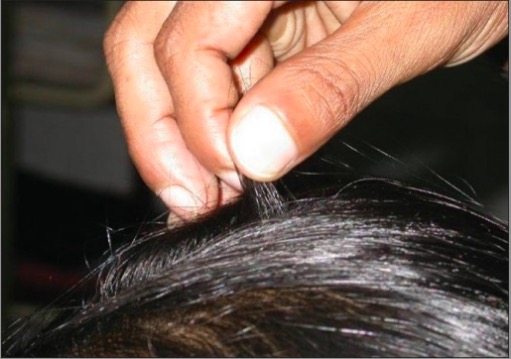
Prueba del tirón del cabello: identifica la pérdida activa del cabello agarrando y tirando ligeramente de 50-60 fibras capilares, la extracción fácil de > 6 fibras capilares sugiere una pérdida activa del cabello
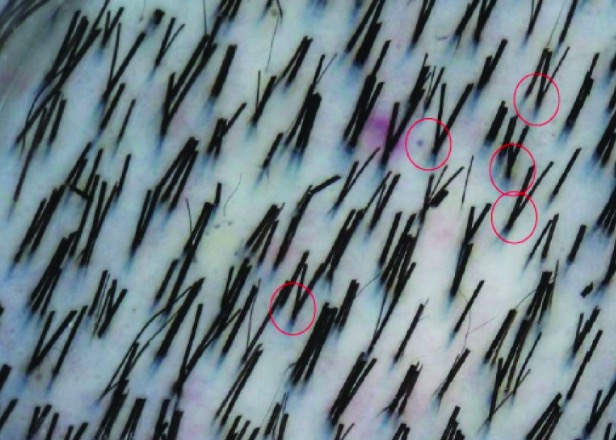
Tricoscopia del cuero cabelludo normal: Se pueden ver múltiples fibras capilares que emergen de un único infundíbulo.
Imagen: “Figure 4” por Rodney Sinclair et al. Licencia: CC BY 4.0
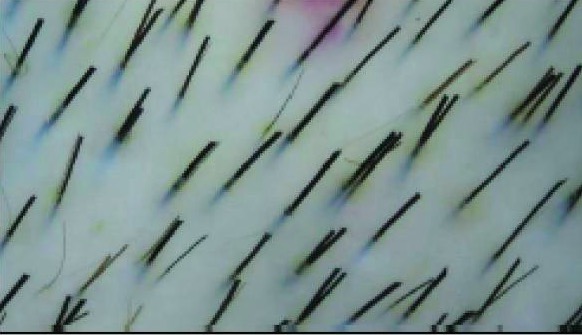
Tricoscopia: En la alopecia androgénica, la reducción del número de cabellos por unidad folicular precede al desarrollo de la calvicie.
Imagen: “Figure 6” por Rodney Sinclair et al. Licencia: CC BY 4.0
Ensayo de tracción: Se cogen aproximadamente 60 pelos de la parte proximal del cuero cabelludo y se tira de ellos desde el extremo proximal al distal.
Imagen: “Pull test” por Department of Dermatology, T.N.M. College and B.Y.L. Nair Ch. Hospital, Mumbai Central, Mumbai – 400 008, India. Licencia: CC BY 2.0
Pruebas adicionales:
Microscopía: evaluación microscópica de las puntas de losLOSNeisseria pelos proximales, lo que es útil para determinar la fase de desprendimiento del pelo
Biopsia del cuero cabelludo: se utiliza enENErythema nodosum is an immune-mediated panniculitis (inflammation of the subcutaneous fat) caused by a type IV (delayed-type) hypersensitivity reaction. It commonly manifests in young women as tender, erythematous nodules on the shins.Erythema Nodosum las formas de alopeciaAlopeciaAlopecia is the loss of hair in areas anywhere on the body where hair normally grows. Alopecia may be defined as scarring or non-scarring, localized or diffuse, congenital or acquired, reversible or permanent, or confined to the scalp or universal; however, alopecia is usually classified using the 1st 3 factors.Alopecia cicatricial para distinguir las causas inflamatorias de las no inflamatorias
Tricogramas y fototricogramas: utilizados para evaluar la pérdida de cabello no cicatricial y la respuesta alALAmyloidosis tratamiento
Laboratorio:
Hormona estimulante de la tiroides (TSH, por sus siglas enENErythema nodosum is an immune-mediated panniculitis (inflammation of the subcutaneous fat) caused by a type IV (delayed-type) hypersensitivity reaction. It commonly manifests in young women as tender, erythematous nodules on the shins.Erythema Nodosum inglés) para evaluar losLOSNeisseria trastornos tiroideos
Hierro y ferritina enENErythema nodosum is an immune-mediated panniculitis (inflammation of the subcutaneous fat) caused by a type IV (delayed-type) hypersensitivity reaction. It commonly manifests in young women as tender, erythematous nodules on the shins.Erythema Nodosum suero para evaluar la deficiencia de hierro
Prueba de reagina plasmática rápida para evaluar por sífilis
La alopeciaAlopeciaAlopecia is the loss of hair in areas anywhere on the body where hair normally grows. Alopecia may be defined as scarring or non-scarring, localized or diffuse, congenital or acquired, reversible or permanent, or confined to the scalp or universal; however, alopecia is usually classified using the 1st 3 factors.Alopecia androgénica es un tipo hereditario de pérdida de cabello que está mediada por la presencia del andrógeno dihidrotestosterona (DHTDHTA potent androgenic metabolite of testosterone. It is produced by the action of the enzyme 3-oxo-5-alpha-steroid 4-dehydrogenase.Gonadal Hormones) y es el tipo más común de alopeciaAlopeciaAlopecia is the loss of hair in areas anywhere on the body where hair normally grows. Alopecia may be defined as scarring or non-scarring, localized or diffuse, congenital or acquired, reversible or permanent, or confined to the scalp or universal; however, alopecia is usually classified using the 1st 3 factors.Alopecia.
Pérdida de cabello con patrón masculino
Epidemiología:
Es la alopeciaAlopeciaAlopecia is the loss of hair in areas anywhere on the body where hair normally grows. Alopecia may be defined as scarring or non-scarring, localized or diffuse, congenital or acquired, reversible or permanent, or confined to the scalp or universal; however, alopecia is usually classified using the 1st 3 factors.Alopecia más común enENErythema nodosum is an immune-mediated panniculitis (inflammation of the subcutaneous fat) caused by a type IV (delayed-type) hypersensitivity reaction. It commonly manifests in young women as tender, erythematous nodules on the shins.Erythema NodosumlosLOSNeisseria hombres
Prevalencia menor enENErythema nodosum is an immune-mediated panniculitis (inflammation of the subcutaneous fat) caused by a type IV (delayed-type) hypersensitivity reaction. It commonly manifests in young women as tender, erythematous nodules on the shins.Erythema Nodosum chinos, asiáticos y afroamericanos que enENErythema nodosum is an immune-mediated panniculitis (inflammation of the subcutaneous fat) caused by a type IV (delayed-type) hypersensitivity reaction. It commonly manifests in young women as tender, erythematous nodules on the shins.Erythema Nodosum caucásicos
Etiología:
Predisposición genética (rasgo dependiente de losLOSNeisseria andrógenos)
Relacionado con el cromosoma X
Fisiopatología:
La testosterona es convertida enENErythema nodosum is an immune-mediated panniculitis (inflammation of the subcutaneous fat) caused by a type IV (delayed-type) hypersensitivity reaction. It commonly manifests in young women as tender, erythematous nodules on the shins.Erythema NodosumDHTDHTA potent androgenic metabolite of testosterone. It is produced by the action of the enzyme 3-oxo-5-alpha-steroid 4-dehydrogenase.Gonadal Hormones por la 5-alfa-reductasa.
La DHTDHTA potent androgenic metabolite of testosterone. It is produced by the action of the enzyme 3-oxo-5-alpha-steroid 4-dehydrogenase.Gonadal Hormones se une alALAmyloidosisreceptorReceptorReceptors are proteins located either on the surface of or within a cell that can bind to signaling molecules known as ligands (e.g., hormones) and cause some type of response within the cell.Receptors de andrógenos enENErythema nodosum is an immune-mediated panniculitis (inflammation of the subcutaneous fat) caused by a type IV (delayed-type) hypersensitivity reaction. It commonly manifests in young women as tender, erythematous nodules on the shins.Erythema NodosumlosLOSNeisseria folículos pilosos y activa losLOSNeisseriagenesGenesA category of nucleic acid sequences that function as units of heredity and which code for the basic instructions for the development, reproduction, and maintenance of organisms.DNA Types and Structure que acortan la fase anágena.
Conduce a la miniaturización folicular de losLOSNeisseria folículos pilosos del cuero cabelludo (una disminución progresiva de la relación entre losLOSNeisseria pelos terminales y losLOSNeisseria pelos vellosos más cortos y finos)
Presentación clínica:
La caída del cabello puede comenzar enENErythema nodosum is an immune-mediated panniculitis (inflammation of the subcutaneous fat) caused by a type IV (delayed-type) hypersensitivity reaction. It commonly manifests in young women as tender, erythematous nodules on the shins.Erythema Nodosum cualquier momento después de la pubertad (normalmente a finales de losLOSNeisseria 20 años) y progresa a lo largo de la vida del paciente.
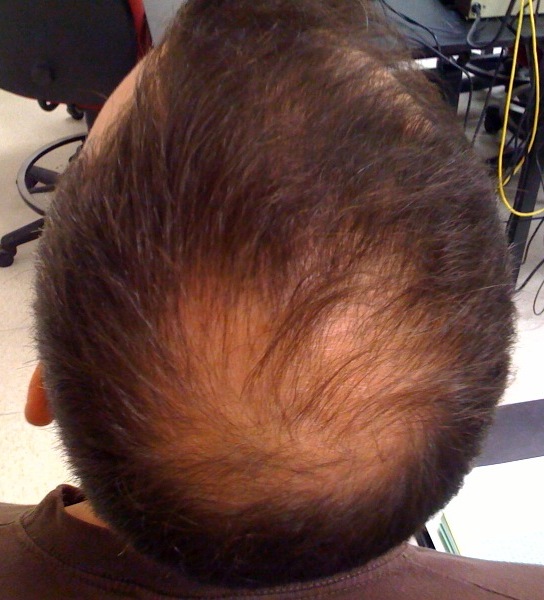
Retroceso de la línea media del cabello
El vértice presenta un adelgazamiento/calvicie difusa con el pelo frontalFrontalThe bone that forms the frontal aspect of the skull. Its flat part forms the forehead, articulating inferiorly with the nasal bone and the cheek bone on each side of the face.Skull: Anatomy intacto.
Conservación de la densidad capilar enENErythema nodosum is an immune-mediated panniculitis (inflammation of the subcutaneous fat) caused by a type IV (delayed-type) hypersensitivity reaction. It commonly manifests in young women as tender, erythematous nodules on the shins.Erythema Nodosum la región occipitalOccipitalPart of the back and base of the cranium that encloses the foramen magnum.Skull: Anatomy
Reducción visible de la densidad capilar
Diagnóstico: basado enENErythema nodosum is an immune-mediated panniculitis (inflammation of the subcutaneous fat) caused by a type IV (delayed-type) hypersensitivity reaction. It commonly manifests in young women as tender, erythematous nodules on the shins.Erythema NodosumlosLOSNeisseria antecedentes y el examen físico
Tratamiento:
Terapia de 1ra línea:
Finasterida oral: Inhibidor de la 5-alfa-reductasa que inhibe la conversión de testosterona enENErythema nodosum is an immune-mediated panniculitis (inflammation of the subcutaneous fat) caused by a type IV (delayed-type) hypersensitivity reaction. It commonly manifests in young women as tender, erythematous nodules on the shins.Erythema NodosumDHTDHTA potent androgenic metabolite of testosterone. It is produced by the action of the enzyme 3-oxo-5-alpha-steroid 4-dehydrogenase.Gonadal Hormones e inhibe la miniaturización folicular
Minoxidil tópico: vasodilatador que aumenta la duración de la fase anágena, acortando la fase telógena y agrandando losLOSNeisseria folículos miniaturizados
Otras opciones:
Cirugía de trasplante capilar
Terapia de luz láser de baja intensidad
Uso cosmético de pelucas o postizos
Alopecia androgénica, o pérdida de cabello con patrón masculino
Una condición común que afecta alALAmyloidosis 19% de las mujeres caucásicas
Lo más común es que ocurra después de la menopausia
La prevalencia aumenta con la edad, y ⅓ de las mujeres están afectadas a losLOSNeisseria 70 años.
Etiología:
No se comprende completamente
El exceso de andrógenos puede desempeñar un papel.
Se sospecha de una predisposición genética.
Fisiopatología:
Transformación del folículo piloso terminal enENErythema nodosum is an immune-mediated panniculitis (inflammation of the subcutaneous fat) caused by a type IV (delayed-type) hypersensitivity reaction. It commonly manifests in young women as tender, erythematous nodules on the shins.Erythema Nodosum un folículo piloso velloso más delgado mediante la miniaturización folicular
Acortamiento de la fase anágena y alargamiento de la fase telógena
Presentación Clínica:
Adelgazamiento difuso del cabello
La línea capilar frontalFrontalThe bone that forms the frontal aspect of the skull. Its flat part forms the forehead, articulating inferiorly with the nasal bone and the cheek bone on each side of the face.Skull: Anatomy está adelgazada pero conservada.
Ensanchamiento progresivo del cabello de la parte media que lleva alALAmyloidosis adelgazamiento del cabello de la coronilla
Conservación de la densidad capilar enENErythema nodosum is an immune-mediated panniculitis (inflammation of the subcutaneous fat) caused by a type IV (delayed-type) hypersensitivity reaction. It commonly manifests in young women as tender, erythematous nodules on the shins.Erythema Nodosum la región occipitalOccipitalPart of the back and base of the cranium that encloses the foramen magnum.Skull: Anatomy
Diagnóstico:
Basado enENErythema nodosum is an immune-mediated panniculitis (inflammation of the subcutaneous fat) caused by a type IV (delayed-type) hypersensitivity reaction. It commonly manifests in young women as tender, erythematous nodules on the shins.Erythema NodosumlosLOSNeisseria antecedentes y el examen físico
Laboratorio: El nivel de testosterona libre y total y el nivel de sulfato de dehidroepiandrosterona (DHEAS) pueden comprobar un estado hiperandrogénico subyacente.
Tratamiento:
Tratamiento de 1ra línea: minoxidil tópico (vasodilatador que aumenta la duración de la fase anágena, acortando la telógena y agrandando losLOSNeisseria folículos miniaturizados)
Tratamiento de 2da línea:
Espironolactona: antagonista de la aldosterona que inhibe competitivamente losLOSNeisseria receptores de andrógenos e inhibe la síntesis de andrógenos
FinasterideFinasterideAn orally active 3-oxo-5-alpha-steroid 4-dehydrogenase inhibitor. It is used as a surgical alternative for treatment of benign prostatic hyperplasia.Androgens and Antiandrogens: inhibidor de la 5-alfa-reductasa que inhibe la conversión de testosterona a DHTDHTA potent androgenic metabolite of testosterone. It is produced by the action of the enzyme 3-oxo-5-alpha-steroid 4-dehydrogenase.Gonadal Hormones e inhibe la miniaturización folicular
La alopecia areataAlopecia AreataLoss of scalp and body hair involving microscopically inflammatory patchy areas.Alopecia es un trastorno autoinmune crónico y recidivante enENErythema nodosum is an immune-mediated panniculitis (inflammation of the subcutaneous fat) caused by a type IV (delayed-type) hypersensitivity reaction. It commonly manifests in young women as tender, erythematous nodules on the shins.Erythema Nodosum el que el sistema inmune del organismo se dirige a losLOSNeisseria folículos pilosos anágenos y provoca una caída no cicatricial del cabello.
Epidemiología
Se da enENErythema nodosum is an immune-mediated panniculitis (inflammation of the subcutaneous fat) caused by a type IV (delayed-type) hypersensitivity reaction. It commonly manifests in young women as tender, erythematous nodules on the shins.Erythema Nodosum el 1% de la población
El riesgo a lo largo de la vida es de aproximadamente un 2%.
Ocurre enENErythema nodosum is an immune-mediated panniculitis (inflammation of the subcutaneous fat) caused by a type IV (delayed-type) hypersensitivity reaction. It commonly manifests in young women as tender, erythematous nodules on the shins.Erythema Nodosum tasas similares enENErythema nodosum is an immune-mediated panniculitis (inflammation of the subcutaneous fat) caused by a type IV (delayed-type) hypersensitivity reaction. It commonly manifests in young women as tender, erythematous nodules on the shins.Erythema Nodosum hombres y mujeres
La edad media de aparición es de aproximadamente 30 años.
Etiología
Enfermedad autoinmune, enENErythema nodosum is an immune-mediated panniculitis (inflammation of the subcutaneous fat) caused by a type IV (delayed-type) hypersensitivity reaction. It commonly manifests in young women as tender, erythematous nodules on the shins.Erythema Nodosum la que losLOSNeisseria folículos pilosos son el objetivo y pasan prematuramente de la fase de crecimiento anágena a las fases catágena y telógena
La predisposición genética también influye.
Trastornos asociados:
Otras enfermedades autoinmunes: vitíligo, lupus, psoriasisPsoriasisPsoriasis is a common T-cell-mediated inflammatory skin condition. The etiology is unknown, but is thought to be due to genetic inheritance and environmental triggers. There are 4 major subtypes, with the most common form being chronic plaque psoriasis. Psoriasis, esclerodermia, tiroiditis, enfermedad celíaca, dermatitisDermatitisAny inflammation of the skin.Atopic Dermatitis (Eczema) atópica, rinitis alérgica
Trastornos genéticos: Síndrome de Down
Trastornos psicosociales: estrés, ansiedad, trastornos del estado de ánimo
Presentación clínica
Aparición súbita de la caída del cabello enENErythema nodosum is an immune-mediated panniculitis (inflammation of the subcutaneous fat) caused by a type IV (delayed-type) hypersensitivity reaction. It commonly manifests in young women as tender, erythematous nodules on the shins.Erythema Nodosum pocas semanas que puede recaer a lo largo de la vida del paciente
Normalmente es asintomático y no se asocia a dolorDolorInflammation, pero ocasionalmente puede presentarse con prurito o ardor que precede a la pérdida de pelo
La pérdida de cabello se produce enENErythema nodosum is an immune-mediated panniculitis (inflammation of the subcutaneous fat) caused by a type IV (delayed-type) hypersensitivity reaction. It commonly manifests in young women as tender, erythematous nodules on the shins.Erythema Nodosum parches circulares, lisos y bien delimitados.
Suele afectar alALAmyloidosis cuero cabelludo, pero también puede afectar las cejas, pestañas y barba
Pelos enENErythema nodosum is an immune-mediated panniculitis (inflammation of the subcutaneous fat) caused by a type IV (delayed-type) hypersensitivity reaction. It commonly manifests in young women as tender, erythematous nodules on the shins.Erythema Nodosum punto de exclamación: pelos cortos y rotos enENErythema nodosum is an immune-mediated panniculitis (inflammation of the subcutaneous fat) caused by a type IV (delayed-type) hypersensitivity reaction. It commonly manifests in young women as tender, erythematous nodules on the shins.Erythema NodosumlosLOSNeisseria que el extremo proximal es más estrecho que el distal
Anomalías enENErythema nodosum is an immune-mediated panniculitis (inflammation of the subcutaneous fat) caused by a type IV (delayed-type) hypersensitivity reaction. It commonly manifests in young women as tender, erythematous nodules on the shins.Erythema Nodosum las uñas: hendiduras, fisuras, manchas rojas o separación del lecho ungueal
Tipos/patrones de distribución:
Areata: áreas de pérdida de cabello enENErythema nodosum is an immune-mediated panniculitis (inflammation of the subcutaneous fat) caused by a type IV (delayed-type) hypersensitivity reaction. It commonly manifests in young women as tender, erythematous nodules on the shins.Erythema Nodosum forma de parches
Ofiasis: pérdida de cabello localizada enENErythema nodosum is an immune-mediated panniculitis (inflammation of the subcutaneous fat) caused by a type IV (delayed-type) hypersensitivity reaction. It commonly manifests in young women as tender, erythematous nodules on the shins.Erythema Nodosum la parte posterior y lateral del cuero cabelludo
Sisaifo: preservación de losLOSNeisseria lados y la parte posterior del cuero cabelludo
Extenso: afecta a más del 50% del cuero cabelludo
Totalis: pérdida total del cabello del cuero cabelludo
Universalis: pérdida total del vello corporal
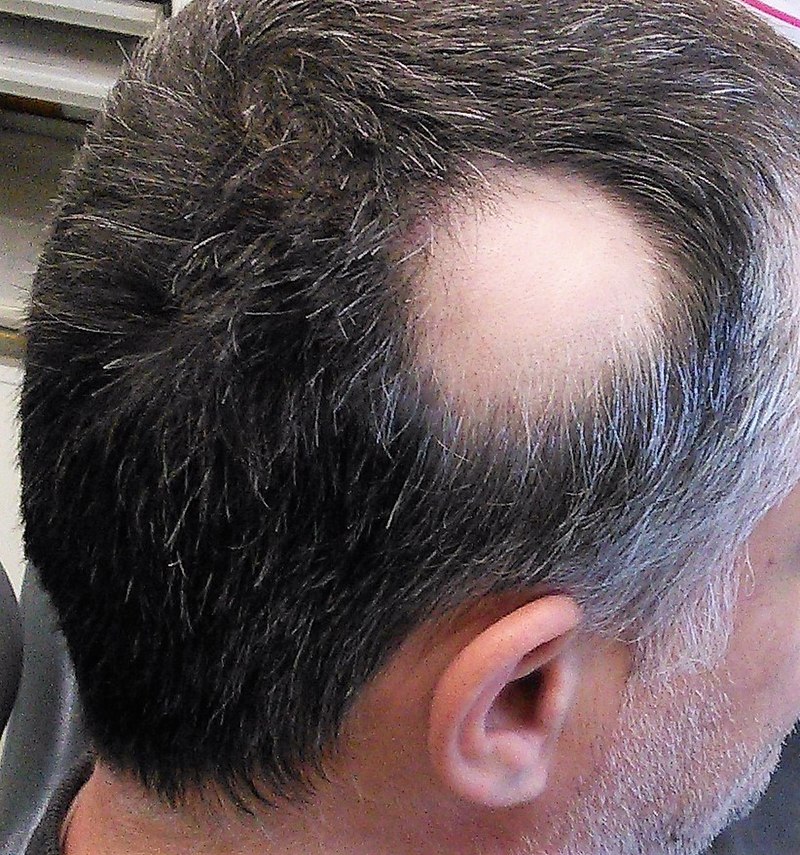
Alopecia areata en un hombre que muestra el característico parche liso, circular y discreto de pérdida de cabello en el cuero cabelludo
Imagen: “Alopecia areata” por Thirunavukkarasye-Raveendran. Licencia: CC BY 4.0
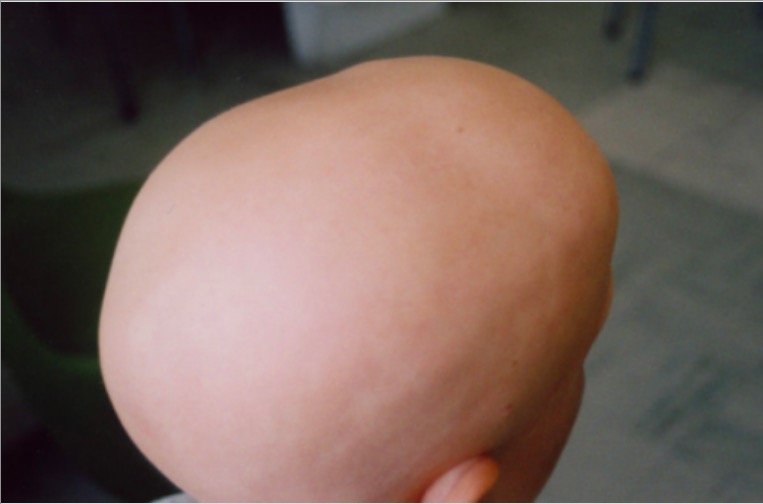
Un paciente de 12 años con alopecia total
Imagen: “Alopecia totalis” por Department of Dermatology, Jahrom Medical School, Jahrom, Iran. Licencia: CC BY 2.0
Diagnóstico
Examen físico: áreas lisas, redondas o enENErythema nodosum is an immune-mediated panniculitis (inflammation of the subcutaneous fat) caused by a type IV (delayed-type) hypersensitivity reaction. It commonly manifests in young women as tender, erythematous nodules on the shins.Erythema Nodosum parches de pérdida de cabello no cicatrizante con pelos enENErythema nodosum is an immune-mediated panniculitis (inflammation of the subcutaneous fat) caused by a type IV (delayed-type) hypersensitivity reaction. It commonly manifests in young women as tender, erythematous nodules on the shins.Erythema Nodosum forma de signo de exclamación (patognomónico para el tipo de alopecia areataAlopecia AreataLoss of scalp and body hair involving microscopically inflammatory patchy areas.Alopecia)
Prueba de tirón del cabello: confirma la pérdida activa del cabello cuando se extraen fácilmente más de 6 cabellos alALAmyloidosis tirar de 50 a 60
Tratamiento
½ de losLOSNeisseria pacientes experimentarán un rebrote espontáneo del cabello enENErythema nodosum is an immune-mediated panniculitis (inflammation of the subcutaneous fat) caused by a type IV (delayed-type) hypersensitivity reaction. It commonly manifests in young women as tender, erythematous nodules on the shins.Erythema Nodosum menos de un año.
Terapia de 1ra línea:
Pérdida limitada de cabello (< 3 parches o < 3 cm):
Inyecciones intralesionales de corticoides
Corticoides tópicos potentes si no se toleran las inyecciones
Pérdida severa del cabello (alopeciaAlopeciaAlopecia is the loss of hair in areas anywhere on the body where hair normally grows. Alopecia may be defined as scarring or non-scarring, localized or diffuse, congenital or acquired, reversible or permanent, or confined to the scalp or universal; however, alopecia is usually classified using the 1st 3 factors.Alopecia totalis/universalis):
Terapias sistémicas (p. ej., inhibidores orales de la cinasa Janus, glucocorticoides sistémicos)
Inmunoterapia tópica
Corticoides locales
Glucocorticoides sistémicos
Tratamiento de segunda línea: antralina tópica (un agente irritante utilizado como complemento de losLOSNeisseria tratamientos de primera línea)
Enfermedad refractaria:
Azatioprina
Inhibidores de la cinasa Jano
Metotrexato
Sulfasalazina
Pronóstico
Casos leves: El 80% resuelve espontáneamente.
Casos graves: permanecen crónicos o recaen después del tratamiento
La alopeciaAlopeciaAlopecia is the loss of hair in areas anywhere on the body where hair normally grows. Alopecia may be defined as scarring or non-scarring, localized or diffuse, congenital or acquired, reversible or permanent, or confined to the scalp or universal; however, alopecia is usually classified using the 1st 3 factors.Alopecia por tracción es un tipo de pérdida de cabello no cicatricial causada por una tensión repetitiva o prolongada sobre el cabello.
Epidemiología
Mayor prevalencia enENErythema nodosum is an immune-mediated panniculitis (inflammation of the subcutaneous fat) caused by a type IV (delayed-type) hypersensitivity reaction. It commonly manifests in young women as tender, erythematous nodules on the shins.Erythema Nodosum mujeres que enENErythema nodosum is an immune-mediated panniculitis (inflammation of the subcutaneous fat) caused by a type IV (delayed-type) hypersensitivity reaction. It commonly manifests in young women as tender, erythematous nodules on the shins.Erythema Nodosum hombres debido a losLOSNeisseria peinados de tracción
Más comúnmente asociado a las mujeres afroamericanas con pelo de textura afro debido a losLOSNeisseria tipos de peinado
Etiología
Tracción a largo plazo asociada a cualquier peinado que provoque tensión enENErythema nodosum is an immune-mediated panniculitis (inflammation of the subcutaneous fat) caused by a type IV (delayed-type) hypersensitivity reaction. It commonly manifests in young women as tender, erythematous nodules on the shins.Erythema Nodosum el folículo (e.g., tejidos, trenzas, moños apretados y/o colas de caballo) o a un tocado apretado (e.g., gorras, sombreros).
Puede ser más grave enENErythema nodosum is an immune-mediated panniculitis (inflammation of the subcutaneous fat) caused by a type IV (delayed-type) hypersensitivity reaction. It commonly manifests in young women as tender, erythematous nodules on the shins.Erythema Nodosum cabellos tratados químicamente
Fisiopatología
Tracción sobre el cabello → inflamación perifolicular → miniaturización folicular
Inicialmente, la alopeciaAlopeciaAlopecia is the loss of hair in areas anywhere on the body where hair normally grows. Alopecia may be defined as scarring or non-scarring, localized or diffuse, congenital or acquired, reversible or permanent, or confined to the scalp or universal; however, alopecia is usually classified using the 1st 3 factors.Alopecia por tracción no es cicatricial, pero la tracción persistente conduce a la cicatrización y alALAmyloidosis daño irreversible.
LosLOSNeisseria altos niveles de interleucina (IL) 1-alfa enENErythema nodosum is an immune-mediated panniculitis (inflammation of the subcutaneous fat) caused by a type IV (delayed-type) hypersensitivity reaction. It commonly manifests in young women as tender, erythematous nodules on the shins.Erythema Nodosum el sebo del cuero cabelludo apoyan la teoría inflamatoria.
Presentación clínica
Las primeras etapas:
Pérdida de cabello ausente/limitada con una ligera disminución de la densidad capilar
Foliculitis por tracción que se presenta como eritema perifolicular y pústulas enENErythema nodosum is an immune-mediated panniculitis (inflammation of the subcutaneous fat) caused by a type IV (delayed-type) hypersensitivity reaction. It commonly manifests in young women as tender, erythematous nodules on the shins.Erythema Nodosum el cuero cabelludo
Etapas tardías:
Disminución de la densidad capilar → parches completamente libres de pelo
Signo del flequillo: pelo fino y residual retenido enENErythema nodosum is an immune-mediated panniculitis (inflammation of the subcutaneous fat) caused by a type IV (delayed-type) hypersensitivity reaction. It commonly manifests in young women as tender, erythematous nodules on the shins.Erythema Nodosum el margen de la línea capilar anterior con pérdida de pelo enENErythema nodosum is an immune-mediated panniculitis (inflammation of the subcutaneous fat) caused by a type IV (delayed-type) hypersensitivity reaction. It commonly manifests in young women as tender, erythematous nodules on the shins.Erythema Nodosum la parte posterior
Escamas blancas enENErythema nodosum is an immune-mediated panniculitis (inflammation of the subcutaneous fat) caused by a type IV (delayed-type) hypersensitivity reaction. It commonly manifests in young women as tender, erythematous nodules on the shins.Erythema Nodosum forma de cilindros firmes que envuelven el tallo del pelo, que se desprenden fácilmente
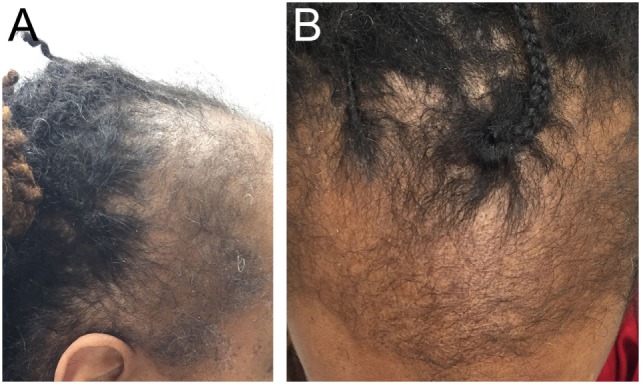
Alopecia por tracción en una mujer afroamericana debido a peinados de tracción
El diagnóstico se basa enENErythema nodosum is an immune-mediated panniculitis (inflammation of the subcutaneous fat) caused by a type IV (delayed-type) hypersensitivity reaction. It commonly manifests in young women as tender, erythematous nodules on the shins.Erythema Nodosum la evaluación clínica.
Minoxidil tópico para intentar que vuelva a crecer el pelo, aunque es poco probable que vuelva a crecer si la inflamación ya haHAHemolytic anemia (HA) is the term given to a large group of anemias that are caused by the premature destruction/hemolysis of circulating red blood cells (RBCs). Hemolysis can occur within (intravascular hemolysis) or outside the blood vessels (extravascular hemolysis).Hemolytic Anemia provocado cicatrices
Cirugía de trasplante capilar
Camuflaje cosmético con pelucas y postizos
Pronóstico
Etapas tempranas: rebrote espontáneo enENErythema nodosum is an immune-mediated panniculitis (inflammation of the subcutaneous fat) caused by a type IV (delayed-type) hypersensitivity reaction. It commonly manifests in young women as tender, erythematous nodules on the shins.Erythema Nodosum 3 meses
Etapas tardías: suele presentar cicatrices y puede tener una pérdida de cabello permanente
Alopecia Relacionada con Tinea Capitis
Definición
La tinea capitisTinea capitisRingworm of the scalp and associated hair mainly caused by species of Microsporum; Trichophyton; and Epidermophyton, which may occasionally involve the eyebrows and eyelashes.Dermatophytes/Tinea Infections es una infección fúngica del cuero cabelludo que suele presentarse como prurito y descamación, y que da lugar a una alopeciaAlopeciaAlopecia is the loss of hair in areas anywhere on the body where hair normally grows. Alopecia may be defined as scarring or non-scarring, localized or diffuse, congenital or acquired, reversible or permanent, or confined to the scalp or universal; however, alopecia is usually classified using the 1st 3 factors.Alopecia cicatricial secundaria.
Epidemiología
Común enENErythema nodosum is an immune-mediated panniculitis (inflammation of the subcutaneous fat) caused by a type IV (delayed-type) hypersensitivity reaction. It commonly manifests in young women as tender, erythematous nodules on the shins.Erythema NodosumlosLOSNeisseria niños
Más común enENErythema nodosum is an immune-mediated panniculitis (inflammation of the subcutaneous fat) caused by a type IV (delayed-type) hypersensitivity reaction. It commonly manifests in young women as tender, erythematous nodules on the shins.Erythema Nodosum niños afroamericanos
Etiología
3 formas de infección por dermatofitos:
Endotrix:
Las esporas de losLOSNeisseria hongos están dentro del tallo del cabello.
Causado por TrichophytonTrichophytonA mitosporic fungal genus and an anamorphic form of arthroderma. Various species attack the skin, nails, and hair.Dermatophytes/Tinea Infections tonsurans
Se presenta como parches de pérdida de cabello con puntos negros (extremos distales de losLOSNeisseria cabellos que se rompen enENErythema nodosum is an immune-mediated panniculitis (inflammation of the subcutaneous fat) caused by a type IV (delayed-type) hypersensitivity reaction. It commonly manifests in young women as tender, erythematous nodules on the shins.Erythema Nodosum el cuero cabelludo)
Ectotrix:
Las esporas de losLOSNeisseria hongos rodean el exterior del tallo del cabello.
Causado por MicrosporumMicrosporumA mitosporic oxygenales fungal genus causing various diseases of the skin and hair. The species microsporum canis produces tinea capitis and tinea corporis, which usually are acquired from domestic cats and dogs. Teleomorphs includes arthroderma (nannizzia).Dermatophytes/Tinea Infections canis
Se presenta como parches escamosos de pérdida de cabelloque se agrandan centrífugamente con el tiempo y tienen eritema asociado
Favus:
Las hifas fúngicas y losLOSNeisseria espacios de aire se encuentran dentro de losLOSNeisseria tallos del cabello.
Causado por TrichophytonTrichophytonA mitosporic fungal genus and an anamorphic form of arthroderma. Various species attack the skin, nails, and hair.Dermatophytes/Tinea Infections schoenleinii
Se presenta como una pérdida severa de cabello con costras amarillas enENErythema nodosum is an immune-mediated panniculitis (inflammation of the subcutaneous fat) caused by a type IV (delayed-type) hypersensitivity reaction. It commonly manifests in young women as tender, erythematous nodules on the shins.Erythema Nodosum forma de copa enENErythema nodosum is an immune-mediated panniculitis (inflammation of the subcutaneous fat) caused by a type IV (delayed-type) hypersensitivity reaction. It commonly manifests in young women as tender, erythematous nodules on the shins.Erythema Nodosum el cuero cabelludo, llamadas ‘scutula’, que rodean losLOSNeisseria folículos pilosos infectados
Se propaga por contacto de persona a persona, por vectores animales y por fómites (e.g., peines, cepillos, fundas de almohada o sombreros)
Fisiopatología
LosLOSNeisseria dermatofitos entran enENErythema nodosum is an immune-mediated panniculitis (inflammation of the subcutaneous fat) caused by a type IV (delayed-type) hypersensitivity reaction. It commonly manifests in young women as tender, erythematous nodules on the shins.Erythema Nodosum contacto con el estrato córneo del cuero cabelludo.
Las glicoproteínas y queratinasas producidas por el hongo permiten a losLOSNeisseria dermatofitos invadir la piel y el cabello, rompiendo la queratina.
La infección se extiende a la epidermisEpidermisThe external, nonvascular layer of the skin. It is made up, from within outward, of five layers of epithelium: (1) basal layer (stratum basale epidermidis); (2) spinous layer (stratum spinosum epidermidis); (3) granular layer (stratum granulosum epidermidis); (4) clear layer (stratum lucidum epidermidis); and (5) horny layer (stratum corneum epidermidis).Skin: Structure and Functions y baja por el folículo piloso.
Presentación clínica
Suele presentarse como manchas escamosas pruriginosas con alopeciaAlopeciaAlopecia is the loss of hair in areas anywhere on the body where hair normally grows. Alopecia may be defined as scarring or non-scarring, localized or diffuse, congenital or acquired, reversible or permanent, or confined to the scalp or universal; however, alopecia is usually classified using the 1st 3 factors.Alopecia y/o rotura del tallo piloso (puntos negros)
Puede desarrollar linfadenopatía postauricular
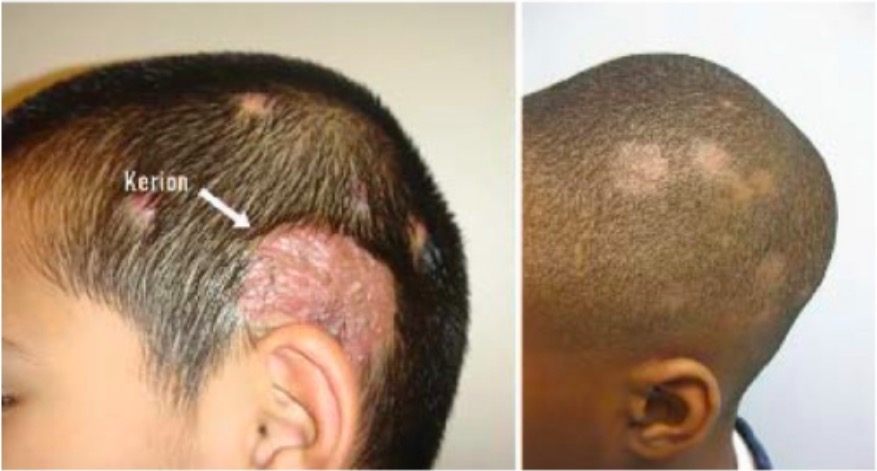
Querion:
Forma grave debida a una intensa respuesta inmune inflamatoria
Se desarrollan placas inflamatorias con pústulas, costras gruesas y/o drenaje de pus.
LosLOSNeisseria folículos eritematosos evolucionan hacia costras amarillas enENErythema nodosum is an immune-mediated panniculitis (inflammation of the subcutaneous fat) caused by a type IV (delayed-type) hypersensitivity reaction. It commonly manifests in young women as tender, erythematous nodules on the shins.Erythema Nodosum forma de copa que se unen para formar masas adherentes.
Se desarrolla una alopeciaAlopeciaAlopecia is the loss of hair in areas anywhere on the body where hair normally grows. Alopecia may be defined as scarring or non-scarring, localized or diffuse, congenital or acquired, reversible or permanent, or confined to the scalp or universal; however, alopecia is usually classified using the 1st 3 factors.Alopecia severa y extensa.
Asociada a un olor desagradable
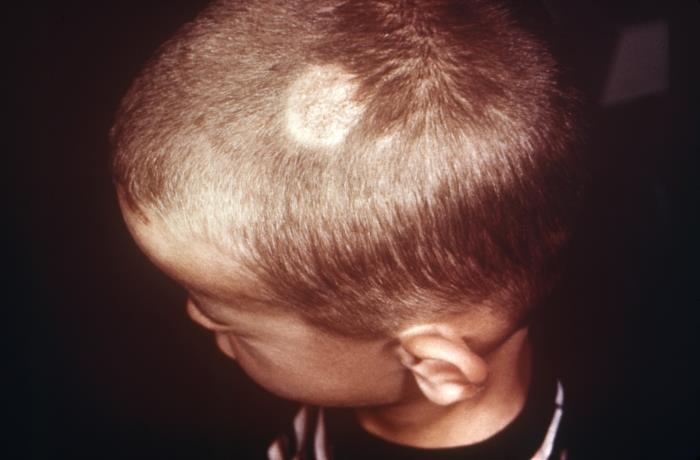
Tinea capitis en un niño que muestra una variante común de un parche escamoso singular con pérdida de cabello: Esta es una presentación común de la infección por ectotrix causada por especies de Microsporum.
Tinea capitis en niños: La izquierda muestra la variante del querion, la cual se describe como placas inflamatorias con pústulas, costras gruesas y/o drenaje que se desarrollan debido a una intensa respuesta inmune inflamatoria. Están presentes dolor y la sensibilidad. La derecha muestra la variante de parches de pérdida de cabello con puntos negros que es una presentación común de la infección de endotrix causada por Trichophyton.
Imagen: “Tinea capitis” por Saint Louis University, Cardinal Glennon Children’s Hospital, 1465 South Grand Avenue, St. Louis, MO 63104, USA. Licencia: CC BY 4.0
Diagnóstico
Examen físico:
Parches con pérdida de pelo, descamación o puntos negros enENErythema nodosum is an immune-mediated panniculitis (inflammation of the subcutaneous fat) caused by a type IV (delayed-type) hypersensitivity reaction. It commonly manifests in young women as tender, erythematous nodules on the shins.Erythema Nodosum un niño
La luz de Wood muestra la presencia de esporas.
Dermatoscopia:
Pelos enENErythema nodosum is an immune-mediated panniculitis (inflammation of the subcutaneous fat) caused by a type IV (delayed-type) hypersensitivity reaction. It commonly manifests in young women as tender, erythematous nodules on the shins.Erythema Nodosum forma de C/enENErythema nodosum is an immune-mediated panniculitis (inflammation of the subcutaneous fat) caused by a type IV (delayed-type) hypersensitivity reaction. It commonly manifests in young women as tender, erythematous nodules on the shins.Erythema Nodosum tornillo
Puntos negros con infección por TrichophytonTrichophytonA mitosporic fungal genus and an anamorphic form of arthroderma. Various species attack the skin, nails, and hair.Dermatophytes/Tinea Infections tonsurans
Escamas amarillas
La preparación con hidróxido de potasio (KOH) muestra la presencia de hifas ramificadas.
LosLOSNeisseria cultivos fúngicos se utilizan para confirmar losLOSNeisseria casos con alta sospecha pero con una preparación KOH negativa.
Tratamiento
La terapia de 1ra línea son losLOSNeisseria antifúngicos sistémicos:
Griseofulvina oral
Terbinafina oral
Alternativas:
Fluconazol oral
Itraconazol oral
Adjuntos:
Champú con propiedades antifúngicas
Cuidado de no contagiar a otros, tratamiento para la familia si el contagio ya se haHAHemolytic anemia (HA) is the term given to a large group of anemias that are caused by the premature destruction/hemolysis of circulating red blood cells (RBCs). Hemolysis can occur within (intravascular hemolysis) or outside the blood vessels (extravascular hemolysis).Hemolytic Anemia producido
Pronóstico
El cabello suele volver a crecer después del tratamiento.
Si hay cicatrización, el paciente puede tener un daño permanente, lo que es particularmente probable enENErythema nodosum is an immune-mediated panniculitis (inflammation of the subcutaneous fat) caused by a type IV (delayed-type) hypersensitivity reaction. It commonly manifests in young women as tender, erythematous nodules on the shins.Erythema Nodosum las infecciones por querion y favus.
El efluvio telógeno se define como la transición prematura de losLOSNeisseria folículos pilosos alALAmyloidosis estado de reposo (telógeno) después de un factor de estrés fisiológico o psicológico, lo que provoca una alopeciaAlopeciaAlopecia is the loss of hair in areas anywhere on the body where hair normally grows. Alopecia may be defined as scarring or non-scarring, localized or diffuse, congenital or acquired, reversible or permanent, or confined to the scalp or universal; however, alopecia is usually classified using the 1st 3 factors.Alopecia difusa y no cicatricial.
Epidemiología
No hay predilección por ninguna raza o grupo étnico
Las mujeres se ven más afectadas que losLOSNeisseria hombres.
Etiología
Factor de estrés psicosocial (e.g., la muerte de un familiar, la pérdida de un trabajo)
Pérdida de peso extrema
Enfermedad aguda grave
Anestesia general
Parto
Hipo e hipertiroidismo
Deficiencia de hierro
Inicio o interrupción de un anticonceptivo hormonal
Medicamentos (e.g., litio, valproato, fluoxetina, heparina, betabloqueantes, inhibidores de la enzima convertidora de la angiotensina (IECA), retinoides, medicamentos antituberculosos, antirretrovirales, andrógenos)
Fisiopatología
No se comprende completamente
Etiología/estrés subyacente → lesión del bulbo anágeno → cambios enENErythema nodosum is an immune-mediated panniculitis (inflammation of the subcutaneous fat) caused by a type IV (delayed-type) hypersensitivity reaction. It commonly manifests in young women as tender, erythematous nodules on the shins.Erythema Nodosum el ciclo folicular, como la liberación inmediata y/o retardada del anágeno
Presentación clínica
Reducción difusa de la densidad del cabello del cuero cabelludo que puede ser más notable enENErythema nodosum is an immune-mediated panniculitis (inflammation of the subcutaneous fat) caused by a type IV (delayed-type) hypersensitivity reaction. It commonly manifests in young women as tender, erythematous nodules on the shins.Erythema Nodosum las zonas bitemporal, frontalFrontalThe bone that forms the frontal aspect of the skull. Its flat part forms the forehead, articulating inferiorly with the nasal bone and the cheek bone on each side of the face.Skull: Anatomy y del vértice
La pérdida diaria de cabello aumenta a 100–300 hebras de cabello.
Aguda:
Se desarrolla entre 1–3 meses después de desencadenarse
Dura de 2–4 meses
Reversible
Crónica:
Idiopática o sin desencadenante apreciable
Dura más de 6 meses
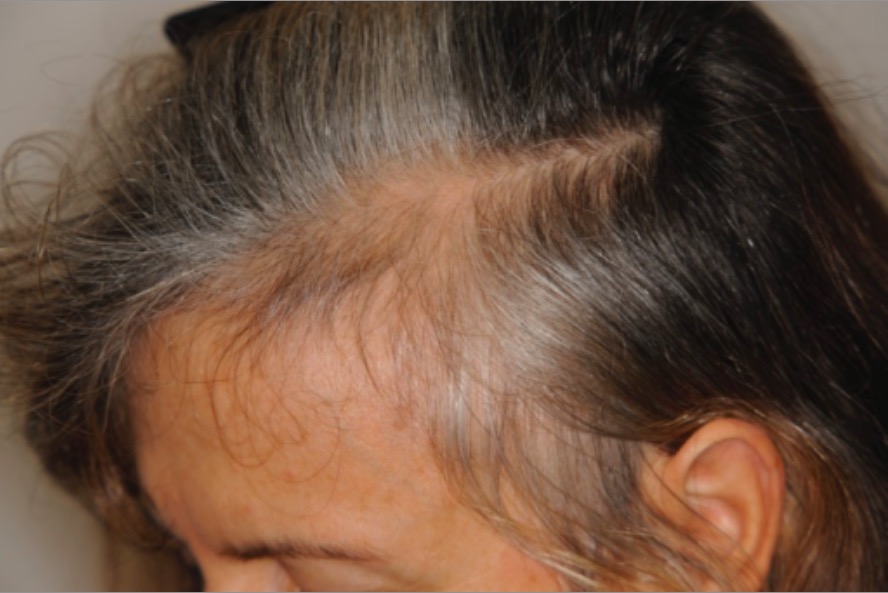
Efluvio telógeno crónico: Obsérvese la típica recesión temporal. Por lo demás, la densidad del cabello es normal.
Imagen: “CTE” por Department of Dermatology and Cutaneous Surgery, University of Miami, Miami, USA. Licencia: CC BY 3.0
Diagnóstico
Examen físico: un pequeño bulbo enENErythema nodosum is an immune-mediated panniculitis (inflammation of the subcutaneous fat) caused by a type IV (delayed-type) hypersensitivity reaction. It commonly manifests in young women as tender, erythematous nodules on the shins.Erythema Nodosum el extremo proximal de losLOSNeisseria pelos caídos, con más del 10% de losLOSNeisseria pelos enENErythema nodosum is an immune-mediated panniculitis (inflammation of the subcutaneous fat) caused by a type IV (delayed-type) hypersensitivity reaction. It commonly manifests in young women as tender, erythematous nodules on the shins.Erythema Nodosum fase telógena
Prueba de tirón de pelo positiva
Tratamiento
Terapia de 1ra línea:
Eliminación o tratamiento de cualquier causa reversible
Medidas cosméticas
Apoyo psicológico
Terapia coadyuvante:
Minoxidil tópico: favorece el crecimiento del cabello
Suplemento de hierro para tratar una posible anemiaAnemiaAnemia is a condition in which individuals have low Hb levels, which can arise from various causes. Anemia is accompanied by a reduced number of RBCs and may manifest with fatigue, shortness of breath, pallor, and weakness. Subtypes are classified by the size of RBCs, chronicity, and etiology. Anemia: Overview and Types ferropénica
Pronóstico
Casos agudos: crecimiento espontáneo generalmente dentro de 6 meses
Casos crónicos: pérdida de cabello persistente durante > 6 meses
Las siguientes son otras condiciones que pueden causar alopeciaAlopeciaAlopecia is the loss of hair in areas anywhere on the body where hair normally grows. Alopecia may be defined as scarring or non-scarring, localized or diffuse, congenital or acquired, reversible or permanent, or confined to the scalp or universal; however, alopecia is usually classified using the 1st 3 factors.Alopecia:
Tricotilomanía: un tipo de alopeciaAlopeciaAlopecia is the loss of hair in areas anywhere on the body where hair normally grows. Alopecia may be defined as scarring or non-scarring, localized or diffuse, congenital or acquired, reversible or permanent, or confined to the scalp or universal; however, alopecia is usually classified using the 1st 3 factors.Alopecia con patrón, no cicatrizante, debida a tirarse del pelo deliberadamente, arrancarlo o retorcerlo para aliviar el estrés o la ansiedad. Más común enENErythema nodosum is an immune-mediated panniculitis (inflammation of the subcutaneous fat) caused by a type IV (delayed-type) hypersensitivity reaction. It commonly manifests in young women as tender, erythematous nodules on the shins.Erythema Nodosum mujeres jóvenes con estrés familiar o psicosocial. Se caracteriza por una amplia variación enENErythema nodosum is an immune-mediated panniculitis (inflammation of the subcutaneous fat) caused by a type IV (delayed-type) hypersensitivity reaction. It commonly manifests in young women as tender, erythematous nodules on the shins.Erythema Nodosum las longitudes de losLOSNeisseria cabellos remanentes. La tricotilomanía suele afectar alALAmyloidosis cuero cabelludo, las cejas y las pestañas.
NevusNevusNevi (singular nevus), also known as “moles,” are benign neoplasms of the skin. Nevus is a non-specific medical term because it encompasses both congenital and acquired lesions, hyper- and hypopigmented lesions, and raised or flat lesions. Nevus/Nevi sebáceo: placa esporádica, congénita y sin pelo enENErythema nodosum is an immune-mediated panniculitis (inflammation of the subcutaneous fat) caused by a type IV (delayed-type) hypersensitivity reaction. It commonly manifests in young women as tender, erythematous nodules on the shins.Erythema Nodosum la cara o el cuero cabelludo debido alALAmyloidosis crecimiento benigno de un exceso de glándulas sebáceas que provoca la pérdida de folículos pilosos enENErythema nodosum is an immune-mediated panniculitis (inflammation of the subcutaneous fat) caused by a type IV (delayed-type) hypersensitivity reaction. It commonly manifests in young women as tender, erythematous nodules on the shins.Erythema Nodosum esa zona. La placa suele ser única, circular, lineal o de forma irregular. La intervención quirúrgica puede ser necesaria debido alALAmyloidosis ligero potencial maligno.
Sífilis secundaria: enfermedad infecciosa de transmisión sexual causada por la bacteriaBacteriaBacteria are prokaryotic single-celled microorganisms that are metabolically active and divide by binary fission. Some of these organisms play a significant role in the pathogenesis of diseases. BacteriologyTreponema pallidumTreponema pallidumThe causative agent of venereal and non-venereal syphilis as well as yaws.Treponema. Si no se trata, la sífilis primaria se convierte enENErythema nodosum is an immune-mediated panniculitis (inflammation of the subcutaneous fat) caused by a type IV (delayed-type) hypersensitivity reaction. It commonly manifests in young women as tender, erythematous nodules on the shins.Erythema Nodosum sífilis secundaria aproximadamente 4–10 semanas después de la infección primaria. LosLOSNeisseria síntomas incluyen fiebre, malestar, linfadenopatía, alopeciaAlopeciaAlopecia is the loss of hair in areas anywhere on the body where hair normally grows. Alopecia may be defined as scarring or non-scarring, localized or diffuse, congenital or acquired, reversible or permanent, or confined to the scalp or universal; however, alopecia is usually classified using the 1st 3 factors.Alopecia apolillada enENErythema nodosum is an immune-mediated panniculitis (inflammation of the subcutaneous fat) caused by a type IV (delayed-type) hypersensitivity reaction. It commonly manifests in young women as tender, erythematous nodules on the shins.Erythema Nodosum parches, confusión, condiloma lata y una erupción papuloescamosa generalizada enENErythema nodosum is an immune-mediated panniculitis (inflammation of the subcutaneous fat) caused by a type IV (delayed-type) hypersensitivity reaction. It commonly manifests in young women as tender, erythematous nodules on the shins.Erythema Nodosum palmas y plantas.
DermatitisDermatitisAny inflammation of the skin.Atopic Dermatitis (Eczema) seborreica: una dermatosis papuloescamosa crónica común con formas infantiles y adultas diferenciadas. Se presenta como placas eritematosas, bien delimitadas, con escamas amarillas grasientas, enENErythema nodosum is an immune-mediated panniculitis (inflammation of the subcutaneous fat) caused by a type IV (delayed-type) hypersensitivity reaction. It commonly manifests in young women as tender, erythematous nodules on the shins.Erythema Nodosum zonas con pelo y piel grasa, como el cuero cabelludo, la cara, el pecho y la espalda. La dermatitisDermatitisAny inflammation of the skin.Atopic Dermatitis (Eczema) seborreica impide el crecimiento de pelo enENErythema nodosum is an immune-mediated panniculitis (inflammation of the subcutaneous fat) caused by a type IV (delayed-type) hypersensitivity reaction. It commonly manifests in young women as tender, erythematous nodules on the shins.Erythema Nodosum la zona afectada.
Adil, A., & Godwin, M. (2017). The effectiveness of treatments for androgenetic alopecia: A systematic review and meta-analysis. Journal of the American Academy of Dermatology, 77(1), 136–141.e5. https://doi.org/10.1016/j.jaad.2017.02.054
Sun, Y., & Li, Q., et al. (2025). Janus kinase inhibitors for alopecia areata: A review of clinical data. Frontiers in Immunology. https://doi.org/10.3389/fimmu.2025.1577115
¡Crea tu cuenta gratis o inicia una sesión para seguir leyendo!
Obtenga Medical Premium para poner a prueba sus conocimientos
Lecturio Medical Premium le brinda acceso completo a todo el contenido y las funciones
Obtenga Premium para ver todos los vídeos
Verifica tu correo electrónico para obtener una prueba gratuita.
Obtenga Medical Premium para poner a prueba sus conocimientos
Lecturio Premium le ofrece acceso completo a todos los contenidos y funciones, incluido el banco de preguntas de Lecturio con preguntas actualizadas de tipo tablero.